
How to Write Your Self-Review From Your Task History With AI
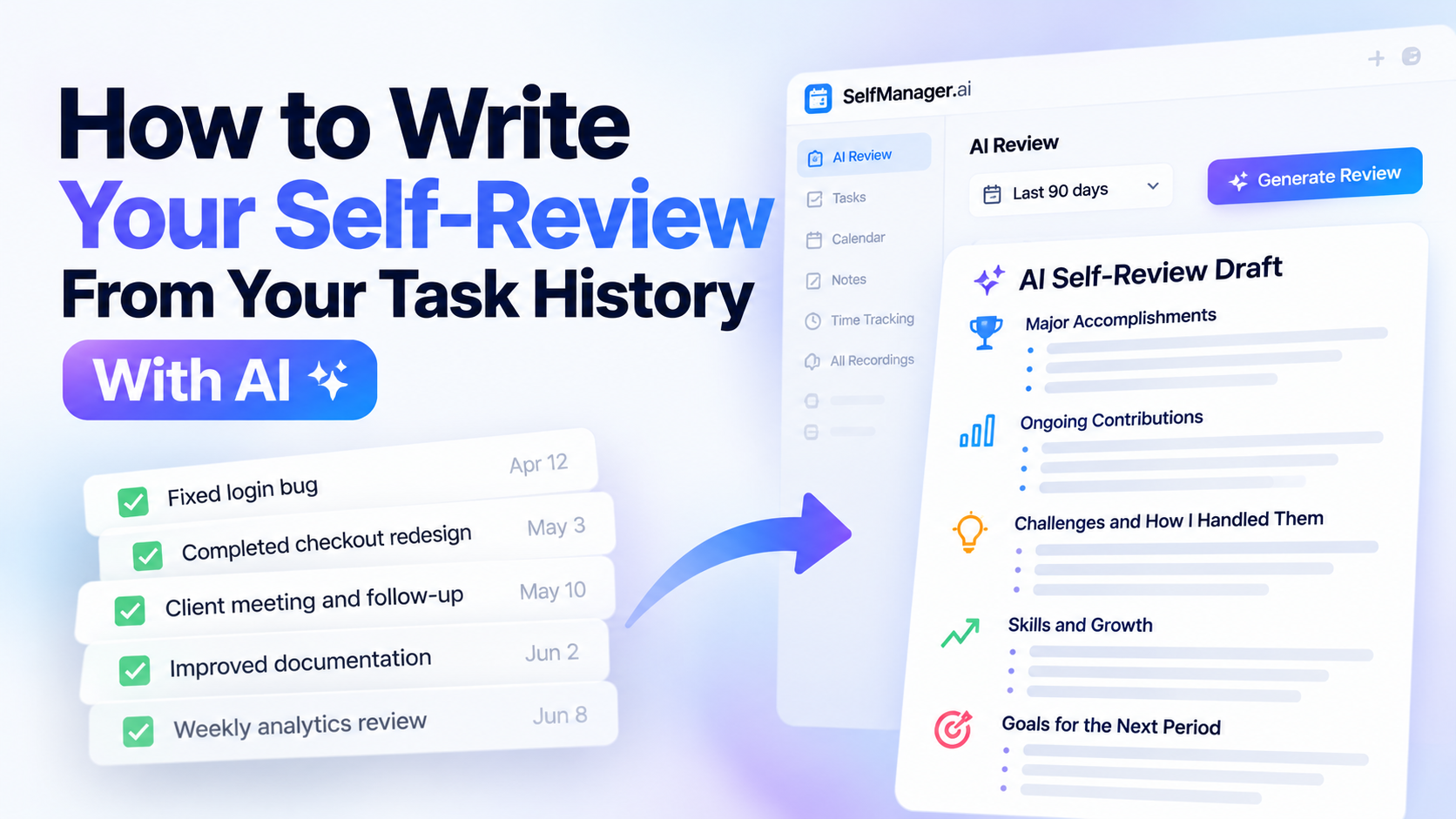
Writing a self-review is difficult for a simple reason: most people do not remember everything they accomplished over the last three, six, or twelve months.
AI can help write the final review, but it still needs evidence.
The easiest way to build a stronger self-evaluation is to start from your actual work history - completed tasks, projects, notes, tracked time, decisions, and unfinished work - then use AI to turn that history into a structured first draft.
Why Self-Reviews Are Harder Than They Look
A performance self-review usually sounds simple.
You are asked to answer questions such as:
- What did you accomplish?
- What were your biggest contributions?
- What challenges did you face?
- What did you learn?
- Where did you improve?
- What do you want to work on next?
The problem is not usually writing.
The problem is remembering.
You may remember the large project you finished last month.
But what about the bug you fixed eight months ago?
The process you improved?
The client issue you resolved?
The internal documentation you wrote?
The repetitive work you quietly handled every week?
The task you took ownership of when nobody else did?
Most people remember recent or emotionally significant work better than ordinary work.
That can make a self-review incomplete even when the person had a productive year.
Start With Evidence, Not Memory
A better self-review starts with records.
Before writing anything, gather the work you actually completed.
Useful sources include:
- Completed tasks
- Project history
- Daily or weekly plans
- Notes
- Comments
- Time tracking
- Client updates
- Documents
- Messages
- Calendar history
- Previous weekly or monthly reviews
The goal is not to copy all of this into the final self-review.
The goal is to reconstruct what actually happened.
Once you have the evidence, AI becomes much more useful.
Instead of asking:
"Write my self-review."
You can ask:
"Review this work history and identify my most important accomplishments, repeated responsibilities, problems I solved, areas of growth, and work that had a clear impact."
That is a much better prompt because it gives the AI something real to analyze.
A Simple Self-Review Structure
Most self-reviews can be organized into five sections.
1. Major Accomplishments
Focus on the work that mattered most.
Examples:
- Projects completed
- Revenue-impacting work
- Important launches
- Problems solved
- Customer or client improvements
- Operational improvements
- New responsibilities
Do not try to list every task.
Look for patterns and outcomes.
2. Ongoing Contributions
Some important work is not a single project.
You may have consistently:
- Supported clients
- Fixed issues
- Maintained systems
- Helped teammates
- Reviewed work
- Improved documentation
- Managed recurring responsibilities
These contributions are easy to forget because they happen gradually.
Your task history often reveals them better than memory does.
3. Challenges and How You Handled Them
A good self-review does not need to pretend everything went perfectly.
You can mention:
- Projects that were delayed
- Technical problems
- Changing requirements
- Workload challenges
- Areas where you needed help
- Mistakes that led to improvement
The important part is explaining what happened next.
What did you learn?
What did you change?
What did you handle differently afterward?
4. Skills and Growth
Look for evidence that your work changed over time.
Maybe you became faster.
Maybe you started taking ownership of larger tasks.
Maybe you learned a new tool.
Maybe you became more independent.
Maybe you improved your communication or planning.
Your task history can show this progression.
5. Goals for the Next Period
Your next goals should connect naturally to the work you already did.
For example:
- Improve a skill you used frequently
- Take ownership of larger projects
- Reduce repetitive work
- Improve planning
- Communicate progress more consistently
- Learn a technology that repeatedly appeared in your work
This makes the goals feel grounded rather than invented at review time.
Example: Turning Task History Into a Self-Review
Imagine your last three months contain work like this:
- Completed a checkout redesign
- Fixed several login-related bugs
- Helped resolve a production incident
- Responded to recurring client requests
- Improved internal documentation
- Built a small automation that reduced repetitive work
- Started reviewing analytics weekly
- Missed an initial deadline on one feature
- Improved estimation afterward
- Helped onboard a new teammate
A basic AI assistant can turn that list into polished prose.
But first, it helps to extract the patterns.
What the History Shows
Major accomplishments:
- Shipped the checkout redesign
- Solved important login issues
- Created an automation that reduced manual work
Ongoing contributions:
- Client support
- Production maintenance
- Documentation
- Weekly analytics review
Growth:
- Improved work estimation
- Took part in teammate onboarding
- Became more proactive about recurring work
Challenge:
- One feature missed its original deadline
Lesson:
- Better estimation and earlier identification of risk
Now the self-review has substance.
Example AI-Generated Draft
A first draft might look like this:
"Over the last quarter, I focused on improving both product quality and the reliability of day-to-day operations. One of my largest contributions was completing the checkout redesign while also addressing several login issues that were affecting users.
I also continued supporting recurring client requests, improved internal documentation, and built an automation that reduced some repetitive manual work.
One area I worked to improve was estimation. A feature missed its original deadline earlier in the quarter, which led me to become more deliberate about identifying risks and breaking larger tasks into smaller pieces before committing to timelines.
I also became more involved in team support by helping onboard a new teammate and sharing documentation that made recurring processes easier to understand.
For the next quarter, I want to continue improving estimation, take ownership of larger projects, and identify more opportunities to automate repetitive work."
That is already much stronger than asking AI to invent a generic self-review from nothing.
The Human Editing Step Still Matters
Do not submit the first AI draft unchanged.
AI is useful for organizing and summarizing your work.
You should still review the wording.
Ask:
- Does this actually sound like me?
- Is anything exaggerated?
- Is any important accomplishment missing?
- Does the review explain impact?
- Are the examples specific enough?
- Does it sound too generic?
- Is there anything I would not be comfortable discussing with my manager?
AI should help you remember and structure your work.
It should not turn your self-review into corporate-sounding fiction.
How SelfManager.ai Can Build a Self-Review From Your Work History
If you already plan and track work inside SelfManager.ai, the underlying evidence is already there.
Tasks are organized by date.
Your history can include:
- Completed tasks
- Unfinished work
- Notes
- Comments
- Uploaded material
- Tracked time
- Daily organization
- Previous work across tables
Instead of reconstructing months of work manually, you can review a period directly.
SelfManager.ai includes AI Review and Instant AI Review for analyzing work history.
You can select a period and ask questions such as:
"What were my biggest accomplishments?"
"What projects received most of my attention?"
"What work did I consistently complete?"
"What tasks were repeatedly delayed?"
"What problems did I solve?"
"What evidence should I include in my performance self-review?"
"What improved compared with the beginning of the period?"
The AI is then working from your recorded activity instead of an empty prompt.
Generate a Self-Review Draft From Your Last 90 Days
For a performance review, start by reviewing the most recent quarter.
Ask the AI to produce:
- Major accomplishments
- Important recurring contributions
- Problems solved
- Areas of improvement
- Missed goals or unfinished work
- Skills demonstrated
- Suggested goals for the next quarter
Then turn the results into your own final self-review.
This gives you a structured first draft without relying entirely on memory.
What if Your Review Covers a Full Year?
SelfManager.ai Instant AI Review can cover a custom range of up to 90 days in one review.
So for an annual performance review, use four quarterly reviews.
For example:
- January through March
- April through June
- July through September
- October through December
Generate a summary for each quarter.
Then combine the most important accomplishments and patterns from all four.
This approach can actually make the final review better because it prevents recent work from dominating your memory of the entire year.
A Self-Review Prompt You Can Copy
Use this after gathering your work history:
"Review the work below and help me prepare a performance self-review.
Identify:
- My most important accomplishments
- Projects or responsibilities I handled consistently
- Problems I solved
- Skills I demonstrated
- Areas where I improved
- Challenges or missed goals I should acknowledge
- Examples that show impact
- Good goals for the next review period
Do not exaggerate my impact or invent results that are not supported by the work history.
After analyzing the evidence, write a concise self-review draft in a professional but natural tone."
The final sentence is important.
You want AI to summarize your evidence, not create achievements that never happened.
Example Self-Review Template
You can also write the review manually using this structure.
Overall Summary
During this review period, I focused primarily on [main areas of responsibility]. My biggest contributions were [accomplishment], [accomplishment], and [accomplishment].
Major Accomplishments
I completed [project or responsibility], which resulted in [outcome or impact].
I also worked on [project], where I was responsible for [specific contribution].
Another area I contributed to was [area], especially by [specific action].
Ongoing Contributions
Throughout the review period, I consistently handled [recurring responsibility].
I also supported [team, clients, product, process] by [examples].
Challenges and Learning
One challenge during this period was [challenge].
I responded by [action], and the experience helped me improve [skill or process].
Growth
I improved in [skill or responsibility].
Compared with the beginning of the review period, I am now better at [specific improvement].
Goals for the Next Period
During the next review period, I want to focus on:
- [Goal]
- [Goal]
- [Goal]
Do You Need a Dedicated Brag Document?
A brag document is another way to solve the same memory problem.
Instead of waiting until review season, you continuously record accomplishments throughout the year.
That works well.
But it requires another habit.
If your daily work is already recorded inside a task manager, your task history can serve a similar purpose.
The important thing is that the evidence exists somewhere before you need it.
Trying to reconstruct twelve months of work from memory in December is much harder than reviewing a record you already created while working.
Your Daily Task History Is More Valuable Than It Looks
Most people think task managers are mainly about future work.
What do I need to do today?
What do I need to do tomorrow?
What is due next week?
But a task manager also creates a history.
Over months, that history becomes a record of:
- What you completed
- What you worked on
- What consumed your time
- What you postponed
- What changed
- What you learned
- What responsibilities you repeatedly handled
That record can become useful far beyond daily planning.
A performance review is one of the clearest examples.
Where AI Helps Most
AI is good at finding patterns across a large amount of text and structured work.
That makes it useful for questions such as:
"What did I accomplish?"
But more importantly:
"What did I accomplish that I may have forgotten?"
That second question is where work history becomes powerful.
You do not need AI to invent a better version of your career.
You need it to help surface the work you actually did.
Generate a Draft From Your Last 90 Days
If your work already lives inside SelfManager.ai, use AI Review or Instant AI Review to examine your recent history before writing your self-evaluation.
Start with your last 90 days.
Find the accomplishments, repeated responsibilities, unfinished work, improvements, and challenges.
Then use those facts to write a review that reflects what actually happened.
Frequently Asked Questions
How do I write a good self-review?
Start with concrete evidence from the review period. Identify your most important accomplishments, ongoing responsibilities, challenges, growth, and future goals. Use specific examples instead of generic statements about being hardworking or productive.
Can AI write my performance self-review?
Yes. AI can help organize your accomplishments and turn them into a polished draft. The result is much better when you provide actual work history rather than asking the AI to generate a generic review from memory.
What should I include in a self-evaluation?
Include major accomplishments, ongoing contributions, problems solved, skills developed, challenges, lessons learned, and goals for the next review period.
How can I remember what I accomplished during the year?
Review your task history, completed projects, notes, calendar, messages, weekly reviews, client updates, and other work records. Breaking the year into quarters usually makes this easier.
Can SelfManager.ai review an entire year at once?
A single Instant AI Review can cover a custom range of up to 90 days. For an annual review, divide the year into four quarterly reviews and combine the most important results.
Should I mention failures in my self-review?
You can mention relevant challenges or missed goals when they help show what you learned or changed. The goal is not to hide every difficulty, but to explain how you responded and improved.
What is the difference between a self-review and a brag document?
A self-review is usually written for a specific performance-review period. A brag document is an ongoing record of accomplishments that you maintain throughout the year. Task history can provide much of the evidence needed for both.
Date-based AI Task Manager
Plan smarter, execute faster, achieve more
Create tasks in seconds, generate AI-powered plans, and review progress with intelligent summaries. Perfect for individuals and teams who want to stay organized without complexity.
Get started with your preferred account