
1:1 Meeting Prep: What to Bring From Your Last Two Weeks
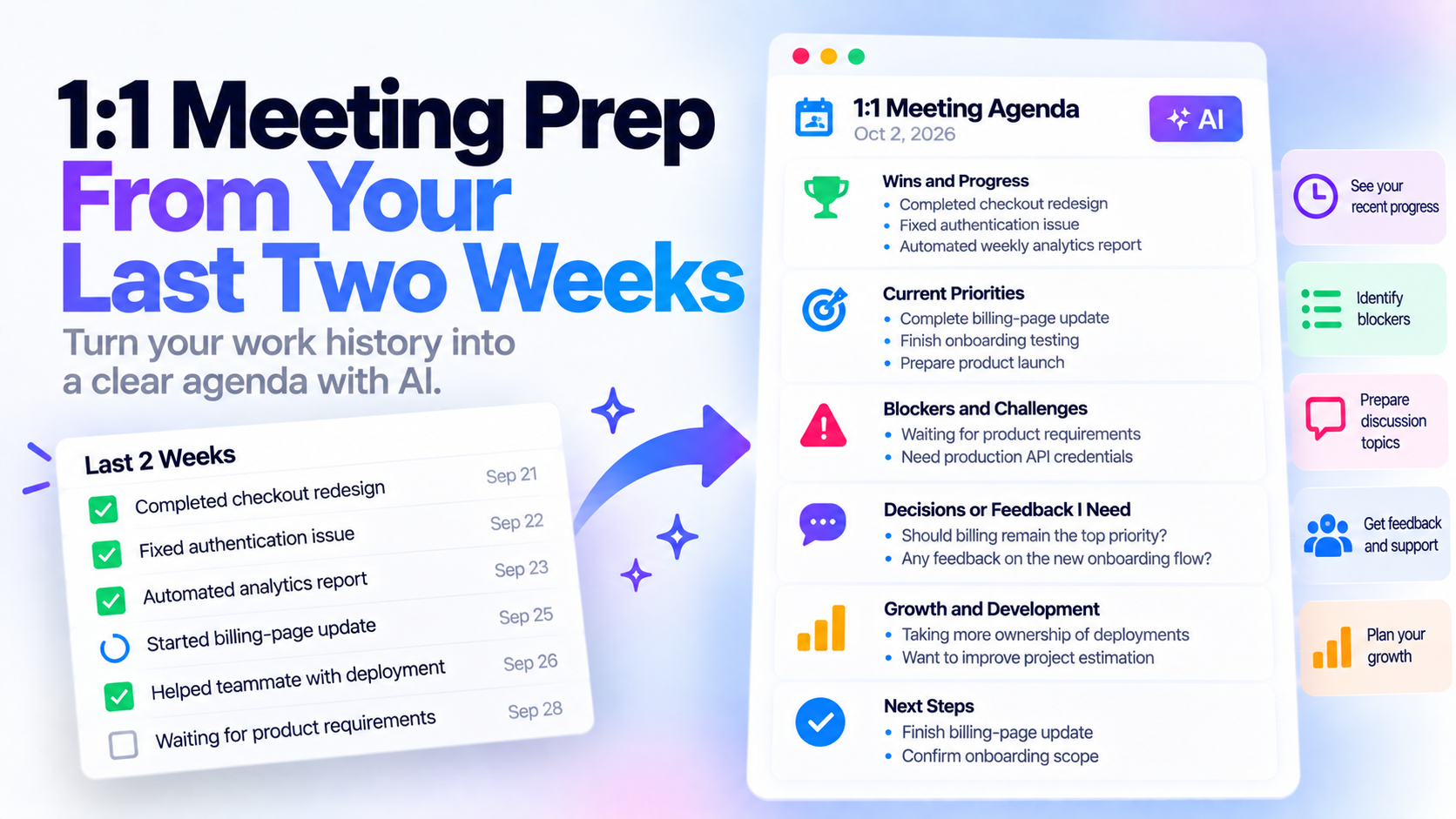
A good 1:1 meeting should not begin with both people trying to remember what happened since the last meeting.
The easiest way to prepare is to review your actual work from the previous one or two weeks, identify what moved, what is blocked, what needs discussion, and what support you need - then turn that history into a short agenda.
1:1 Meeting Agenda Template
Use this simple structure:
1:1 Meeting - [Date]

1. Wins and progress
- [Important accomplishment]
- [Progress worth discussing]

2. Current priorities
- [Main focus]
- [Important project]

3. Blockers and challenges
- [Problem]
- [Where I need help]

4. Decisions or feedback I need
- [Question]
- [Decision]

5. Growth and development
- [Skill, responsibility, or area I want to improve]

6. Next steps
- [Action]
- [Follow-up]
You do not need to fill every section every time.
The goal is to arrive with something useful to discuss.
What Is a 1:1 Meeting?
A one-on-one meeting is a recurring conversation between an employee and manager, team lead, founder, or another person they work closely with.
Unlike a project-status meeting, a good 1:1 can cover both the work and the person doing it.
Typical topics include:
- Recent progress
- Priorities
- Problems
- Feedback
- Decisions
- Career development
- Workload
- Communication
- Goals
- Support needed
The meeting becomes less useful when it turns into:
"What are you working on?"
followed by:
"Same things as last week."
Why 1:1 Meetings Are Hard to Prepare For
The problem is similar to writing a self-review.
You remember what happened yesterday.
You may remember the largest event from last week.
But over two weeks, dozens of smaller things may have happened:
- Tasks finished
- Problems solved
- Projects delayed
- Feedback received
- Priorities changed
- Meetings created decisions
- New responsibilities appeared
- Something repeatedly blocked progress
By the time your 1:1 starts, much of that context has already disappeared from memory.
This is why preparation should start with your work history.
Start With the Last Two Weeks
If your 1:1 happens every two weeks, review that exact period.
Do not start by asking yourself:
"What do I want to talk about?"
Start with:
"What actually happened?"
Look through:
- Completed tasks
- Unfinished work
- Notes
- Comments
- Project updates
- Tracked time
- Decisions
- Feedback
- Things repeatedly postponed
Then decide what is important enough to bring into the meeting.
Step 1: Find the Important Wins
A win does not have to be a major launch.
Examples include:
- Finished an important project
- Fixed a difficult problem
- Helped unblock another person
- Improved a process
- Received positive feedback
- Finished something that had been stuck
- Reduced repetitive work
- Took ownership of something new
Your manager may not know about all of these unless you mention them.
A 1:1 is a useful place to surface important work without turning the conversation into self-promotion.
Example
Raw history:
- Fixed recurring checkout issue
- Updated onboarding page
- Helped new employee with deployment
- Automated weekly analytics report
- Finished client migration
Useful 1:1 summary:
Wins:
- Resolved the recurring checkout issue
- Finished the client migration
- Automated the weekly analytics report
- Helped the new teammate complete their first deployment
You are not listing everything.
You are extracting what matters.
Step 2: Identify What Is Still Moving
The meeting should not only look backward.
Review your active work.
Ask:
- What am I currently focused on?
- What is taking most of my attention?
- What is likely to matter before the next 1:1?
- Has any priority changed?
For example:
Current priorities:
- Complete the billing-settings redesign
- Finish onboarding testing
- Prepare next month's product launch
This helps you and your manager check whether you are aligned.
Sometimes the most useful outcome of a 1:1 is discovering that something you considered important is no longer the team's priority.
Step 3: Find Blockers
Your task history may reveal work that repeatedly stays unfinished.
That is worth investigating.
Maybe a task appears on:
Monday.
Wednesday.
Friday.
Next Monday.
Still unfinished.
That does not automatically mean poor productivity.
There may be a blocker.
For example:
- Waiting for client approval
- Missing access
- Dependency on another team
- Unclear requirements
- Technical problem
- Competing priorities
- Too much work at once
These are exactly the things a 1:1 should surface.
A Better Blocker Question
Instead of asking:
"What am I blocked on?"
ask:
"What important work did not move as expected, and why?"
That question catches more useful problems.
A task may technically be possible to complete but still be delayed by uncertainty, workload, or conflicting priorities.
Step 4: Identify Decisions You Need
One-on-one meetings are useful places to get decisions that are difficult to resolve asynchronously.
Examples:
- Which project has higher priority?
- Should I continue investing time in this feature?
- Can we delay this deadline?
- Who should own this responsibility?
- Should I involve another team?
- Is this quality level sufficient to ship?
- Which approach should I take?
If you already know you need a decision, put it on the agenda before the meeting.
Do not wait until the final two minutes to remember it.
Step 5: Prepare Questions
A useful 1:1 should not be a one-way status update.
Prepare questions.
For example:
- Is there anything I should prioritize differently?
- Where do you think I could take more ownership?
- Is there anything about my work that I should change?
- What does the team need more of from me?
- Is there anything coming up that I should prepare for?
- Which skills would be most useful for me to develop next?
The exact questions depend on the relationship.
But preparing them improves the conversation.
Step 6: Include Growth Occasionally
Not every 1:1 needs a career-development discussion.
But if every meeting is only about today's tasks, long-term development can disappear.
Every few meetings, ask:
- What am I getting better at?
- What responsibility do I want next?
- Which skill am I trying to develop?
- What kind of work do I want more of?
- Where am I still struggling?
A work history can help here too.
You may notice that over the last several months you have gradually taken on more:
- Client communication
- Technical ownership
- Planning
- Mentoring
- Decision-making
- Project leadership
Those patterns can be difficult to see day to day.
Example 1:1 Agenda
Imagine the last two weeks included:
- Completed checkout redesign
- Fixed authentication issue
- Automated weekly reporting
- Started billing-page redesign
- Onboarding project delayed
- Waiting for product requirements
- Helped teammate deploy
- Reviewed analytics every week
The resulting agenda might be:
1:1 Meeting - October 2

Wins:
- Completed the checkout redesign
- Resolved the authentication issue
- Automated weekly analytics reporting
- Helped with teammate onboarding and deployment

Current priorities:
- Billing-page redesign
- Onboarding improvements

Challenges:
- Onboarding work is moving slowly because requirements are still changing

Decisions I need:
- Should billing work remain the highest priority next week?
- Can we finalize onboarding requirements before more development?

Growth:
- I have been taking more ownership of deployment and onboarding support

Next steps:
- Finish billing-page redesign
- Confirm onboarding scope
That gives both people useful material immediately.
How to Use AI for 1:1 Meeting Prep
AI is helpful when it can look at your actual history.
Without context, an AI assistant can generate a generic 1:1 agenda.
It cannot tell you what you should actually discuss.
With work history, you can ask:
Review my work from the last two weeks and help me prepare for a 1:1 with my manager.

Identify:

1. My most important accomplishments
2. Current priorities
3. Work that is blocked or repeatedly delayed
4. Problems I may need help with
5. Decisions I should ask for
6. Evidence of growth or increased responsibility
7. Useful questions to bring to the meeting

Do not invent outcomes or problems that are not supported by the work history.

Keep the final agenda concise.
The AI can do the first pass.
You decide what actually belongs in the conversation.
Preparing a 1:1 With SelfManager.ai
SelfManager.ai includes AI Review for analyzing a selected period of work.
For a biweekly 1:1, choose a custom range covering the previous two weeks.
Then ask questions such as:
- What did I complete?
- What important work is still unfinished?
- What appears to be blocked?
- What received most of my attention?
- What should I discuss with my manager?
- What decisions would help me move forward?
- What evidence shows increased responsibility?
The advantage is that the AI is not working from a generic prompt.
It is reviewing your actual work history.
Pull Your Last Two Weeks Into a 1:1 Agenda
For a typical biweekly meeting, your workflow can be:
1. Select the previous two weeks
Use the period leading up to the meeting.
2. Generate an AI Review
Ask for:
- Accomplishments
- Priorities
- Blockers
- Open questions
- Growth
3. Remove noise
Not every completed task belongs in your 1:1.
Keep only what is useful to discuss.
4. Add context the AI cannot know
For example:
"This project is politically sensitive."
"This client is our highest priority."
"I want more responsibility in this area."
5. Bring the final agenda
You now have a short, evidence-based meeting plan.
AI Should Not Invent Impact
Suppose your history says:
"Finished onboarding redesign."
An AI assistant should not automatically turn that into:
"Improved onboarding conversion."
Unless you have actual evidence for that result.
A useful 1:1 agenda stays factual.
You can say:
- Completed onboarding redesign
Then, if analytics later show improved conversion, add that outcome.
This matters because AI-generated professional language can easily sound more confident than the evidence supports.
1:1 Meeting Prep for Employees
For an employee, the most useful areas are often:
- Wins
- Priorities
- Blockers
- Feedback
- Career growth
A simple agenda:
Wins:
- What I completed

Priorities:
- What I am focused on

Challenges:
- Where I am stuck

Feedback:
- What I want input on

Growth:
- What I want to improve
That is usually enough.
1:1 Meeting Prep for Managers
Managers can use a similar approach, but the questions change.
Review the last two weeks and ask:
- What did this person accomplish?
- What work appears stuck?
- Where might they need support?
- Has their workload changed?
- Is there good work I have not acknowledged?
- Is there feedback I have delayed giving?
- Is there a decision I owe them?
The meeting should not place all preparation responsibility on the employee.
Both people benefit from evidence.
1:1 Meeting Prep for Remote Teams
Remote work makes written history especially valuable.
In an office, you may casually see what somebody is working on.
Remotely, much of that context is invisible.
A work record provides a clearer picture.
It can also stop the 1:1 from becoming a basic status meeting.
If both people already know what happened, they can spend more of the meeting discussing:
- Decisions
- Problems
- Feedback
- Development
- Priorities
That is a better use of the time.
1:1 Meeting vs Daily Standup
A standup is operational.
It asks:
- What happened yesterday?
- What happens today?
- What is blocked?
A 1:1 is broader.
It can ask:
- How are things going?
- Are priorities right?
- What is difficult?
- What support do you need?
- Where are you growing?
- What should change?
Do not turn your 1:1 into a 30-minute standup.
Task history should help you skip the basic reconstruction and get to the useful discussion faster.
1:1 Meeting vs Performance Review
A performance review looks across a much longer period.
A 1:1 happens frequently.
That means the 1:1 can actually feed the performance review.
If you regularly discuss:
- Wins
- Challenges
- Responsibilities
- Growth
- Goals
then review season becomes easier.
You already have a trail of evidence.
This is one reason frequent work review is more useful than trying to reconstruct an entire year at once.
What Not to Bring to a 1:1
Avoid turning the agenda into every task you touched.
Your manager does not need:
- Every email sent
- Every meeting attended
- Every minor fix
- Every checkbox completed
Instead, choose the work that changes the conversation.
Bring:
- Important progress
- Meaningful challenges
- Decisions
- Patterns
- Questions
- Growth
The task history is the source.
The agenda is the filter.
What if Nothing Major Happened?
That is fine.
A useful 1:1 does not require a dramatic accomplishment every two weeks.
You can discuss:
- Current workload
- Priorities
- Small friction
- Upcoming projects
- Feedback
- Skills
- Team communication
- Something you want to understand better
Do not manufacture achievements just to make the meeting feel important.
What if You Have Too Much to Discuss?
Prioritize.
Ask:
"If we only discussed three things, which three would make the next two weeks better?"
Those belong at the top.
A long agenda that you never finish is not better than a short agenda that resolves important issues.
Make Your 1:1S Build on Each Other
The most useful one-on-one meetings are not isolated conversations.
At the end of each meeting, record:
- Decisions
- Follow-ups
- New priorities
- Questions to revisit
Then the next meeting begins with context.
For example:
Last 1:1:
"Improve estimation on larger tasks."
Two weeks later:
"How did estimation go?"
Last 1:1:
"Take more ownership of client communication."
Two weeks later:
"What happened when you handled the client updates?"
This turns the meetings into an ongoing development process.
Your Work History Is Better Than Your Memory
The main idea is simple.
Do not spend ten minutes before every 1:1 staring at a blank agenda.
Look at what actually happened.
Your previous two weeks already contain:
- Accomplishments
- Priorities
- Delays
- Problems
- Decisions
- Growth signals
The preparation process is mostly about extracting those things.
AI can make that extraction faster.
Prepare Your Next 1:1 From Your Actual Work
If you already use SelfManager.ai to organize your days, select the previous two weeks and use AI Review to examine the period.
Ask:
"What got done?"
"What is still blocked?"
"What should I discuss with my manager?"
"What decisions do I need?"
"What shows growth?"
Then turn the results into a short agenda.
The goal is not to make your 1:1 more complicated.
It is to arrive with better evidence and spend less time trying to remember what happened.
Frequently Asked Questions
What should I bring to a 1:1 meeting?
Bring a short list of recent wins, current priorities, blockers, decisions or feedback you need, and any growth or career topics you want to discuss.
How should I prepare for a 1:1 with my manager?
Review the work you completed since the previous meeting, identify unfinished or blocked work, consider where you need input, and prepare a few useful questions.
What is a good 1:1 meeting agenda?
A simple agenda can include wins, priorities, blockers, decisions or feedback needed, growth, and next steps.
How far back should I review before a 1:1?
Match the review period to your meeting frequency. If you meet every two weeks, review the previous two weeks. If you meet weekly, review the previous week.
Can AI prepare a 1:1 agenda?
Yes. AI can review your work history and identify accomplishments, blockers, priorities, and possible discussion topics. You should still decide which items actually matter.
How can SelfManager.ai help with 1:1 preparation?
SelfManager.ai AI Review can analyze a custom period of work. For a biweekly 1:1, you can review the previous two weeks and ask the AI to identify wins, blockers, priorities, and useful discussion topics.
Should a 1:1 meeting be a status update?
Not primarily. Basic status information can provide context, but a 1:1 is usually more valuable when it focuses on decisions, blockers, feedback, support, priorities, and development.
Date-based AI Task Manager
Plan smarter, execute faster, achieve more
Create tasks in seconds, generate AI-powered plans, and review progress with intelligent summaries. Perfect for individuals and teams who want to stay organized without complexity.
Get started with your preferred account