
Willpower Starts It, Systems Keep It: How to Actually Learn a High-Value Skill
There is a piece of productivity advice that has hardened into gospel: do not rely on willpower, build systems instead. It is good advice, mostly. Willpower is unreliable, it fluctuates with your sleep and stress and mood, and any plan that needs you to feel strong every day will not survive the year. So far, correct.
But it is only half the story, and the missing half is the one that actually matters when you are trying to learn something hard and valuable from scratch. Because systems do not start themselves. A routine cannot run before it exists. A habit cannot carry you before it is formed. In the very beginning, when there is no system yet, no momentum, no groove, nothing automatic to fall back on, the only thing that can get you moving is exactly the thing everyone tells you not to trust: willpower and motivation. They are not the enemy of systems. They are what you use to build the system in the first place.
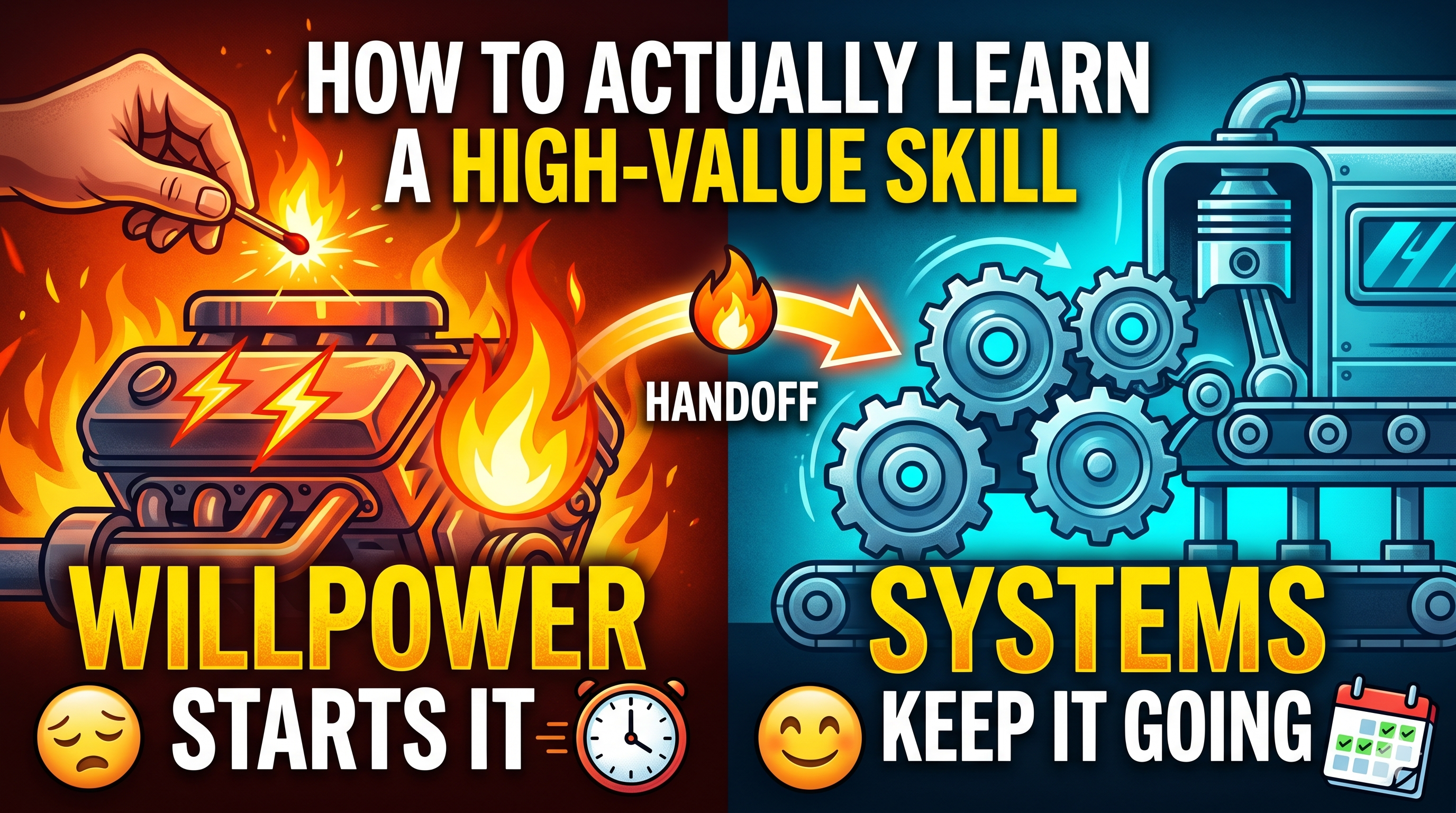
This is the part the standard advice gets wrong. It treats willpower as a flawed substitute for systems, when really the two are tools for two different phases. Willpower is the ignition. Systems are the engine that keeps running once you are moving. Learning a genuinely high-value skill, the kind that changes what your time is worth, requires both, in the right order. This article is mostly about the phase nobody talks about: the ignition. How to use motivation and willpower deliberately to get a hard new skill off the ground, and then how to hand off to systems so it sustains. Let me start with why the start is the hard part.
Why the start is where almost everyone fails
Think about how skill-learning attempts actually die. They do not usually die in month six, when someone has a routine and quits out of boredom. They die in week one, before anything got going. The person downloads the course, watches one video, feels overwhelmed, and never comes back. The attempt dies at ignition, not in flight.
This matters because it tells you where to aim your effort. The beginning of learning a hard skill is uniquely brutal for reasons that have nothing to do with the later stages. You are at your worst at the thing, so every attempt feels clumsy and discouraging. There is no momentum yet, so nothing is pulling you forward. There is no habit, so every session requires a fresh decision to show up. And there is no payoff yet, because skills take time to produce visible results, so your brain gets all of the effort and none of the reward that would normally reinforce the behavior. The early phase is maximum difficulty for minimum return, which is precisely the condition under which most people stop.
This is also why the just build a system advice fails people at the start. You cannot build a system out of nothing. A system is a structure that runs a behavior automatically, but in week one there is no behavior to automate, no track record to systematize, no rhythm to lock in. The system is the destination, not the starting point. To get to the point where a system can take over, you first have to manually force the behavior to happen, repeatedly, through raw intention, before it is anywhere near automatic. That manual forcing is what willpower and motivation are for, and treating them as something to avoid leaves you with no tool for the one phase where they are indispensable.
The ignition phase: using willpower and motivation on purpose
If willpower is the right tool for the start, the question becomes how to use it well, because willpower used badly burns out fast and willpower used well gets you to the system. The mistake most people make is treating willpower as something that should carry the whole journey, white-knuckling their way through months of effort until they collapse. That is the wrong job for it. Willpower has a specific, limited, crucial role: to force the behavior into existence long enough for a system to take over. Here is how to spend it wisely in that window.
Spend motivation while it is high, do not waste it
Motivation is real, and it is genuinely useful, but it is also perishable. When you decide to learn something new, there is usually a burst of motivation at the start, a window where you actually feel excited and willing. Most people waste this window. They spend it researching, planning, buying courses, and getting ready, and by the time they are set up to actually begin, the motivation has evaporated and they never start.
The smart move is to treat that initial motivation as a scarce, time-limited fuel and spend it on the hardest part: starting the actual behavior, immediately. Do not use your motivation to plan. Use it to do the first real, clumsy, uncomfortable session while the willingness is still there. Motivation is at its highest right at the beginning and declines from there, so the job is to convert that early enthusiasm into actual action before it fades, rather than burning it on preparation that feels productive but moves nothing. You will not feel this motivated again for a while. Spend it on the thing that is hardest to do without it, which is beginning.
Make the first step small enough that willpower can win
Willpower is limited, so do not pit it against an enormous task it will lose to. The reason starting feels so hard is often that the first step you are imagining is too big. Learn data analysis is overwhelming. Open the spreadsheet and follow one tutorial for fifteen minutes is not. The size of the first step determines whether your willpower is enough to clear it.
The principle is to shrink the starting action until it is small enough that even a modest amount of willpower can get you over the line. The goal of the first session is not to make real progress. It is simply to begin, because beginning is what breaks the inertia and starts building the track record a system will later run on. Make the first step almost embarrassingly small, do it, and let the act of starting do its work. Once you have started, continuing is far easier than starting was, and you have converted a daunting mountain into a sequence of small, willpower-sized steps. This is willpower applied intelligently: not heroically forcing a huge effort, but using a small push to overcome the hardest moment, which is the moment of beginning.
Use motivation to push through the ugly beginner phase
There is a specific, predictable stretch early in learning any skill where you are bad at it and you know you are bad at it, and the gap between your effort and your results is demoralizing. This is where most people quit, because the discouragement is real and there is not yet any competence or momentum to counter it. This phase is exactly what motivation is for.
The honest truth is that the early incompetence stage cannot be made comfortable. You will be clumsy, you will make mistakes, and progress will feel invisible. What gets you through is connecting to a strong enough reason, a real motivation, that you are willing to tolerate being bad at something temporarily because of what it leads to. This is where having a powerful why matters most, not as a vague nicety, but as the concrete fuel that makes the unpleasant beginner phase worth enduring. Motivation rooted in a genuine reason, the income it could unlock, the work it could let you do, the person you want to become, is what carries you across the valley where skill has not yet caught up to effort. Use it deliberately here, because this is the stretch it was made for, and pushing through this valley is what gets you to the point where competence starts to build and the system can begin to take over.
Build belief with deliberate early wins
Willpower and motivation both get easier to summon when you have evidence that the effort is working, so engineer that evidence early. In the beginning, you have no proof yet that you can learn this thing, and that lack of belief makes every session harder. The fix is to manufacture small, real wins quickly, to give yourself concrete evidence of progress that refuels your motivation.
The way to do this is to structure the early learning so that you achieve something small and tangible fast, rather than grinding for weeks before anything clicks. Complete one small real thing with the skill, however basic, so you can see it work. That first tangible result does something powerful: it converts abstract faith into demonstrated capability, and the feeling of this is actually working becomes its own motivation. Momentum in learning is largely psychological, built on accumulating evidence that you are capable of progress, and each early win lowers the willpower cost of the next session. You are using deliberate small victories to make motivation partly self-sustaining, which is the bridge toward the phase where a system, not raw will, keeps you going.
Burn willpower on building the system, not on the work forever
This is the most important strategic point about the ignition phase, and it reframes what willpower is even for. Do not spend your willpower trying to force the actual learning to happen every single day indefinitely. That is unsustainable and it is the wrong target. Spend your willpower, while you have it at the start, on building the structures that will later run the behavior without it.
In practice this means using your early motivation and self-control to set up the routine, the schedule, the environment, and the defaults that will carry the habit once the initial fire dies down. Use the burst of early willingness to establish a fixed time you will practice, to remove the friction that makes starting hard, to prepare your space and tools, and to create the if-then rules that will trigger the behavior automatically later. You are deliberately investing a limited resource, your early willpower, into building something more durable than willpower, a system, before the willpower runs out. This is the handoff. The whole point of spending willpower well in the beginning is to reach the moment where you no longer need much of it, because the system has taken over. That moment is where the second phase begins.
The handoff: when systems take over
There comes a point, if you have used the ignition phase well, where the behavior starts to feel less like something you force and more like something you simply do. This is the handoff from willpower to system, and recognizing it matters, because the tools change. What got you started is not what keeps you going, and continuing to rely on raw willpower past this point is both unnecessary and exhausting.
The shift happens as the behavior accumulates repetition and starts to become a habit. Early on, every session was a decision that required willpower. With enough repetition, anchored to a consistent time and trigger, the behavior begins to run more automatically, the way established habits do, requiring far less conscious effort to initiate. The willpower you spent forcing those early sessions was buying exactly this: enough repetitions to let the behavior start becoming a default. Once it is a default, the system is doing the work that willpower used to do, and your job changes from forcing the behavior to simply maintaining the structure that runs it.
This is why the standard advice about systems is correct for the long haul, even though it is incomplete at the start. Over months and years, you genuinely cannot rely on willpower, and a skill that depended on constant self-control would die. The sustaining of a skill, the showing up week after week long after the novelty is gone, does belong to systems, routines, and habits rather than to motivation. The error was only in thinking systems could do the starting too. They cannot. The accurate picture is sequential: willpower and motivation ignite the behavior and force the early repetitions, and then systems and habits take over to sustain it for the long run. Each tool does the job it is suited to, in the order that works.
Why getting the order right changes everything
Step back and the whole thing resolves into a simple correction of a popular half-truth. The advice to stop relying on willpower and build systems is right about the destination and wrong about the journey. It describes where you need to end up, with a behavior that runs on structure rather than effort, but it skips the part where you have to use effort to build that structure in the first place.
When you understand the two phases, a lot of failed learning attempts suddenly make sense. The people who never start are often the ones who were told willpower does not work, so they waited for a system to carry them that could not exist yet, and nothing ever got off the ground. The people who burn out are often the ones who tried to make willpower do the whole job forever, white-knuckling indefinitely instead of using that early effort to build something that would eventually run on its own. Both failures come from misunderstanding which tool belongs to which phase. Get the order right and you avoid both. You use willpower and motivation hard and deliberately at the start, knowing it is temporary and knowing exactly what you are buying with it, and then you let the system you built take over so you do not have to keep forcing it.
This is what actually learning a high-value skill looks like in practice. Not a heroic, endless act of discipline, and not a passive hope that a system will somehow carry you from day one, but a deliberate two-phase process. Ignite with willpower. Sustain with systems. The skill that changes what your time is worth is built in exactly that sequence, and knowing it is what separates the attempts that get off the ground from the ones that die in week one.
Takeaways
The advice to stop relying on willpower and build systems is only half right. Systems sustain a behavior, but they cannot start one, because in the beginning there is no system, momentum, or habit to fall back on.
Willpower and motivation are the right tools for the ignition phase. Most skill-learning attempts die at the very start, before anything is automatic, which is exactly where deliberate willpower is indispensable.
Use the ignition phase well: spend early motivation on starting immediately rather than on planning, make the first step small enough that willpower can win, use a strong why to push through the ugly beginner stage, engineer early wins to build belief, and crucially, spend your early willpower on building the system that will later run the behavior without it.
The handoff comes as repetition turns the behavior into a habit. Once it runs on structure, systems take over and you no longer need constant willpower. The sustaining belongs to systems and habits, just not the starting.
Getting the order right avoids both common failures: never starting because you waited for a system that could not exist yet, and burning out because you tried to force willpower to do the whole job forever. Ignite with willpower, sustain with systems.
FAQ
Is willpower or a system better for learning a new skill?
Both, but for different phases. Willpower and motivation are the right tools for the start, when there is no habit or momentum yet and the only thing that can get you moving is deliberate effort. Systems and habits are the right tools for the long haul, once the behavior has been repeated enough to start running automatically. The common advice to rely on systems over willpower is correct for sustaining a skill but wrong for starting one, because a system cannot run before it exists.
Why do I keep failing to start learning new skills?
Because the start is the hardest phase and most attempts die there, not later. At the beginning you are bad at the skill, there is no momentum pulling you forward, no habit making you show up, and no visible payoff yet, so you get maximum difficulty for minimum reward. The fix is to use your initial motivation immediately to begin, rather than spending it on planning and setup, and to make the first step small enough that a modest amount of willpower is enough to clear it.
How do I use motivation before it fades?
Treat the initial burst of motivation as scarce, perishable fuel and spend it on the hardest part, which is starting the actual behavior right away. Most people waste early motivation on researching and preparing, and by the time they are ready to begin it has evaporated. Instead, do a real first session while the willingness is still high, even a clumsy fifteen-minute one, because you are unlikely to feel that motivated again for a while and beginning is the thing that is hardest to do without it.
What is the role of willpower if it runs out so quickly?
Its job is not to carry the whole journey but to force the behavior into existence long enough for a system to take over. You spend limited early willpower on getting the first repetitions done and, most importantly, on building the routine, schedule, and environment that will later run the behavior automatically. In other words, you invest willpower in building something more durable than willpower. Once the habit forms, the system does the work and you no longer need constant self-control.
How do early wins help with learning?
Early wins give you concrete evidence that the effort is working, which refuels motivation and lowers the willpower cost of the next session. At the start you have no proof you can learn the thing, and that lack of belief makes every session harder. By structuring the early learning so you achieve something small and tangible quickly, you convert abstract faith into demonstrated capability, and the feeling that it is actually working becomes its own fuel, making motivation partly self-sustaining.
When do habits and systems take over from willpower?
The handoff happens as the behavior accumulates enough repetition, anchored to a consistent time and trigger, to start becoming a default. Early on, every session is a decision requiring willpower. With enough repetitions, the behavior begins to run more automatically the way established habits do, requiring far less conscious effort. The willpower you spent forcing the early sessions was buying exactly those repetitions, and once the habit is established, the system sustains it.
Why does the order of willpower then systems matter so much?
Because getting it wrong causes the two most common failures. People who are told willpower does not work sometimes wait for a system to carry them that cannot exist yet, so they never start. People who try to make willpower do the whole job forever burn out from endless white-knuckling. The accurate sequence avoids both: use willpower and motivation hard and deliberately at the start to ignite the behavior and force the early repetitions, then let the system you built take over to sustain it for the long run.
Date-based AI Task Manager
Plan smarter, execute faster, achieve more
Create tasks in seconds, generate AI-powered plans, and review progress with intelligent summaries. Perfect for individuals and teams who want to stay organized without complexity.
Get started with your preferred account