
When You've Outgrown Free Task Management: 5 Signs It's Time to Move On
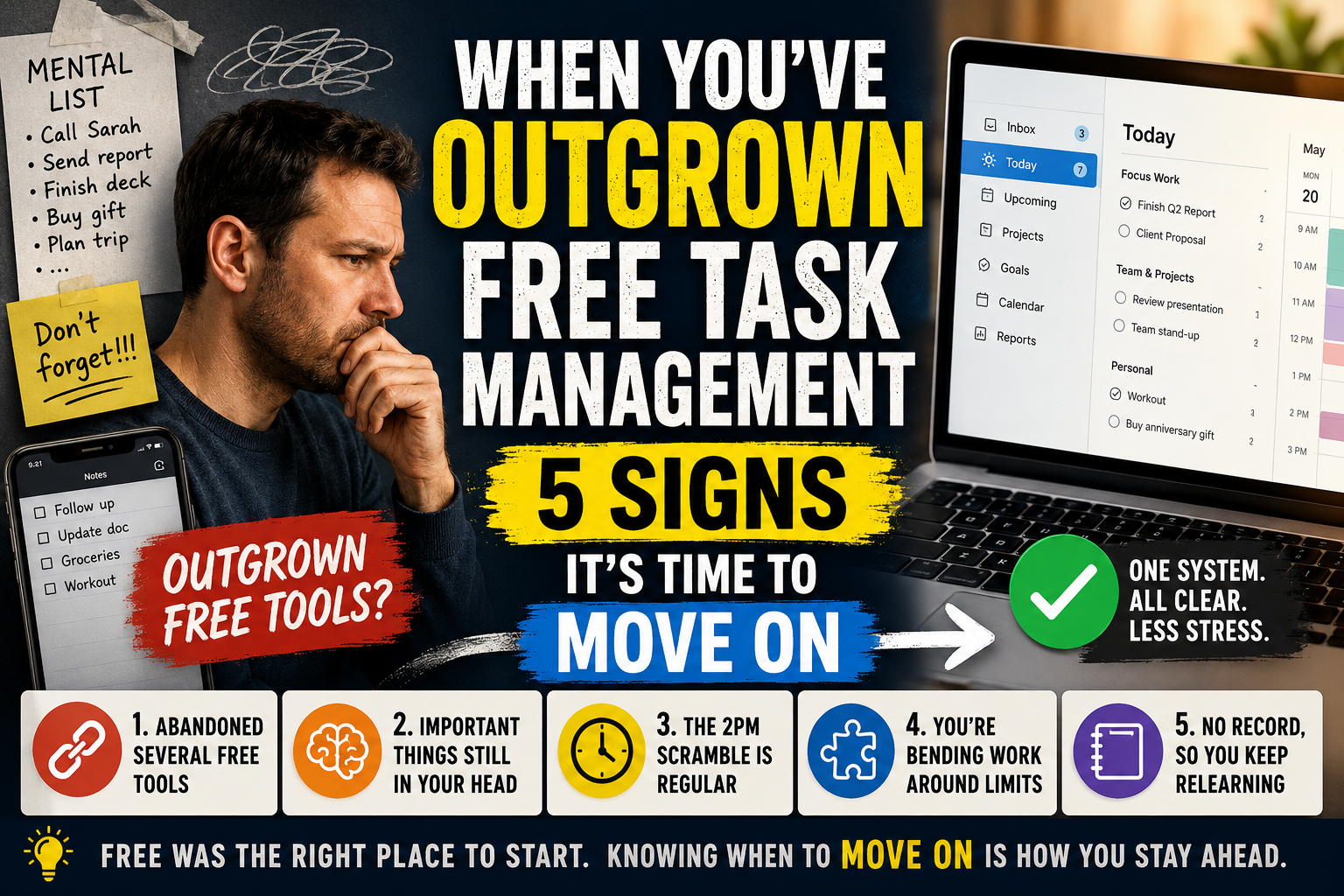
Free tools are the right place to start. A sticky note on the monitor, the notes app on your phone, a running mental list of what needs doing - for a while, these are genuinely enough. They cost nothing, they require no setup, and they handle a life that is not yet complicated enough to need more. Anyone who tells you to pay for a task manager before you have felt the limits of free is selling something.
But there is a point where free quietly stops being enough, and the strange thing about that point is how easy it is to pass without noticing. Nothing dramatic happens. There is no alert, no moment where the sticky notes visibly fail. Instead the cost shows up indirectly - in forgotten commitments, in a low background hum of stress, in days that get away from you - and because none of those things announce themselves as a task-management problem, most people never connect the symptoms to the cause. They just feel vaguely behind, and they assume the answer is to try harder rather than to change the tool.
This article is about recognizing that point. Not a pitch to upgrade before you are ready, but an honest set of signals that you have already outgrown free task management and are paying for it in ways that do not show up on any invoice. If you read through these five signs and most of them describe you, the free stage is probably behind you, whether you have admitted it yet or not.
Why outgrowing free is so hard to notice
Before the signs themselves, it is worth understanding why this particular transition sneaks up on people, because the reason is psychological and it works against you.
The first problem is that the cost of an inadequate system is hidden and distributed. When a paid subscription is not worth it, the cost is obvious - a charge on your card every month for something you do not use. But when a free system is not enough, the cost is spread across dozens of small moments that never get totaled. A dropped ball here, a stressful scramble there, ten minutes lost re-deriving what you already knew yesterday. Each instance is too small to notice on its own. Nobody adds them up. So the free system feels free, when in reality you are paying for it constantly in a currency that does not look like money.
The second problem is the anchor of zero. Once you are used to paying nothing, any price feels like a step down, even a small one. Behavioral research on how people value things consistently finds that the jump from free to any cost at all carries a disproportionate psychological weight - free is not just a low price, it is a special category that other prices have to overcome. This is why people will tolerate a great deal of friction and lost productivity to avoid paying eight dollars a month, even when the friction is costing them far more than eight dollars in time and stress. The math says upgrade. The anchor says stay. The anchor usually wins, for longer than it should.
The third problem is that trying harder feels more virtuous than spending money. When your system is failing you, the culturally approved response is to be more disciplined, more organized, to get your act together through sheer effort. Buying a better tool can feel like cheating, or like admitting a personal failing. So people grind away at an inadequate setup, treating a tooling problem as a character problem, and the grinding obscures the simpler truth - that the tool stopped fitting the work a while ago.
With those forces in mind, here are the signs they tend to obscure.
Sign one: you have tried several free tools and abandoned every one
If you have downloaded a handful of free task apps over the years and quietly stopped using every single one, that pattern is itself the signal. And the signal is usually misread.
The standard interpretation is personal: I am just not the kind of person who sticks with these things, I lack the discipline, the tools work for organized people but not for me. This reading is almost always wrong, and it is worth dismantling, because it keeps people stuck. The more likely explanation is structural. Free tools are built to be free. They are often deliberately limited, designed as the narrow end of a funnel toward a paid version, or built by someone in their spare time without the depth that daily reliance requires. They are not built to be lived in for years, and so they do not hold your days well enough to become a genuine habit.
There is a real mechanism underneath the failure to stick. A task system only becomes valuable once you have used it long enough for it to accumulate your life - your projects, your patterns, your history - and to weave itself into your daily habits. That accumulation takes time and consistency. Research on habit formation by Phillippa Lally and colleagues found that a new behavior takes a median of around sixty-six days to become automatic, with wide variation. A tool that is frustrating, limited, or untrustworthy never survives those weeks. You bounce off it before the habit can form, conclude that you failed, and move on to the next free option, where the cycle repeats.
So the pattern of serial abandonment is not evidence that you cannot use a task manager. It is evidence that you have been trying to build a durable habit on tools that were never built to support one. When you have cycled through several and nothing has taken, the useful question is not "which free app should I try next?" It is "what would a tool need to be for me to actually commit to it?" And the honest answer usually involves something built to be paid for - because the thing that makes a tool worth living in is precisely the depth and reliability that free versions tend to lack.
Sign two: you still keep the things that actually matter in your head
Here is a subtle one that almost everyone misses. Look at how you currently use whatever free system you have, and notice what you do not put into it. Most people, using a tool they do not fully trust, write down the minor things but keep the genuinely important ones in their head - the critical deadline, the thing they absolutely cannot forget, the high-stakes commitment. The reasoning, usually unconscious, is that the system is not reliable enough to be trusted with what really matters.
That instinct is the tell. If part of you does not trust the system enough to offload the important things into it, then you are still carrying those things mentally, which is the exact load a task manager is supposed to lift. You have a tool, but you are not actually getting the central benefit of having one, because the most important items are still running in your head.
And running things in your head has a real cost, well documented in cognitive science. The psychologist Bluma Zeigarnik observed in 1927 that unfinished tasks and unkept intentions stay active in the mind - they nag, they intrude, they resurface at inconvenient moments, consuming background attention until they are dealt with. Holding your most important commitments mentally means living with a constant low-grade cognitive tax, a background process that never quite shuts off. Later work by Masicampo and Baumeister found the antidote, and it is precise: you do not have to complete a task to quiet its nagging, you simply have to capture it in a specific, trusted plan. The key word is trusted. A plan you do not believe in does not release the mental load, because some part of you is still keeping watch, unwilling to let go.
This is what makes sign two so important. If you are keeping the crucial things in your head because your free tool has not earned your trust, you are already paying for task management - just in the most expensive currency there is. You are paying in mental bandwidth, in the attention and calm that the unkept items quietly consume. The question is not whether to pay. You already are. The question is whether you would rather pay a small amount of money for a tool you can actually trust, and get that bandwidth back, or keep paying in the currency of a mind that never fully rests.
Sign three: the 2pm scramble is a regular event
You know the moment. Somewhere in the early afternoon, you surface from the day and realize it got away from you. You have been busy - genuinely, continuously busy - but the things that actually mattered did not get touched. Now there is a scramble, a reactive scramble to salvage the day, doing in a rushed afternoon what should have been spread calmly across the morning. If that moment is familiar, and especially if it is a regular feature of your days rather than an occasional bad one, it is telling you something specific about your system.
The 2pm scramble is what an unplanned day feels like from the inside. When you start a day without a real plan - without having decided in advance what matters and when you will do it - you spend the day reacting to whatever arrives. Email sets your agenda. The loudest request wins. You are busy the entire time, but busyness is not the same as progress, and the gap between the two does not become visible until the afternoon, when there is suddenly not enough day left for the things that mattered.
There are two well-established reasons an unplanned day goes this way. The first is decision fatigue. Research associated with Roy Baumeister and colleagues suggests that the capacity for good decisions draws on a limited and depletable resource, so the quality of your choices degrades as the day's small decisions accumulate. Starting each part of the day by deciding from scratch what to do next burns that resource fast, and by early afternoon you are making worse calls with less in the tank. The second is attention residue, a phenomenon documented by researcher Sophie Leroy. When you switch rapidly between tasks without ever completing or properly setting them down - which is exactly what a reactive day forces - a part of your attention stays stuck on the previous task, so you are never fully present on the current one. A day of constant switching leaves you depleted and scattered even if you cannot point to much you accomplished, which is precisely the exhausted, behind feeling the 2pm scramble announces.
One scramble is a bad day, and everyone has those. But a steady diet of them is not bad luck. It is a system problem - the predictable result of navigating your days without a map - and a system problem has a system fix. If most of your afternoons contain that moment, you have outgrown running your days out of your head and a handful of notes.
Sign four: you have started bending your work around the tool's limits
This sign is quieter than the others and easy to rationalize away, which is exactly why it is worth watching for. Notice whether you have started building little workarounds to compensate for what your free tool cannot do. Keeping a separate document because the tool does not handle a certain kind of information. Emailing yourself because there is no good way to capture something on the go. Maintaining a parallel system on paper for the parts the app does not cover. Each workaround feels reasonable and small in the moment. Together, they mean you have outgrown the tool.
The principle here is simple. When you work with a tool, the tool serves you. When you start working around a tool, you have begun serving the tool - bending your process to fit its limitations rather than the other way around. The workarounds are friction, and friction is a tax you pay on every interaction. A little tax is fine. But when you find yourself maintaining multiple overlapping systems, or regularly doing extra steps to compensate for what the tool lacks, the cumulative cost has grown large, and worse, it has grown invisible, because each workaround became a habit you no longer notice performing.
There is a hidden danger in this state beyond the wasted effort. Fragmentation across multiple workarounds reintroduces exactly the problem a task manager is meant to solve. When your commitments are scattered across an app, a document, a paper list, and your email inbox, no single place shows you everything, which means you are once again relying on your memory to stitch the full picture together. The cognitive load you were trying to offload comes back, smuggled in through the gaps between your workarounds. A system that requires this much compensation is not really functioning as a system. It is a collection of partial tools held together by your own mental effort, which is the situation you presumably adopted a task manager to escape.
If you have quietly accumulated a set of workarounds and now spend real energy keeping your patchwork coordinated, that energy is the cost of staying on a tool you have outgrown. The workarounds are proof that the tool no longer fits the shape of your work.
Sign five: you have no record, so you keep relearning the same things
The final sign is the most overlooked, because it concerns an absence, and absences are hard to notice. Most free task setups are built around the present and the future - what do I need to do, what is coming up. Very few preserve a usable record of the past, of what you actually did day to day over weeks and months. And without that record, you are deprived of something genuinely valuable: the ability to learn from your own history.
Consider what a record makes possible. When you can look back over your real days - what you planned, what you finished, what slipped, how long things actually took - you can see your true patterns rather than your imagined ones. This matters because memory is a poor and flattering historian. We systematically misremember our own past, recalling the days we performed well and quietly forgetting the rest, which leaves us with a rosier and less accurate picture than the truth. Without a record to correct it, you keep planning based on a fantasy version of your own capacity. You believe you can do eight meaningful things in a day because you remember the rare day you did, and you keep overcommitting and falling short, never learning the real number because nothing is keeping honest score.
This connects to a broader idea about how the mind works best. The philosophers Andy Clark and David Chalmers argued in 1998 that an external tool - a notebook, a record, a trusted store of information - can function as a genuine extension of your mind, holding what your biological memory cannot reliably hold and freeing your brain for other work. A task system that keeps a real record of your days becomes exactly this kind of external memory. It lets you offload the job of remembering how your weeks actually went, and it gives you something to reason from. Without it, every week starts from a kind of amnesia. You re-decide things you already decided, repeat mistakes you have no record of making, and relearn lessons your past would have taught you if it had been written down anywhere you could see it.
If you keep having the same realizations, making the same misjudgments about your time, and feeling like you are starting fresh each week with no accumulated wisdom about your own patterns, that is the signature of a system with no memory. You have outgrown a tool that only ever looks forward. What you need is one that also remembers - because working from evidence about your real self is a different and far more effective thing than working from a flattering guess.
The free-to-paid decision, reconsidered
Step back from the five signs and the larger picture comes into focus. The decision to move from free to paid task management is usually framed wrongly, as a question of whether the tool is worth the money. But that framing smuggles in the zero anchor and almost guarantees the wrong answer, because it compares a concrete small price against an imagined free alternative that is not actually free.
The honest comparison is not paid versus free. It is paid versus the real, hidden cost of an inadequate free system - the dropped commitments, the mental load of things you do not trust the tool to hold, the reactive scrambles, the friction of your workarounds, the repeated mistakes you have no record to learn from. When the comparison is drawn correctly, the small subscription stops looking like a cost and starts looking like what it is: a way to stop paying a much larger, hidden bill you have been quietly covering for months or years.
None of this means free tools were a mistake. They were the right first step, exactly as a bicycle is the right way to learn balance before you ever need a car. Outgrowing them is not a failure of the tools or of you. It is simply what happens when the work gets real enough that the free option can no longer carry it. The signs above are the markers of that transition, and the only real mistake is the common one - to notice the symptoms for years, attribute them to your own shortcomings, and grind on with a setup you outgrew long ago, all to avoid crossing a line that, once crossed, tends to feel obvious in hindsight.
Putting it together
Here are the five signs, gathered in one place, so you can take an honest measure of where you stand. You have tried several free tools and abandoned every one, which points not to your lack of discipline but to tools never built to be lived in. You still keep the genuinely important things in your head, which means you are already paying for task management in the expensive currency of mental load. You know the 2pm scramble as a regular event, which is what an unplanned day feels like from the inside. You have started bending your work around your tool's limits, accumulating workarounds whose hidden cost has quietly grown large. And you have no usable record of your own days, so you keep relearning the same lessons and planning against a flattering fantasy of your real capacity.
If one of these describes you, you may simply be having a rough patch, and free might still be fine. If two or three describe you, you are likely standing right at the line. If four or five describe you, you crossed it some time ago and have been paying the hidden bill ever since.
The point of recognizing this is not to rush you into spending money. It is to correct a misperception that keeps capable people stuck for far too long - the belief that their failing system reflects a personal failing, when it actually reflects a tool that stopped fitting the work. Seeing the signs clearly lets you make the decision deliberately, on the real merits, instead of drifting along on the default of free because zero has a gravity that is hard to escape. You started with free because it was the right place to start. Knowing when you have outgrown it is just the next piece of the same good judgment.
Takeaways
Free task tools are the correct place to start, and outgrowing them is a normal transition rather than a failure of either the tools or your own discipline. The real mistake is staying on a system you have outgrown for years because the symptoms never announce themselves as a tooling problem.
The cost of an inadequate free system is real but hidden - distributed across many small moments of dropped balls, mental load, reactive scrambles, and lost time that never get added up. This is why people tolerate far more friction than the price of a better tool, and why the honest comparison is paid versus the hidden cost of free, not paid versus zero.
The five signs you have outgrown free task management: you have abandoned several free tools in a row, you still keep the important things in your head because you do not trust the system, the mid-afternoon scramble is a regular event, you have built workarounds to compensate for the tool's limits, and you have no record of your days to learn your real patterns from.
The decision to upgrade is usually framed as whether the tool is worth the money, which the psychological pull of free tends to answer wrongly. Reframed honestly - as a way to stop paying a larger hidden bill in time, stress, and mental bandwidth - the small cost of a tool you can actually rely on looks very different.
FAQ
When should I start paying for a task manager instead of using free tools?
When the hidden costs of your free system start to outweigh the small price of a better one. The practical markers are the five signs covered above - serial abandonment of free tools, keeping important things in your head, regular afternoon scrambles, accumulating workarounds, and having no record to learn from. If several of these describe you, you have likely outgrown free, and the comparison that matters is not paid versus free but paid versus the real cost of staying on a system that no longer fits.
Is it worth paying for a task manager when free ones exist?
Often, yes, once you have genuinely outgrown free. Free tools are the right starting point, but they tend to be limited and not built to be relied on for years, which is why so many people cycle through and abandon them. A tool worth paying for is usually one with the depth and reliability to actually become a lasting habit. The key is timing - paying before you have felt the limits of free is premature, but staying on free long after you have outgrown it means quietly paying a larger hidden cost in time and stress.
Why do I keep abandoning task manager apps?
Usually not because you lack discipline, but because the tools were not built to be lived in, or because you never used one long enough for it to become a habit. Research on habit formation suggests a new behavior takes weeks of consistency to become automatic, and a frustrating or untrustworthy tool rarely survives that window. The pattern of abandoning several free tools in a row is often a sign that you need a more reliable tool worth committing to, not that you are incapable of sticking with one.
Why does an unplanned day leave me so exhausted and behind?
Because reacting all day burns mental energy and fragments your attention. Decision fatigue means the quality of your choices degrades as the day's small decisions pile up, so starting each stretch by deciding from scratch what to do drains you quickly. Attention residue means that constantly switching tasks without finishing or properly setting them down leaves part of your mind stuck on the previous task, so you are never fully focused. Together these produce the busy-but-behind feeling and the mid-afternoon scramble that mark a day run without a plan.
Why is it bad to keep important tasks in my head?
Because unfinished tasks held in memory stay mentally active and consume background attention, a phenomenon first described by Bluma Zeigarnik in 1927. Carrying your most important commitments in your head means living with a constant low-grade cognitive tax that never fully shuts off. Later research found that capturing tasks in a specific, trusted plan relieves this load - but the plan has to be one you actually trust, which is why keeping important things in your head is often a sign that your current tool has not earned that trust.
How do I know if I have outgrown my current productivity system?
Look for the gap between what your system does and what your work now requires. Clear indicators include building workarounds to compensate for missing features, maintaining several overlapping tools, not trusting the system with important items, and having no usable record of your past to learn from. When you find yourself working around your tool rather than with it, or stitching multiple partial systems together with your own mental effort, the tool has stopped fitting the shape of your work and you have outgrown it.
Why does keeping a record of my days matter?
Because memory is a flattering and unreliable historian, and without a record you plan against a fantasy version of your own capacity rather than the truth. A record of what you actually planned and finished lets you see your real patterns, learn how long things genuinely take, and stop repeating the same misjudgments. It functions as a kind of external memory - an idea philosophers Clark and Chalmers formalized in 1998 - that holds what your brain cannot reliably hold, so you can reason from evidence about your real self instead of starting each week from a kind of amnesia.
Date-based AI Task Manager
Plan smarter, execute faster, achieve more
Create tasks in seconds, generate AI-powered plans, and review progress with intelligent summaries. Perfect for individuals and teams who want to stay organized without complexity.
Get started with your preferred account