
Productivity for People Who Work From Home: The Real Problems and How to Fix Them
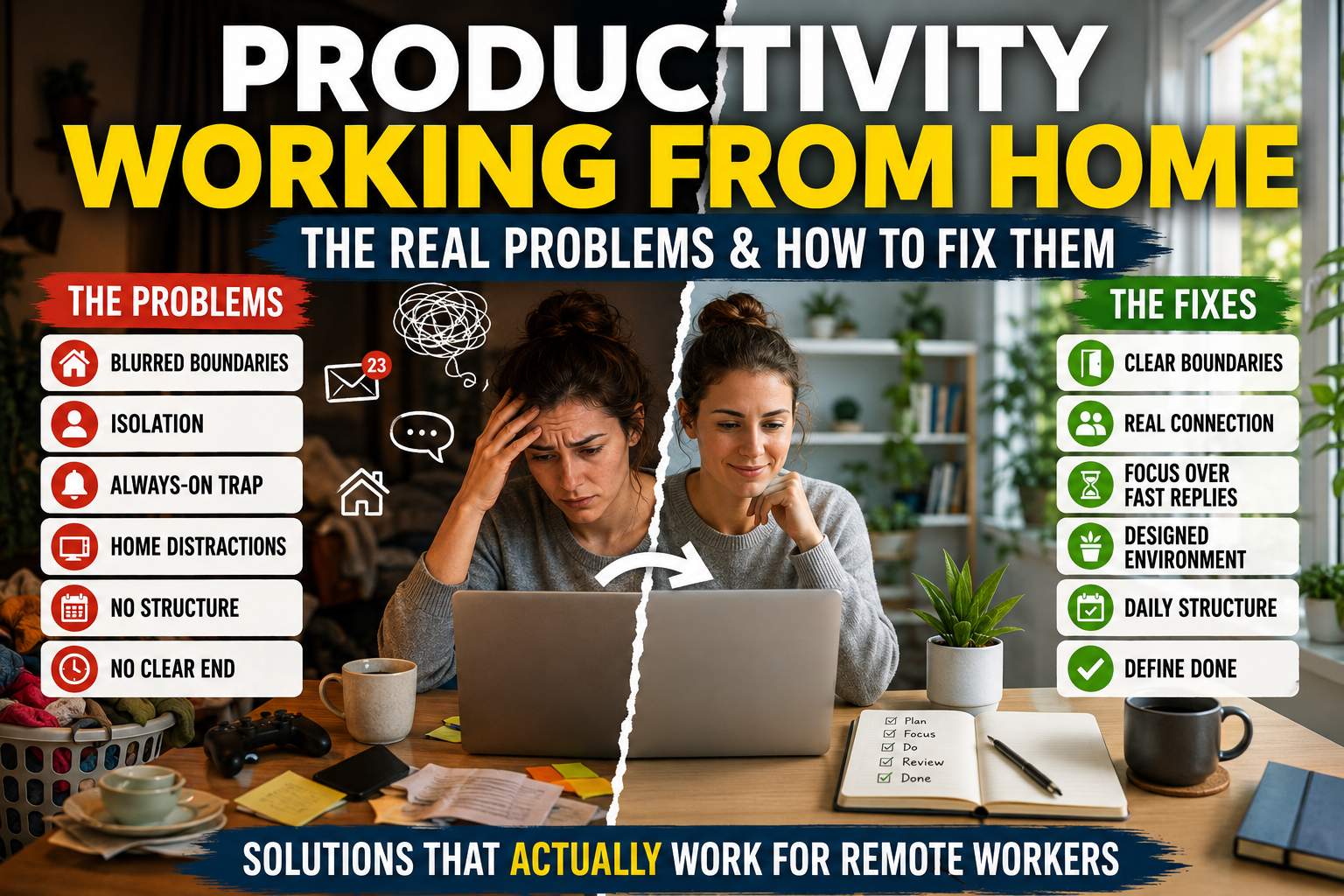
Most advice about working from home is some version of make a to-do list and take breaks, which would be useful if the problem were a lack of to-do lists. It is not. The reason working from home is hard has almost nothing to do with the generic productivity tips that apply everywhere, and almost everything to do with a specific set of problems that an office quietly solved for you and your home does not.
An office gives you a hard line between work and life, a commute that marks the transition, other people around you, a manager who can see you are working, and an environment built for one purpose. Take all of that away and replace it with your kitchen table, and a set of new problems appears that no amount of generic discipline advice addresses. The blurred boundary that means you never fully stop. The isolation that grinds you down. The pressure to look available every second. The distractions of a space designed for living, not working.
This article goes through those problems one at a time, the real ones that are specific to working from home, and gives you a concrete fix for each. Not generic productivity tips, but solutions aimed at the actual reasons remote work is harder than it looks.
Problem 1: Work and home blur into one thing
This is the central problem of working from home, the one most of the others grow out of. In an office, work happens in a place you leave. At home, work happens in the place you live, and the line between the two dissolves. Work bleeds into your evenings and weekends, and home life bleeds into your work hours, until there is no clean separation between being on and being off.
The damage runs in both directions. Because work has no clear end, you never fully switch off, which is how remote workers end up quietly working longer hours than they ever did in an office while feeling less accomplished. And because home is always present, the laundry, the dishes, the personal errands seep into your focused work time. Neither mode gets your full attention, and you end the day feeling like you were vaguely working the entire time without ever really working or really resting.
The fix is to manually recreate the boundaries the office used to enforce, since they will not appear on their own. Create separation in space by having a specific spot that is for work and only work, even if it is just one end of a table, so that being there means working and leaving it means stopping. Create separation in time by setting a real start and a real end to your workday and treating the end as a hard stop, closing the laptop and physically leaving the work spot. The goal is to give work a container with walls, in both place and time, so it stops leaking into everything else. The boundary will not hold itself. You have to build it and then defend it.
Problem 2: There is no commute to start and end the day
This sounds like a perk, and losing the commute genuinely is in some ways, but it removes something important that people rarely notice until it is gone. The commute was a transition ritual. It was the buffer that let your brain shift from home mode to work mode in the morning and back again in the evening. Without it, you lurch straight from bed into work and straight from work into your living room, with no mental gear change in between.
The result is that you start the day without ever really arriving at work, so you spend the first hour foggy and unfocused, and you end the day without ever really leaving, so work thoughts follow you into the evening. The clean psychological separation the commute provided is gone, and nothing has replaced it. Your brain never gets the signal that one mode has ended and another has begun.
The fix is to build your own transition rituals to replace the commute. In the morning, do something deliberate that signals the start of work before you begin, a short walk around the block, making coffee a certain way, a few minutes of planning the day, anything that functions as a starting line. In the evening, do the equivalent to mark the end, a walk, a change of clothes, shutting down and tidying the workspace, a clear closing action. These rituals do the job the commute used to do. They give your brain the gear change it needs to enter and exit work cleanly, and they are one of the most underrated fixes for the foggy-start and never-quite-finished feeling that plagues remote workers.
Problem 3: The always-on trap
Remote work comes with a peculiar pressure that the office did not have in the same way. When no one can see you working, you can start to feel you have to prove you are, and the way that shows up is a compulsion to be constantly available and instantly responsive. You feel you must reply to every message within seconds, stay visibly online all day, and never appear to be away from your desk, because your presence is now measured by your responsiveness rather than by being physically seen.
This is corrosive for two reasons. It keeps you in a state of permanent shallow availability, interrupting your real work constantly to demonstrate that you are working, which guarantees you never get the deep focus that actually produces results. And it stretches your working hours, because being always-on has no natural end, so you remain tethered to messages into the evening to keep proving your engagement. You end up busy, interrupted, and exhausted, with little real work to show for it, which ironically makes you feel you need to be even more available.
The fix is to deliberately decouple your value from your responsiveness. Build blocks of focused time where you are genuinely unavailable, with notifications off, and let people know this is when you do deep work. Respond to messages in batches at set times rather than reacting to each as it arrives, which both protects your focus and trains others to expect considered replies rather than instant ones. Most importantly, judge yourself and let yourself be judged on the work you produce, not on how fast you reply, because the always-on trap is fundamentally a confusion between looking busy and being effective. Breaking it requires the confidence to be unavailable while you do the work that actually matters.
Problem 4: Isolation wears you down
This is the problem people underestimate most, because it does not look like a productivity issue at first. Working from home, especially full-time, can be genuinely isolating. The casual human contact of an office, the chats, the shared lunches, the small interactions that punctuate a day, simply vanishes, and many remote workers go long stretches with very little real human connection during their working hours.
The productivity cost is real even though it is indirect. Isolation drags down mood and motivation over time, and a person who feels disconnected and a little lonely does not do their best work. It also removes the informal exchange of ideas and the sense of being part of something, which for a lot of people is part of what made work engaging. The slow erosion of connection shows up eventually as lower energy, lower motivation, and a creeping flatness that makes everything harder, and because it builds gradually, people often do not connect the dip in their output to the loneliness causing it.
The fix is to be intentional about connection, because it will not happen by accident the way it did in an office. Build deliberate human contact into your week, whether that is regular calls with colleagues that are not strictly about tasks, working occasionally from a cafe or shared space to be around other people, or making sure your non-work life has enough social contact to compensate for its absence during the day. The key is recognizing that the connection an office gave you for free now has to be created on purpose, and that doing so is not a soft indulgence but a real input to staying motivated and effective. Isolation is a productivity problem wearing the disguise of a mood problem, and it needs to be treated as one.
Problem 5: Home is full of distractions an office does not have
Your home was designed for living, not for focused work, and it is full of things that pull at your attention in ways an office never did. The television, the kitchen, the household chores that are always visible, family members or housemates who are around, the personal projects and comforts that surround you. An office is a sterile environment built to minimize these pulls. Your home is the opposite, a space optimized for everything except concentration.
The challenge is that these distractions are uniquely hard to resist because they are woven into your environment and often feel legitimate. Tidying up, starting a load of laundry, grabbing a snack, dealing with a small household task all feel reasonable and even productive, which makes them more insidious than obvious time-wasting. They fragment your focus throughout the day under the cover of being sensible things to do, and the constant low-level pull of a space full of non-work options makes sustained concentration far harder than it was in a purpose-built office.
The fix is to engineer your environment to reduce these pulls during work hours. Set up your workspace to be as free of distractions as you can manage, facing away from the television and the visible chores rather than toward them. Make a clear agreement with yourself that household tasks belong to non-work time, not work time, so that the laundry waits until you are off the clock rather than interrupting a focused block. If you share your space, set explicit expectations with the people around you about when you are working and not to be interrupted. The principle is to make your work environment work for focus rather than against it, since your home will never be neutral the way an office was. You have to actively shape it.
Problem 6: No structure is imposed, so the day can dissolve
In an office, a certain amount of structure is handed to you whether you want it or not. There are set hours, the presence of others working creates a rhythm, meetings anchor the day, and the simple fact of being in a workplace pulls you into work mode. At home, almost none of that exists. You face a completely unstructured day, and you alone are responsible for giving it shape, which is far harder than it sounds.
The danger is that without any imposed structure, the day can quietly dissolve. With no fixed rhythm, it is easy to drift, to start late, to let tasks sprawl without boundaries, to never quite get into a focused groove, and to look up at the end of the day wondering where the time went and why so little got done. The freedom of an unstructured day sounds appealing, but for most people total structurelessness leads to drift rather than productivity, because the human brain works better with some scaffolding than with none, and a blank day offers nothing to push against.
The fix is to give yourself the structure that the office used to provide, deliberately. Decide in advance what your day will look like, with a planned start, a rough shape to your working hours, and a clear sense of what you intend to accomplish, so that you are working to a plan rather than improvising into the void. Build a consistent daily rhythm and stick to it, because the routine itself does a lot of the work of keeping you on track. The point is that the structure an office imposed on you for free now has to be self-imposed, and the people who thrive working from home are almost always the ones who build themselves a clear shape for the day rather than leaving it to chance.
Problem 7: It is hard to tell when you have done enough
This is a subtle but draining problem unique to the blurred world of remote work. In an office, there were natural signals that the workday was complete. People started packing up, the office emptied, you physically left. Those external cues told you that you had done your day and could stop. At home, those signals are gone, and you are left with no clear marker of when enough is enough.
The consequence is a persistent low-grade guilt and an inability to fully rest. Because there is no obvious endpoint, many remote workers feel they could always be doing a bit more, so they never feel truly finished, and they carry a vague sense that they should be working even in their off hours. This is exhausting in a way that is hard to name. Without a clear line marking the end of the workday, work expands to fill all available psychological space, and you never get the clean satisfaction of having completed your day and earned your rest.
The fix is to define what done looks like for yourself, since no one else will. Decide at the start of the day what would constitute a good and complete day of work, a specific set of things you intend to accomplish, so that there is a clear target you can actually hit and recognize as finished. When you hit it, let yourself genuinely stop, and treat the workday as over rather than something that could always continue. Pair this with a clear end-of-day ritual, as covered earlier, so that there is both an internal sense of completion and an external marker of it. The goal is to create the endpoint that the office provided automatically, so that you can finish, know you have finished, and rest without guilt. Defining done is what turns an endless, guilt-tinged workday into one with a clear finish line.
Pulling it together: build what the office gave you for free
Look across all seven problems and a single theme connects them. Working from home is hard not because remote workers lack discipline, but because the office was silently providing a whole set of supports that you only notice once they are gone. The boundary between work and life. The transition of a commute. A natural limit on availability. Human contact. A focused environment. An imposed structure. A clear end to the day. The office handed you all of these without you having to think about them.
When you work from home, every one of those supports has to be rebuilt deliberately, by you. That is the real skill of remote work, and it is why generic productivity advice misses the point so badly. The task is not to be more disciplined in the abstract. It is to consciously recreate, one by one, the specific structures the office used to provide, with your own boundaries, your own transition rituals, your own limits on availability, your own connection, your own focused environment, your own daily structure, and your own definition of a finished day.
The people who work from home well are not superhuman. They have simply understood that the freedom of remote work comes with the hidden cost of having to build your own scaffolding, and they have done the work of building it. Once that scaffolding is in place, working from home can genuinely be better than an office, more focused, more flexible, and more humane. But it does not happen automatically. It happens because you replaced what the office gave you for free with something you built on purpose.
Takeaways
Working from home is hard because of specific remote problems, not a lack of generic discipline. The office quietly provided supports that vanish when you work from home, and they have to be rebuilt deliberately.
The blurred line between work and home is the central problem. Recreate the boundary in both space and time, with a dedicated work spot and a hard start and stop to the day.
Replace the commute with your own transition rituals so your brain can shift into and out of work mode, and define a clear end to the day so work stops expanding into your rest.
Break the always-on trap by decoupling your value from your responsiveness, protect against home distractions by engineering your environment, counter isolation by building connection on purpose, and give an unstructured day the shape the office used to impose.
The unifying lesson is that remote work means rebuilding what the office gave you for free, and the people who do it well are the ones who consciously build that scaffolding rather than relying on willpower.
FAQ
Why is working from home harder than it looks?
Because an office silently provides a set of supports that disappear when you work from home: a clear boundary between work and life, a commute that marks the transition, other people around you, a focused environment, imposed structure, and a clear end to the day. Remote work is difficult not because people lack discipline, but because every one of those supports now has to be rebuilt deliberately by the individual.
How do I separate work and home when they happen in the same place?
Recreate the boundary the office used to enforce, in both space and time. Have a specific spot that is for work and only work, so being there means working and leaving it means stopping. Set a real start and a hard end to your workday, and physically leave the work area when you finish. The separation will not appear on its own, so you have to build it and then defend it.
How do I switch off from work at the end of the day when working remotely?
Build an end-of-day transition ritual to replace the commute that used to mark the boundary, such as a walk, changing clothes, or shutting down and tidying your workspace. Also define in advance what a complete day of work looks like, so that when you hit it you can recognize the day as genuinely finished and let yourself stop. Without a clear endpoint, work expands to fill all your psychological space, so you have to create one.
How do I deal with the pressure to always be available when working from home?
Decouple your value from your responsiveness. Build blocks of focused time where you turn off notifications and are genuinely unavailable, and respond to messages in batches at set times rather than reacting instantly to each one. Let yourself be judged on the work you produce rather than how fast you reply. The always-on trap is a confusion between looking busy and being effective, and breaking it takes the confidence to be unavailable while you do real work.
How do I stay focused at home with so many distractions?
Engineer your environment to reduce the pulls, since your home was designed for living rather than focused work. Set up your workspace facing away from the television and visible chores, agree with yourself that household tasks belong to non-work time, and set clear expectations with anyone you share the space with about when you are not to be interrupted. Your home will never be neutral the way an office was, so you have to actively shape it for focus.
How do I handle the loneliness of working from home?
Treat isolation as the real productivity issue it is, and build connection into your week on purpose, because it will not happen by accident the way it did in an office. That might mean regular calls with colleagues that are not strictly about tasks, occasionally working from a cafe or shared space, or making sure your life outside work has enough social contact to compensate. Isolation quietly drains mood and motivation over time, so deliberately maintaining connection is a genuine input to staying effective.
How do I structure my day when no one is imposing a schedule?
Give yourself the structure the office used to provide for free. Decide in advance what your day will look like, with a planned start, a rough shape to your hours, and a clear sense of what you intend to accomplish, so you are working to a plan rather than drifting. Build a consistent daily rhythm and stick to it, because the routine itself keeps you on track. Total structurelessness tends to lead to drift, so the scaffolding now has to be self-imposed.
Date-based AI Task Manager
Plan smarter, execute faster, achieve more
Create tasks in seconds, generate AI-powered plans, and review progress with intelligent summaries. Perfect for individuals and teams who want to stay organized without complexity.
Get started with your preferred account