
Why Your Productivity System Keeps Failing (2026)
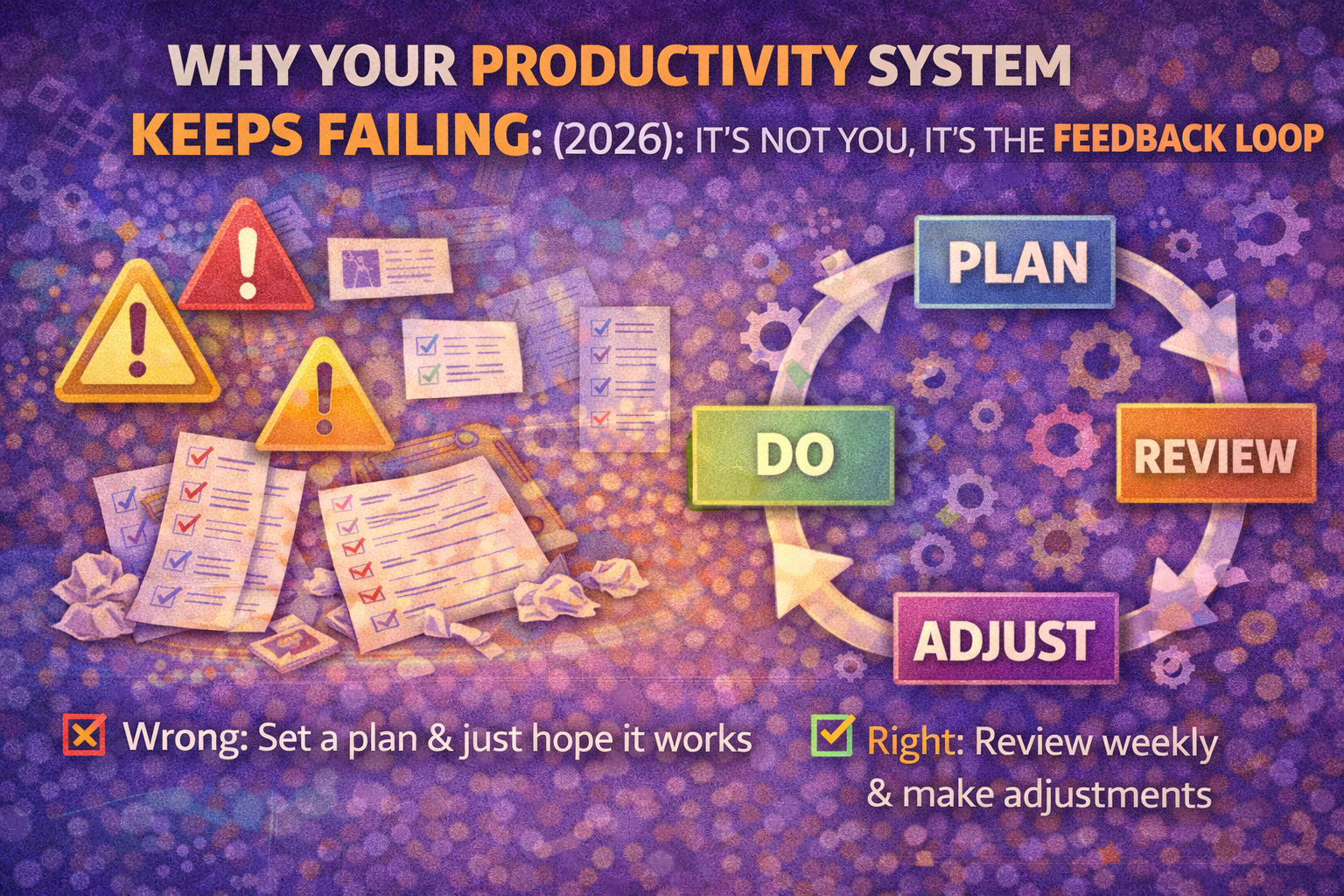
It’s Not You - It’s the Feedback Loop
If you’ve tried multiple productivity systems and they all worked for a few days, then collapsed, you’re not broken.
Most people don’t fail because they lack discipline.
They fail because their system has no feedback loop.
It’s like trying to drive a car without looking at the road:
- you set a plan
- reality changes
- you keep following the plan anyway
- then you crash into overwhelm
- and quit
A productivity system that doesn’t adapt will always fail.
Not because you’re inconsistent.
Because it has no mechanism to improve.
What a feedback loop actually means
A feedback loop is a simple cycle:
Plan → Do → Review → Adjust (repeat)
That’s it.
And it’s the difference between a productivity attempt and a productivity system.
Without review and adjustment, you’re stuck in hope mode:
This time it will work.
With a feedback loop, you’re in improvement mode:
This week gave me data. Now I’ll adjust.
Why most productivity systems fail (the 5 common reasons)
1) The plan is unrealistic
Most people plan like an optimist:
- too many tasks
- no buffer
- no energy awareness
- no interruptions accounted for
Then reality hits. The plan fails. You feel guilty. You quit.
But the correct response isn’t guilt. It’s calibration.
2) Tasks aren’t clear next actions
The system fails because the tasks aren’t executable.
Examples:
- Marketing
- Website
- Work on project
- Fitness
Those are categories, not actions.
Unclear tasks create friction, procrastination, and carryover.
3) You’re trying to do too many projects at once
Overwhelm is often not too many tasks. It’s too many active projects.
When everything is active, nothing moves.
A system needs limits.
4) You don’t review what actually happened
This is the big one.
Most people do planning. Few people do review.
So they repeat the same mistakes every week:
- over-planning
- underestimating time
- ignoring energy
- getting hijacked by distractions
Without review, there’s no learning. Without learning, there’s no improvement.
5) You judge yourself instead of adjusting the system
A bad week happens and people conclude:
- I’m not consistent.
- I’m lazy.
- I can’t do routines.
But a bad week is usually not identity. It’s data. And data is useful.
The reality of productivity in 2026: life is dynamic
A system only works long-term if it adapts to:
- changing workload
- changing energy
- unexpected meetings
- family/life events
- different seasons
- health fluctuations
Static systems fail.
Adaptive systems win.
The fix: build a simple feedback loop (15 minutes per week)
You don’t need a complex method. You need a weekly checkpoint.
Weekly review (15 minutes)
Ask:
- What were my wins this week?
- What didn’t happen?
- Why? (pick the real reason)
- What will I change next week?
- What are the 3 outcomes for next week?
That’s a feedback loop. You improve weekly.
The 4 adjustments that solve most problems
When a week fails, it’s usually one of these.
Adjustment 1: Cut planned work by 30–40%
Plan less than you think. Leave buffer for reality.
Adjustment 2: Rewrite vague tasks into next actions
Marketing → Draft 10 post ideas for Reddit
Adjustment 3: Reduce active projects to 3–5
Park the rest.
Adjustment 4: Schedule deep work first
If deep work isn’t scheduled, it won’t happen.
A bad week is not failure. It’s calibration.
This is how high performers think:
- they don’t expect perfect weeks
- they expect learning weeks
- they adjust the system until it fits reality
That’s how consistency is built.
Not with motivation. With iteration.
How SelfManager.ai supports the feedback loop
Most apps help you store tasks.
SelfManager.ai (formerly Self-Manager.net) supports the feedback loop because it’s built around:
- planning by day/week/month
- keeping tasks connected to projects
- weekly/monthly review workflows
- optional AI summaries to speed up reflection
It helps you do the important part: review reality and adjust.
Because the tool isn’t the system. The loop is the system.
Copy/paste: Feedback Loop Template (2026)
WINS:
- _______________________
MISSES:
- _______________________
WHY (real reasons):
- too much planned
- unclear tasks
- interruptions
- low energy
- too many projects
ADJUSTMENTS FOR NEXT WEEK:
NEXT WEEK - 3 OUTCOMES:
- _______________________
- _______________________
- _______________________
Run this every week. Your system will stop failing.
Final thought
If your productivity system keeps failing, it’s not proof that you’re inconsistent.
It’s proof that you’re using a system with no feedback loop.
Add the loop:
Plan → Do → Review → Adjust
Do it weekly.
And your productivity stops being random. It starts compounding.
Date-based AI Task Manager
Plan smarter, execute faster, achieve more
Create tasks in seconds, generate AI-powered plans, and review progress with intelligent summaries. Perfect for individuals and teams who want to stay organized without complexity.
Get started with your preferred account