
How to Break Big Projects Into Weekly Milestones (2026)
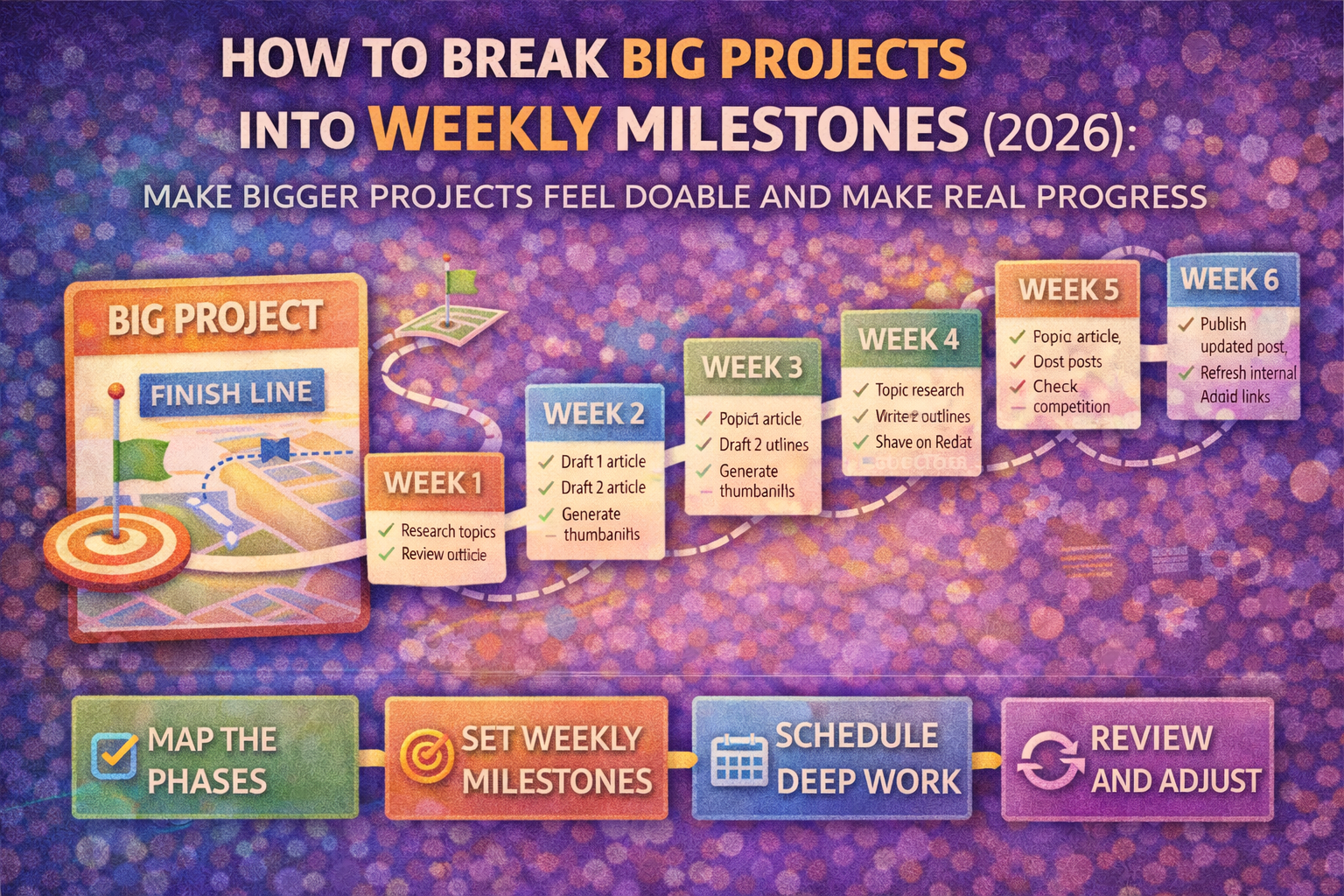
The simple method that turns "someday" projects into real progress
Big projects don't fail because you're lazy.
They fail because they stay too big for too long.
When a project lives in your task manager as one giant item like:
- Build the website
- Launch the product
- Grow SEO
- Get in shape
- Redesign onboarding
Your brain has nothing clear to execute. So you do small tasks instead. Weeks pass. The project stays "active," but nothing moves.
The fix is simple: Break the project into weekly milestones.
Not daily to-do's. Weekly milestones.
Because a week is the perfect unit:
- long enough to complete meaningful work
- short enough to create urgency
- easy to review and adjust
Why weekly milestones work better than daily planning
Daily plans are fragile. A single interruption can destroy them.
Weekly milestones are resilient. They let you handle real life while still moving the project forward.
They also create structure that helps you:
- prioritize
- schedule deep work
- measure progress
- avoid busy mode
Step 1: Define the project outcome (the finish line)
You need a clear "done" state.
Bad outcome:
- Improve marketing
- Work on app
- Get better at fitness
Good outcome:
- Publish 12 SEO articles by end of March
- Ship onboarding v2 + reduce drop-off
- Run 5km without stopping
- Launch landing page + checkout + email onboarding
If you can't describe "done," you can't plan milestones.
Step 2: Identify the 3–7 major phases (the project map)
Almost every big project has phases.
Examples for a SaaS feature launch:
- Research and decision
- Design / scope
- Build MVP
- Test + fix
- Launch
- Measure + iterate
Examples for content / SEO:
- Topic research
- Outlines
- Writing
- Thumbnails
- Publish + internal links
- Update old posts
You're creating the "chapter list" of the project.
Step 3: Turn phases into weekly milestones (Week 1–12)
Now convert phases into weekly commitments.
Each milestone should be:
- specific
- measurable
- realistic
- outcome-based
Example: "Publish 10 articles"
- Week 1: finalize topics + outlines for first 4
- Week 2: publish 2 posts
- Week 3: publish 2 posts
- Week 4: publish 2 posts
- Week 5: publish 2 posts
- Week 6: publish 2 posts + internal linking pass
Example: "Launch onboarding v2"
- Week 1: audit current onboarding + identify drop-offs
- Week 2: design new flow + write copy
- Week 3: implement v1
- Week 4: test + fix
- Week 5: launch + track metrics
- Week 6: iterate based on data
A weekly milestone is basically: What must be true by Friday?
Step 4: Break weekly milestones into 3–7 tasks
The milestone is the outcome. Tasks are the actions.
Example: Week 2 milestone "Publish 2 posts"
Tasks:
- finalize draft 1
- finalize draft 2
- generate thumbnails
- publish both
- add internal links
- share on X/Reddit
Now the tasks feel executable because they have a weekly purpose.
Step 5: Schedule 2–4 deep work blocks per week
Weekly milestones don't happen by accident. They happen because you protect time.
Minimum system:
- 2–4 blocks of 60–90 minutes/week
- schedule them early
- no notifications
A single deep work block can move a milestone more than 4 hours of shallow work.
Step 6: Do a weekly review (this is what makes it compound)
Every week:
- Did the milestone complete?
- If not, why?
- Was it too big?
- Was the plan unrealistic?
- What changes next week?
This keeps your milestones calibrated to reality.
The "milestone size" rule (so you don't overplan)
A good weekly milestone should feel slightly challenging — but definitely doable.
If it feels scary or vague, it's too big. Reduce scope.
Examples:
- "Write the article" → "Write outline + intro"
- "Build feature" → "Implement step 1 + tests"
- "Redo marketing" → "Publish one high-quality post"
Consistency beats intensity.
Copy/paste template: Weekly Milestone Planner (2026)
Project: _______________________
Finish line (definition of done): _______________________
Phases (3–7):
- _______________________
- _______________________
- _______________________
- _______________________
- _______________________
Weekly milestones (Week 1–6 / 12):
- Week 1: _______________________
- Week 2: _______________________
- Week 3: _______________________
- Week 4: _______________________
- Week 5: _______________________
- Week 6: _______________________
This week milestone: _______________________
Tasks (3–7):
- _______________________
- _______________________
Deep work blocks scheduled:
- _______________________
Weekly review:
- What shipped?
- What didn't?
- Why?
- What changes next week?
How SelfManager.ai helps you run weekly milestones
SelfManager.ai (formerly Self-Manager.net) is a natural fit for milestone-based execution because it's built around time periods:
- daily/weekly/monthly planning
- projects organized in tables
- easy weekly reviews
- optional AI summaries to extract lessons and adjust faster
So instead of holding the project in your head, you run it as a visible weekly system.
Final thought
Big projects feel overwhelming when they stay abstract.
Weekly milestones make them real.
They turn "I should work on this sometime" into "This week, this specific thing gets done."
That's how progress becomes inevitable.
Date-based AI Task Manager
Plan smarter, execute faster, achieve more
Create tasks in seconds, generate AI-powered plans, and review progress with intelligent summaries. Perfect for individuals and teams who want to stay organized without complexity.
Get started with your preferred account