Why Smart People Need Task Management the Most (Not the Least)
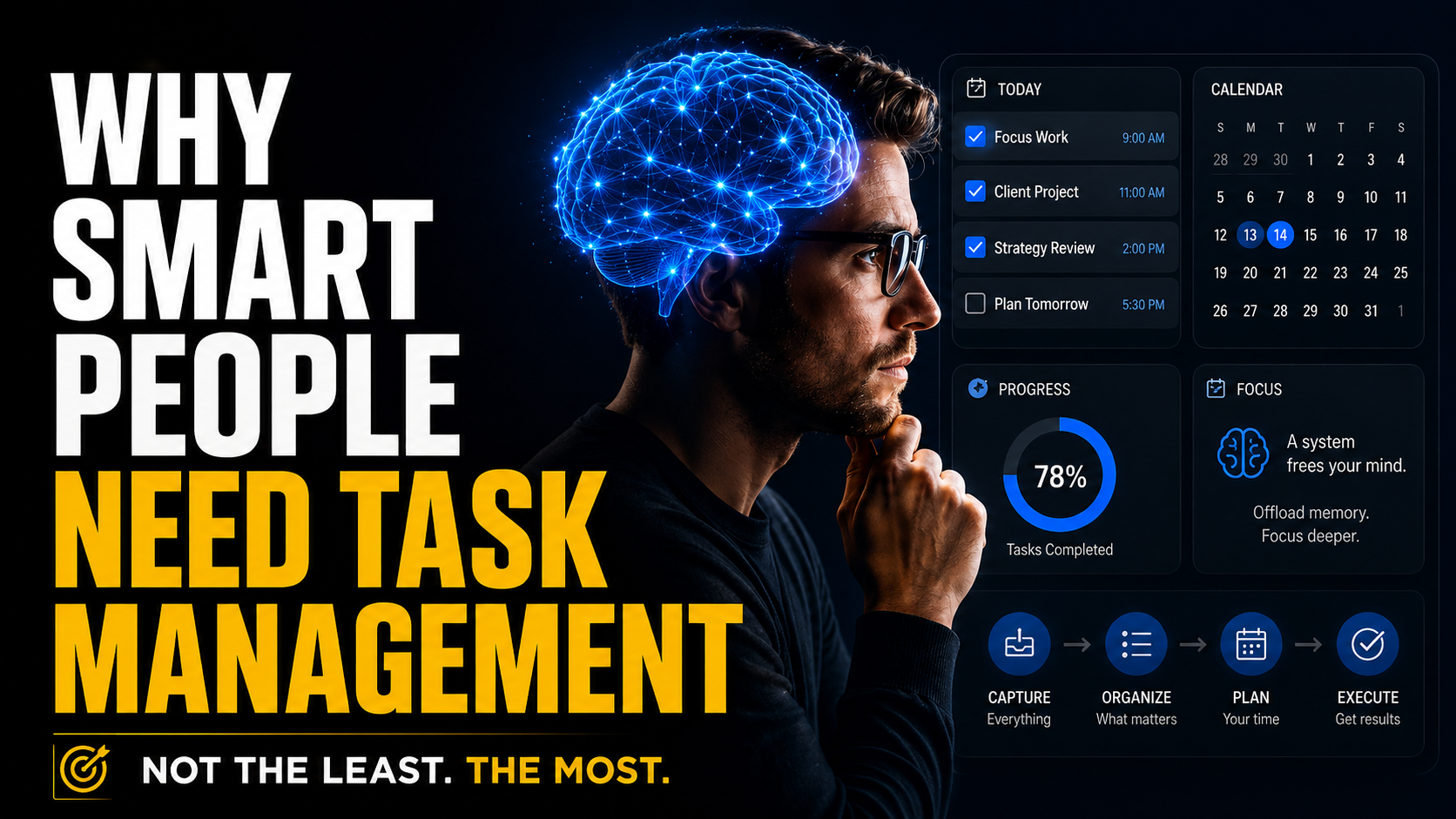
There's a quiet belief shared by a lot of capable people: task management is for people who can't keep things in their head. If you're smart enough, organized enough, sharp enough, you don't need an app to remember your own life. You just hold it.
For a while, that works. A strong mind can carry a remarkable amount - parallel projects, half-finished ideas, a mental queue of what's next. It's genuinely impressive, and it's exactly why so many high performers never build a system. Their memory has never let them down badly enough to force the issue.
But the belief is backwards. The people who do the most demanding mental work don't need a system of record less than everyone else. They need it more - and for reasons that come directly from what makes them effective in the first place. The same cognitive machinery that lets you think deeply is the machinery that drops the big picture, loses the parallel threads, and quietly taxes your performance in ways you can't feel happening.
Here's the case, grounded in what the research actually says.
Deep focus is a narrowing, by design
The thing knowledge workers are best at - sustained, deep focus on a hard problem - works by narrowing attention. That's not a side effect. It's the mechanism. To go deep on one thing, your brain suppresses awareness of everything else.
In human factors research this has a name: attentional tunneling. When attention locks onto a demanding task, the perceptual and cognitive aperture narrows, and information outside the focus - including things that matter - stops registering. It's been studied extensively in aviation, where skilled pilots fixated on one instrument have missed others that were plainly in view. The expertise doesn't prevent the tunneling. In some cases it deepens it, because experts engage more completely.
For a knowledge worker, the tunnel is where the best work happens. Three hours lost in a hard problem is the whole point. But while you're in it, the other seven things you were tracking that morning don't get gracefully paused - they fall out of awareness entirely. You surface from deep work clear-headed about the problem you solved and genuinely blank on the commitment you made yesterday. Not because you're careless. Because focus did exactly what it's supposed to do.
The smarter and more absorbed you are, the deeper the tunnel goes, and the more falls outside it.
Your working memory is smaller than your intelligence suggests
The intuition that a sharp mind can "just hold it all" runs into a hard biological limit, and intelligence doesn't move that limit nearly as much as people assume.
George Miller's famous 1956 paper put the capacity of short-term memory at around seven items, plus or minus two. Later work tightened the estimate considerably - Nelson Cowan's influential 2001 review argued the real number of independent chunks we can actively hold is closer to four. Four. That's the live workspace, the mental desk where active manipulation happens.
High performers do have advantages here: they chunk information more efficiently, build richer mental models, and retrieve from long-term memory faster. But the size of the active workspace is remarkably stable across people. Being smart lets you do more with the slots you have. It doesn't give you many more slots.
So when a capable person runs eleven active threads "in their head," they are not actually holding eleven things in working memory. They're holding a few and trusting that the rest will resurface when needed. Usually it does. The failure mode is invisible precisely because it's intermittent - the thread that doesn't resurface doesn't announce itself. You don't notice the dropped commitment until it's late, and even then you experience it as a one-off lapse rather than a structural certainty.
The hidden tax of open loops
Here's the part that costs you even when nothing gets dropped.
In the 1920s, the psychologist Bluma Zeigarnik observed that waiters remembered unpaid orders far better than completed ones, and that interrupted tasks lingered in memory more insistently than finished ones. The Zeigarnik effect describes how unfinished tasks maintain a kind of cognitive tension - they stay partly active, consuming background attention until they're resolved.
For someone juggling many open commitments, that tension isn't free. Every unresolved task you're holding in your head is a small, persistent draw on the same limited mental resources you need for deep work. You can feel it as a low background hum of "there's something I'm forgetting," or as the difficulty of fully settling into a hard problem when the rest of your responsibilities are circling.
The crucial finding came much later. In 2011, E.J. Masicampo and Roy Baumeister ran a series of studies on this exact tension, published as "Consider It Done! Plan Making Can Eliminate the Cognitive Effects of Unfulfilled Goals." Unfulfilled goals impaired people's performance on unrelated tasks - the open loops interfered with focus, as Zeigarnik would predict. But there was a clean remedy. Participants who made a specific plan for how and when they'd complete the unfinished task showed the interference disappear. Not the task. Just a concrete plan for it.
The implication is direct and underappreciated: writing a task down, with a date attached, doesn't merely store it. It releases the mental tension the open loop was costing you. The mind treats a committed plan almost as if the thing were already handled, and hands the bandwidth back. For people whose work depends on that bandwidth, this is not a minor convenience. It's the difference between focusing fully and focusing through static.
Switching between deep topics leaves residue
Knowledge workers rarely have the luxury of one problem at a time. They move between deep contexts - a design question in the morning, a thorny analysis after lunch, a strategic decision before the day ends. Each of those is a tunnel of its own, and moving between them is more expensive than it feels.
Sophie Leroy's 2009 research named the cost: attention residue. When you switch from one task to another, part of your attention stays stuck on the first - especially if it was unfinished or cognitively demanding. Her studies showed that this residue measurably degrades performance on the new task. You're not fully present on the second thing because a piece of you is still resolving the first.
The deeper you go on each topic, the more residue each switch leaves. So the very people who are best at deep engagement pay the highest switching tax. And in the absence of a system, every switch also forces a small act of reconstruction: what was I tracking? what's next? what did I tell that person I'd do? That reconstruction is done from memory, under load, in the gaps between deep sessions - which is exactly when working memory is most taxed and most likely to drop something.
A system of record removes the reconstruction step. You don't rebuild the picture from memory at every transition. You look at the day, see what's there, and put your scarce attention into the work instead of into remembering the work.
Offloading memory is how smart people get smarter
There's a stubborn pride that makes high performers resist all this. Externalizing your tasks can feel like an admission - as if a truly capable mind shouldn't need the crutch.
The philosophy and cognitive science here argue almost the opposite. In their 1998 paper "The Extended Mind," Andy Clark and David Chalmers made the case that the tools we think with - the notebook, the sketch, the external record - aren't crutches propping up cognition. They're part of the cognitive system itself. The mind was never confined to the skull; it has always extended into the artifacts that hold information so the brain doesn't have to.
Seen this way, a planning system isn't compensating for a weak memory. It's the same move that every form of expert thought relies on: the mathematician's notation, the architect's drawing, the writer's outline. None of these exist because their users are incapable of holding the work in their heads. They exist because offloading the holding frees the mind to do the part only the mind can do - reason, connect, decide, create.
David Allen compressed the whole idea into one line: your mind is for having ideas, not holding them. The most cognitively productive people aren't the ones with the most capacious memories. They're the ones who've stopped wasting a brilliant mind on storage.
The compounding advantage of a record you can actually read
Everything so far is about the present - freeing attention, reducing the tax, protecting focus. But the largest advantage of a system of record shows up over time, and it's the one deep thinkers are best positioned to exploit.
A mind is a poor archive. Memory is reconstructive, not reproductive - we don't replay the past, we rebuild it each time, and the rebuild is biased by recency, mood, and story. Ask a sharp person what their last month actually consisted of and you'll get a confident narrative that's mostly wrong: dominated by the last few days, shaped by whatever felt significant, blank on the steady work that filled most of the hours.
A daily record fixes this. When you've logged your days as they happened, you can look back at what actually occurred rather than what you vaguely remember occurring. For someone whose job is thinking well, that raw material is gold. Pattern recognition - the thing intelligent people are best at - needs accurate data to work on. Feed it a real record of where your time and attention went, and you can see which kinds of work compound and which quietly drain you, where you consistently over-commit, which projects you keep deferring and why.
This is also where the recent wave of AI tools becomes genuinely useful rather than decorative. AI laid over scattered, structureless notes produces generic summaries. AI laid over a real, time-ordered record of your actual days can tell you something true about how you work - because the structure underneath it is real. The quality of the reflection is capped by the quality of the record. Smart people who keep a record get a feedback loop on their own behavior that memory alone can never provide, and they're precisely the ones with the analytical horsepower to act on it.
Why a date-based structure fits deep work specifically
If the goal is to free the mind, close open loops, and build a record worth reviewing, the structure of the system matters - and most tools are built on the wrong one for this purpose.
Task managers organized around projects, boards, or lists ask you to maintain the structure: to file things correctly, groom backlogs, decide which list a task belongs to. That maintenance is itself a cognitive load, and it accumulates into the exact guilt-pile of unfinished items that the Zeigarnik effect makes so draining to look at. The structure works against the goal.
A date-based system inverts this. The organizing unit is the day, which requires no maintenance - tomorrow arrives on its own, and yesterday seals itself. You put a task against a date and the open loop is closed in the sense that matters: it has a committed plan, which is exactly what Masicampo and Baumeister found releases the mental tension. Nothing to file, nothing to groom, no backlog to confront. And because every day is logged in sequence, the record builds itself as a byproduct of normal use, ready to review whenever you want to look back.
This is the thinking behind SelfManager. It's built around the day rather than the project precisely because the day is the one unit that doesn't bend, doesn't need upkeep, and naturally produces the time-ordered record that makes reflection - human or AI-assisted - actually work. For someone doing demanding mental work, that combination is the point: a system that takes almost nothing to maintain, closes the loops that drain focus, and quietly accumulates the data their analytical mind can later put to use.
The takeaway
The argument against task management - "I'm sharp enough to hold it in my head" - is true right up to the point where it isn't, and the people most likely to believe it are the ones for whom it's most expensive.
Deep focus narrows your awareness by design. Working memory is small even when intelligence is large. Open loops tax the exact bandwidth your best work depends on, and a committed plan is what releases them. Switching between deep topics leaves residue that a record can absorb. Offloading memory isn't weakness - it's the move that frees a strong mind to do what only it can. And a real record turns your own past into data your pattern-matching mind can learn from.
None of this is about being disorganized. It's about refusing to spend a rare and valuable mind on the one job it's worst at: holding everything, all at once, forever. Put the holding somewhere else, and you get the mind back for thinking.
Date-based AI Task Manager
Plan smarter, execute faster, achieve more
Create tasks in seconds, generate AI-powered plans, and review progress with intelligent summaries. Perfect for individuals and teams who want to stay organized without complexity.
Get started with your preferred account