
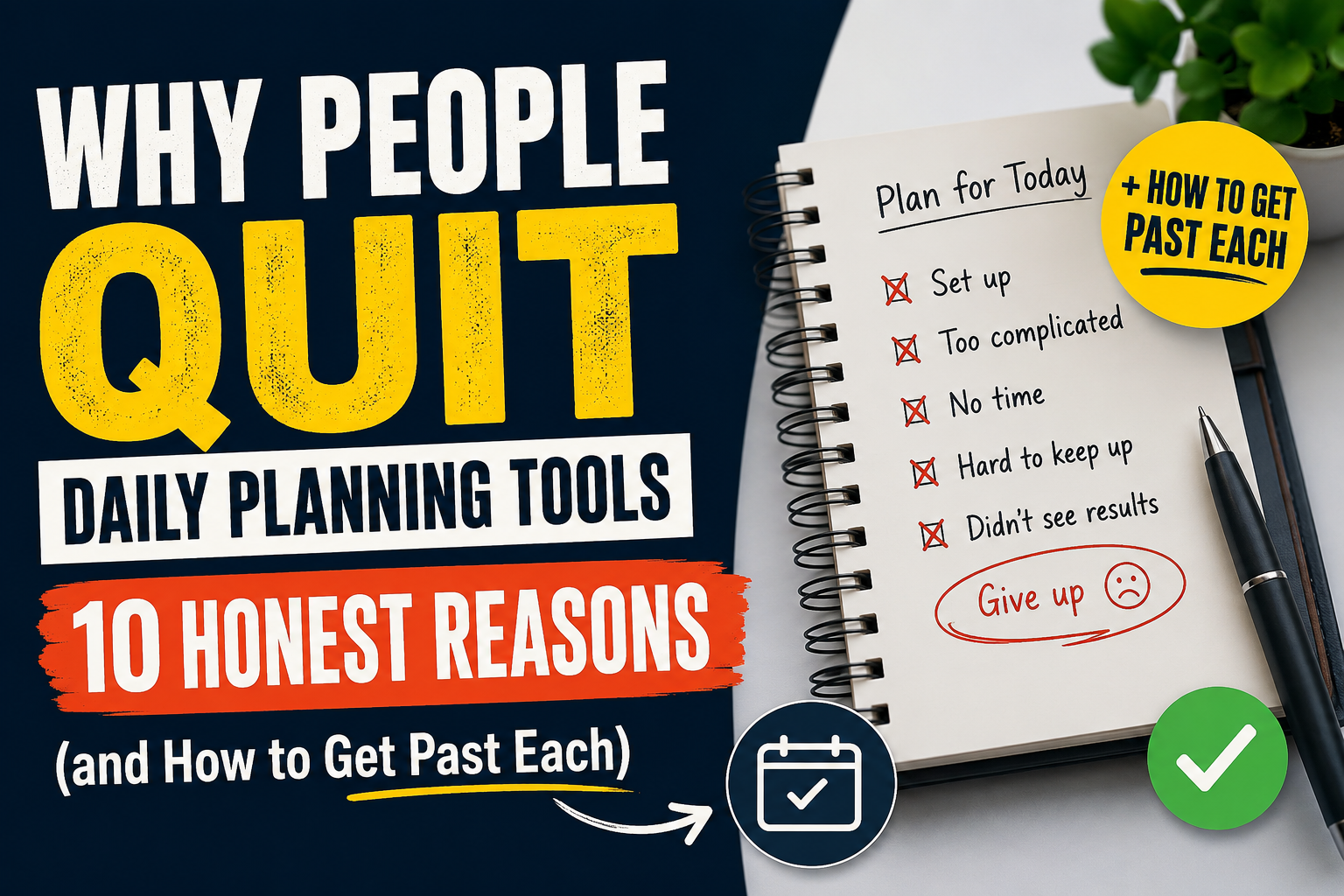
Why People Quit Daily Planning Tools: 10 Honest Reasons (and How to Get Past Each)
Almost everyone has signed up for a planning tool at some point. A task manager, a planner app, a fresh notebook, a new system someone swore by. And almost everyone has watched it quietly die two weeks later.
The usual explanation is personal: "I'm just not disciplined enough." "I'm bad at sticking with things." "I don't have the willpower."
That explanation is almost always wrong.
People don't quit daily planning because of some character flaw. They quit for specific, predictable reasons - most of which have nothing to do with discipline and everything to do with how the tools are built and how getting started actually feels. Once you can name the reason, you can usually get past it.
Here are the ten most common ones. At least one of them is yours.
1. "I'll set it up later"
This is the most common killer, and it happens before you ever really start.
You sign up, you see a screen asking you to create projects, add categories, connect integrations, and define your workflow - and you think, reasonably, "I'll do this properly when I have time." That time never comes, because there's always something more urgent than configuring a tool you haven't used yet.
The blocker isn't laziness. It's that setup is friction, and friction placed before value almost always wins.
The fix is to pick a tool that needs no setup, or to skip setup entirely. In a date-based system like SelfManager, there's nothing to configure - you open today and start typing tasks against it. AI Plan removes even that step: you describe your week in plain language and it builds the structure for you. The first session is the first real use, not an hour of admin.
2. "I tried it once and nothing changed"
You opened the app, poked around for five minutes, added a couple of tasks, and felt no transformation. So you concluded it didn't work.
Here's the problem: planning tools don't pay off on day one. They pay off around day ten to fourteen, once you've logged enough actual days that patterns start to surface - what you keep pushing, what you consistently finish, where your time actually goes.
Five minutes of poking can't produce that. The test was simply too short.
This is why a single login tells you almost nothing, and why the people who benefit most are the ones who gave it a real week or two. If you're going to evaluate a planning tool, evaluate it across enough days that it has something to show you.
3. "It feels like another job"
Some tools become work in themselves. You spend more time maintaining the system - tagging, sorting, moving cards between columns, grooming the backlog - than doing the things the system was supposed to help with.
That overhead feels productive, but it isn't planning. It's busywork wearing planning's clothes.
The reason this happens is structural: most tools are built around a unit that needs constant upkeep. Boards need columns. Projects need statuses. Lists need pruning. The maintenance is baked in.
Date-based systems sidestep most of it. The day is the unit, and days take care of themselves - tomorrow arrives whether you maintain it or not. Tasks belong to dates, and there's nothing else to file, tag, or groom. The system stays light because time does the organizing for you.
4. "I plan in my head"
This one is common among capable, high-output people. You hold the week in your head, adjust on the fly, and it works - right up until it doesn't.
The trouble is that mental planning has no record. You overestimate how much you're actually tracking, things slip without you noticing, and by Friday you genuinely cannot account for half the week. Not because you wasted it, but because you have no way to look back at it.
Writing things down isn't about needing a reminder for the obvious tasks. It's about creating a record you can review. The difference between a thought and a logged day is the difference between a vague sense that you were busy and an actual account of what you did. One disappears; the other compounds.
5. "I'll start when things calm down"
This is the polite, well-intentioned version of "I'll set it up later." You genuinely want to plan. You're just waiting for a calmer week to begin.
The calmer week is a myth. Things don't reliably calm down - and even when they do, that's the week you least need a system. The slow week is easy to coast through on memory alone. The chaotic week, the one you're trying to wait out, is exactly the week a planning system would save you.
There is no perfect moment to start. Waiting for one is just a comfortable way of never starting. The next reasonable moment is the current week, mess and all.
6. "My calendar already does this"
A calendar feels like a planner, so it's easy to assume you already have one. But a calendar and a planning system answer different questions.
Your calendar shows what's scheduled - meetings, appointments, time-boxed commitments. It does not show what you intended to get done, what you actually finished, or what quietly slipped from one day to the next. It has no memory of completion and no record of the work that lives between the meetings.
That gap is where most of your real work happens. The tasks that aren't appointments - the deep work, the follow-ups, the small things that accumulate - have nowhere to live on a calendar. A daily planning system captures exactly that layer, and lets you look back on it later. The calendar tells you where you were supposed to be. A planner tells you what you actually did.
7. "I don't want to see how much I didn't finish"
This one is rarely said out loud, but it's powerful. Opening a planning tool can mean confronting a pile of unfinished tasks, and that feels bad. So you avoid the tool to avoid the feeling.
The avoidance is real, but it's a symptom of how most tools are built. List-based and project-based apps accumulate incompletions indefinitely. The "done" column becomes a landfill, the "to-do" list becomes a guilt monument, and nothing ever ages out. Of course you don't want to open that.
Date-based systems handle this differently. When tomorrow opens, today closes. Yesterday is sealed - it happened, it's a record now, not a reproach. There's no growing guilt pile because the structure provides closure automatically. You're not staring at six months of accumulated failure; you're looking at one day at a time, and the past simply becomes history you can read rather than debt you owe.
8. "I'm too busy to plan"
This is the most self-defeating blocker, because it's exactly backwards. The busier you are, the more a few minutes of planning pays off - and the less likely you are to spend them.
When everything is urgent, planning feels like a luxury you can't afford. But five minutes spent deciding what matters today is what prevents eight hours of reacting to whatever shouts loudest. Skipping the plan doesn't save time; it just moves the cost into the day, where it's far more expensive.
The fix is to shrink the planning, not skip it. A daily reset doesn't need to be a ritual. Two or three minutes - what's carried over, what's new, what's the one thing that matters today - is enough to change the shape of a busy day. Busy isn't a reason to skip planning. It's the reason to do it.
9. "I've tried every app and none of them stuck"
If you've cycled through five task managers and abandoned all of them, it's natural to conclude that planning tools just don't work for you. But notice the pattern: you kept changing the app and getting the same result.
That suggests the app was never the variable. The thing all those tools had in common was their structure - they organized your work around a board, a project, a list, or a page. If that underlying unit doesn't fit how your life actually flows, no amount of switching between apps built on the same unit will help.
The variable worth changing isn't the brand of app. It's the organizing principle. Most tools are built around things that bend - projects get renamed, boards get archived, lists get restructured. Time doesn't bend. A system organized around days rather than projects is a genuinely different structure, not just another app with the same bones in a new color.
10. "Planning feels rigid - I like staying flexible"
Some people resist planning because it feels like signing a contract with their future self. You write down the plan, the day goes sideways, and now you're behind on a schedule you made up. Better to stay loose and adapt.
But good planning was never meant to be a contract. A plan is a hypothesis - your best current guess about how the day should go, fully expecting reality to revise it. The point isn't to obey the plan; it's to start the day from a considered position rather than a blank, reactive one.
And flexibility is built into the practice, not opposed to it. The daily reset exists precisely because plans drift. Each morning you adjust: move what slipped, drop what no longer matters, add what's new. A date-based system makes this effortless because the day you're in is always the screen in front of you. Planning doesn't remove flexibility. It gives your flexibility something to push against.
The common thread
Read these back and a pattern emerges. Almost none of them are really about discipline.
They're about tools that demand setup before they deliver value, that take days to pay off but get judged in minutes, that pile up guilt instead of providing closure, or that organize work around units that don't match how life actually moves. The failures are structural and psychological, not moral.
That reframing matters, because it changes what you do next. If the problem is your character, the only fix is to somehow become a more disciplined person - which rarely works. If the problem is friction, mismatch, and unrealistic expectations, those are fixable. You can choose a tool with no setup. You can give it a fair two-week trial. You can pick a structure - like a date-based one - that provides closure and matches the forward motion of time. You can shrink the daily practice until it's too small to skip.
Takeaways
Most people who quit daily planning weren't undisciplined. They hit a specific, nameable blocker and assumed it was a personal failing.
If you recognized yourself in one of these, the path forward is usually simple: reduce the friction that stopped you, give the tool long enough to actually show its value, and choose a structure that doesn't fight the way your life already works.
SelfManager is built around the one unit that never bends - the day. There's no setup, closure is automatic, and a 14-day trial is long enough to get past most of the blockers on this list. If a planning habit has never stuck for you before, it may be worth finding out whether the problem was you, or just the shape of the tools you tried.
Date-based AI Task Manager
Plan smarter, execute faster, achieve more
Create tasks in seconds, generate AI-powered plans, and review progress with intelligent summaries. Perfect for individuals and teams who want to stay organized without complexity.
Get started with your preferred account