
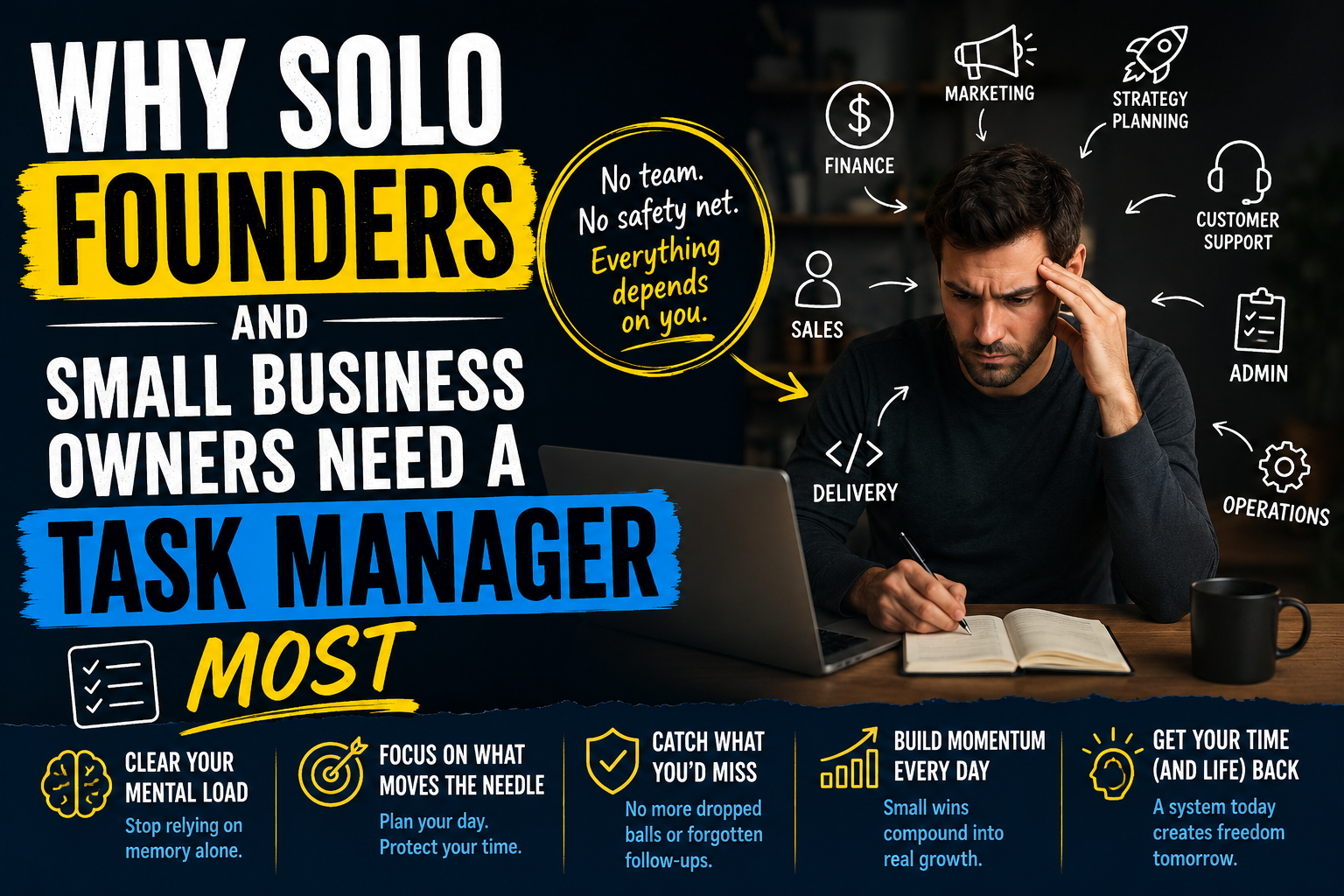
Why Solo Founders and Small Business Owners Need a Task Manager Most
In a company of any size, a lot of work stays on track for reasons nobody notices. A teammate remembers the thing you forgot. A process flags the invoice that didn't go out. A manager follows up on the commitment that slipped. The organization is, among other things, a giant distributed memory - dozens of people each holding a piece, quietly catching each other's dropped balls.
Run a business alone, and all of that disappears at once.
There is no teammate who remembers. No process that flags. No one following up but you. Every role the company would normally spread across departments - sales, delivery, finance, support, marketing, admin - now lives inside one head and one calendar. And every ball that gets dropped is dropped for good, because there's no one standing behind you to catch it.
This is why the people who most need a task manager and a daily planning habit aren't the employees of large organizations with systems and safety nets around them. It's the solo founders, freelancers, and small business owners doing everything themselves. The advice to "just stay organized" lands very differently when staying organized is the only thing standing between your business and a missed deadline that costs you a client.
Here's the real shape of the problem, and why a system of record is less a productivity nicety and more the operating backbone of a one-person business.
The problem isn't how much you do - it's how different each thing is
It's tempting to frame the solo founder's challenge as volume. Too many tasks, not enough hours. But volume alone is manageable. The thing that actually breaks people running a business alone is the sheer unlikeness of the tasks they switch between in a single day.
In one morning you might write a proposal (sales brain), debug something a customer reported (delivery brain), reconcile two invoices (finance brain), answer a support email that needs care (relationship brain), and sketch next month's promotion (marketing brain). These aren't five tasks of the same kind. They're five different modes of thinking, each with its own context, its own stakes, its own mental setup.
A company hands each of those modes to a different person who lives in it all day. The salesperson stays in sales brain. The accountant stays in finance brain. The solo operator switches between all of them, often within the same hour, and pays a cost every single time.
That cost is real and has been measured. Research on what the psychologist Sophie Leroy called "attention residue" shows that when you switch from one task to another, part of your attention stays stuck on the first - and that lingering residue measurably degrades your performance on the next thing. For someone switching between unlike domains all day, the residue never fully clears. You arrive at each task carrying fragments of the last three, never quite at full capacity on any of them.
A task manager doesn't eliminate the switching - that's the nature of running a business alone. But it removes the part of the switch that does the most damage: the frantic mental reconstruction of "wait, what was I supposed to do here, and what's next after this?" When the day is laid out in front of you, the switch becomes a glance instead of a scramble.
Every hat is a different job with a different mind
It's worth being concrete about how unlike these modes really are, because the gap between them is the whole problem.
Selling requires optimism, energy, and a tolerance for rejection. You have to believe in the thing and project that belief outward, hold the prospect's objections in mind, and stay warm under pressure. Then you hang up, and ten minutes later you're doing the books - which requires the opposite temperament entirely: cold precision, attention to small discrepancies, zero tolerance for "close enough." The qualities that make you good at one actively get in the way of the other.
Delivery is different again. Whether you're writing code, designing, consulting, or making a product, the work demands sustained depth - long uninterrupted stretches where you sink into a problem. But you can't sink very far when you know a support email from an unhappy customer is sitting unanswered, because support runs on responsiveness and empathy, and the part of you tracking it won't let the deep part settle.
Marketing wants creativity and a long time horizon. Admin wants none of that - it just wants to be done. Strategy wants you to lift your head and think about the next year. The day-to-day wants you back in the weeds immediately.
A person who only had to be one of these could organize their whole working life around that single mode. The solo operator has to be all of them, and has to transition between them cleanly enough that the optimism of the sales call doesn't leak into the books and the precision of the books doesn't kill the creativity of the campaign. That's an enormous amount of mental gear-shifting, and none of it is the actual work - it's the overhead of switching roles. Anything that reduces that overhead, even a little, pays for itself many times over across a week. A clear view of what each part of the day is for is one of the few things that does.
The missing safety net changes the math entirely
Inside an organization, forgetting something is usually recoverable. The system has redundancy. Someone notices the gap, a recurring meeting surfaces the dropped item, a shared document reminds everyone what was agreed. Memory is distributed, so no single person's lapse is fatal.
A solo business has none of that redundancy. You are the only node. If the follow-up email to a warm lead doesn't get sent, no one sends it. If the renewal date passes, no one catches it. If you promised a client something on a call and didn't write it down, the only record of that promise is a memory that's already fading - and the client's memory of it is the one that will count.
This is the part that makes "I'll remember it" so much more dangerous for solo operators than for employees. It's not that founders have worse memories. It's that the consequences of the inevitable lapse are uncushioned. In a company, a forgotten task is an inconvenience. In a one-person business, a forgotten task is a lost client, an unbilled month, a broken promise that quietly erodes the reputation the whole business depends on.
There's a compounding reputational dimension here too. A large company can absorb the occasional dropped ball because its reputation is spread across many interactions and many people. When a solo operator drops one, it's personal - the client doesn't experience it as "the company made an error," they experience it as "this person forgot about me." For a small business that runs on referrals and repeat work, a few of those can quietly close the pipeline without you ever knowing which dropped ball did it.
A system of record is how you rebuild the safety net by yourself. It can't replace a team, but it can replace the single most important thing a team provides: the guarantee that nothing important depends on one fallible memory at one stressful moment. When every commitment lives on a date instead of in your head, the dropped ball stops being a question of whether you happen to remember at the right time.
You're also the only one who decides
Switching between roles is one load. Being the only person who decides anything is another, and it's easy to miss.
In a company, most decisions are absorbed before they reach any single person. Priorities are set by managers, defaults are set by process, and the vast majority of "what should happen next" questions are answered by structure rather than by a fresh choice. An employee can spend most of the day executing decisions that were made elsewhere.
A solo founder decides everything. What to work on this morning. Whether to chase the lead or finish the delivery. Whether today's fire is worth dropping the week's plan for. Which of forty possible tasks actually matters. Every one of these is a small act of judgment, and they don't stop coming. The mental cost of making decision after decision, with no structure to lean on, is a real drain - and it falls hardest precisely when you're tired, which is when judgment is worst and the temptation to just react to whatever's loudest is strongest.
This is where planning earns its keep in a way that has nothing to do with memory. When you decide the shape of the day in advance - in the morning, or the night before, in a calm few minutes - you make the hard prioritization choices once, deliberately, instead of forty times reactively as the day throws things at you. You're using a moment of clear thinking to set defaults for a day that will not be clear. The plan won't survive contact with reality intact, but that's not the point. The point is that you've already decided what matters, so when the day gets loud you're defending a considered position instead of improvising from zero every time something interrupts.
For a business of one, where the founder is the only decision-maker and therefore the bottleneck on everything, protecting the quality of those decisions is not a soft concern. It's most of the job.
"I run it all in my head" works until exactly the moment it doesn't
Most solo founders started out genuinely able to hold the whole business in their head. Early on, there isn't much to hold - a handful of clients, a few moving parts, a short list of what's next. Memory is more than enough, and building a system feels like overkill for a business this simple.
The trap is that the business grows continuously while your capacity to hold it does not. There's no alarm that goes off the day the complexity exceeds what your head can track. It happens gradually, and the first sign is usually not a feeling of overload - it's a dropped ball you didn't see coming. A deadline that arrived sooner than you thought. A client who "never heard back." A bill you forgot to send for three weeks.
By the time those start happening, you've usually been over capacity for a while without knowing it. The mind doesn't warn you when it's full; it just quietly stops keeping everything, and you find out after the fact. The founders who avoid this aren't the ones with the best memories. They're the ones who built the habit of writing things down before they were forced to - while the business was still simple enough that the system felt unnecessary.
That's the counterintuitive timing of it. The best moment to start planning your days and capturing your tasks is when it still feels like you don't need to. Starting the habit while the load is light means the system is already in place and trusted by the time the load gets heavy - which it will, if the business is working at all. Trying to build the habit during the overwhelmed phase, on the other hand, is like trying to install a filing system during a flood. Possible, but much harder than it needed to be.
When the business and the life share the same head
There's one more pressure that employees rarely face to the same degree: for a solo founder, there is no clean line between the business's mental load and your own.
An employee can, at least in principle, close the laptop and leave the company's open loops at the company. The unfinished tasks belong to a role you step out of. For someone running their own business, the open loops follow you home, because there's no one else holding them. The unsent invoice, the half-finished proposal, the client who's waiting - these don't get handed to a night shift. They sit in the same head that's trying to have dinner with family or fall asleep.
Psychologists have a name for the way unfinished tasks linger in the mind - the Zeigarnik effect, after the researcher who first observed that incomplete tasks stay mentally "open" and keep drawing on attention until they're resolved. For a solo operator, that background hum of unresolved business never fully switches off, because the business never hands its open loops to anyone else. It's a major and underdiscussed source of the burnout that hits people running their own businesses: not just the hours worked, but the hours not worked that the mind spends quietly holding everything anyway.
Getting the loops out of your head and onto dates is, among other things, a way to actually leave work when you stop working. A task captured with a clear plan for when you'll handle it stops nagging - research on planning shows that the mind largely releases an open loop once it trusts there's a concrete plan to close it. For a founder, that release is the difference between an evening genuinely off and an evening spent physically away from the desk but mentally still at it. The system isn't only protecting the business. It's protecting the person running it.
The day is the only place all your hats actually meet
Here's a structural problem unique to wearing many hats: the work doesn't naturally live anywhere together. Your sales tasks, delivery tasks, finance tasks, and marketing tasks belong to different tools, different mental categories, different parts of the business. There's no single place where "everything I'm responsible for" naturally assembles.
Except one. The day.
Whatever roles you're playing, they all converge on the same finite container: today. Today holds a bit of sales, a bit of delivery, a bit of admin, a bit of whatever the business needs from you in the next sixteen hours. The day is the one unit where all the hats meet, because time is the one resource every role draws from equally. You can't be in finance brain and marketing brain at the same instant - they compete for the same hours.
This is exactly why daily planning fits a multi-hat operator so well, and why organizing work by project or by category often doesn't. Project-based tools keep each hat in its own silo, which means you never see the real picture: the total demand on this specific day across everything you do. You can have a perfectly organized sales pipeline and a perfectly organized delivery board and still be blindsided, because nothing showed you that Tuesday had eleven hours of work crammed into eight.
Plan the day, and you're forced to confront the truth that all your roles are spending the same hours. That confrontation is uncomfortable, but it's the entire point. It's where you decide what actually gets done versus what you were vaguely hoping to fit in - which, for a business of one, is the most important decision you make all day. The siloed tools let you keep pretending each hat has its own time. The day refuses to let you pretend, and that refusal is what makes it useful.
Daily planning is the operating rhythm a solo business doesn't have by default
A company has rhythm built in. Standups, weekly meetings, sprint cycles, monthly reviews - structures that force regular moments of "what are we doing and how's it going." These rhythms aren't bureaucracy; they're what keep a group coordinated and looking up from the immediate work.
A solo business has no built-in rhythm at all. Nothing forces you to stop and look. You can spend weeks heads-down reacting to whatever's loudest, never once stepping back to ask whether the loud things are the important things. The absence of structure feels like freedom, and sometimes it is - but more often it's how a solo operator ends up busy for a month with little to show for it, having spent the whole time firefighting instead of building.
Daily planning is how you give a one-person business the rhythm it otherwise lacks. A few minutes each morning to decide what today is for, and a few minutes to set up the coming week, replaces the coordinating function that meetings serve in a company. It's the moment you look up. It's where the urgent gets weighed against the important instead of automatically winning. For a solo founder, this small ritual is doing the job that an entire layer of management does elsewhere - keeping the work pointed at what matters rather than just at what's nearest.
The weekly version matters just as much as the daily one. Once a week - a Sunday evening, a Friday afternoon, whenever fits - stepping back to look at the whole week ahead is the closest a solo operator gets to a planning meeting with themselves. It's where you notice that you've taken on three deliverables due the same week, or that you haven't done anything that grows the business in a fortnight because every day got eaten by maintenance. The daily plan keeps you on track; the weekly plan makes sure the track is pointed somewhere worth going.
And it compounds. A single planned day is useful. A habit of planned days becomes the difference between a business that drifts wherever the loudest client pulls it and one that moves, however slowly, in a direction you actually chose.
The record is your only honest view of where the business went
Run a business alone and you also lose something companies take for granted: an objective account of what actually happened. Organizations have records everywhere - tickets closed, deals logged, hours tracked, reports filed. The solo operator, relying on memory, has only a story. And the story is unreliable.
Ask a founder how last month went and you'll get an impression shaped by the last few days and the most emotionally charged moments - the big win, the painful client, the stressful week. What you won't get is an accurate picture, because memory is reconstructive: it rebuilds the past from fragments and fills the gaps with narrative. The steady, unglamorous work that actually filled most of the hours simply isn't in the recollection.
This matters because a solo founder makes every strategic decision based on this internal story. Which kind of work to take more of. Which to stop. Where the time is going. Whether the new offering is worth the effort it's eating. If the story is wrong - and it usually is - the decisions built on it are wrong too.
A daily record replaces the story with data. When your days are captured as they happen, you can look back at what the month genuinely consisted of rather than what you vaguely feel it consisted of. You can see that the client you remember as profitable actually consumed three times the hours you billed. You can see that the marketing you keep deprioritizing is the only thing that ever preceded a good month. You can see that the "quick favors" you do for existing clients quietly add up to a full unpaid day every week. These are the decisions that determine whether a small business survives, and they're impossible to make well from memory alone.
This is also where AI has started to genuinely help solo operators rather than just adding noise. A language model laid over scattered, structureless notes gives you generic summaries. The same AI laid over a real, time-ordered record of your actual days can surface patterns you'd never catch yourself - because the underlying data is real and structured by time. The quality of any review, human or AI-assisted, is capped by the quality of the record beneath it. For a founder with no analyst and no operations team, that record is the closest thing to having one.
The system is also what you hand to your first hire
There's a longer-term reason to build this habit early, and it has nothing to do with your own memory: the day you bring on help, the system you've kept is what makes the handoff possible.
Most solo founders eventually want to delegate something - a virtual assistant, a contractor, a first employee. And most discover that delegation is far harder than it looks, for one specific reason: everything the business knows lives in the founder's head, in a form no one else can access. You can't hand over what you've never written down. The knowledge transfer becomes a slow, painful process of the new person asking questions and the founder dredging up answers from memory, one at a time, while still doing all the actual work.
A founder who's been planning their days and keeping a record has a head start that's hard to overstate. The recurring tasks are already visible. The rhythms of the business are documented in the simple fact of what happens on which days. "Here's what a typical week looks like, here's what needs doing and when" is a question you can answer by pointing at your own history rather than by trying to reconstruct it. The system you built to keep yourself on track turns out to be the first draft of the operations manual you'll need to grow beyond yourself.
Even if you never hire anyone, this framing is clarifying. A business whose entire operation exists only in one person's memory is a fragile business - it can't be sold, can't be handed off, can't survive its founder being sick for two weeks. Externalizing the work into a system isn't just personal productivity. It's the beginning of turning a person who's very busy into an actual business that could, in principle, run without them.
Why a date-based system fits multi-hat work specifically
If daily planning is the right rhythm and a time-ordered record is the goal, then the structure of the tool matters - and most task managers are built around the wrong unit for someone wearing many hats.
Tools organized around projects, boards, or lists keep each hat in its own compartment. That's fine if you're one role in a larger company, living inside a single board all day. It works against you when you're every role at once, because your actual constraint isn't any single project - it's the total demand landing on each day across all of them. A project-based tool can't show you that, because it never assembles the day; it only ever shows you one slice of one hat.
A date-based system flips the organizing principle. The unit is the day, which is exactly where a multi-hat operator's real decisions get made. Every task - regardless of which role it belongs to - lives on a date, so the day shows you the whole truth: everything competing for these particular hours. There's nothing to file into the right project and no backlog to groom, which matters enormously when administrative overhead is yet another hat you're already too busy to wear. And because every day is captured in sequence, the record that powers honest review builds itself as a byproduct of simply using the tool.
This is the thinking behind SelfManager. It's organized around the day rather than the project precisely because the day is where a solo operator's roles collide and where their most important choices actually happen. It takes almost nothing to maintain - no setup, no filing, no upkeep - which is the only kind of system a one-person business can realistically sustain. You can plan a day by hand in a couple of minutes, or describe your week in plain language and let AI Plan lay it out for you against real dates. And at the end of the week, the days you've logged become something you can actually review - by scrolling back, or by letting AI Review pull the picture together - so the founder finally has an honest account of where the business went, instead of a half-remembered story.
The takeaway
The instinct to skip the system - "I'll keep it in my head, I'm only one person, it's not that complicated yet" - is exactly backwards for a business of one.
You don't have a team to catch what you drop. You switch between more unlike kinds of work in a day than most employees do in a month, and pay a tax on every switch. You're the only one who decides anything, which means the quality of your decisions is the business. Your memory will quietly hit its ceiling without warning, and the first sign will be a dropped ball that costs you something real. The business's open loops follow you home because no one else holds them. You have no built-in rhythm forcing you to look up, no objective record to make good decisions from, and nothing written down to hand to the first person you hire.
A task manager and a daily planning habit don't fix all of that, but they address the core of it: they give a one-person business the memory, the rhythm, and the record that a larger organization gets for free from simply having more people. For a solo founder or small business owner, that isn't an optimization. It's the infrastructure that lets one person credibly do the work of several - without the whole thing quietly falling through the cracks, and without burning out the one person the entire business depends on.
Date-based AI Task Manager
Plan smarter, execute faster, achieve more
Create tasks in seconds, generate AI-powered plans, and review progress with intelligent summaries. Perfect for individuals and teams who want to stay organized without complexity.
Get started with your preferred account