
The Psychology of People Who Actually Stick With a Task Manager
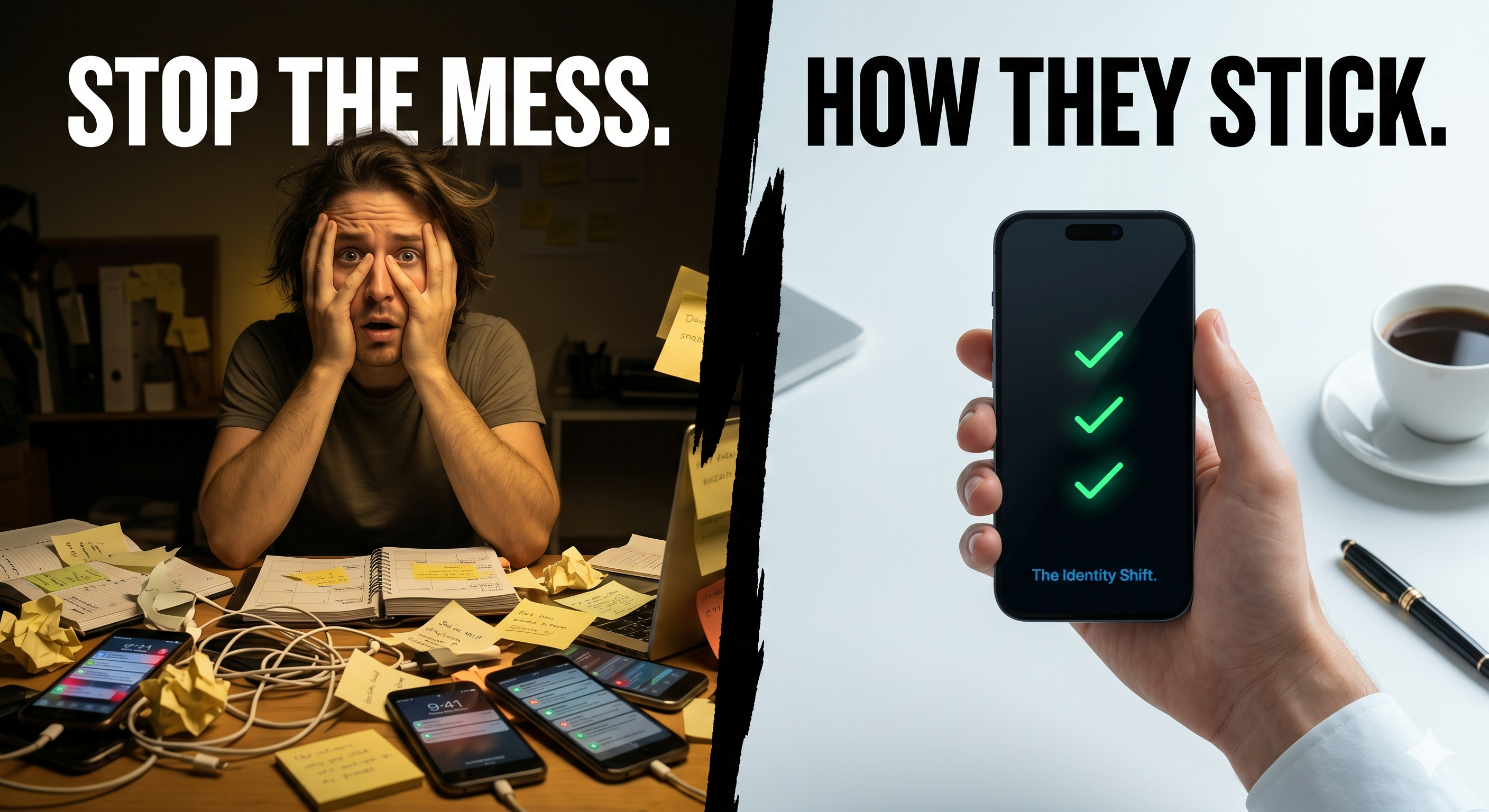
Almost everyone has tried a task manager. Most have tried several. The pattern is so common it is almost a rite of passage: a burst of enthusiasm, a beautifully set-up system, a week or two of diligent use, and then a slow fade back to sticky notes, mental lists, and the quiet hope that you will remember the important things.
But not everyone fades. There is a minority of people for whom a task manager becomes permanent infrastructure, as automatic as checking the time, something they would feel genuinely lost without. They are not more disciplined than you in some general, heroic sense. They are not better people. They have simply, often without naming it, done a handful of things differently at the psychological level, and those differences are what separate a tool that lasts from one more abandoned app.
This article is about those people. Not what app they use, but how their minds relate to the system. Because the durable difference between sticking and quitting is almost never the software. It is psychology. And the good news is that the psychology is learnable. Once you can see what the people who stick are actually doing, you can do it too.
The core insight: sticking is identity, not effort
Start with the deepest difference, because everything else grows out of it. People who abandon task managers treat using one as a thing they are doing. People who stick treat it as a part of who they are.
This sounds like a small semantic distinction. It is not. It is the whole game. When something is a thing you are doing, it draws on motivation and willpower, both of which are finite and both of which fade. Every day you have to decide, on some level, to keep doing it, and decisions are exhausting. Eventually a hard day comes, the motivation is not there, and the decision goes the other way. That is how most systems die. Not in a dramatic quit, but in a quiet day where you just did not open it, and then another, and then it was over.
When something is part of who you are, it stops requiring that decision. People who stick have crossed a line where they no longer think of themselves as someone trying to use a task manager. They think of themselves as someone who plans, someone who keeps track, someone whose life runs through a system. The behavior flows from the identity, and identity does not need daily willpower to sustain it. You do not summon motivation to brush your teeth or to put on a seatbelt. You just do it, because that is the kind of person you are.
This is why telling people to be more disciplined almost never works. You cannot brute-force a behavior into permanence through effort, because effort runs out. What lasts is a shift in self-image, where the system becomes part of how you see yourself rather than a project you are managing. Everything that follows in this article is really a description of how that shift happens, and how the people who stick make it, often by accident, where everyone else does not.
They lowered the stakes before they raised the consistency
Here is a paradox that trips up almost everyone who quits. The more ambitious your system, the more likely you are to abandon it. The people who stick tend to start embarrassingly small, and that is precisely why they last.
When you set up a brand-new task manager in a burst of motivation, the temptation is to capture everything. Every project, every someday-maybe, every area of your life, all tagged and categorized and organized into an elaborate structure. It feels productive. It feels like finally getting your life together. And it is one of the most reliable ways to guarantee you will quit.
The problem is psychological load. A massive, intricate system is heavy to maintain, and the heavier it is, the more friction stands between you and using it on a low-energy day. Worse, an ambitious system creates a brittle standard. You have implicitly told yourself that to use this properly, you must keep all of it current. The first time you fall behind, and you will, the gap between the pristine system you built and the messy reality of your actual usage becomes painful. That gap produces a specific feeling: the system is reproaching you. And people do not keep using tools that make them feel guilty. They quietly close the tab.
People who stick avoid this trap, usually without theorizing about it. They start with almost nothing. A few tasks. One simple list. They let the system prove useful at a tiny scale before they trust it with more. By keeping the early stakes low, they keep the early friction low, and low friction is what lets a behavior repeat often enough to become automatic. The elaborate structure, if it ever comes, arrives later and organically, built on a habit that already exists rather than imposed on a habit that does not. They earned complexity instead of importing it.
This is the deeper logic behind every "keep it simple" piece of advice you have ever ignored. Simplicity is not aesthetic preference. It is survival strategy for a new habit. A small system you actually use beats a perfect system you abandon, every single time, and the people who stick understood this in their bones even if they never said it out loud.
They attached it to something that already exists
A new behavior floating on its own is fragile. People who stick almost always anchored their task manager to something already solid in their day, and that anchoring is one of the most powerful psychological mechanisms in habit formation.
Think about why brushing your teeth is automatic. It is not just repetition. It is welded to other stable moments: waking up, going to bed. Those existing anchors pull the behavior along with them. You do not remember to brush your teeth through an act of will. The context triggers it. This is the principle behind what psychologists call implementation intentions and habit stacking: a new behavior sticks far better when it is tied to a specific existing cue rather than left to float on good intentions.
People who abandon task managers usually leave the behavior unanchored. They intend to use it, vaguely, at some point in the day, whenever they remember. But "whenever I remember" is not a trigger, it is a hope, and hope loses to a busy day. With no fixed cue, opening the system depends entirely on motivation, and we already know how that ends.
People who stick, by contrast, bound the behavior to a real anchor. They check their system the moment they sit down at their desk, every morning, before anything else. They review it with their first coffee. They plan tomorrow as the last thing before closing the laptop. The specific anchor varies, but the structure is the same: an existing, stable moment becomes the trigger, and the trigger does the remembering so willpower does not have to. Over time the cue and the behavior fuse, and checking the system becomes as automatic as the anchor it rides on. They stopped relying on memory and started relying on context, which is far more reliable than memory ever is.
They felt the payoff fast enough to believe in it
Habits form around reward. If a behavior does not pay off, or pays off so slowly you cannot feel it, your brain has no reason to keep doing it. A crucial difference in people who stick is that they experienced a real, felt benefit early, and that early reward is what carried them through the fragile first weeks.
The benefit of a task manager is real but it can be slow and abstract, which is dangerous for a young habit. The deep payoff, a calmer mind, fewer dropped balls, a life that runs more smoothly, accrues over months. But your brain forms habits on a much shorter timescale. It wants to know, soon, whether this thing is worth the effort. If all it gets in the first weeks is more work with no obvious return, it concludes the behavior is not worthwhile and lets it lapse. This is the quiet killer behind a lot of abandonment. The system had not yet had time to pay off, so it died before the payoff could arrive.
People who stick get over this hump, and usually it is because they experienced one concrete win early. They captured a task they genuinely would have forgotten, and it got done, and they felt the relief of that. They sat down to a planned day and noticed how much smoother it ran than an unplanned one. They had the specific experience of their head feeling lighter because something nagging was now safely written down. That felt moment of "oh, this actually helps" is the reward that wires the habit in. It gives the brain the evidence it needs to keep going.
There is a practical pattern here worth naming. People who stick tend to use the system first for the thing that hurts most, the area where forgetting carries a real cost or causes real stress. That maximizes the early payoff, because the relief is sharpest where the pain was sharpest. People who quit often do the opposite, dutifully logging trivial tasks that would have been fine in their head, so the system feels like pure overhead with no felt return. The lesson is to point the tool at something that genuinely matters to you early, so the benefit is impossible to miss, and let that felt win buy the time the deeper benefits need to accumulate.
They made peace with falling behind
This may be the single most underrated difference, and it is almost entirely about emotion. Everyone falls behind on their system sometimes. The people who quit treat falling behind as failure. The people who stick treat it as normal, and that difference in interpretation decides whether the habit survives its inevitable rough patches.
Picture the moment. You have been using your task manager well, and then life happens. A busy week, a trip, an illness, a stretch where you just stopped keeping up. You come back to a system that is now out of date, full of overdue items and stale entries. This moment arrives for everyone, without exception. What you do next determines everything.
The person who quits looks at that messy, out-of-date system and feels they have blown it. The streak is broken, the system is no longer pristine, and the gap between the ideal and the reality feels like proof that they failed at this, like every other time. That feeling of having failed is intolerable, so they avoid the source of it, which means avoiding the system, which means the lapse becomes permanent. The mess did not kill the habit. The story they told themselves about the mess did.
The person who sticks looks at the same mess and feels almost nothing about it. They expected this. Falling behind is not a referendum on their character, it is just a normal event, like dishes piling up in a sink. You do not conclude you have failed at life because there are dishes in the sink. You just wash them. So they sit down, clear out what is stale, update what matters, and carry on, with no drama and no guilt. The system absorbs the disruption and keeps going, because the person's relationship to it is forgiving rather than perfectionist.
This is, at bottom, a difference in self-talk and emotional maturity. Perfectionism, which feels like high standards, is actually one of the great destroyers of lasting habits, because it makes every imperfection feel like a verdict and every lapse feel like a reason to quit. The people who stick have a more durable, more compassionate relationship with their own inconsistency. They have internalized that the goal was never perfect use. The goal was to keep coming back. And coming back after falling behind, repeatedly and without self-punishment, is the entire skill. The streak does not matter. The return does.
They stopped looking for a better one
There is a restless behavior that quietly guarantees you will never stick with anything, and the people who last have given it up. People who quit are often perpetually shopping for a better system. People who stick committed to one and stopped looking.
The endless search feels responsible. You are optimizing, finding the best tool, refusing to settle for less than ideal. But underneath, constant tool-switching is corrosive, because a task manager only becomes valuable once you have committed to it long enough for it to accumulate your life and become woven into your habits. Every switch resets that to zero. You are perpetually in the fragile first-week phase, where the system holds little, the habit is not formed, and the payoff has not arrived. No tool can ever prove itself if you never give one the months it needs.
The switching also has a hidden emotional driver. Often the search for a better system is really a search for a version of the tool that will make the behavior effortless, that will finally remove the friction of having to maintain anything. That tool does not exist, because the friction is not in the software. It is in the nature of the habit. Believing the next app will fix it keeps you from doing the actual work, which is committing to one imperfect tool and building the habit around it. The shopping is a sophisticated form of avoidance, and it feels like diligence the whole time it is sabotaging you.
People who stick made a decision that looks almost careless from the outside: they picked something good enough and quit looking. They understood, explicitly or not, that commitment itself is the active ingredient, that the value comes from depth of use over time rather than from finding the theoretically perfect features. By staying put, they let the system accumulate their projects, their history, their habits, until switching would mean abandoning something genuinely valuable. The tool became theirs in a way no freshly downloaded app ever can be. They stopped treating the choice of tool as the important decision, because they realized the important decision was to commit at all.
They use it to think, not just to store
One last difference is subtle but powerful. People who quit tend to treat a task manager as a passive storage bin, a place to dump tasks. People who stick use it as an active thinking tool, and that changes their entire relationship to it.
When a system is only storage, it is mostly a chore. You put things in, the list grows, and a growing list of obligations is faintly oppressive. There is no real engagement, no thinking, just accumulation. A bin of undone tasks is not something you look forward to opening. It is something you avoid, because it mostly reminds you of everything you have not done. Storage-only systems have a way of becoming guilt machines, and guilt machines get abandoned.
People who stick use the system as a place to actually think through their work and their days. They use it to decide what matters, to shape what tomorrow should look like, to get a clear view of their commitments so they can choose deliberately rather than react. The act of planning in the system is itself valuable to them, separate from the storage. It is where they do the thinking that makes their days coherent. That makes opening the system an act of taking control rather than confronting a pile, and a tool that gives you a feeling of control is one you return to willingly.
This reframe, from passive bin to active thinking space, transforms the emotional texture of the whole habit. The system stops being a nagging list of debts and becomes the place where you make sense of your life and steer it. People do not abandon tools that make them feel clear and in command. They abandon tools that make them feel buried. The people who stick built, knowingly or not, a relationship of the first kind.
Putting it together: how to become someone who sticks
These differences are not personality traits you either have or lack. They are approaches, and you can adopt them deliberately. Here is the pattern, drawn from everything above.
Start far smaller than feels satisfying, and let low friction protect the young habit until it can stand on its own. Anchor the behavior to a fixed moment you already have, so context does the remembering instead of willpower. Point the tool at something that genuinely matters to you early, so you feel a real payoff fast enough to believe in it. Expect to fall behind, and treat it as a sink full of dishes rather than a personal failure, returning without guilt every time. Commit to one good-enough tool and stop shopping, so it has the months it needs to accumulate your life and become valuable. And use it to think and steer rather than only to store, so opening it feels like taking control instead of facing a pile.
Underneath all of it is the identity shift. Every one of these approaches is really a way of helping the behavior move from something you are effortfully doing to something you simply are. The small start, the anchor, the early win, the forgiveness, the commitment, the thinking, they all serve to repeat the behavior gently and often enough, with low enough friction and high enough reward, that it sinks below the level of decision and becomes part of how you see yourself. That is the moment you stick. Not when you finally find enough discipline, but when you stop needing discipline because the system has become part of who you are.
The people who made a task manager permanent are not a different species. They just crossed that line, usually without a map. Now you have the map. You can cross it on purpose.
Takeaways
The durable difference between sticking and quitting is psychological, not technical. It is almost never about the app and almost always about how your mind relates to the system.
People who stick treat using a system as part of their identity rather than a thing they are effortfully doing. Identity sustains behavior without the daily willpower that always eventually runs out.
The specific approaches that make it last: start far smaller than feels satisfying, anchor the behavior to an existing daily cue, aim it at something that matters so you feel a payoff fast, make peace with falling behind instead of treating it as failure, commit to one tool and stop shopping, and use the system to think rather than only to store.
None of these are innate traits. They are learnable approaches, and together they move the behavior below the level of decision until it becomes automatic, which is the real definition of sticking.
FAQ
Why do most people abandon task managers so quickly?
Usually because the behavior never moved past relying on motivation and willpower, both of which fade. Common accelerants include building a system too elaborate to maintain, leaving the habit unanchored to any daily cue, not feeling a real payoff before the brain loses interest, and treating the first lapse as failure. The tool is rarely the actual problem.
What do people who stick with a task manager do differently?
They treat the system as part of their identity rather than a project, start small to keep friction low, anchor the habit to an existing daily moment, point the tool at something that matters so they feel an early benefit, forgive themselves for falling behind, commit to one tool instead of constantly switching, and use the system to think and plan rather than only to store tasks.
How long does it take for using a task manager to become a habit?
It varies by person and by how consistently the behavior is repeated, but the fragile early weeks are the critical window. The deep benefits accrue over months, while the brain decides much sooner whether the behavior is worth keeping. That is why feeling a concrete payoff early, and not quitting during a lapse, matters so much for getting the habit to take hold.
Why does starting with a simple system help it stick?
Because a young habit survives on low friction. A small, simple setup is easy to maintain on a low-energy day and does not create a brittle standard you feel guilty for failing to keep up. An elaborate system is heavy to maintain and makes the inevitable first lapse feel like failure, which is when most people quit. Complexity is better earned over time than imposed at the start.
Is falling behind on my task manager a sign I should quit?
No, and believing it is one of the main reasons people give up. Everyone falls behind eventually. The people who stick treat it like dishes piling up in a sink, something normal to clear without drama, rather than a verdict on their character. The skill that actually matters is returning after a lapse without self-punishment, not maintaining a perfect unbroken streak.
Why does switching between task manager apps stop me from sticking?
Because a system only becomes valuable once you have committed to it long enough to accumulate your tasks, history, and habits, and every switch resets that to zero. Constant switching keeps you permanently in the fragile first-week phase where nothing has had time to pay off. Often the search for a better app is really avoidance of the real work, which is committing to one good-enough tool and building the habit.
Does the choice of task manager app actually matter?
Less than people think. Beyond meeting your basic needs, the specific tool matters far less than your psychological relationship to it. Commitment, consistency, and how you use the system determine whether it lasts. A good-enough tool used deeply and habitually will always outperform a theoretically perfect one you abandon while shopping for the next thing.
Date-based AI Task Manager
Plan smarter, execute faster, achieve more
Create tasks in seconds, generate AI-powered plans, and review progress with intelligent summaries. Perfect for individuals and teams who want to stay organized without complexity.
Get started with your preferred account