
Charlie Munger's Productivity Secret: Avoid Stupidity Instead of Chasing Brilliance
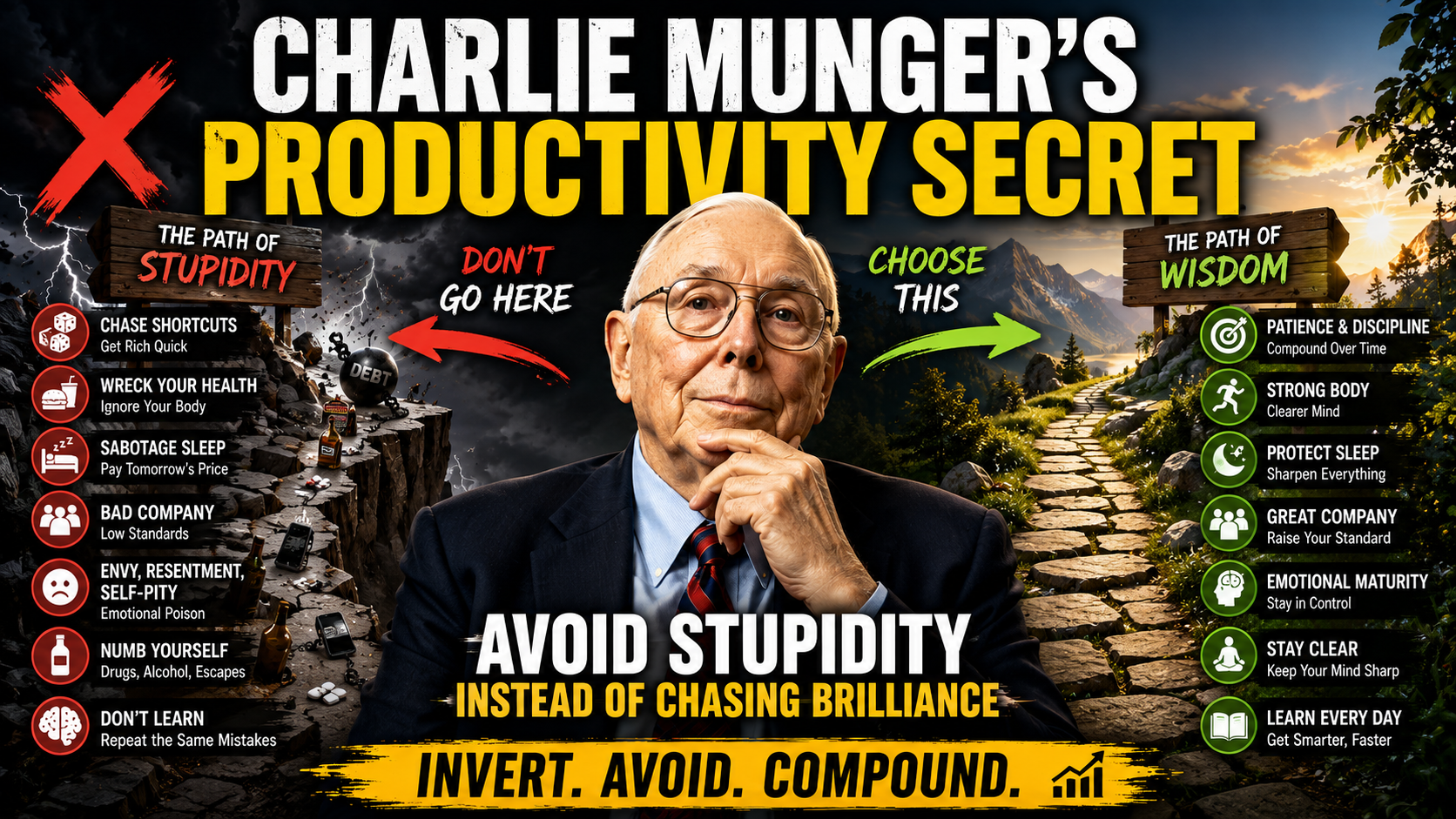
Most productivity advice is obsessed with addition. Add a new app, a new routine, a new morning ritual, a new system that will finally turn you into a machine. Charlie Munger spent his life pointing in the opposite direction, and he had the track record to back it up.
Munger, the long-time partner of Warren Buffett at Berkshire Hathaway, was not interested in being brilliant. He was interested in not being stupid. His view was that you do not need a high IQ or rare genius to do well in life. You mostly need to consistently avoid the standard, predictable ways people destroy themselves, and then let time do the rest. Stay rational, sidestep the obvious mistakes, and you end up far ahead of people far more talented who keep stepping on the same rakes.
This is one of the most useful and least applied ideas in all of productivity. You probably do not have a brilliance problem. You have a stupidity problem, in the precise, non-insulting sense Munger meant it: a handful of self-inflicted habits that quietly drain your energy, scramble your judgment, and undo your best work. Fix those and you do not need to be a genius. You just need to stop sabotaging yourself.
This article lays out the principle Munger built his thinking on, then gives you a clear list of the stupidities worth avoiding, all through the lens of staying productive and effective over a long life.
The principle: invert, always invert
Munger's whole approach rests on a mental move he borrowed from the mathematician Carl Jacobi: invert, always invert. When a problem is hard to solve facing forward, turn it around and solve it backward.
Applied to a life, the question most people ask is "how do I become successful and productive." Munger's instinct was to flip it. Ask instead: what reliably produces a wasted, ineffective, miserable life? Make that list, then systematically avoid everything on it. Whatever is left tends to go well on its own.
He had a darkly funny way of summarizing it. He liked to joke that all he wanted to know was where he was going to die, so that he could simply never go there. It sounds like a throwaway line, but it carries his entire philosophy. You do not need a perfect map of the road to success. You need a reliable map of the cliffs, so you can stay away from them.
There is a reason this works better than chasing brilliance. Brilliance is rare, hard to summon on demand, and easy to overrate. Avoiding stupidity is available to anyone, every single day, and it compounds. The person who never blows themselves up does not need spectacular wins. They just need to stay in the game while everyone around them periodically detonates. Munger believed temperament and rationality mattered far more than raw intelligence, precisely because the smartest people in the room are often the ones who talk themselves into the dumbest decisions.
So the productivity version of his idea is simple. Stop asking only what you should add. Start asking what you should refuse to do. Below is the list of refusals that does the most work.
The stupidities worth avoiding
These are not exotic mistakes. That is the point. They are the ordinary, predictable, self-inflicted ones that almost everyone knows are bad and does anyway. Munger's edge was not knowing secrets. It was actually avoiding the things everyone already knows to avoid.
1. Chasing the shortcut
Munger was relentlessly hostile to gambling, speculation, and every flavor of get-rich-quick thinking. He saw it as a tax on people who could not resist the fantasy of easy money, and he treated the impulse itself as a kind of poison, because of what it does to your judgment.
The productivity cost is not just the money. It is the wiring. Chasing shortcuts trains your brain to crave fast, unpredictable rewards, which is the exact opposite of the patient, boring consistency that actually produces results. Once you are hooked on the rush of the long shot, the slow work that builds real skill and real progress starts to feel unbearable. You become someone who needs a jackpot to feel motivated, and almost nothing worthwhile pays out like a jackpot.
This applies well beyond literal gambling. It is the side hustle you abandon after a week because it did not explode, the constant tool-switching in search of a magic productivity hack, the refusal to do unglamorous work because it does not feel like winning. Munger's answer was to find the slow, reliable path and walk it without drama. If gambling has crossed from a habit into a compulsion, that is a real thing that deserves real help rather than willpower, and worth treating as seriously as any other health issue. For everyone else, the rule is simpler: distrust anything that promises a lot for a little.
2. Wrecking your physical baseline
Munger lived to ninety-nine, and while he was not a fitness obsessive, he understood something most ambitious people ignore: your mind runs on your body, and you cannot out-think a neglected one.
This is the stupidity hiding in plain sight. You treat your body as a vehicle for getting work done and then feed it in ways that sabotage the work. Junk food and constant sugar produce energy crashes, foggy afternoons, and the kind of low-grade sluggishness that makes everything harder than it should be. You sit motionless for ten hours and wonder why your focus and mood are deteriorating. None of this is a mystery. It is cause and effect.
You do not need a perfect regimen or a rigid plan, and chasing one is its own trap. The Munger move is to avoid the obvious self-harm. Stop running your brain on fuel that crashes it. Move your body enough that it does not seize up. The goal is not optimization, it is simply refusing to undermine the instrument you do all your thinking with. The returns on not trashing your physical baseline are enormous, and almost everyone leaves them on the table.
3. Sabotaging your own sleep
If there is a single dumbest self-inflicted productivity wound, this is it. You stay up too late, scrolling or working badly, then face the next day with a degraded brain, and you do it on purpose, night after night.
Sleep is when your brain consolidates what you learned, clears the day's waste, and rebalances the chemistry that governs your mood and focus. Shortchange it and every cognitive function you rely on gets worse. Your attention narrows, your judgment slips, your emotional control frays, and your willpower collapses, which then makes you more likely to do all the other stupid things on this list. Bad sleep is the mistake that multiplies every other mistake.
The Munger logic is brutal in its simplicity. You would never knowingly choose to work with a worse brain. Sacrificing sleep is choosing exactly that, in advance, for tomorrow. Protecting your sleep is not soft self-care. It is refusing to handicap yourself before the day even starts. It is among the highest-leverage refusals available, and it costs nothing but the discipline to stop.
4. Keeping bad company
Munger and Buffett both hammered a point most people underestimate: you become like the people you spend time with. Their advice was to associate with people better than you, people of high character and good judgment, and to steer clear of those of low integrity no matter how useful they seem.
This is not about social climbing. It is about the slow, almost invisible pull of your environment. The people around you set your baseline for what is normal. If your circle treats discipline as a joke, complains constantly, glorifies cutting corners, or drags every conversation toward cynicism and gossip, you will drift in that direction without deciding to. Their habits become your habits. Their excuses become your excuses. Their ceiling becomes your ceiling.
The productivity damage is real and compounding. It is hard to do focused, ambitious work while marinating in a culture that quietly punishes it. Munger's answer was deliberate. Spend less time with people who pull you down and more with people who raise the standard, even if that means spending more time alone in the meantime. One of the most powerful things you can do for your output is to be honest about which relationships are draining you and which are lifting you, and to adjust accordingly.
5. Letting envy, resentment, and self-pity run you
This is where Munger's idea of stupidity gets personal, and where most people fail. He considered certain emotional habits to be among the surest ways to ruin a life, and he was especially harsh on three: envy, resentment, and self-pity.
Envy he thought was uniquely foolish, because unlike other vices it offers no pleasure at all. It just makes you miserable about someone else's good fortune while doing nothing for your own. Resentment keeps you chained to whoever wronged you, replaying old grievances instead of moving forward. And self-pity, which he regarded with real contempt, traps you in a story where you are the helpless victim and nothing is your responsibility, which is the most disempowering position a person can occupy.
The productivity cost of these is enormous and largely hidden. Every hour spent comparing yourself to others, nursing a grudge, or feeling sorry for yourself is an hour of energy and attention pulled away from the work in front of you. Worse, these emotions corrode your judgment and your relationships over time. Emotional maturity, in Munger's sense, is not about being warm or expressive. It is about refusing to let these specific destructive emotions drive your behavior. It is choosing responsibility over victimhood, action over grievance, and your own progress over the scoreboard of other people's lives. Master this one and you protect everything else.
6. Numbing yourself
Munger was blunt about a short list of things that reliably destroy capable people, and substances were near the top. He repeatedly warned that a few specific habits ruin lives with grim predictability, alcohol and drugs prominent among them, alongside taking on dangerous debt.
The productivity angle is direct. Anything you use to regularly numb out, dull your mind, or escape your life is borrowing energy and clarity from your future self at a terrible interest rate. It is not only the immediate impairment. It is the slow erosion of the sharpness, drive, and reliability that effective work depends on. A mind you keep fogging is a mind you cannot fully use.
This extends past the obvious substances to any compulsive escape that has its hooks in you, the endless scroll, the binge, the anything-to-avoid-feeling-this. The Munger principle is to be honest about what you are using to numb out and to take it seriously, because these patterns rarely stay small. As with gambling, if something has become a genuine dependency, that is a matter for real support, not self-criticism. The broader rule stands either way: protect your clarity, and be deeply suspicious of anything you reach for to escape rather than to genuinely rest.
7. Refusing to learn from mistakes, especially other people's
Munger admired Charles Darwin for a particular habit: actively hunting for evidence that he was wrong, and paying special attention to facts that contradicted his own conclusions. Munger thought this was rare and immensely valuable, because the natural human tendency is the exact opposite. We cling to being right, ignore disconfirming information, and defend our existing beliefs like they are part of our body.
The stupidity here is twofold. First, refusing to learn from your own mistakes means you repeat them, which is the slowest and most painful way to live. Second, and more importantly to Munger, refusing to learn from other people's mistakes throws away the cheapest education available. Other people have already made nearly every error you could make and paid the price for it. You can study those failures and avoid the cost entirely. Choosing not to, out of arrogance or laziness, is leaving free wisdom on the table.
For productivity this means building a habit of honest review. Look back at what went wrong and ask why without flinching. Stay curious about how things fail. Read about the wreckage of others not as gossip but as a map of cliffs to avoid. The person who learns vicariously from a thousand mistakes outperforms the person who insists on making all thousand personally.
How to actually use this
A list of stupidities does nothing if you only nod at it. The Munger approach is to turn it into a practice, and the practice is mostly subtraction.
Start by writing your own anti-stupidity list. Invert your goals. Whatever you are trying to achieve this year, ask what would reliably wreck it, and write those failure modes down plainly. For most people the honest list looks a lot like the one above, with a few personal additions only you know about. That list is more useful than any goal, because it is specific, it is yours, and it points directly at what to stop.
Then treat your avoid-list as more important than your to-do list. A to-do list tells you what to add to a day that may already be sabotaged. An avoid-list protects the conditions that make any of it possible. On a normal day, most of your real progress comes not from a heroic act of brilliance but from simply not doing the handful of things that would have ruined it. You stayed off the shortcut, you slept, you did not let envy hijack your afternoon, you kept clear of the people and habits that drag you down. That is a productive day, and almost none of it required genius.
Finally, trust the compounding. This is the part that feels too simple to work, which is exactly why it works. Avoiding stupidity is unglamorous and produces no dramatic moments, so people abandon it for flashier strategies. But the person who consistently does not blow themselves up, day after day and year after year, ends up somewhere remarkable, while more talented people keep resetting to zero. Munger's long life was the proof of concept. He was not the flashiest mind in finance. He was one of the hardest to knock out of the game, and over enough time that is what wins.
Takeaways
Munger's central idea was that you do not need brilliance to do well, you need to consistently avoid the standard ways people ruin themselves. Avoiding stupidity beats chasing genius because it is available to anyone, every day, and it compounds.
The tool is inversion. Instead of asking only how to succeed, ask what reliably produces failure, then refuse to do those things. Map the cliffs and stay away from them.
The stupidities worth avoiding are mostly ordinary and self-inflicted: chasing shortcuts, wrecking your physical baseline, sabotaging your sleep, keeping bad company, letting envy and resentment and self-pity drive you, numbing yourself, and refusing to learn from mistakes.
Turn it into practice by writing your own anti-stupidity list, treating it as more important than your to-do list, and trusting that not blowing yourself up, repeated over years, is what actually wins.
FAQ
What did Charlie Munger mean by avoiding stupidity?
He meant that consistently sidestepping the obvious, predictable ways people harm themselves matters more than any rare stroke of brilliance. His view was that most people fail not from a lack of talent but from repeating standard mistakes, so the reliable path to doing well is to identify those mistakes and simply refuse to make them.
What is inversion and how do I use it for productivity?
Inversion is solving a problem backward. Instead of asking how to become productive, you ask what reliably destroys your productivity, list those things, and then systematically avoid them. It works because failure modes are usually more predictable and easier to spot than the path to success, so eliminating them clears the way almost automatically.
Why does avoiding mistakes beat chasing success?
Because brilliance is rare and hard to produce on command, while avoiding self-inflicted damage is available every single day to anyone. The person who never blows themselves up stays in the game and lets progress compound, while more talented people who keep making big mistakes repeatedly reset to zero. Over a long enough timeline, staying in the game wins.
What habits did Charlie Munger consider most destructive?
He was especially wary of speculation and gambling, of envy, resentment, and self-pity, and of a few reliable life-wreckers such as alcohol, drugs, and dangerous debt. He also thought that refusing to learn from mistakes, particularly other people's, was a serious and avoidable error.
How does poor sleep affect productivity?
It degrades nearly everything your work depends on. Sleep is when your brain consolidates learning, clears waste, and rebalances mood and focus, so cutting it short narrows your attention, weakens your judgment and willpower, and frays your emotional control. Worse, it makes you more likely to fall into other bad habits, which is why poor sleep tends to multiply every other mistake.
Why does who I spend time with affect my productivity?
Because your environment quietly resets your sense of what is normal. The habits, standards, and attitudes of the people around you pull you in their direction over time, often without your noticing. A circle that dismisses discipline or glorifies cutting corners makes focused, ambitious work harder, while company that raises the standard makes it easier.
What does emotional maturity have to do with getting things done?
A great deal, in Munger's sense of the term. He saw envy, resentment, and self-pity as destructive emotional habits that drain energy, distort judgment, and trap you in unproductive stories. Emotional maturity here means refusing to let those emotions drive your behavior, choosing responsibility over victimhood and action over grievance, which protects the focus and stability that real work requires.
Is it bad to want to get rich quickly?
The danger is less the goal than the wiring it creates. Chasing fast, unpredictable rewards trains your brain to crave jackpots and makes the patient, consistent work that builds real results feel unbearable. Munger's preference was to find a slow, reliable path and walk it without drama, treating anything that promises a lot for very little with deep suspicion.
Date-based AI Task Manager
Plan smarter, execute faster, achieve more
Create tasks in seconds, generate AI-powered plans, and review progress with intelligent summaries. Perfect for individuals and teams who want to stay organized without complexity.
Get started with your preferred account