
Why Some People Quit a Task Manager After a Few Days (And How to Make It Finally "Click")
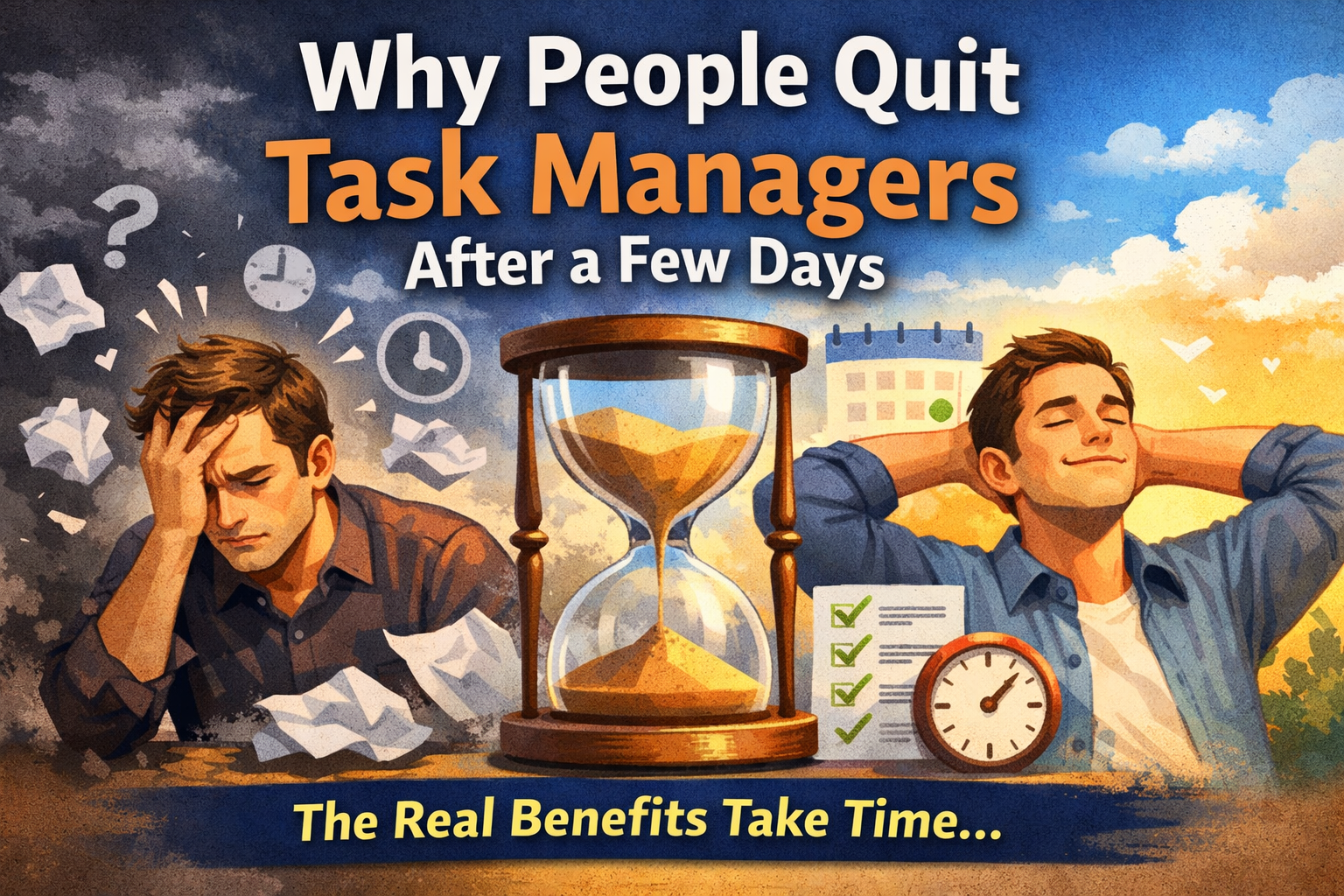
Most people don’t quit a task manager because the app is bad.
They quit because they expected a miracle in 72 hours.
A task manager won’t change your life in a few days—because your life didn’t become messy in a few days either.
The real power shows up later, when you’ve built:
- a clear daily schedule
- a habit of capturing tasks outside your brain
- a weekly/monthly review loop that helps you improve instead of repeat the same chaos
That’s when the tool stops being “another app” and starts becoming your external memory—so you can finally breathe.
1) The most common reason: people expect instant results
A task manager feels like it should work immediately:
“Okay, I wrote tasks down. Why am I still stressed?”
Because stress isn’t just “too many tasks.”
Stress is usually:
- unclear priorities
- unfinished loops
- too many open tabs in your mind
- no time boundaries
- no review process to reduce future mess
A task manager doesn’t magically remove all that in a weekend.
It gives you the infrastructure to do it—if you keep using it.
2) A task manager isn’t productivity… it’s memory
Here’s the shift that changes everything:
A task manager is not a motivation tool.
It’s a limited-memory problem solver.
Humans have terrible working memory for modern life.
When you keep everything in your head, your brain runs a background process all day:
- “don’t forget to reply…”
- “I have to pay that…”
- “I need to remember to do this next week…”
- “what was that thing I promised…?”
That constant mental pinging is exhausting.
A task manager is how you stop relying on your brain as a storage device.
When your tasks are captured and trusted, you can relax—because you’re not holding the universe in RAM.
3) Most people don’t quit the app — they quit the capture habit
In the first few days, people tend to do one of two things:
Option A: they “organize” too much
They build a perfect structure:
folders, tags, systems, templates…
…and then they don’t actually capture consistently.
Option B: they capture, but not enough to trust it
They add 12 tasks, but keep 40 in their head.
So the brain says:
“This app is not reliable. I still need to remember things.”
And once you don’t trust the system, you stop using it.
The goal in week one isn’t organization.
The goal is trust.
4) The real payoff comes from time + review loops
The “magic” of a task manager doesn’t come from writing tasks.
It comes from reviewing patterns over time:
- What keeps slipping?
- What takes longer than you think?
- What tasks are pointless?
- What commitments are draining you?
- What should you stop doing entirely?
You can’t see that in 3 days.
You need at least:
- a few planned days
- a few completed weeks
- a couple monthly reviews
That’s when you start optimizing your workflow like a system.
And that’s when your stress drops, because your life stops being a reaction.
5) Why “clear schedule” matters more than “task list”
A big list doesn’t calm you down.
A list often adds anxiety.
Because the list says:
“Look at all the things you’re not doing.”
What you actually need is:
- today’s plan
- time boundaries
- realistic capacity
- one main outcome
A schedule is what turns tasks into action.
In SelfManager.ai, the idea is simple:
your work should live on the day it will be done.
Not floating in a giant bucket of guilt.
6) The “breathing effect”: when your brain stops buzzing
When your system starts working, you’ll feel something that’s hard to describe until you experience it:
You stop mentally repeating your responsibilities.
That’s the breathing effect.
Because:
- reminders are captured
- future commitments have a place
- small tasks don’t need constant rehearsal
- you’re not afraid you’ll forget
This is what people actually want from a task manager:
not “productivity”.
They want mental quiet.
7) The 10-day rule that prevents quitting
If you want a task manager to work, don’t judge it after 2–3 days.
Use this simple rule:
Commit to 10 days of consistent usage
Not perfect usage. Consistent.
For 10 days:
- Capture everything (small tasks included)
- Plan today each morning (even 3 minutes)
- Do a 10-minute weekly review at the end of the week
After 10 days, you’ll have enough data and momentum to feel the shift.
After 4 weeks, you’ll start seeing pattern-level improvements.
After 2–3 months, it becomes a real system.
How SelfManager.ai is built for the “long game”
Most apps are optimized for quick dopamine:
checklists, streaks, gamification.
SelfManager.ai is built for something more powerful:
- date-centric planning so tasks live where they belong: on the day
- multiple tables per date so your day can be structured by context (work, personal, admin, etc.)
- review loops (weekly/monthly/quarterly summaries) so you improve over time
- AI beside your real work so you can reflect and adjust without leaving your system
Because the app isn’t supposed to “fix your life in a weekend.”
It’s supposed to become your reliable external memory—so your brain can stop carrying everything.
If you quit after 3 days, it doesn’t mean you failed
It usually means you expected the app to do the hard part for you.
The app can’t do the hard part.
But it can make the hard part possible:
- clarity
- planning
- consistency
- review
- improvement
And once you have those, you don’t just get “more productive”.
You get something better:
you get your breathing space back.
Date-based AI Task Manager
Plan smarter, execute faster, achieve more
Create tasks in seconds, generate AI-powered plans, and review progress with intelligent summaries. Perfect for individuals and teams who want to stay organized without complexity.
Get started with your preferred account