
The Hidden Productivity Cost of Spending Too Much Time on Your Computer
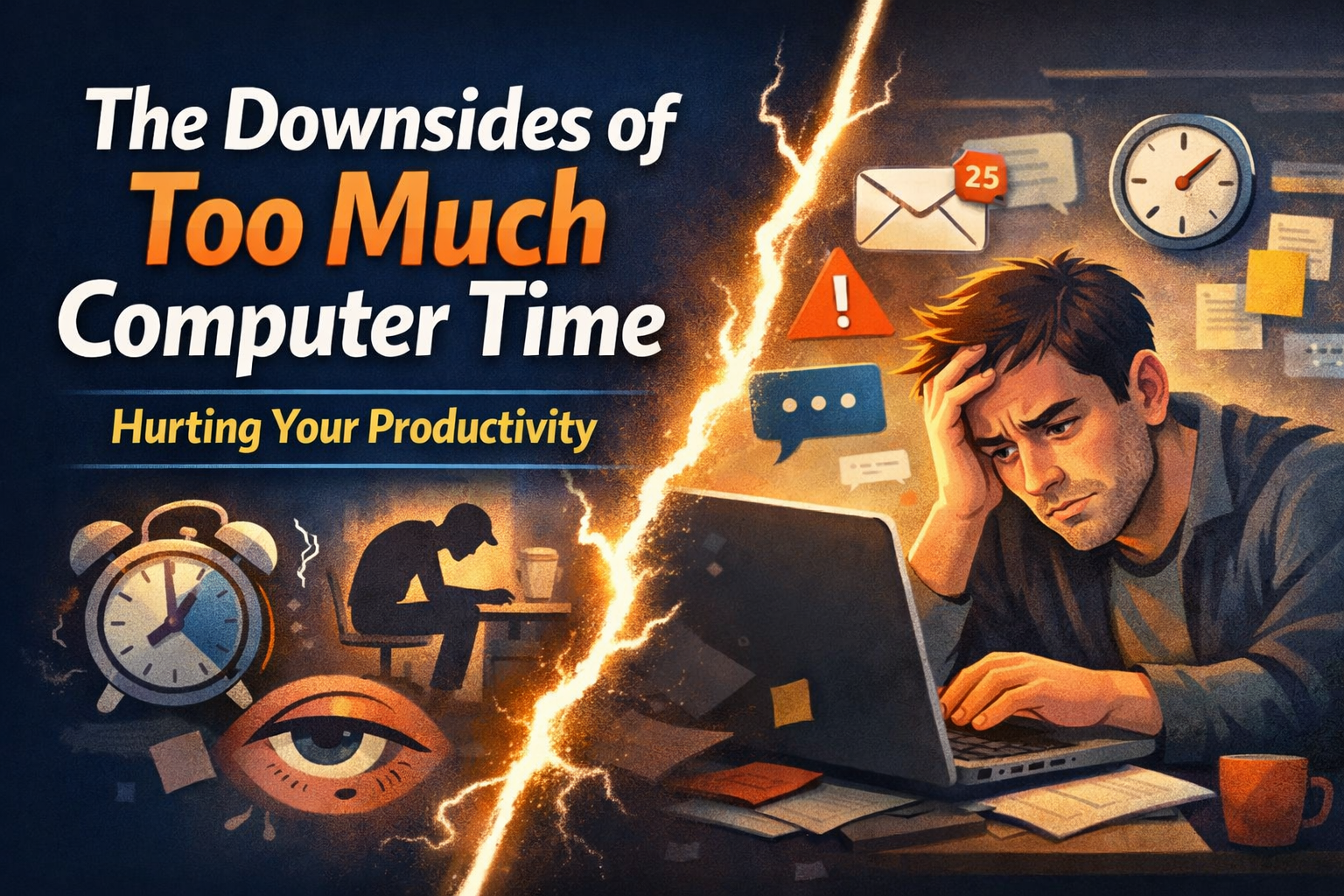
For many knowledge workers, freelancers, founders, and office employees, the computer is the center of daily work.
It is where ideas are written, meetings happen, projects are managed, messages are answered, and businesses are built.
But there is a downside that many people underestimate: spending too much time on your computer can slowly reduce the very productivity you are trying to increase.
At first, more time at the computer can feel like more output. You sit longer, push harder, open more tabs, answer more messages, and try to squeeze more out of the day.
But after a certain point, the relationship flips.
Instead of helping you produce better work, too much screen time can lead to mental fatigue, worse attention, physical discomfort, weaker decision-making, and lower-quality output.
The danger is that this decline often happens gradually. You may still feel “busy,” but your effectiveness starts dropping.
That is why it is important to understand not only how computers help us work, but also how overusing them can hurt our energy, clarity, and long-term performance.
1) Mental fatigue builds up faster than you think
A computer is not just a work tool. It is a machine for constant stimulation.
You may start the day with one task, but within minutes you are exposed to emails, notifications, tabs, messages, updates, headlines, dashboards, and endless opportunities to switch context.
Even if you are technically “working,” your brain may be paying a hidden tax from constant digital input.
Too much time in front of a screen often leads to:
- reduced concentration
- lower patience for deep work
- more mental clutter
- faster decision fatigue
- weaker memory of what you actually worked on
The result is that your day can feel full without feeling meaningful.
You may sit at your desk for 10 hours but only produce 3 or 4 hours of truly strong work.
That gap matters.
Productivity is not about how long you are present in front of a machine. It is about how well your mind can think, prioritize, and execute.
2) Your attention gets fragmented
The longer you stay at your computer, the easier it becomes to drift into reactive work.
Reactive work includes things like:
- checking messages too often
- constantly refreshing email
- jumping between tasks
- doing small, easy actions to feel productive
- responding instead of creating
This kind of work feels active, but it often destroys momentum.
Your brain becomes trained to expect novelty and interruption. Over time, it becomes harder to stay with one difficult task long enough to make real progress.
This is one of the most damaging effects of too much computer time: it changes the way you work.
You become less comfortable with slow, focused, high-value thinking.
And that is a serious problem, because the best professional results usually come from sustained attention, not from rapid digital movement.
3) Your body starts fighting your work
Productivity is not only mental. It is physical too.
Spending too much time on your computer usually means long hours sitting in the same position, staring at the same distance, using the same small hand movements, and putting tension into the neck, shoulders, wrists, and lower back.
Even if the discomfort feels minor at first, it can build into:
- stiffness
- back pain
- neck pain
- wrist strain
- headaches
- lower energy
- reduced willingness to stay engaged
When the body feels worse, the mind usually follows.
You become more distracted, more irritable, less patient, and less able to sustain high-quality effort.
A lot of people think they have a motivation problem, when in reality part of the issue is physical strain from a work setup and rhythm that their body cannot handle well.
4) Screen overload can make your eyes feel tired and your brain feel dull
Long computer sessions can leave you with dry eyes, blurry focus, tension around the forehead, and that strange feeling where your brain is technically awake but no longer sharp.
This matters because visual fatigue affects mental performance more than people realize.
When your eyes are tired, work starts feeling heavier.
Tasks that should take 20 minutes start taking 40. Reading becomes slower. Writing becomes more effortful. Even simple decisions begin to feel annoying.
This is one reason some people confuse exhaustion with laziness.
They are not lazy. They are simply overloaded.
5) Too much computer time can reduce sleep quality
Many people continue using their computer late into the evening, often without a real boundary between work time and recovery time.
That creates two problems.
First, the brain stays stimulated for longer.
Second, the body does not get a clear signal that the workday is over.
When this happens repeatedly, you may notice:
- harder time falling asleep
- lower sleep quality
- feeling mentally tired the next morning
- needing more caffeine just to feel normal
- starting the day already slightly drained
This becomes a productivity trap.
You stay on the computer too long, which hurts sleep, which hurts next-day focus, which makes you slower, which makes you stay on the computer even longer.
That cycle can quietly damage performance for weeks or months.
6) You can confuse screen time with real progress
One of the biggest dangers of computer-based work is that it creates a strong illusion of productivity.
When you are typing, clicking, reading, researching, replying, scrolling through documents, adjusting designs, or organizing tabs, it feels like something important is happening.
Sometimes it is.
But sometimes it is just movement without meaningful output.
Too much time on your computer can make you forget to ask the most important question:
What did I actually finish?
Without that question, it becomes easy to spend entire days inside digital activity while making very little progress on the work that truly matters.
That is why structured review matters.
It helps separate effort from results.
7) Your creativity can drop when you never step away
Many good ideas do not appear while you are forcing them at your desk.
They appear during a walk, during rest, during a shower, during a quiet moment, or after stepping away from the screen.
When you spend too much time on your computer, you reduce the amount of space your mind has to process, connect ideas, and think more naturally.
Constant input leaves little room for reflection.
And reflection is often where better strategy, better writing, better solutions, and better priorities come from.
Sometimes the most productive thing you can do is leave the computer for 10 minutes and let your brain breathe.
8) You may become more anxious without realizing why
Too much time on your computer can also increase a subtle sense of pressure.
Why?
Because the computer is often where unfinished work lives.
Unread messages, pending tasks, overdue items, open tabs, admin work, alerts, requests, deadlines, and comparison with others can all exist in the same space.
When you spend too long inside that environment, your brain may stay in a low-grade stress state.
Even if you are not consciously panicking, you may feel:
- mentally crowded
- slightly restless
- unable to relax fully
- guilty when not working
- overwhelmed by the volume of things on screen
This is terrible for sustained productivity.
A stressed brain does not plan clearly. It reacts.
9) Longer hours often reduce the quality of decisions
Good work depends on good decisions.
What matters most today?
What can wait?
What should be ignored?
What deserves deep focus?
What is just noise?
When you spend too many hours at the computer, decision quality usually declines.
You become more likely to:
- overcomplicate simple tasks
- procrastinate on important work
- say yes to too many things
- choose easy work over valuable work
- continue working when rest would help more
In other words, you may still be working hard, but no longer working wisely.
That is a major productivity loss.
10) The real problem is not computers - it is unstructured computer use
Computers are not the enemy.
For many of us, they are essential.
The real issue is spending too much time on them without enough structure, recovery, movement, and reflection.
The goal is not to avoid computer work.
The goal is to make computer work sustainable and effective.
That means using your time at the computer deliberately, instead of letting the computer consume the entire day by default.
How to reduce the productivity damage
The solution is not complicated, but it does require intention.
1) Work in focused blocks
Do not let your day become one long, blurry screen session.
Break your work into focused blocks with short breaks between them. That helps protect concentration and reduces mental fatigue.
2) Define what “done” looks like
Before starting work, identify the few outcomes that would make the day meaningful.
Without this, computer time expands endlessly.
3) Take real breaks away from the screen
Not a tab switch.
Not checking your phone.
Actually stand up, move, walk, stretch, or look away.
That helps reset both mind and body.
4) Reduce unnecessary digital input
Turn off non-essential notifications. Close extra tabs. Keep your workspace simpler.
A cleaner digital environment often leads to a clearer mind.
5) Review your work by results, not hours
Instead of asking, “How long was I at my computer?” ask:
- What did I complete?
- What created value?
- What drained time without helping much?
- What should I do differently tomorrow?
That shift alone can improve productivity a lot.
6) Create a clear end to the workday
If your computer remains open all night, your brain may never fully exit work mode.
A proper shutdown routine helps recovery, sleep, and next-day performance.
Why this matters for long-term productivity
Anyone can push through a few overloaded days.
But long-term productivity is different.
Long-term productivity depends on protecting:
- focus
- clarity
- physical comfort
- sleep
- motivation
- decision quality
- mental freshness
When those decline, your output declines too - even if your screen time increases.
That is why spending too much time on your computer is not a badge of honor.
In many cases, it is a warning sign that the system needs improvement.
The highest performers are not always the people who spend the most time at the screen.
They are often the people who manage their energy, focus, priorities, and recovery better.
Final thought
Your computer can help you build incredible things.
But it can also quietly reduce your effectiveness if you stay attached to it for too long without structure.
More screen time does not automatically mean more progress.
Sometimes it means more fatigue, more distraction, and less clarity.
The goal is not to work less seriously.
The goal is to work more intelligently.
Use the computer as a tool, not as a place to disappear for endless hours.
Because real productivity comes from clear priorities, focused execution, regular review, and enough space for your mind and body to stay strong.
Date-based AI Task Manager
Plan smarter, execute faster, achieve more
Create tasks in seconds, generate AI-powered plans, and review progress with intelligent summaries. Perfect for individuals and teams who want to stay organized without complexity.
Get started with your preferred account