
Why a Low-Device Day Refills Your Mental Batteries: What Actually Happens in Your Brain
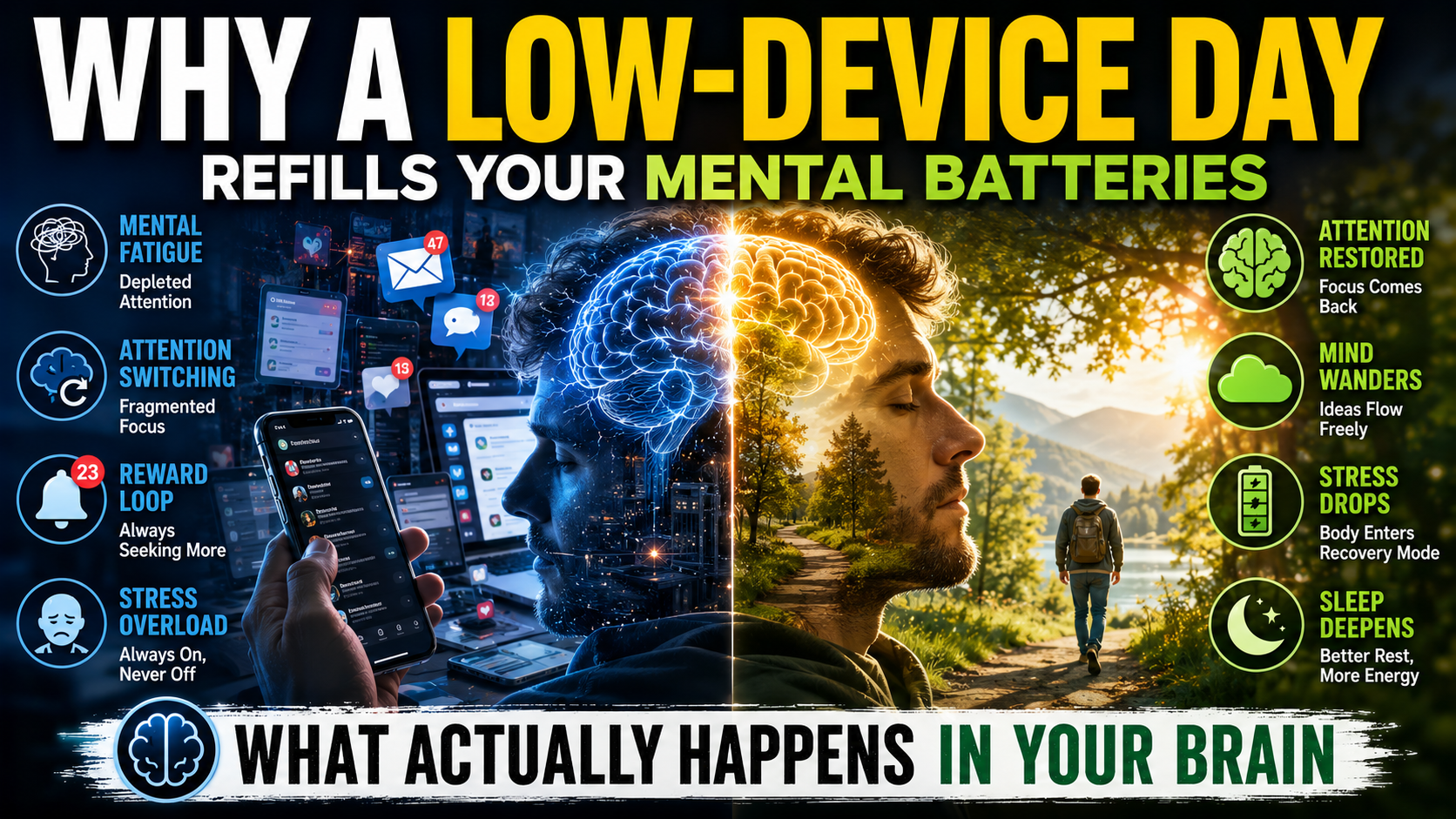
You finish a full day at the computer feeling wrung out. Not sleepy exactly, just empty. So you do what feels like rest. You drop onto the couch and pick up your phone. An hour later you are still tired, a little more irritable, and somehow you cannot remember a single thing you scrolled past.
This is the quiet problem most people who work on screens never name. You spend the day staring into one screen for work, then you spend the evening staring into a smaller one for relief. Your eyes change targets. Your brain does not. The same systems that ran hard all day keep running into the night, and the recovery you think you are getting never actually arrives.
A day with low device use is not laziness, and it is not a wellness trend. It is the recovery your brain is physically built to need and rarely gets. The drained feeling you carry around is real, it has a biological basis, and it responds to one specific thing: time when your attention is not being demanded by a glowing rectangle.
This article is about what is happening inside your head when you never put the screens down, and why pulling back for even a day lets your mental batteries refill. Not metaphor batteries. The actual neural and physiological systems that produce the feeling of having energy.
The double-exposure problem: your brain never clocks out
Here is what makes screen workers different from almost everyone else in history. Your job and your rest now run on the same machinery.
A laborer who dug ditches all day went home to a quiet evening. The body was tired, but the mind got to wander, settle, and reset. The parts of them that worked all day were not the parts they used to relax. There was a clean handover from effort to recovery.
For you, there is no handover. You spend eight or ten hours holding focus on a screen, filtering distractions, switching between tasks, and processing a constant stream of information. Then you close the laptop and immediately hand the same tired attention system another stream of information to process, just with brighter colors and faster pacing. The work screen and the leisure screen tax the same cognitive resources. Your brain does not register the second one as rest. It registers it as more of the same.
This is the double-exposure problem. You are exposed to demanding screen stimulation during work and again during what is supposed to be recovery, and the second exposure quietly cancels out the recovery the first one made necessary. The result is a brain that is on from the moment you wake until the moment you sleep, never getting the offline stretch it depends on to recover.
A low-device day breaks that loop. It creates the gap your brain has been missing, the stretch of hours where the demanding systems finally get to stand down. To understand why that gap matters so much, it helps to understand what those systems actually are and what happens to them when they never get a break.
Mental fatigue is real, and it is not the same as being tired
The exhaustion you feel after a screen-heavy day is not laziness or weak willpower. It is mental fatigue, and it is a measurable state with real consequences for how you think, feel, and perform.
When you focus deliberately on something, you are using directed attention. This is the effortful kind of focus you use to read a dense document, write code, sit through a video call while ignoring your inbox, or follow a complicated conversation. It is different from the effortless attention you give to something genuinely captivating. Directed attention takes work, and the capacity for it is limited. Spend it all day and it runs low, the same way a muscle gets weak after hours of lifting.
A long-standing idea in psychology called Attention Restoration Theory describes exactly this. Sustained directed attention depletes a finite resource, and when that resource is depleted you feel scattered, irritable, and slow. You make more mistakes. You reread the same sentence three times. You snap at small things. Your judgment gets worse without you noticing.
The important part of the theory is the second half. This resource does not refill on its own while you keep demanding things from it. It refills in environments that ask very little of your directed attention and instead engage what researchers call soft fascination. A walk where your eyes drift across trees and sky. Watching water move. Cooking something slowly. These activities hold your attention gently without forcing it, and that is precisely the condition under which the depleted system recovers.
A phone is the opposite of soft fascination. A feed is engineered to grab and hold your directed attention through constant novelty and small surprises. So an evening on your phone does not restore the attention you burned through at work. It keeps drawing on an account that is already overdrawn. You wake up the next day starting in deficit, and the deficit compounds across a week until you call it burnout.
What your brain does when you finally leave it alone
There is a common assumption that a busy brain is a productive brain and an idle brain is a wasted one. The neuroscience says almost the reverse. Some of your most important mental processes only run when you are doing nothing in particular.
When you are not focused on an external task, your brain does not switch off. It switches modes, into a state involving what scientists call the default mode network. This is the network that activates during mind-wandering, daydreaming, and quiet idle moments. Far from being downtime, this mode is where a lot of essential work gets done.
In this mode your brain consolidates memories, turning the day's raw experiences into something stored and usable. It works through unresolved problems in the background, which is why solutions so often arrive in the shower or on a walk rather than while you are grinding at the desk. It integrates what you have learned, connects ideas, and does the reflective processing that turns information into understanding. It is also where a sense of self and perspective gets maintained, the quiet stepping-back that keeps you feeling like a person rather than a task-processing machine.
All of this requires idle time. It requires moments of being unstimulated, even bored. And boredom is exactly the state the phone has eliminated from modern life. The instant a quiet moment appears, in a queue, in an elevator, the second a task ends, the hand reaches for the phone and fills the gap with input. Every gap filled is a moment the default mode network does not get to run.
This is one of the most underrated costs of constant device use. It is not just that you are tired. It is that the maintenance and integration your brain does during idle time never happens, so experiences pile up unprocessed and problems stay unsolved. A low-device day hands those quiet stretches back. The boredom you might feel in the first hours is not a problem to fix. It is the sound of a system that has been starved finally getting to run.
The attention you keep spending without realizing
Beyond the slow depletion of a full day, there is a faster, sneakier drain happening every time you check your phone, and it costs far more than the few seconds the check seems to take.
When you switch your attention from one thing to another, part of your mind stays stuck on the previous thing for a while. Researchers call this attention residue. After you glance at a message and look back at your work, a portion of your focus is still lingering on the message, and it takes time to fully arrive back at the task. The switch is never clean. There is always a tail.
Now multiply that by a normal day. Most people who work on a computer also keep a phone within reach, and they check it constantly, often without deciding to. Each check is a switch, and each switch leaves residue. Your attention spends the day fragmented into dozens of partial states, never fully present anywhere, always carrying a little baggage from the last thing. This fragmentation is exhausting in a way that sustained focus on a single task is not, because the brain is paying a switching cost again and again all day long.
The phone is the primary engine of this fragmentation, both at work and after. In the evening it does not stop. You watch something while scrolling something else while half-thinking about a message you have not answered. Three partial attentions, none of them whole, no single thing getting the kind of immersion that actually feels restful.
A low-device day removes the switching engine. With the phone out of the loop, your attention gets to do something it almost never does anymore. It stays in one place. Whether that is a conversation, a book, a walk, or a meal, single-tasking without the constant pull to switch is one of the most genuinely restorative states available to a modern brain, and it is nearly impossible to reach with a phone in your pocket buzzing for attention.
The reward loop your phone keeps running
People talk about a dopamine detox as if dopamine were a toxin you flush out by abstaining. That is not how it works, and the myth gets in the way of understanding what is actually going on. It is worth getting right, because the real mechanism explains a lot about why you feel the way you do.
Dopamine is not a pleasure chemical that you use up and refill. It is closely tied to motivation, anticipation, and the seeking of reward. Your phone, and especially the apps designed to hold your time, runs on this seeking system through a pattern psychologists call variable reward. Sometimes you check and there is something good waiting, a message, a like, an interesting post. Often there is nothing. The unpredictability is the point. A reward you get sometimes but not always is far more compelling than a reward you get every time, which is the same mechanism that makes slot machines so hard to put down.
This keeps a low-grade seeking loop running in the background of your day. You are not even enjoying most of the checks. You are chasing the possibility of a reward that occasionally pays out, and the chase itself is mildly draining and hard to switch off. It trains you toward constant novelty, so quieter activities start to feel unbearably slow by comparison. A book feels too still. A walk feels too empty. The bar for what counts as stimulating keeps creeping up.
Here is what a low-device day actually does, stated honestly. It does not detoxify a chemical. It interrupts the behavioral loop. With the slot machine out of reach, the constant seeking has nowhere to go, and over a stretch of hours the compulsive pull to check starts to quiet down. Lower-stimulation activities begin to feel satisfying again rather than boring, because your sense of what is interesting recalibrates toward something more sustainable. You are not refilling dopamine. You are letting your reward system stop sprinting after micro-hits long enough to remember that slower things are rewarding too.
The stress you cannot feel
The most invisible cost of constant connectivity is what it does to your stress physiology, because this one runs below the level of conscious feeling. You can be in it all day and not know.
Your nervous system has two broad modes. One is the activating mode, often summarized as fight-or-flight, that prepares you to respond and stay alert. The other is the calming mode, the rest-and-digest state, where your body actually recovers, repairs, and replenishes. Recovery, in a real physiological sense, happens in the second mode. It cannot happen in the first.
A phone that is always present, always capable of delivering a message, a demand, an alarming headline, or a piece of bad news, keeps you in a state of mild, low-grade activation. You are subtly braced for input. Even the anticipation of a possible notification keeps a thread of alertness running. Add the steady drip of stressful or outrage-driven content that fills most feeds, and you have a nervous system that gets little chance to drop into the calming mode where recovery lives.
Over time this carries a cost that researchers describe as allostatic load, the wear and tear that accumulates when your stress systems are activated too often and recover too rarely. It is the difference between a stress you experience and resolve, which is healthy, and a chronic low hum of activation that never fully switches off, which grinds you down. The drained, depleted, slightly-wired feeling of burnout is largely this: too much activation, not enough of the calming state, day after day.
A low-device day lets your nervous system finally drop into the recovery mode and stay there. Without the constant low-level bracing for input, without the drip of stressful content, the activating system quiets and the calming system takes over for a sustained stretch. This is where the real refilling happens. Not the metaphor of charging a battery, but the actual physiological process of a stressed system getting enough uninterrupted time in the recovery state to repair and replenish. It is the single most direct answer to why you feel restored after a day away from screens and depleted after a day soaked in them.
Why relaxing on your phone is not recovery
This is the heart of it, and it is the thing most people get wrong about their own rest. You feel tired, you reach for the phone to relax, and you genuinely believe you are recovering. The research on how people actually recover from work says you are mostly not.
Recovery from work depends on a few specific conditions, and the most important is psychological detachment. To recover, you have to mentally switch off from the demands that drained you, not just physically step away from them. Your mind has to stop being engaged with effortful, work-like processing. Only then do the depleted systems get to stand down and refill.
A phone makes detachment almost impossible. Scrolling a feed is not the absence of cognitive effort, it is a different flavor of the same effort. You are processing information, making micro-decisions, reacting, comparing, switching. Your work email is one tap away, so part of you stays tethered to work even on the couch. The same attentional and cognitive systems that ran all day keep running, just pointed at different content. You have changed the channel, not turned off the television.
This is why an evening on your phone leaves you feeling like you rested and got nothing from it. You occupied the time, but you never detached, so recovery never started. You spent your supposed downtime keeping the tired systems busy, and you went to bed as depleted as you woke up. Over weeks, this is the engine of burnout. Not too much work alone, but too little genuine recovery between bouts of work, because the recovery time keeps getting spent on the same machine that did the draining.
A low-device day forces the detachment that a phone prevents. With the device out of reach, your attention and your stress systems get the one thing they cannot get with it present: a real break, where the demanding work is not just paused but mentally gone. That is what refills the batteries. Detachment is not a nice extra. It is the mechanism, and the phone is the main thing standing between you and it.
Sleep: the recovery you sabotage without noticing
Even if your waking hours were perfect, devices reach into the most important recovery process you have, and quietly degrade it. Sleep is when the deepest restoration happens, and screens interfere with it on multiple fronts.
During deep sleep your brain runs maintenance it cannot run while awake. It clears metabolic waste that builds up during the day through a process that ramps up during sleep. It consolidates memories and locks in learning. It rebalances the chemistry that governs mood and motivation. A night of good sleep is the most powerful battery refill available to a human being, and nothing else comes close.
Devices attack this in two ways. The first is light. The bright, blue-heavy light of screens in the evening signals to your brain that it is still daytime, which delays the release of the hormones that prepare you for sleep and pushes your whole sleep schedule later. The second, and arguably worse, is arousal. The content keeps your mind active and engaged right up to the moment you try to sleep, and a stimulated, racing mind does not drop easily into rest. You lie down still buzzing from the last thing you watched or read, and sleep comes late and shallow.
A low-device day, especially a low-device evening, protects the recovery process you most depend on. Without the late light exposure and the pre-sleep stimulation, your sleep schedule stays aligned, you fall asleep faster, and you spend more time in the deep restorative stages. You wake up actually rested, which is the foundation everything else sits on. A great deal of the energy a low-device day gives you is simply the better sleep it makes possible.
What a low-device day actually does to refill your batteries
Pull the threads together and the picture is clear. The drained feeling you carry is not one thing, it is several systems running too hard for too long with no recovery window, and the phone is what keeps the window closed.
A low-device day lets your depleted directed attention recover, instead of spending it on a feed engineered to consume it. It hands back the idle time your brain needs to consolidate, integrate, and quietly solve, the work that only happens when you are doing nothing. It stops the constant attention-switching that fragments your focus and exhausts you through sheer churn. It lets the reward-seeking loop wind down so slower, calmer activities feel satisfying again. It gives your stress physiology a sustained stretch in the recovery state where repair actually happens. It allows the psychological detachment that genuine rest requires and a phone prevents. And it protects the deep sleep that is the most powerful recovery you have.
That is what refilling the batteries actually means. Not a metaphor, but a set of real systems getting the offline time they are built to need. The energy you feel after a day away from screens is the sum of all of it, attention restored, stress dropped, sleep deepened, the seeking loop quieted. It feels like magic, but it is just biology finally being allowed to do its job.
What it looks like in practice
You do not need to vanish into the woods. A low-device day is about reducing demanding screen use, not achieving zero contact with technology. A few principles make it work.
Pick a day, or even half a day, where you decide in advance that screens are not the default. The decision matters, because without it the hand reaches for the phone automatically. Put the phone somewhere out of sight and out of easy reach, since presence alone keeps the seeking loop alive even when you are not using it. Fill the time with the soft-fascination activities your attention recovers from, a walk, time outdoors, cooking, a real conversation, a physical book, anything that engages you gently without demanding constant focus.
Expect the first hour or two to feel uncomfortable. The pull to check will be strong, and you may feel bored or restless. This is the seeking loop protesting, and it passes. On the other side of it is the quiet your brain has been missing, and that is where the recovery lives. One day like this can shift how you feel for days afterward, and made into a regular rhythm it becomes one of the most effective things you can do for sustained energy and against burnout.
Takeaways
The drained feeling after a screen day is real mental fatigue, with a biological basis, and it is not solved by resting on another screen.
The double-exposure problem is the core issue. Working on a screen all day and relaxing on one all evening taxes the same systems, so recovery never starts and depletion compounds into burnout.
Constant device use depletes your directed attention, eliminates the idle time your brain needs to consolidate and reflect, fragments your focus through endless switching, and keeps a low-grade reward-seeking loop and a low-grade stress response running all day.
Relaxing on your phone is not recovery, because recovery requires psychological detachment, and a phone keeps you cognitively engaged and tethered to work. Devices also degrade the deep sleep that is your most powerful battery refill.
A low-device day refills your energy by giving all of these systems the offline window they are built to need. Attention recovers, stress drops into the repair state, the seeking loop quiets, and sleep deepens. That is what real recovery is, and it is mostly just biology getting the time to do its job.
FAQ
Why am I so tired after working on a computer all day even though I barely moved?
Because the fatigue is mental, not physical. Holding focus on a screen, filtering distractions, and switching between tasks all day depletes your directed attention and keeps your stress and reward systems mildly activated for hours. That produces a real, measurable state of mental fatigue that feels just as draining as physical work, even though your body stayed still.
Does scrolling my phone in the evening actually help me relax?
Usually not in the way you think. Genuine recovery requires psychologically detaching from demanding mental effort, and scrolling is a different version of the same effort your work used all day. You process information, make micro-decisions, and stay tethered to messages and email, so the tired systems keep running. You occupy the time but rarely recover from it.
What is the double-exposure problem?
It is the modern situation where both your work and your rest run on screens, so the same cognitive systems are taxed during work and again during what should be recovery. The second exposure cancels out the recovery the first one made necessary, which is why screen workers can feel perpetually drained even when they are technically resting.
Is a dopamine detox real?
The popular version is misleading. You do not flush out or refill dopamine by avoiding your phone for a day. What actually changes is the behavioral loop. Phones run on unpredictable rewards that keep you compulsively checking, and stepping away interrupts that loop so the constant seeking quiets down and slower activities start to feel satisfying again. It is a behavioral reset, not a chemical one.
How does device use affect my sleep?
In two main ways. The bright, blue-heavy light of screens in the evening delays the hormones that prepare you for sleep and pushes your schedule later. And the stimulating content keeps your mind active right up to bedtime, so you fall asleep later and sleep less deeply. Since deep sleep is your most important recovery process, this quietly undermines your energy the next day.
How long does a low-device day take to make a difference?
A single day, or even half a day, can noticeably shift how you feel, and the effect often carries over for several days afterward. The first hour or two may feel restless as the urge to check fades, but the recovery happens on the other side of that discomfort. Made into a regular weekly rhythm, it becomes one of the most effective habits for sustained energy and burnout prevention.
Do I have to avoid screens completely for it to work?
No. The goal is reducing demanding screen use, not reaching zero. Putting your phone out of reach, stepping away from feeds and work tools, and filling the time with gentle, absorbing activities is enough to give your attention, stress systems, and reward loop the break they need. The point is removing the constant pull, not living without technology.
Date-based AI Task Manager
Plan smarter, execute faster, achieve more
Create tasks in seconds, generate AI-powered plans, and review progress with intelligent summaries. Perfect for individuals and teams who want to stay organized without complexity.
Get started with your preferred account