
The Best Productivity System Is the One That Fits You (And How to Find It)
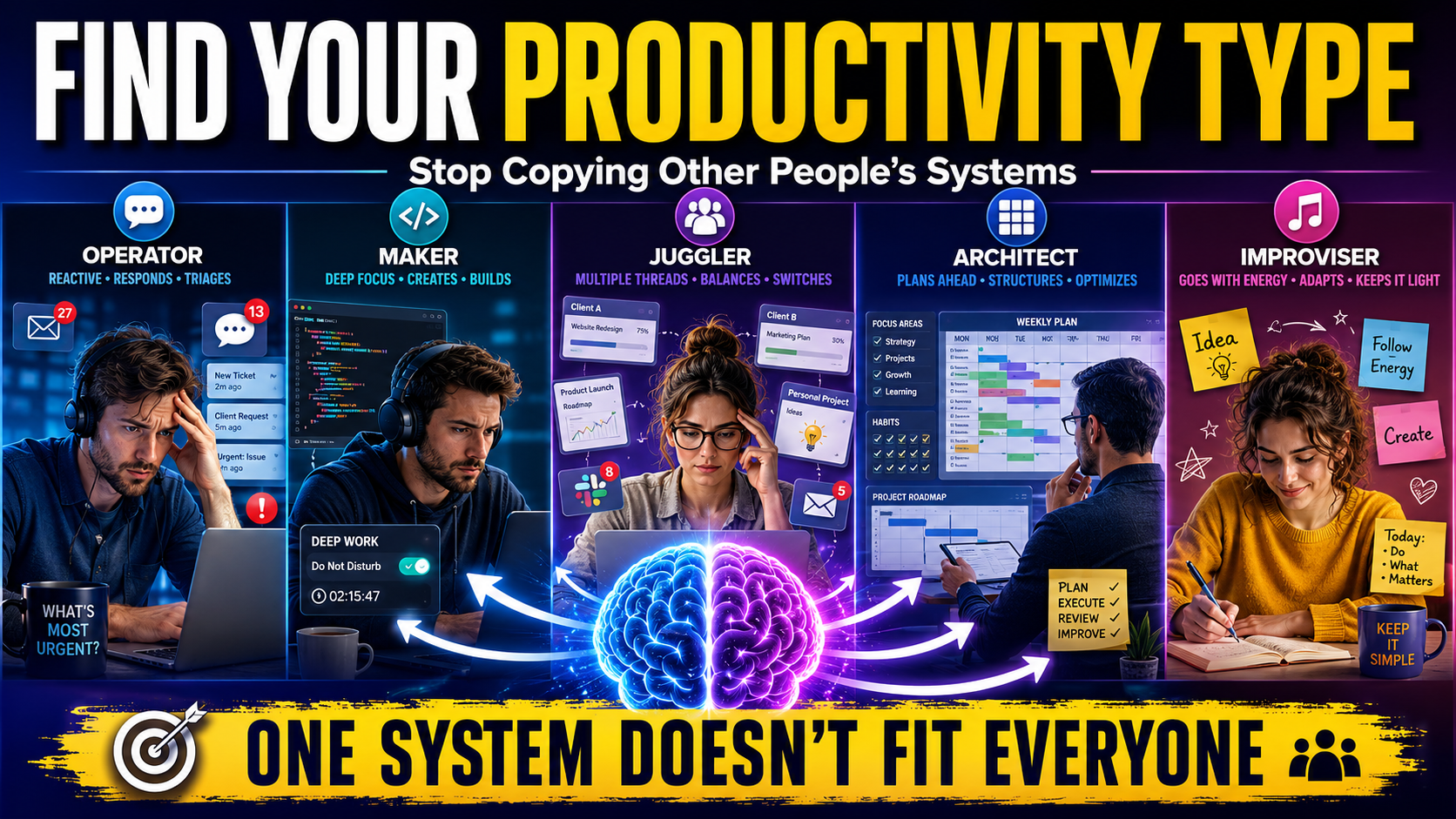
Someone you respect swears by time blocking. Someone else builds their whole life in a single notes app. A founder you follow runs everything from a paper notebook and looks calmer than all of them. So you try the notebook, and within a week your tasks are scattered across three pages and you have no idea what is due tomorrow.
This is the part nobody tells you about productivity. The system that transformed one person's life can do nothing for you, and that does not mean you failed or that the system is fake. It means productivity is personal. The way you handle work, attention, and memory is specific to the kind of person you are, and a method built around someone else's brain will quietly fight yours.
The goal is not to find the system everyone agrees is best. There is no such thing. The goal is to find the one that fits you, prove it works with real results, and then commit to it completely. This article gives you a way to do exactly that: a simple map of the traits that define your work style, the work-style types most people fall into, and a method for testing systems properly instead of collecting them.
Why generic productivity advice keeps failing you
Most productivity advice is really one person describing what works for them and assuming it generalizes. It rarely does, for three reasons.
Your work is different. A support lead whose day is interrupted every nine minutes does not work the way a novelist with four uninterrupted hours does. A method that assumes long quiet stretches is useless to the person who never gets them, and a rigid hourly plan is useless to the person whose day is half meetings they did not schedule.
Your brain is different. Some people think in lists and feel calm when everything is written down. Others feel boxed in by the same lists and do their best work in loose bursts. Some hold a dozen open threads in their head with no stress. Others lose a task the moment it leaves their sight. None of these are better or worse. They are just different operating systems, and they need different software.
Your life is different. Your obligations, your energy across the day, whether your work is one job or five clients, whether you are building something or maintaining something. All of it shapes what a workable system looks like for you specifically.
So when a popular method does nothing for you, the honest conclusion is not that you lack discipline. It is that you have not yet found the system built for your type. The fix is not more willpower. It is a better match.
The four traits that define your productivity type
Before you test anything, it helps to know yourself. Almost every meaningful difference in how people work comes down to four traits. Read each one and notice where you land. You do not need to be at an extreme. Most people lean one way.
1. Time orientation: clock-led or energy-led
Clock-led people think in slots. They plan the day by when things happen and feel comforted by a schedule. Energy-led people think in waves. They know they are sharp in the morning and useless at 3 p.m., and they want to match hard work to high energy rather than to a fixed hour.
If a detailed hourly calendar makes you feel in control, you are clock-led. If it makes you feel trapped and you keep ignoring it, you are energy-led. This single trait explains why time blocking is gospel to some people and torture to others.
2. Structure need: high or low
High-structure people want a place for everything and a clear process. The more organized the system, the calmer they feel. Low-structure people want the least scaffolding they can get away with. Too many fields, tags, and rules and they abandon the tool entirely.
The mistake here is judging yourself against the high-structure ideal that productivity culture pushes. If elaborate systems consistently collapse on you after a week, you are not lazy. You are low-structure, and you need something lighter that you will actually keep using.
3. Input pattern: reactive or deep
Reactive people have days that come at them. Requests, messages, small fires, things they did not plan. Their work is responding well to a stream of inputs. Deep people protect long stretches to focus on one hard thing, and switching context is what wrecks them.
Most people are a mix, but one usually dominates. A reactive day needs fast capture and a clear view of what matters today. A deep day needs protection from inputs and very few moving parts.
4. Memory style: externalizer or internalizer
Externalizers trust nothing they have not written down. The relief of an empty head is the whole point of their system. Internalizers carry a lot in their head naturally and only write down what truly matters, because over-capturing feels like noise to them.
This trait decides how much a system should hold. Push an internalizer into capturing everything and they drown in their own lists. Let an externalizer rely on memory and things start falling through.
Put your four answers together and you have a rough portrait of how you actually work. That portrait is your starting hypothesis, and it points you toward the types below.
The work-style types most people fall into
These are not boxes you have to fit perfectly. They are recognizable patterns built from the four traits. Find the one or two that sound most like you, and pay attention to where each one tends to break, because that is usually where the wrong system hurts.
The Operator
The Operator's day is driven by what comes in. Support, operations, account management, anything client-facing or interrupt-heavy. They are reactive and clock-aware, and they live or die by knowing what needs a response right now.
Where most systems fail them: anything that assumes a calm, plannable day. Elaborate project hierarchies are useless when the real question is always "what is on fire today." Operators get buried in tools built for makers.
What fits: fast capture, a sharp view of today, and the ability to triage quickly. The system has to keep up with a moving day rather than assume a still one.
The Maker
The Maker builds things. Writers, developers, designers, researchers. They are deep and often energy-led, and their enemy is context switching. An hour of fragmented attention produces almost nothing for them.
Where most systems fail them: noisy tools with constant notifications, and rigid schedules that ignore their energy. A maker forced to check a busy task app every twenty minutes never reaches the focus their work requires.
What fits: protection. Few inputs, quiet, and a way to line up deep work against their best hours rather than against arbitrary slots. The best system for a maker is one they barely have to touch while working.
The Juggler
The Juggler runs many parallel threads. Founders, multi-client freelancers, anyone wearing several hats at once. They are both reactive and deep depending on the hour, and they are strong externalizers because no one could hold that many threads in their head.
Where most systems fail them: tools that mix everything into one undifferentiated pile, and tools so rigid they cannot flex between client work and deep work. Jugglers need separation and overview at the same time, which is a hard combination.
What fits: clear boundaries between threads, plus a single place that shows the whole picture. A juggler needs to switch contexts cleanly without losing the thread they just put down.
The Architect
The Architect loves structure. They plan ahead, they enjoy building the system as much as using it, and they feel genuinely calmer when everything has a defined place. They are high-structure and usually clock-led.
Where most systems fail them: tools too simple to hold the detail they want. An Architect handed a bare list feels like something is missing, and they will keep bolting on complexity until the tool finally fits.
What fits: rich structure they can shape, with room to plan across days, weeks, and quarters. The risk for Architects is the opposite of everyone else. They can over-build, so the discipline they need is keeping the system in service of the work rather than the work in service of the system.
The Improviser
The Improviser resists rigid systems on principle. They work in bursts, follow energy and interest, and tend to be low-structure and somewhat internalizing. Heavy tools make them feel caged, and they quietly stop using them.
Where most systems fail them: anything that demands constant upkeep. The Improviser is the person who has abandoned ten productivity apps and concluded that productivity tools are not for them. They are not. The complicated ones are not.
What fits: the lightest possible scaffolding. A small, low-friction system that captures the few things that matter and otherwise stays out of the way. For an Improviser, less is not a compromise. It is the requirement.
The Reflector
The Reflector is driven by looking back. They improve by reviewing what happened, spotting patterns, and adjusting. They value history and feedback more than any single day's plan, and they often combine traits from the other types.
Where most systems fail them: tools with no memory. A system that lets today vanish the moment it passes gives a Reflector nothing to learn from, and they lose the loop that actually drives their progress.
What fits: built-in rhythms for review and a record they can look back over. The Reflector wants to see the week, the month, the quarter, and ask what worked and what did not.
You will probably recognize yourself in one type strongly and a second one partly. That overlap is normal, and it is useful, because it tells you which two or three systems are worth testing rather than the dozens you could try.
How to test a system properly
Knowing your type narrows the field. It does not give you the answer. The only way to know what truly fits is to put a few candidates to the test, and most people test badly. They try a tool for two days, get distracted by a shinier one, and never give anything a fair trial. Here is how to do it properly.
Step 1: Map yourself first
Use the four traits above to write a one-line portrait of how you work. Something like: energy-led, low structure, mostly deep, strong externalizer. This is your hypothesis. It stops you wasting time on systems that are obviously wrong for you, which is most of them.
Step 2: Shortlist two or three, not ten
Pick a small number of approaches that match your portrait. The point of testing is to compare a few real options, not to sample everything. Three is plenty. More than that and you will never commit long enough to learn anything.
Step 3: Run a real two-week trial
Give each candidate a genuine run, ideally two weeks, and commit to it fully during that window. Use it as if it were already your system. The single biggest testing mistake is constant tweaking and half-using something while eyeing the next option. A system you only half-trust will always underperform, and you will blame the tool for your own hedging.
Keep the conditions steady. Test during a normal stretch of work, not a quiet holiday week or your busiest crunch. You want to see how the system holds up in your actual life.
Step 4: Judge by results, not by novelty
This is where most people go wrong. A new system always feels good for the first few days because it is new, not because it is right. Novelty is not a result. Before you start, decide what results actually mean for you. Usually it is some mix of these: more of what matters getting done, fewer things falling through the cracks, less time spent deciding what to do, and a calmer head at the end of the day.
After two weeks, ask the honest question. Did this help me follow through, or did it just feel nice to set up. Aesthetics and clever features are seductive and almost irrelevant. Follow-through is the only thing that counts.
Step 5: Pick the winner and stop shopping
When one system clearly produces better results for you, the test is over. You do not need to keep looking, and you should not. The next section is about why that last step matters more than anything that came before it.
The tool-hopping trap
There is a failure mode that disguises itself as diligence. It is the endless search for the perfect setup. New app, new method, new template, a fresh start every few weeks, always believing the next one will finally click.
This is not productivity. It is procrastination wearing a productive costume. Setting up a system feels like progress, but it produces nothing. The work still has not been done. The dopamine of a clean new tool is real, and it is the exact feeling that keeps people switching forever and finishing nothing.
Here is how to tell testing from avoidance. Testing has a start, a defined trial, a results check, and an end. Avoidance has none of those. If you are on your fifth tool this quarter and you have never given any of them an honest two weeks, you are not testing. You are hiding from the work inside the comfort of setup. The cure is to commit.
Why going all in is the real unlock
Once you have found the system that fits and proves itself, the most important move is to go all in. Not eighty percent. All the way. This matters more than which system you picked, and it is the step almost everyone skips.
A productivity system only works when it becomes the default. The whole value is that you stop deciding where things go and start trusting one place automatically. If you are still keeping a backup list elsewhere, still half-using your old tool, still wondering if something better exists, the system never becomes default and you never get the payoff. You carry the overhead of every system at once and the benefit of none.
Commitment compounds. The first week with a system is clumsy. By the second month it is muscle memory. By the sixth it is holding context you would never be able to keep in your head, surfacing things at the right time, and quietly carrying load you have forgotten you offloaded. That compounding only happens if you stay put. Every time you switch, you reset the clock to week one and pay the setup cost again.
There is also a trust effect. A system you fully commit to is one you actually rely on, and reliance is what makes it work. The moment you half-trust it, you start duplicating it in your head or on paper as insurance, and the insurance quietly recreates the exact mental load the system was supposed to remove.
So the sequence is the whole point. Be aware that many approaches exist. Test a focused few, properly. Keep the one that gives you real results. Then commit completely and let it compound. Skip the last step and the first three were wasted.
How to know you have found yours
You do not need a perfect feeling to know a system fits. You need a few honest signals.
You reach for it without thinking. When something new lands, it goes into your system automatically, not after you decide whether it is worth the effort.
Things stop falling through. The dropped tasks, the forgotten follow-ups, the "I knew there was something today" moments quietly disappear.
Your head feels lighter. You are not holding a running list in the back of your mind anymore, because you trust that the list lives somewhere reliable.
You stop shopping. The urge to try the next tool fades, not because you gave up, but because the search is genuinely over.
When most of those are true, you have found it. Stop looking and go all in.
Takeaways
There is no best productivity system, only the one that fits the kind of person you are. Generic advice fails because work, brains, and lives differ, not because you lack discipline.
Map yourself with four traits first: time orientation, structure need, input pattern, and memory style. That portrait points you to the work-style type and the handful of systems worth testing.
Test properly. Shortlist a few, run an honest two-week trial on each, commit fully during the trial, and judge by real results rather than the buzz of something new.
Beware the tool-hopping trap. Endless setup feels productive and produces nothing. Testing has an end. Avoidance does not.
Then go all in. A system only pays off once it becomes your default and starts to compound, and that only happens if you stop switching and commit.
FAQ
Why does productivity advice work for some people and not others?
Because productivity is personal. The same method assumes a certain kind of work, a certain way of thinking, and a certain daily life. When those match yours, it works. When they do not, it fights you. A method failing for you usually means it was built for a different work style, not that you did something wrong.
How do I find out what productivity type I am?
Look at four traits: whether you plan by the clock or by your energy, whether you want a lot of structure or very little, whether your day is reactive or built around deep focus, and whether you trust written lists or carry things in your head. Your answers form a portrait of how you actually work, which points you toward the systems worth trying.
How long should I test a new productivity system before deciding?
About two weeks, used fully and during a normal stretch of work. A couple of days only shows you the novelty. Two weeks of genuine use shows you whether it holds up in your real life and actually improves your follow-through.
What is the biggest mistake people make when choosing a productivity system?
Judging by how a system feels in the first few days instead of by the results it produces. New tools always feel good because they are new. The only thing that matters is whether you follow through, drop fewer things, and feel calmer over a couple of weeks of real use.
Why do I keep abandoning productivity apps after a week?
Often because the tool is too heavy for your work style. If you are naturally low-structure, complex systems with many fields and rules will keep collapsing on you, and that is a sign to go lighter rather than to try harder. The fix is a better match, not more willpower.
Is it better to use one productivity system or several?
One, fully committed. Splitting across several means you carry the overhead of all of them and get the benefit of none, because nothing ever becomes your trusted default. A single system you rely on completely is what lets the habit compound over months.
What does it mean to go all in on a productivity system?
It means making it your default and stopping the search. No backup list elsewhere, no half-using your old tool, no constant shopping for something better. Full commitment is what turns a system from a clumsy first week into reliable muscle memory that quietly carries your workload.
Date-based AI Task Manager
Plan smarter, execute faster, achieve more
Create tasks in seconds, generate AI-powered plans, and review progress with intelligent summaries. Perfect for individuals and teams who want to stay organized without complexity.
Get started with your preferred account