
Same-Day or Someday: Why 41% of Your To-Do List Never Gets Done
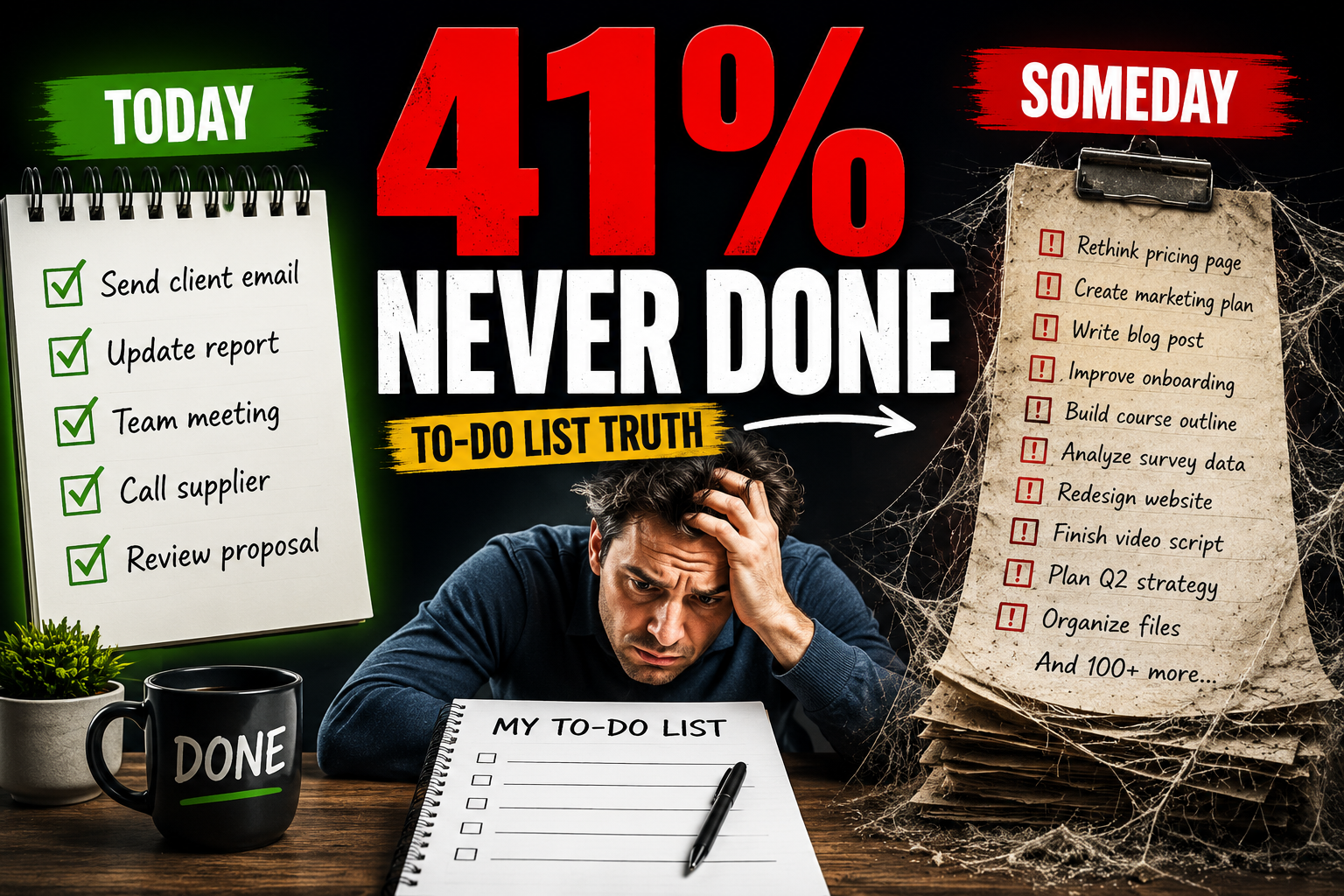
Open your to-do list right now and count the items that have been sitting there for more than a week. Be honest. Most people find a small graveyard - tasks they fully intend to do, that somehow never reach the top of the pile. They are not urgent enough to force the issue and not painful enough to delete. So they wait. And wait.
There is a number that explains that graveyard, and it is larger than most people expect. Research from the productivity company iDoneThis found that 41 percent of all to-do list items are never completed. Not delayed. Never done. Close to half of what you write down is, statistically, decoration.
This article is about that 41 percent - where it comes from, why a plain list almost guarantees it, and what the research says actually moves a task from "someday" to "done." The short version is that the problem is rarely effort or willpower. It is that a list lets every task pretend it belongs to no particular day. Fix that one thing and the math changes.
What actually happens to your to-do list
The 41 percent figure is the headline, but the rest of the picture is just as revealing. The same research found that of the to-do items that do get completed, about half are finished within a single day, and many within the first hour of being written down. In other words, tasks tend to split into two groups: the ones you handle almost immediately, and the ones you never handle at all. The comfortable middle - "I will get to it in a few days" - is mostly a myth. A task that does not get done quickly usually does not get done.
Then there is the strangest finding of all. When researchers looked at what people actually accomplished in a day, only about 15 percent of those completed tasks had started life as items on a to-do list. The vast majority of what you get done was never written down. The list, for most people, is not the engine of the day. It is a side document you glance at, feel slightly guilty about, and then set aside to deal with whatever the day throws at you.
It is not as if the lists are short, either. In their book Willpower, Roy Baumeister and John Tierney point out that a typical person is juggling around 150 tasks at any given moment. No one finishes 150 things this week. So the list keeps growing, the oldest items sink to the bottom, and the graveyard fills up. The longer the list, the more it functions as a record of intentions rather than a plan of action.
Stack these findings together and a clear pattern emerges. A plain to-do list is very good at capturing tasks and very bad at finishing them. It tells you what you could do. It says nothing about when, and that missing "when" is where almost everything goes wrong.
Why "someday" is where tasks go to die
A list has one fatal feature hiding in plain sight: every item sits on the same flat plane, with no time attached. "Reply to the accountant," "rethink the pricing page," and "buy milk" all look equally weightless. So when you scan the list and ask what to do next, you do the natural thing - you pick whatever is quickest and least intimidating. The two-minute tasks get done. The thing that actually matters, the one that needs ninety focused minutes, stays untouched because there is never an obvious moment for it.
This is the urgent-versus-important trap, and a list makes it worse, not better. Without time boundaries, urgency always wins. The email that just arrived feels more pressing than the strategic work that has no deadline, so the strategic work waits. It waits so long that it migrates into a vague mental category we can all recognize: someday.
There is a second force at work, and psychologists have a name for it: the planning fallacy, first described by Daniel Kahneman and Amos Tversky. People consistently underestimate how long their tasks will take, even when they have plenty of experience telling them otherwise. You think the report will take an hour. It takes three. Now the rest of the day's list, which you mentally promised to finish, is impossible. Items spill into tomorrow, then into "later," then into never. A list invites this because it lets you pile on tasks with no sense of how much time any of them will actually consume.
And the graveyard is not free. Every unfinished task you are carrying takes up mental space. The Zeigarnik effect describes how the mind keeps nagging you about things you have started but not completed, which is why a long, stagnant to-do list quietly raises your stress instead of lowering it. You are not just failing to do the tasks. You are paying a low, constant tax for holding them.
Underneath all of this is the simplest reason of all: intending to do something is not the same as doing it. The research on this is blunt. Even strong intentions - "I definitely plan to do this" - predict only a fraction of actual behavior. People will sincerely intend to get to the gym, call the client, or fix the page "some day," and most of the time it does not happen. A to-do list is a machine for generating intentions. It is not a machine for generating action. As productivity author Kevin Kruse, who interviewed more than 200 high performers for his research, put it, to-do lists are "where important tasks go to die."
The science of giving a task a day
Here is the part that should change how you think about your list. The fix for the intention-action gap is not more motivation. It is a specific, almost mechanical move: deciding in advance when and where a task will happen.
Psychologist Peter Gollwitzer spent decades studying this, and the effect is one of the most reliable findings in behavioral science. When you take a vague goal and attach it to a concrete moment - a specific day, a specific time, a specific trigger - your follow-through jumps dramatically. A meta-analysis covering 94 separate studies and more than 8,000 participants found that this kind of planning has a medium-to-large effect on whether people actually reach their goals. Popular summaries of the research put it more plainly: deciding when and where you will do something tends to double or triple your follow-through compared to simply setting the goal.
The size of the effect in individual studies can be startling. In one frequently cited example, every single woman who was prompted to make a specific plan for when and where she would perform a health check did it - 100 percent - compared with just over half of the women who only intended to. Same goal. Same good intentions. The only difference was that one group had pinned the action to a moment, and the other had left it floating.
Why does something so simple work so well? Because attaching a task to a specific time changes who is in charge of remembering and deciding. With a floating to-do item, you have to consciously notice it, decide it is the right moment, override the temptation to do something easier, and then act - every single time. That is a lot of friction, and friction is where tasks die. When the task is tied to a day, the day itself becomes the cue. You do not have to relitigate the decision. The plan has already made it for you. Researchers describe this as handing control of the behavior over to the situation, so it fires more or less automatically when the moment arrives.
Notice what this means for your list. The problem was never that your tasks were unimportant or that you were lazy. The problem was that they had no "when." The single most effective thing you can do for any task is also the most boring: give it a date.
Same-day or someday: the honest test a date forces
This is where the difference between a list and a plan becomes concrete, and it is worth being a little opinionated about, because it is the whole game.
An open-ended to-do list is comfortable precisely because it is dishonest. It lets you add a task without committing to anything. Every item gets to live in a permanent "I will get to this," which feels productive - look how much I am planning to do - while quietly hiding the truth that you have already run out of days to do it in. A list never makes you confront the fact that there are only so many hours in tomorrow. It just keeps accepting more.
A date removes the hiding place. The moment you have to put a task on an actual day, it has to answer a real question: today, or not today? If you try to assign it to today and today is already full, you can see the conflict immediately. You either move something, shrink the task, or admit it is not really happening this week. That can feel uncomfortable, but the discomfort is the point. It is the difference between a wish and a commitment.
There is a knock-on benefit that a flat list can never give you. When tasks live on specific days, slippage becomes visible. You can see that the thing you meant to do on Monday is still sitting there on Thursday, three days late and quietly judging you. A plain list erases that history - a task that has been ignored for three weeks looks identical to one you added this morning. A date-based view keeps the receipts. It shows you not just what you planned, but what actually happened to those plans, which is the only information that ever helps you plan better.
This is why a calendar full of meetings often feels more honest than a to-do list full of intentions. The calendar has time boundaries baked in. You cannot schedule two things in the same slot. The trouble is that most people keep their tasks and their calendar in separate worlds - meetings over here, the real work over there on a list with no time attached. The work that matters most ends up being the only part of your day with no protected place to happen. Pulling tasks onto actual days closes that gap. It treats your own work with the same seriousness you treat a meeting someone else booked.
So the test is simple, and you can apply it to any task on your list right now: what day is this happening? If you cannot answer, you do not have a plan for it. You have a hope. And hopes are exactly what the 41 percent is made of.
How to put this into practice
You do not need a new philosophy to act on this. You need a few habits that force the "when" back into your tasks.
Give every task a real date. Not a priority flag, not a label - a day. If a task earns a place in your system, it earns a day to happen on. This single rule does more than any productivity hack, because it converts a floating intention into a scheduled commitment.
Treat "no date" as a signal, not a default. A task with no day attached is not a task you are doing. It is a task you are considering. That is fine, as long as you are honest about it. Keep those in a separate holding area, not mixed in with the work you have actually committed to, so your real plan does not drown in maybes.
Plan tomorrow before tomorrow arrives. Spend five minutes at the end of each day deciding what actually goes on the next one. When you plan the day in advance, the day already has a shape when you wake up, and you spend your freshest hours doing the work instead of deciding what the work is.
Keep the day finishable. The fastest way to recreate the 41 percent problem is to load a single day with more than it can hold. If everything you assign to today cannot realistically fit, you are just building tomorrow's graveyard a day early. A plan you can actually finish beats an ambitious one you cannot.
Review what slipped, on purpose. Once a week, look at what you planned versus what actually happened. Not to feel bad about it, but to decide consciously: does this unfinished task get a new day, or does it get deleted? Tasks should not rot by default. They should either move forward with intent or leave the system entirely.
Name tasks so your future self knows what to do. "Pricing" is not a task. "Draft three pricing tiers for the new plan" is. A clear, specific task is far more likely to get done than a vague one, because there is no moment of friction where you have to figure out what you even meant.
None of this requires heroic discipline. It requires a system that refuses to let tasks float - one where the question "what day is this happening?" is built into how you work, not something you have to remember to ask.
Where this leaves SelfManager
Most task managers are built as lists or boards first, with dates bolted on as an optional field. SelfManager is built the other way around. The entire system is organized by the day. Every task and every event belongs to a date, and each day gets its own workspace - so the "when" is not an afterthought you have to remember to fill in, it is the structure itself. There is nowhere for a task to float, because the unit of organization is the day it is happening on.
That makes it genuinely good at the thing this article is about: daily planning that reflects reality. You plan a specific day, you see exactly what you committed to, and you see what slid from one day to the next instead of pretending it did not. Because the data is organized around dates rather than an endless list, the picture you get is honest - what you intended, what got done, and what quietly moved. Its AI review uses that same date-based history to summarize your week, month, or quarter, so the slippage you would normally lose track of becomes something you can actually see and act on. It is the difference between a tool that stores your intentions and one that helps you keep them.
Takeaways
- Research from iDoneThis found that 41 percent of to-do list items are never completed, and tasks that are not done quickly usually are not done at all.
- Only about 15 percent of what people actually complete in a day came from their to-do list. The list is rarely where the work happens.
- A plain list fails because its items have no "when." Without a time attached, urgent beats important and tasks drift into "someday."
- Decades of research on implementation intentions show that attaching a task to a specific day and time can double or triple follow-through.
- A date forces an honest question - today or not today - and makes slippage visible, which is the only information that helps you plan better.
- The most effective productivity move is also the most boring: give every task a real day to happen on.
FAQ
What percentage of to-do list items actually get completed?
Research from the productivity company iDoneThis found that 41 percent of to-do list items are never completed. Of the items that do get done, roughly half are completed within a day, often within the first hour of being written down.
Why can I never finish my to-do list?
Usually because the list has no sense of time. Every item looks equally weightless, so you default to quick, easy tasks and put off the important ones. Add the planning fallacy - underestimating how long tasks take - and a day's worth of intentions quickly becomes impossible to finish.
Does scheduling a task to a specific day actually help you complete it?
Yes, and the effect is well documented. Studies on implementation intentions, including a meta-analysis of 94 studies and more than 8,000 people, found that deciding in advance when and where you will do something has a medium-to-large effect on follow-through, often doubling or tripling completion compared with simply setting a goal.
What is the difference between a to-do list and a plan?
A to-do list captures what you intend to do. A plan assigns those tasks to specific days and times. The list lets tasks float indefinitely. The plan forces each task to compete for a real slot in a real day, which is what turns an intention into a commitment.
Is it better to use a calendar or a to-do list?
The most reliable approach combines them, so tasks live on actual days rather than on a separate, timeless list. A calendar has built-in time boundaries that a to-do list lacks, which is why scheduling your important work, not just your meetings, makes it far more likely to get done.
How do I stop tasks from piling up in "someday"?
Give every committed task a specific day, keep undated "maybe" tasks in a separate holding area, and review weekly what slipped so each unfinished task either gets a new day or gets deleted. The goal is to never let a task sit in your system with no day attached.
Date-based AI Task Manager
Plan smarter, execute faster, achieve more
Create tasks in seconds, generate AI-powered plans, and review progress with intelligent summaries. Perfect for individuals and teams who want to stay organized without complexity.
Get started with your preferred account