
Vacation Coverage Plan Template: Backup Owners, Escalations, and Return Handoff
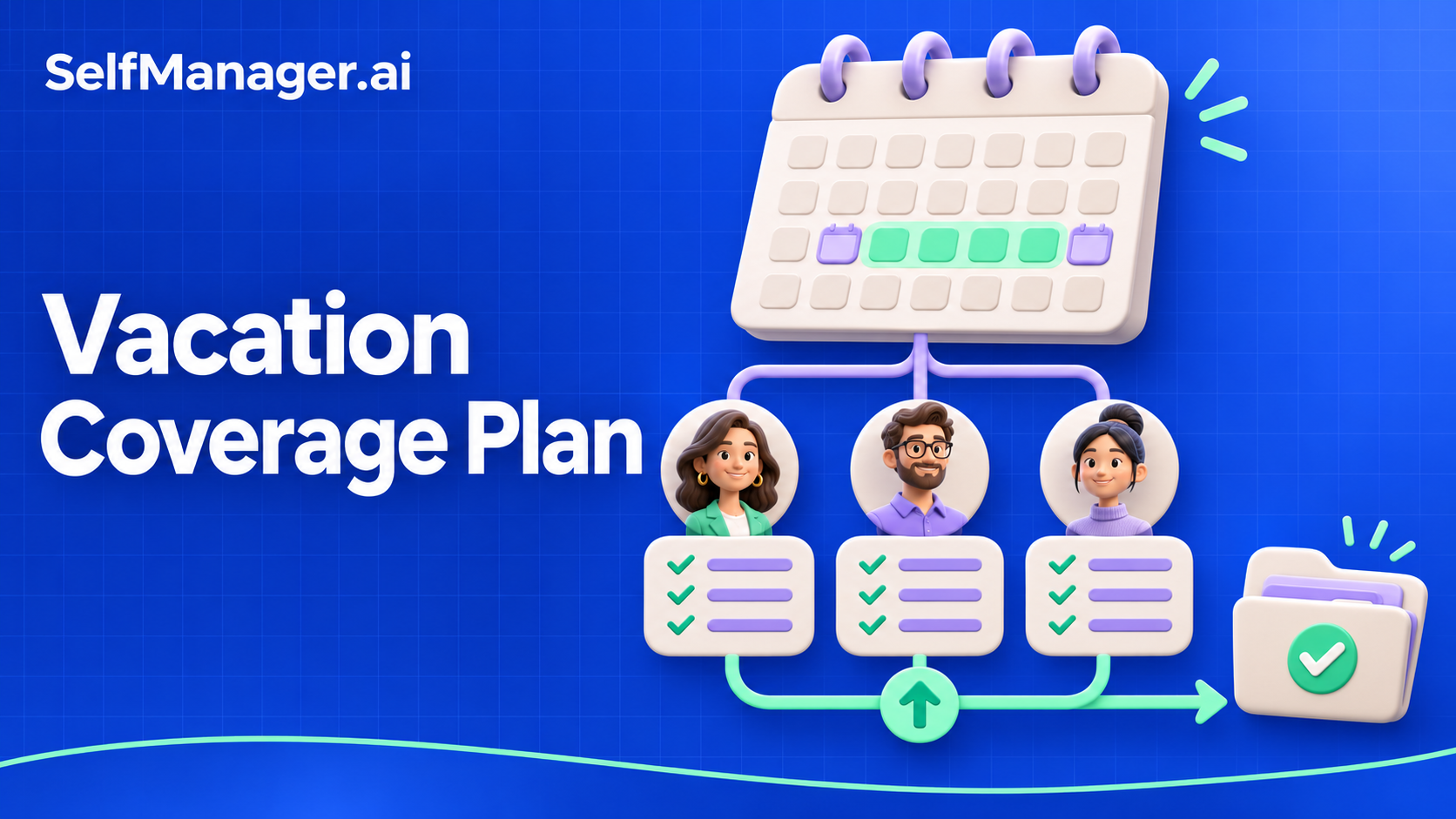
A vacation coverage plan defines the work that must continue during an absence, who has accepted responsibility, what they can decide and where to ask for help. It also states which work can wait. A useful plan becomes the team's working record while the usual owner is away.
You can run that record in SelfManager.ai using shared tables, assigned tasks, deadlines and notes. The coverage instructions stay beside the work, and the actions recorded during the absence become the basis of the return handoff.
Copy this coverage plan
| Plan item | What to record | Fictional example |
|---|---|---|
| Absence window | Last working day, unavailable dates and return date | Away Monday to Friday; returns the following Monday |
| Work that must continue | Specific responsibilities and delivery commitments | Review the client's Friday content package |
| Accepted backup | Person who agreed to handle that responsibility | Project editor, confirmed before leave |
| Work date and deadline | When to act and when the result is due | Review Thursday; send by Friday afternoon |
| Working context | Brief, current state, files and known questions | Approved outline and latest package reference |
| Decision boundaries | What the backup can decide and what needs escalation | Edit agreed copy; escalate scope or budget changes |
| Escalation route | Who can resolve the exception and how to reach them | Account lead through the team's agreed channel |
| Work that can wait | Explicitly paused or queued responsibilities | New non-urgent requests held until return |
| Return record | Actions taken, decisions and open follow-ups | Package sent; one new request still needs a decision |
The role names are examples. Replace them with people who have accepted the responsibility and can access what the work requires.
Define coverage by responsibility
“Cover my inbox” leaves too much undecided. Separate the responsibilities that actually need attention: a delivery, an approval, a recurring check or a time-sensitive client request.
For each one, describe the expected result and the condition that should trigger action. Also identify what can safely wait. A coverage plan should not turn every item in the absent person's backlog into an urgent obligation for a colleague.
For a broader transfer of a project, use the project handover template. This plan concentrates on temporary ownership during a defined absence, including the return.
Assign the work where it will happen
In SelfManager.ai Team, create or prepare the shared table for the relevant workday. Add “Review Friday content package” as a task, assign it to the agreed backup editor and give it the delivery deadline. Subtasks can separate checking the brief, reviewing the package and preparing the reply.
Keep the working instructions in the table's notes and the appropriate reference files in Docs. The backup can then begin with the action and the context together, rather than searching for a handover document before every task.
SelfManager's assignments record who is responsible for the task. They do not automatically decide who should cover an absence. Agree the arrangement first, then make it visible in the work.
Check access and understanding before leave starts
Ask the backup to open the shared table and locate the brief, task and deadline. Have them explain what they would do with an ordinary request and which exception they would escalate.
On SelfManager's Team plan, a Viewer can read but cannot edit the work. Someone responsible for completing tasks needs an appropriate editing role. Share only the tables and material they need, and separately check access to external services used for the job.
Do not put passwords or private account credentials in the coverage notes. Use the organization's approved access arrangements. A task assignment does not grant access to an external mailbox or client system.
This rehearsal is useful because it catches missing context while the usual owner is still available to explain it.
Keep exceptions with the task
During the absence, record what changed where the work is happening. “Client asked for a different package; awaiting account lead's decision” is actionable context. A separate chat saying “there's an issue” is harder for the next person to interpret.
In SelfManager, enable comments on tasks so the backup can keep the question, decision and result with the parent task. Update its status as the work progresses. Keep the final instruction in the notes when it changes what someone should do next.
For recurring coverage work, repeating tables can supply fresh dated copies of the routine. Put the reusable instructions in the notes. Each occurrence needs its own actual result; previous task discussion and evidence should not be treated as the outcome of the new occurrence.
Build the return handoff from the coverage record
When the usual owner returns, summarize completed responsibilities, decisions made, unresolved requests and anything requiring a new commitment. Keep the summary short enough to act on, with references to the underlying work.
SelfManager's Team AI Review can help draft that summary from the shared tables over the absence period. Ask for completed coverage work, open actions and recorded decisions, then verify it against the tasks and comments before handing responsibility back.
Explicitly confirm the return of ownership. A Friday task still assigned to a backup should not silently become Monday's responsibility for someone else. Update assignments and decide the next work date for anything unfinished.
Common questions
Is an out-of-office message enough?
It tells people that someone is unavailable. The coverage plan establishes who will act on the work behind that message and which requests can wait.
Should every open task have a backup?
Cover the responsibilities that must continue. Agree which work is paused so that the backup has a realistic commitment.
What is the best first step?
Choose one responsibility for the next absence and rehearse it with the backup. Set up its coverage table in SelfManager.ai Team, with the task, instructions and deadline together. The 7-day free trial requires no card.
Date-based AI Task Manager
Plan smarter, execute faster, achieve more
Create tasks in seconds, generate AI-powered plans, and review progress with intelligent summaries. Perfect for individuals and teams who want to stay organized without complexity.
Get started with your preferred account