
Top Productivity Lessons Learned From Brian Chesky: Design, Details, and Founder Mode
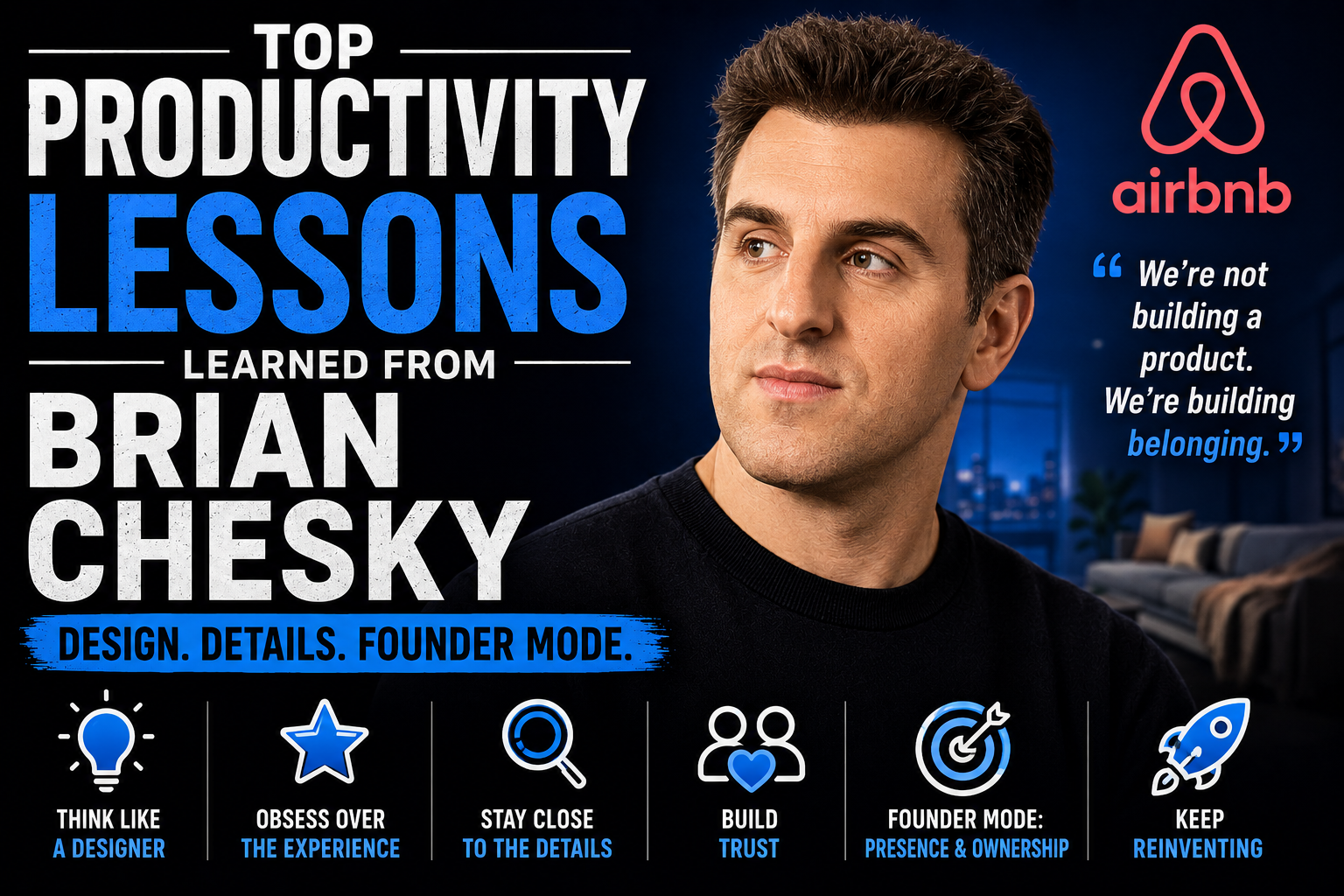
Brian Chesky is usually discussed as the co-founder and CEO of Airbnb.
That makes sense. Airbnb became one of the most important travel and hospitality platforms in the world, and Chesky helped turn a strange early idea, renting air mattresses in an apartment, into a global company.
But Brian Chesky is not only a startup story.
He is also a productivity story.
His work combines design thinking, customer obsession, storytelling, product taste, crisis management, and founder-level attention to detail. Airbnb's official leadership page describes Chesky as a Rhode Island School of Design graduate whose creative roots shaped Airbnb's culture, product, and community.
That makes him a very useful person to study if you are building a product, running a business, freelancing, managing a team, or trying to make better work.
Brian Chesky's productivity lesson is not simply "work harder."
It is:
- Design the experience.
- Stay close to the details.
- Simplify what matters.
- Lead with ownership.
- And build something people remember.
Below are the most useful productivity lessons learned from Brian Chesky.
1) Think like a designer, not only like a manager
Brian Chesky's design background is central to how Airbnb works. Airbnb's own bio says his design-driven approach shaped the company's culture, product, community, and trust system.
That is a productivity lesson.
Most people approach work like managers of tasks.
They ask:
- What do I need to do?
- What is due today?
- What is next?
A designer asks better questions:
- What experience am I creating?
- Where is the friction?
- What is confusing?
- What would make this simpler?
- What would make this memorable?
This changes how you work.
A manager might complete a task.
A designer improves the experience behind the task.
Practical habit:
Before finishing any important work, ask:
What would make this clearer, easier, or more useful for the person receiving it?
That question turns ordinary productivity into better output.
2) Obsess over the customer experience
One of Chesky's most famous ideas is the "11-star experience."
The idea is not to settle for small improvements. Instead, imagine an experience so remarkable that people would naturally talk about it. Reid Hoffman's Masters of Scale article about Chesky describes this framework as a way Airbnb thought beyond a normal 5-star experience and imagined what an unforgettable version would look like.
That is useful for productivity.
Most people ask:
How can I get this done?
A better question is:
How can I make this valuable enough that people remember it?
This applies to almost anything.
- A client proposal.
- A landing page.
- A product feature.
- A support reply.
- A presentation.
- A software update.
- A blog article.
- A meeting.
The goal is not perfection. The goal is to raise your standard.
Practical habit:
For one important task this week, ask:
- What is the 5-star version?
- What is the 7-star version?
- What is the 10-star version?
Then choose the best version that is realistic.
You may not build the 10-star version, but imagining it improves the version you actually ship.
3) Stay close to the details
Chesky became closely connected to the idea of "founder mode."
Paul Graham's 2024 essay on founder mode was based on a talk Chesky gave about scaling Airbnb. Graham wrote that Chesky had followed the common advice to hire good people and give them room, but found that this approach did not work for Airbnb, so he developed a more hands-on way of leading.
This does not mean every founder should micromanage every person.
But it does mean leaders should not disappear from the real work.
A founder, freelancer, or team leader who is too far from the details can lose touch with reality.
- The product gets worse.
- The customer experience gets weaker.
- The team starts optimizing for internal process.
- The company becomes slower.
- The work becomes abstract.
Chesky's lesson is that details matter because details are where the customer feels the product.
Practical habit:
Every week, inspect the real work.
- Use your own product.
- Read customer messages.
- Review the onboarding.
- Look at the actual user experience.
- Check the details that everyone assumes are fine.
Do not manage only from dashboards.
4) Founder mode is presence, not ego
Founder mode can be misunderstood.
Some people hear it and think it means ego, control, or chaos.
But the useful version is different.
In a 2025 discussion about founder mode and AI, Chesky argued that companies need startup-like adaptability in the AI era. He also described the useful meaning of founder mode as leadership through presence and attention to detail, not swagger.
That is a powerful productivity lesson.
- Presence means you care enough to understand what is happening.
- Presence means you know the customer.
- Presence means you know the product.
- Presence means you know the quality standard.
- Presence means you notice when the work drifts.
This applies even if you are a solo founder or freelancer.
You can outsource execution, but you should not outsource judgment.
Practical habit:
Ask yourself:
Where am I too disconnected from the work that matters?
Then get closer to that area.
Not to control everything.
To make better decisions.
5) Simplify until people understand
Airbnb has to make a complicated thing feel simple.
- Travel is complicated.
- Trusting strangers is complicated.
- Booking homes is complicated.
- Host expectations are complicated.
- Guest expectations are complicated.
- Safety is complicated.
- Payments are complicated.
But the product must feel simple enough for normal people to use.
That is a major productivity principle.
Complexity is not impressive if the user gets lost.
Your work becomes more valuable when you simplify it.
- A simpler proposal is easier to approve.
- A simpler product is easier to use.
- A simpler plan is easier to execute.
- A simpler message is easier to remember.
- A simpler task list is easier to follow.
Practical habit:
When something feels too complex, reduce it to one sentence:
- What is this for?
- Who is it for?
- What should happen next?
If you cannot explain it simply, the work is probably not ready.
6) Use storytelling to align people
Chesky is not only a product thinker. He is also a storyteller.
Wired reported that while planning Airbnb's expansion into services and experiences, Chesky wrote a long internal document, later refined it, and shared it with his leadership team as a clear vision for where the company could go next.
That is a productivity lesson for anyone leading work.
People do not only need tasks.
They need context.
They need to understand why the work matters.
A weak task says:
"Build this."
A stronger task says:
"Here is the problem. Here is who we are helping. Here is what success looks like. Here is why this matters now."
Story gives work direction.
Practical habit:
Before starting a major project, write a short project story:
- What problem are we solving?
- Why does it matter?
- Who benefits?
- What does success look like?
- What should be avoided?
This makes execution easier because people understand the point of the work.
7) Build for trust
Airbnb's business required strangers to trust each other.
That is not a small detail. That is the core problem.
Airbnb's official bio connects Chesky's design-driven approach to building a system of trust that allowed strangers to live together.
This is a lesson for every business.
Trust is productivity.
- When people trust your product, they move faster.
- When clients trust you, approvals are easier.
- When your team trusts the system, fewer things need to be rechecked.
- When users trust the experience, they return.
- When you trust your own process, you waste less energy second-guessing everything.
Practical habit:
Ask:
Where does my work create doubt?
Then fix that part.
- Maybe your pricing is unclear.
- Maybe your onboarding is weak.
- Maybe your product has too many confusing steps.
- Maybe your communication creates uncertainty.
Trust reduces friction.
8) Crisis can force clarity
Airbnb had a brutal crisis during the pandemic. Wired reported that Airbnb lost 80 percent of its business in eight weeks and laid off a quarter of its staff, but Chesky later described the pandemic as a turning point for the company.
That is a painful but important productivity lesson.
Crisis exposes what matters.
When everything is easy, you can carry too much.
- Too many projects.
- Too many expenses.
- Too many weak processes.
- Too many unclear priorities.
- Too many assumptions.
But when pressure rises, you are forced to ask:
- What must survive?
- What is essential?
- What should be cut?
- What do customers really need?
- What kind of company are we actually building?
Practical habit:
Do a "crisis clarity" review before you are in crisis.
Ask:
- If I had to cut 50 percent of my commitments, what would stay?
- If I had half the time, what would I still do?
- If I had to rebuild this project from scratch, what would I keep?
This reveals your real priorities.
9) Design work around how people actually live
Chesky has also thought deeply about how work itself is changing.
In a TIME interview, he discussed Airbnb's work-from-anywhere policy and argued that for laptop-based work, the traditional office should be questioned. He said the office is not necessarily gone, but it needs to serve purposes that home cannot, such as collaboration.
That is useful beyond remote work.
Productivity systems should fit real life.
Not fantasy life.
Not influencer life.
Not a perfect morning routine that collapses by Wednesday.
Your system should fit:
- Your energy.
- Your schedule.
- Your responsibilities.
- Your work style.
- Your team.
- Your actual constraints.
Practical habit:
Instead of asking, "What is the perfect productivity system?"
Ask:
What system would I actually use on a normal, imperfect week?
That is the system worth building.
10) Keep reinventing the product
Airbnb could have stayed only a vacation rental company.
But Chesky has pushed the company toward a broader platform around travel, services, experiences, trust, identity, and eventually AI-powered personalization. Wired reported on Airbnb's major reinvention, including services, experiences, stronger profiles, and a long-term AI concierge vision.
That is a productivity lesson.
The system that got you here may not get you to the next stage.
- Your product may need to evolve.
- Your workflow may need to evolve.
- Your content strategy may need to evolve.
- Your business model may need to evolve.
- Your personal productivity system may need to evolve.
Consistency is good.
But blind repetition is not.
Practical habit:
Every quarter, ask:
- What part of my work is outdated?
- What user behavior has changed?
- What market reality has changed?
- What old assumption am I still carrying?
- What needs to be redesigned?
Productivity is not only about maintaining systems.
Sometimes it is about redesigning them.
11) Make the product emotionally memorable
Airbnb is not only about booking a place to sleep.
The stronger version of the product is about belonging, connection, travel, memory, and human experience.
That emotional layer matters.
A purely functional product can work.
But an emotionally memorable product can become part of someone's life.
This also applies to personal work.
People remember how your work made them feel.
- Was it clear?
- Was it thoughtful?
- Was it easy?
- Was it stressful?
- Was it surprising?
- Was it trustworthy?
- Was it useful?
- Was it human?
Practical habit:
After finishing important work, ask:
What will the other person feel when they experience this?
- Confused?
- Relieved?
- Impressed?
- Motivated?
- Safe?
- Excited?
If you design for the feeling, the work becomes stronger.
12) Do not apologize for caring about the details
One of the strongest Chesky lessons is this:
Do not apologize for caring deeply.
Wired reported that after the pandemic, Chesky said one of his first principles became not apologizing for how he wanted to run the company, especially not apologizing for being in the details.
That is a useful lesson for founders and builders.
Sometimes people will tell you:
- Do not be so involved.
- Do not care so much.
- Do not check every detail.
- Do not overthink the experience.
- Just delegate it.
Sometimes they are right.
But sometimes the details are the product.
The key is knowing which details matter.
You do not need to control every tiny thing.
But you should care deeply about the details that shape quality, trust, and the customer experience.
Practical habit:
Create a "details that matter" list.
For example:
- First user experience.
- Checkout flow.
- Client onboarding.
- Product quality.
- Support response tone.
- Design consistency.
- Core feature reliability.
Then stay close to those details.
A Simple Brian Chesky-Inspired Productivity Framework
Daily
- Work on the part of the product or project that affects the user most.
- Ask what experience you are creating.
- Simplify one confusing thing.
- Stay close to the details that matter.
- Do not only complete tasks. Improve the experience.
Weekly
- Review customer feedback.
- Use your own product or service.
- Identify one friction point.
- Write down one improvement that would make the experience more memorable.
- Check whether your work still matches the bigger story.
Monthly
- Review your product, service, or workflow like a designer.
- Ask where trust is weak.
- Ask where the experience feels generic.
- Ask where the system became too complex.
- Remove one source of friction.
Quarterly
- Rethink the bigger vision.
- Ask whether the current system still fits the future.
- Look for outdated assumptions.
- Decide which details deserve founder-level attention.
- Redesign what no longer works.
How to Apply This With SelfManager.ai
Brian Chesky's productivity lessons fit naturally into a date-based productivity system.
Design thinking: Use each date to design the day, not just store tasks.
Customer obsession: Track feedback, product ideas, support issues, and improvement opportunities where they happen.
Founder mode: Stay close to the work that shapes quality and customer experience.
Simplification: Use weekly reviews to remove friction from your workflow.
Reinvention: Use monthly and quarterly reviews to ask whether your system still matches the way you work now.
A good productivity system is not just a place to collect tasks.
It is a place to design better days, better projects, better products, and better experiences.
That is the Brian Chesky lesson.
Do not only manage the work.
Design the experience.
Date-based AI Task Manager
Plan smarter, execute faster, achieve more
Create tasks in seconds, generate AI-powered plans, and review progress with intelligent summaries. Perfect for individuals and teams who want to stay organized without complexity.
Get started with your preferred account