Top Productivity Lessons Learned From Marc Andreessen: Build, Think, and Bet on the Future
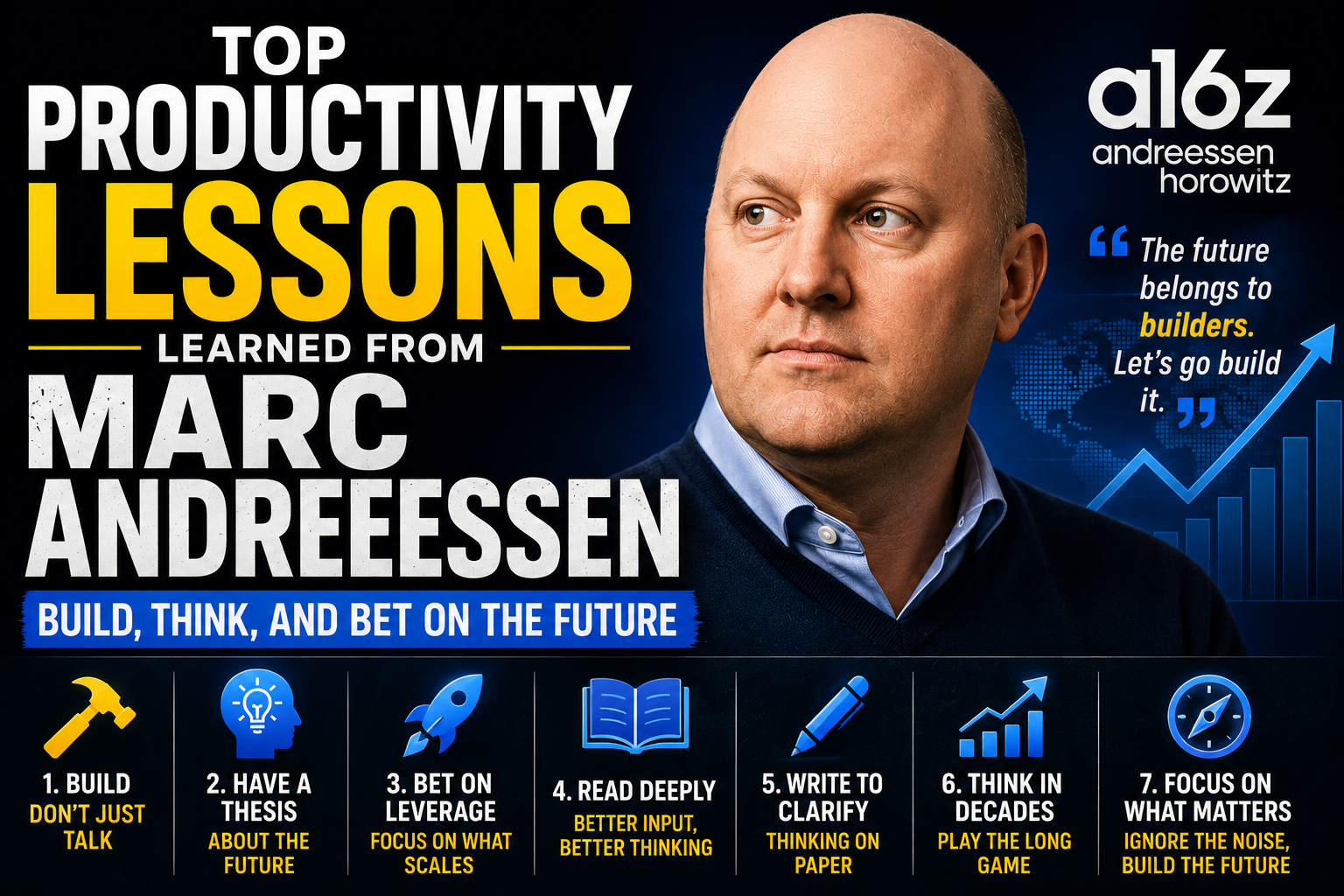
Marc Andreessen is usually discussed as a venture capitalist, entrepreneur, and one of Silicon Valley's most influential technology thinkers.
That makes sense.
He is a co-founder and general partner at Andreessen Horowitz, also known as a16z. The firm describes him as an innovator and creator who helped pioneer a software category used by more than a billion people and helped establish multiple billion-dollar companies.
But Marc Andreessen is not only an investor story.
He is also a productivity story.
His career sits at the intersection of software, startups, venture capital, writing, technology optimism, and long-term strategic thinking.
The useful lesson is not "become a venture capitalist."
The useful lesson is:
- Think clearly.
- Read deeply.
- Build instead of complain.
- Use technology as leverage.
- Have a thesis about the future.
- And spend your time on things that can compound.
Below are the most useful productivity lessons learned from Marc Andreessen.
1) Build instead of only talking about problems
One of Andreessen's most famous essays is It's Time to Build.
The core message is simple: societies, companies, and people need to build more. The essay argues that production, invention, construction, and technological progress are what create the future people want.
That is a direct productivity lesson.
Many people spend too much time analyzing problems and not enough time building solutions.
- They complain about tools.
- They complain about markets.
- They complain about platforms.
- They complain about clients.
- They complain about competitors.
Sometimes the complaints are valid.
But complaining does not create leverage.
Building does.
Practical habit:
When you catch yourself complaining, ask:
What can I build in response?
- A better article.
- A better workflow.
- A better product.
- A better offer.
- A better process.
- A better system.
A builder turns frustration into output.
2) Have a thesis about where the world is going
Andreessen's 2011 essay Why Software Is Eating the World became one of the most important technology essays of the last 15 years. In it, he argued that the economy was going through a major technological and economic shift, with software companies positioned to transform large parts of industry.
That was not just a prediction.
It was a thesis.
A thesis helps you decide where to spend your time.
Without a thesis, everything looks equally interesting.
With a thesis, you know what deserves attention.
For productivity, this matters a lot.
- If you believe AI will reshape knowledge work, you should spend time learning AI workflows.
- If you believe content compounds, you should build a publishing system.
- If you believe software keeps eating services, you should learn how to turn repeated services into products.
- If you believe distribution matters more than features, you should build marketing skills.
A thesis gives your work direction.
Practical habit:
Write down your current work thesis in one sentence.
For example:
"I believe small teams using AI and software can compete with much larger companies."
Then ask:
Does my calendar match that belief?
If not, your thesis is just a sentence.
3) Bet on leverage
Andreessen's career has been shaped by software, venture capital, networks, startups, and technology platforms.
All of those are leverage systems.
- Software scales.
- Capital scales.
- Networks scale.
- Writing scales.
- Media scales.
- Technology platforms scale.
That is the productivity lesson.
Not all work has the same return.
Some work disappears as soon as you finish it.
Some work keeps producing value long after the original effort.
- A private meeting may be useful once.
- A published essay can influence thousands of people.
- A manual process may solve one problem.
- A software system can solve the same problem repeatedly.
- A custom client solution may help one client.
- A reusable framework can help many clients.
Practical habit:
At the end of each week, ask:
What did I do that can compound?
If the answer is "nothing," your week may have been busy, but not leveraged.
4) Read enough to think independently
Marc Andreessen is known for being a heavy reader and a broad thinker.
That shows up in his essays, interviews, and investment worldview. His writing often connects economics, technology, markets, culture, history, and startup strategy.
This matters because productivity is not only about execution.
It is also about input quality.
If your inputs are shallow, your decisions become shallow.
If your inputs are noisy, your thinking becomes noisy.
If your inputs are only social media reactions, your strategy becomes reactive.
Better thinking requires better input.
Practical habit:
Create a serious reading diet.
Not just posts.
Not just summaries.
Not just short videos.
Read books, long essays, annual reports, founder interviews, technical explainers, market analysis, and opposing views.
The goal is not to collect information.
The goal is to improve judgment.
5) Write to clarify your thinking
Andreessen's influence does not only come from investing.
It also comes from writing.
Essays like Why Software Is Eating the World, It's Time to Build, and The Techno-Optimist Manifesto helped shape technology conversations far beyond a16z. The 2023 manifesto argued for technology, markets, innovation, and growth as forces for progress.
Writing is one of the most underrated productivity tools.
Writing forces clarity.
A vague idea can survive in your head.
It has a much harder time surviving on the page.
When you write, you notice the gaps.
- You see weak assumptions.
- You discover contradictions.
- You sharpen the argument.
- You turn intuition into something usable.
Practical habit:
Before making a major decision, write a one-page memo.
Include:
- What I believe.
- Why I believe it.
- What evidence supports it.
- What could prove me wrong.
- What I will do next.
Writing makes thinking visible.
6) Be optimistic, but not passive
Andreessen is strongly associated with techno-optimism.
His Techno-Optimist Manifesto argues that technology, markets, and innovation can drive progress, abundance, and growth.
But productive optimism is not sitting around and hoping things improve.
Productive optimism means believing improvement is possible and then acting accordingly.
That is very different from blind positivity.
Blind positivity says:
Everything will work out.
Productive optimism says:
The future can be better if we build, learn, invest, experiment, and solve hard problems.
This matters for daily work.
- A pessimistic person sees obstacles and stops.
- A naive optimist ignores obstacles.
- A productive optimist sees obstacles and starts building around them.
Practical habit:
When you face a difficult problem, ask:
What would I do if I believed this could be solved?
That question changes your posture from helpless to active.
7) Think in decades, not just days
Andreessen's best-known ideas are long-term ideas.
Software eating the world was not a one-week trend.
Techno-optimism is not a quarterly tactic.
Venture investing itself is based on long time horizons, uncertain outcomes, and asymmetric upside.
That creates a useful productivity lesson:
Not every important thing gives feedback immediately.
- Building skill takes time.
- Building a product takes time.
- Building a reputation takes time.
- Building a content library takes time.
- Building a company takes time.
- Building trust takes time.
If you only optimize for immediate feedback, you may avoid the very work that matters most.
Practical habit:
Divide your tasks into two groups:
- Short-term maintenance.
- Long-term compounding.
You need both.
But if your entire week is maintenance, your future is not being built.
8) Look for platform shifts early
Andreessen has spent much of his career around platform shifts.
- The web.
- Software.
- Cloud.
- Mobile.
- Crypto.
- AI.
Whether every bet works or not, the productivity lesson is useful:
Big changes create new leverage.
People who notice platform shifts early can adapt faster.
- They can learn earlier.
- Build earlier.
- Publish earlier.
- Create offers earlier.
- Understand markets earlier.
This does not mean chasing every trend.
It means watching for changes that alter how work gets done.
AI is the obvious current example.
The useful question is not only:
"What tool is popular?"
The better question is:
"What work becomes cheaper, faster, easier, or newly possible because of this platform shift?"
Practical habit:
Once per month, ask:
What changed in technology that affects my work?
Then create one small experiment.
Do not just read about the shift.
Test it.
9) Separate criticism from creation
Andreessen's writing often pushes against pessimism, bureaucracy, stagnation, and anti-technology thinking. Whether someone agrees with all his views or not, there is a clear productivity lesson:
Criticism is easier than creation.
- It is easier to explain why something will fail than to build something that might work.
- It is easier to mock a new idea than to test it.
- It is easier to be cynical than to be responsible for an outcome.
Many people confuse being critical with being intelligent.
But criticism without creation can become a trap.
Practical habit:
For every criticism, require a constructive version.
Instead of:
"This is broken."
Ask:
"What would better look like?"
Instead of:
"This product is bad."
Ask:
"What would I change?"
Instead of:
"This market is crowded."
Ask:
"What is still underserved?"
This keeps criticism useful.
10) Study markets, not only products
As a venture capitalist, Andreessen does not only look at products.
He looks at markets, timing, distribution, technology shifts, founders, incentives, and scale.
That is a productivity lesson for builders.
- A product can be good and still fail.
- A service can be excellent and still be hard to sell.
- A feature can be clever and still not matter.
- A business idea can be interesting and still have no market pull.
Productivity is not only doing the work well.
It is choosing work connected to real demand.
Practical habit:
Before committing deeply to a project, ask:
- Who wants this?
- How painful is the problem?
- How do people solve it now?
- Why now?
- What changes if this works?
- Where is the market pull?
Better questions prevent wasted execution.
11) Use strong opinions as working tools
Andreessen is known for strong opinions.
Strong opinions are useful when they create direction.
They are dangerous when they become ego.
The productive version is:
- Have a clear thesis.
- Act on it.
- Test it against reality.
- Update when needed.
The unproductive version is:
- Have a loud opinion.
- Ignore evidence.
- Defend your identity.
- Refuse to learn.
Strong opinions are not the enemy.
Unreviewed opinions are.
Practical habit:
When you make a strong claim, attach a review point.
For example:
"I believe this content strategy will work. I will review it after 90 days based on traffic, backlinks, signups, and engagement."
This turns opinion into an experiment.
12) Spend more time on what can change the future
The deepest Andreessen productivity lesson is this:
Work on things that matter beyond the current moment.
That does not mean every task must be world-changing.
- You still need admin.
- You still need maintenance.
- You still need replies, fixes, bills, support, and routine work.
But the center of your work should not be only maintenance.
Some part of your week should be future-building.
- Learning a high-leverage skill.
- Writing a strategic article.
- Building a product feature.
- Improving a system.
- Creating an asset.
- Testing a new channel.
- Developing a better offer.
- Studying a platform shift.
- Meeting people who expand your thinking.
Practical habit:
Schedule future-building work before maintenance consumes the week.
Do not wait for free time.
Free time rarely appears.
A Simple Marc Andreessen-Inspired Productivity Framework
Daily
- Build something instead of only consuming.
- Write down one clear decision or thesis.
- Spend time on work that creates leverage.
- Avoid getting trapped in low-value criticism.
- Ask what can compound from today's effort.
Weekly
- Review what you built.
- Review what you only talked about.
- Read one serious long-form piece.
- Write one memo, article, or strategy note.
- Identify one platform shift or market change worth testing.
Monthly
- Ask whether your calendar matches your thesis.
- Cut work that has no leverage.
- Review your strongest assumptions.
- Look for one system, asset, or piece of writing that can compound.
- Run one experiment around a technology or market shift.
Quarterly
- Update your worldview.
- Ask what future you are betting on.
- Decide which long-term work deserves more focus.
- Stop one project that no longer fits the thesis.
- Double down on the few things that can create asymmetric upside.
Final Thoughts
Marc Andreessen's productivity lessons are not about simple task management.
They are about strategic productivity.
- Build more.
- Read deeply.
- Write clearly.
- Think from first principles.
- Have a thesis.
- Use technology as leverage.
- Pay attention to platform shifts.
- Spend your time on work that can compound.
The most important lesson may be the simplest:
If you want a better future, do not only predict it.
Build toward it.
Date-based AI Task Manager
Plan smarter, execute faster, achieve more
Create tasks in seconds, generate AI-powered plans, and review progress with intelligent summaries. Perfect for individuals and teams who want to stay organized without complexity.
Get started with your preferred account