
Why Knowledge Workers Can't Switch Off After Work (And What Actually Helps)
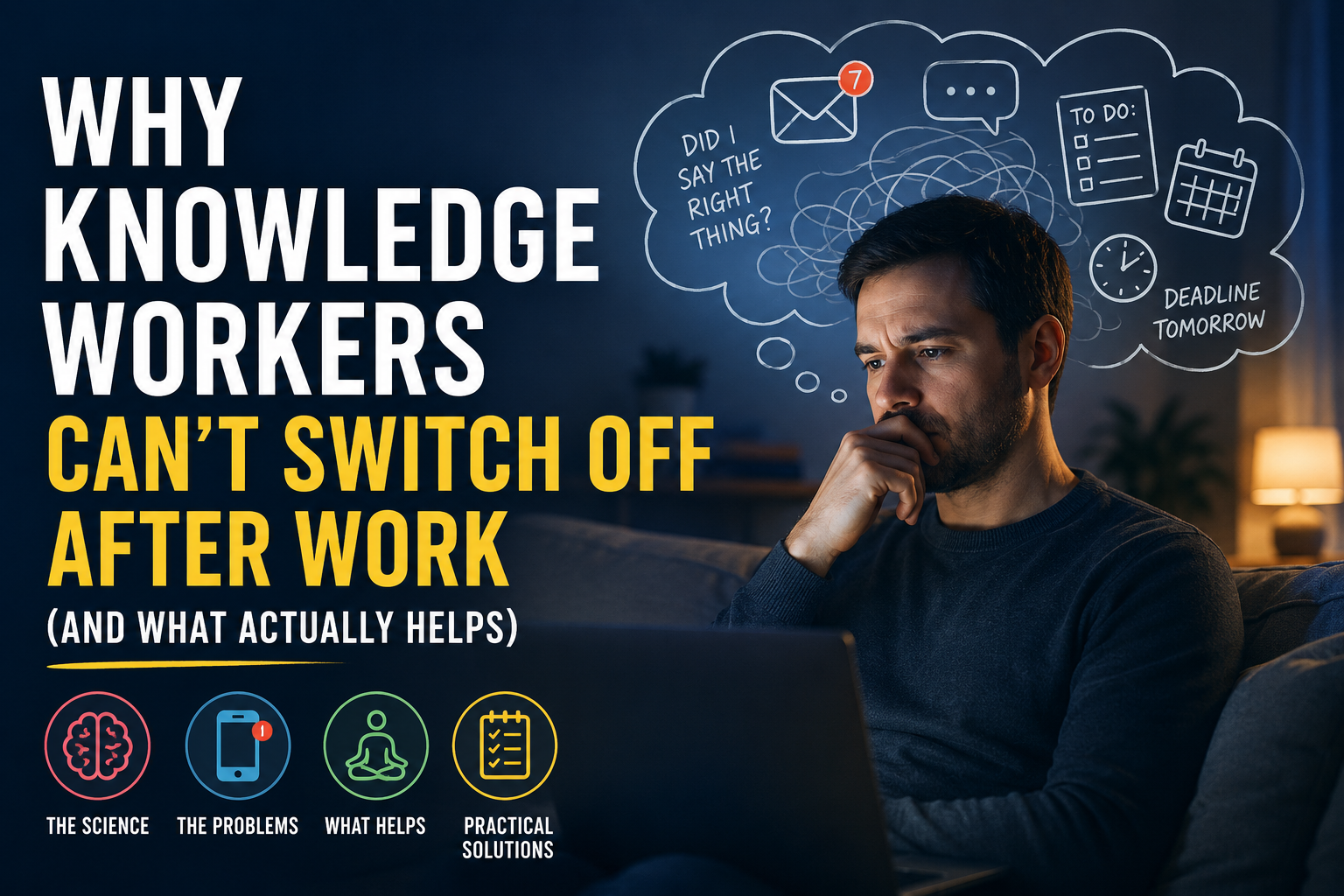
There's a specific kind of exhaustion that knowledge workers feel at 9pm that doesn't make sense on paper.
You've already closed the laptop. You're sitting on the couch. The day is technically over. But your brain is still rehearsing the email you didn't send, recalculating the deadline you might miss, or replaying that meeting with a small loop of "I should have said." Sometimes the laptop opens itself again at 10:30pm just to "check one thing."
This is one of the most consistent complaints in modern knowledge work. Not "I worked too many hours today" - though that happens too - but "I can't stop working in my head." The day ends in the calendar but doesn't end in the mind.
This article is about why that happens and what actually helps. There is real research here. There is also a lot of bad advice. The goal is to separate the two.
Why Knowledge Work Follows You Home
Physical work has a clear ending. The bricks are laid. The kitchen is closed. The shift is over. Even when the body is exhausted, the work itself stays at the worksite when you leave.
Knowledge work doesn't have that. The work lives in your head. The decisions, the open questions, the half-finished documents, the things you still need to think through - none of it stays in the office because there's no office anymore. The office is your brain.
A few specific forces have made this harder, not easier, in the last decade.
1. The Disappearance of Physical Boundaries
For most of the 20th century, knowledge workers had a commute. The commute did invisible work - it created a transition between work mode and home mode. Even if you spent the train ride thinking about emails, the body knew it was moving from one context to another.
Remote work removed that. Research by Stanford economist Nicholas Bloom during the pandemic showed remote work increased productivity for many tasks but also extended the working day on both ends. Without the physical transition, the workday bled into morning and evening.
Same chair. Same laptop. Same screen. Same lighting. The brain has no environmental cue that "work is over."
2. Always-On Communication Tools
Slack, email, Teams, WhatsApp work chats, and project management notifications turn your phone into a portable office. Microsoft's 2021 Work Trend Index identified what they called the "triple peak day" - a productivity peak in the morning, a peak in the afternoon, and a new peak after dinner. Knowledge workers were checking back in late at night because the tools made it frictionless.
It is not that anyone forces you to read Slack at 10pm. It is that your phone is right there, the red dot is visible, and you've trained yourself to associate checking it with relief.
3. The Zeigarnik Effect
In the 1920s, psychologist Bluma Zeigarnik observed that waiters at a Vienna restaurant could remember complex orders perfectly - until those orders were served. Once the task was complete, the memory dissolved. Unfinished tasks, on the other hand, stayed sticky.
This is now known as the Zeigarnik effect. Unfinished tasks claim mental resources until they are either completed or properly parked somewhere the brain trusts.
Knowledge work is almost entirely composed of unfinished tasks. You don't ship a document the way a baker ships bread. Documents have versions. Code has branches. Strategies have iterations. The work is structurally incomplete most of the time.
That is why your brain doesn't stop. It is not undisciplined. It is trying to hold onto things it doesn't trust will be there in the morning.
4. Identity Fusion
Many knowledge workers don't just do their work. They are their work. Their LinkedIn headline is their identity. Their title is part of how they introduce themselves at parties. Their self-worth fluctuates with how the week went.
This is especially true for founders, freelancers, and senior individual contributors who chose their field because they love it. Loving your work is great. Being unable to separate from it is not.
When work is identity, switching off feels like switching off yourself. The brain resists it the same way it would resist any erasure of self.
5. Variable Reward Loops
Notifications, Slack pings, dashboard metrics, and email all operate on the same psychological machinery that makes slot machines compelling. Variable reinforcement - reward delivered at unpredictable intervals - is one of the most powerful behavioral patterns in psychology.
This is not a moral failing. The tools are designed this way. Refreshing your inbox or your analytics dashboard hits the same dopamine system as scrolling Instagram. The reason you keep checking is not that you are weak. It's that the design is working on you.
The Cost of Not Switching Off
The research on what happens when knowledge workers cannot recover is consistent and unkind.
Psychologist Sabine Sonnentag has spent decades studying what she calls "psychological detachment from work" - the experience of mentally disengaging from work during off-hours. Her work shows that the inability to detach predicts emotional exhaustion, sleep problems, lower next-day energy, and reduced creativity at work.
The irony is sharp. People who can't switch off after work get worse at work the following day. The exhaustion compounds.
There are also less measurable costs. Relationships erode. Hobbies vanish. People stop reading novels, stop calling friends, stop being present at dinner. The week becomes a blur of work and recovery from work, with no actual life in between.
Most knowledge workers know this. They feel it. But they don't know what to do about it, because the standard advice - "set boundaries," "work-life balance" - is too vague to act on.
What Recovery Actually Looks Like
Sonnentag's research is a useful place to start on what helps. She identified four recovery experiences that contribute to actual psychological detachment from work:
- Psychological detachment - actively not thinking about work
- Relaxation - low-effort activities that reduce arousal
- Mastery - non-work activities that demand attention and skill
- Control - feeling in charge of how you spend your off-hours
Notice that "relaxation" is only one of the four. The other three require activity. This is the part most people miss. Recovery is not passive. Knowledge workers who detach successfully tend to do something with their off-hours, not just collapse.
What follows is a breakdown of the specific solutions backed by research and used in the field. Some of them sound obvious. Almost none of them are practiced consistently, which is what makes them effective when actually done.
Shutdown Ritual
Cal Newport, in Deep Work, calls this "Schedule Shutdown, Complete." The idea is to formally close the workday with a short, repeatable ritual.
In Newport's version, you review every open task. You either complete it, schedule it, or capture it somewhere you trust. Then you say a phrase ("Schedule shutdown, complete") out loud. After that, you don't engage with work until the next morning.
The phrase isn't the magic. The ritual is. By giving your brain a clear signal that everything is captured, you address the Zeigarnik effect directly. The unfinished tasks aren't unfinished in your head anymore. They are in the system.
This is the single most evidence-supported tactic for psychological detachment. It is also the one most knowledge workers skip because it feels silly. It's not silly. It works because of how memory and attention are structured.
Physical Transition
Without a commute, you need a synthetic one. Something physical that moves your body from work mode to off mode.
The most common versions:
- A short walk outside, 5 to 20 minutes
- A workout at the end of the workday
- Changing out of "work clothes," even if you work from home
- Closing the laptop and physically putting it in a drawer or bag
- A specific route through the house that signals the workday is over
The mechanism is dual. Physical movement reduces stress hormones, cortisol especially. The change of context tells the brain that the situation has changed. The brain takes cues from the body more than the other way around.
Exercise
Exercise is the most over-recommended and under-done solution in knowledge work. The research is overwhelming. Aerobic exercise reduces cortisol, increases BDNF (brain-derived neurotrophic factor), improves sleep, and reliably reduces rumination - the technical name for "thinking about work in the shower for 40 minutes."
Anything counts. A 20-minute walk counts. Lifting counts. Cycling counts. The threshold for benefit is low. The threshold for "I'm too tired" is high. Most knowledge workers feel too tired after work because their bodies have been sitting still all day, not because they actually lack energy.
The post-workout state is one of the most reliable times to feel "switched off" without any effort to do so.
Nature Exposure
Research from Yoshifumi Miyazaki at Chiba University and the Japanese practice of shinrin-yoku (forest bathing) shows measurable drops in cortisol and blood pressure after 30 to 40 minutes in a natural environment. Studies from Stephen and Rachel Kaplan at the University of Michigan on what they called "attention restoration theory" suggest that natural environments restore the cognitive resources that work depletes - in a way that screens never do.
You don't need a forest. A park works. A tree-lined street works. The mechanism is partly the absence of digital input and partly the visual complexity that human attention evolved to handle.
This is one of the easiest free interventions available and one of the most consistently effective. Twenty minutes in a green space at the end of the workday changes the chemistry of the next four hours.
Caffeine, But Earlier
Many knowledge workers reach for coffee at 4pm to push through the afternoon slump. Caffeine has a half-life of around five hours, which means the cup you drink at 4pm still has half its load active at 9pm. That is enough to disrupt sleep and to keep your brain in problem-solving mode well past dinner.
A morning coffee ritual is great for switching on. An afternoon coffee, especially after 2pm, often works against switching off.
A coffee or tea break during the day, away from the screen, can also serve as a mini-transition. It is a small but real shift in attention. Used well, it builds a rhythm of small resets throughout the day that makes the final shutdown easier when the day actually ends.
Electronics Boundaries
The phone is the hardest piece. It is the device you use for work, communication, entertainment, navigation, and identity. Asking someone to "put down the phone" is asking them to detach from everything at once.
The research suggests the strongest interventions are environmental, not willpower-based:
- Phone in another room during meals and the hour before sleep
- Notification settings that batch instead of interrupt
- Focus modes or do-not-disturb settings that auto-engage after work hours
- No work apps installed on the phone where possible
- A separate reading device (Kindle, paperback) for evening content instead of the same phone
Willpower fails consistently against well-designed apps. The only sustainable approach is reducing friction in the right direction.
Hobbies and Mastery Activities
This is Sonnentag's "mastery" recovery experience. Activities that demand attention and skill, without being work, tend to produce some of the strongest psychological detachment.
The specifics matter less than the structure. Music. Cooking. A sport. Writing fiction. Restoring furniture. Learning a language. Climbing. The point is something that requires real engagement, that has its own progress arc, and that's not work.
Passive consumption - scrolling, streaming, doomscrolling - doesn't qualify. Those activities reduce arousal slightly but don't restore attention or build identity outside of work. They are rest in the same way junk food is food.
The knowledge workers who detach best tend to have at least one mastery activity they protect even on bad weeks.
Social Time, Especially In Person
Conversations with people who don't ask about your work are a strong detachment signal to the brain. Family time, friend time, a phone call with someone outside your field - all of these compete with work for mental space and tend to win.
In-person social time appears to be more restorative than digital social time. Research on loneliness and social connection consistently shows that physical presence with other humans has effects that text and video calls partially replicate but do not fully match.
This is one of the reasons working from home alone for years can erode detachment skills even if the rest of life looks fine. The brain needs other people, not just other faces on a screen.
Planning Tomorrow Tonight
This is one of the most underrated tactics for switching off.
Spend five minutes at the end of the day deciding what tomorrow's three priorities are. Write them down somewhere your brain trusts you'll check in the morning.
The Zeigarnik effect dissolves once the brain believes a task is captured and will be picked up. Planning the next day creates that belief. It is also a clean stopping point - you've decided what is next, so today is officially over.
This is the single highest-leverage habit for ending the day cleanly. It takes five minutes. Most people skip it because they're "too tired" - which is exactly the energy state that creates anxiety about tomorrow.
Wind-Down Routines That Are Not "Just Read a Book"
A wind-down routine is not a list of activities. It is a sequence the brain learns to recognize as "the day is closing."
The most useful version isn't elaborate. Twenty to forty minutes between work and sleep where the body does the same things in roughly the same order. A walk after dinner. A shower. A book on a non-work topic. Lights dimming.
The reason this works is partly behavioral conditioning and partly circadian. Dim lights signal melatonin production. Lower stimulation signals the autonomic nervous system to shift toward parasympathetic activity. The brain follows.
Watching Netflix in bed with a phone in the other hand is not a wind-down routine. It looks like rest. It functions like more input.
What Doesn't Work (Or Works Less Than Advertised)
A few common solutions get more credit than they deserve.
"Just take a vacation." Vacations help, but the recovery effects fade within two weeks. Sonnentag's research and others show the return-to-work bounce is brief. Vacations don't fix the system. They give you a break from it. The system needs to change for the rest of the year to matter.
"Set boundaries." Boundaries without infrastructure fail. Telling yourself "I won't check Slack after 6pm" while leaving Slack on your phone is asking willpower to do work that environment design should do.
"Mindfulness apps." Meditation has real research behind it, but downloading an app rarely produces a habit. The people who benefit from meditation are the ones who do it consistently, which is a small percentage of the people who install the apps.
"Working harder during the day so you can fully rest." This sounds logical and doesn't survive contact with reality. People who work harder during the day tend to be more wired at the end of it, not less. Recovery is not a reward you earn through exhaustion. It's a separate skill.
"Just don't think about work." This is the dieting advice of mental health. Suppressing thoughts about work actually increases them. Daniel Wegner's "white bear" experiments in the 1980s demonstrated this directly. Trying not to think about something is a reliable way to think about it more. The solution is to give the brain something else to engage with, not to instruct it to stop.
The Honest Take
The reason most knowledge workers can't switch off isn't that they are broken or lazy. It is that the structure of the work, the tools, the environment, and the identity stack are all designed - directly or accidentally - to keep them engaged.
You cannot outrun a system through willpower. You can only redesign the inputs.
The knowledge workers who switch off well tend to share three things:
- A clear end-of-day ritual that captures open tasks somewhere they trust and decides what tomorrow's priorities are.
- A physical transition that signals the day is over - walk, gym, change of clothes, change of room, anything that involves the body.
- At least one engaging non-work activity that demands real attention and that they protect even on busy weeks.
That's it. Most of the rest is noise.
If you are going to add one thing to your week, make it the shutdown ritual with the next-day plan. It does the most work for the least input. Five minutes at the end of the day to clear the open loops is the difference between "still thinking about work at 10pm" and "not thinking about work at 10pm."
If you are going to add a second thing, make it a physical transition. Walk, lift, run, swim, anything. The body needs to know the situation has changed.
If you are going to add a third thing, find one hobby or activity that demands attention and isn't work. Then protect it like it pays your bills, because in a quieter way, it does.
Everything else - meditation apps, vacation planning, complex time blocks - is downstream of those three.
A Note on Why This Is Worth the Effort
The case for switching off is sometimes framed as a wellness argument - sleep better, feel happier, prevent burnout. All true, but it understates the case.
Knowledge work depends on a brain that can think clearly, take risks, see patterns, and notice what is actually important. A brain that has been "on" for sixteen hours straight cannot do any of those things. The work you do in your eleventh hour is rarely your best work, and the cost of producing it is the work you would have done in the first hour the next day.
Switching off is not the opposite of doing good work. It is part of it.
The people who appear to outwork everyone else over a long career are almost always the ones who recover the hardest. They sleep more, walk more, build hobbies that have nothing to do with their field, and treat their off-hours as part of their craft, not as time stolen from it.
That's the model. The hours you don't work are not lost. They are how the work stays sharp.
Key Takeaways
- Knowledge work follows you home because it lives in your head, not at a worksite. Modern tools and remote work have made the boundary even thinner.
- The inability to mentally detach predicts burnout, sleep problems, and reduced next-day performance. It is not a personality trait. It is a recoverable skill.
- Recovery is not passive. Research on psychological detachment shows that mastery activities, physical movement, and social time outperform passive rest.
- A shutdown ritual that captures open tasks and plans tomorrow resolves the Zeigarnik effect. It is the single highest-leverage habit.
- Physical transitions matter more than people expect. A walk, a workout, a change of clothes - the brain takes cues from the body.
- Phones, notifications, and "always-on" tools are designed to keep you engaged. Environment design beats willpower every time.
- Vacations, mindfulness apps, and generic "set boundaries" advice all work less than advertised. They help, but only inside a larger structure.
- The hours you don't work are how the work stays sharp. Treat recovery as part of the craft, not as time stolen from it.
Date-based AI Task Manager
Plan smarter, execute faster, achieve more
Create tasks in seconds, generate AI-powered plans, and review progress with intelligent summaries. Perfect for individuals and teams who want to stay organized without complexity.
Get started with your preferred account