
Your To-Do List Isn't the Problem — Your Weekly Plan Is (2026)
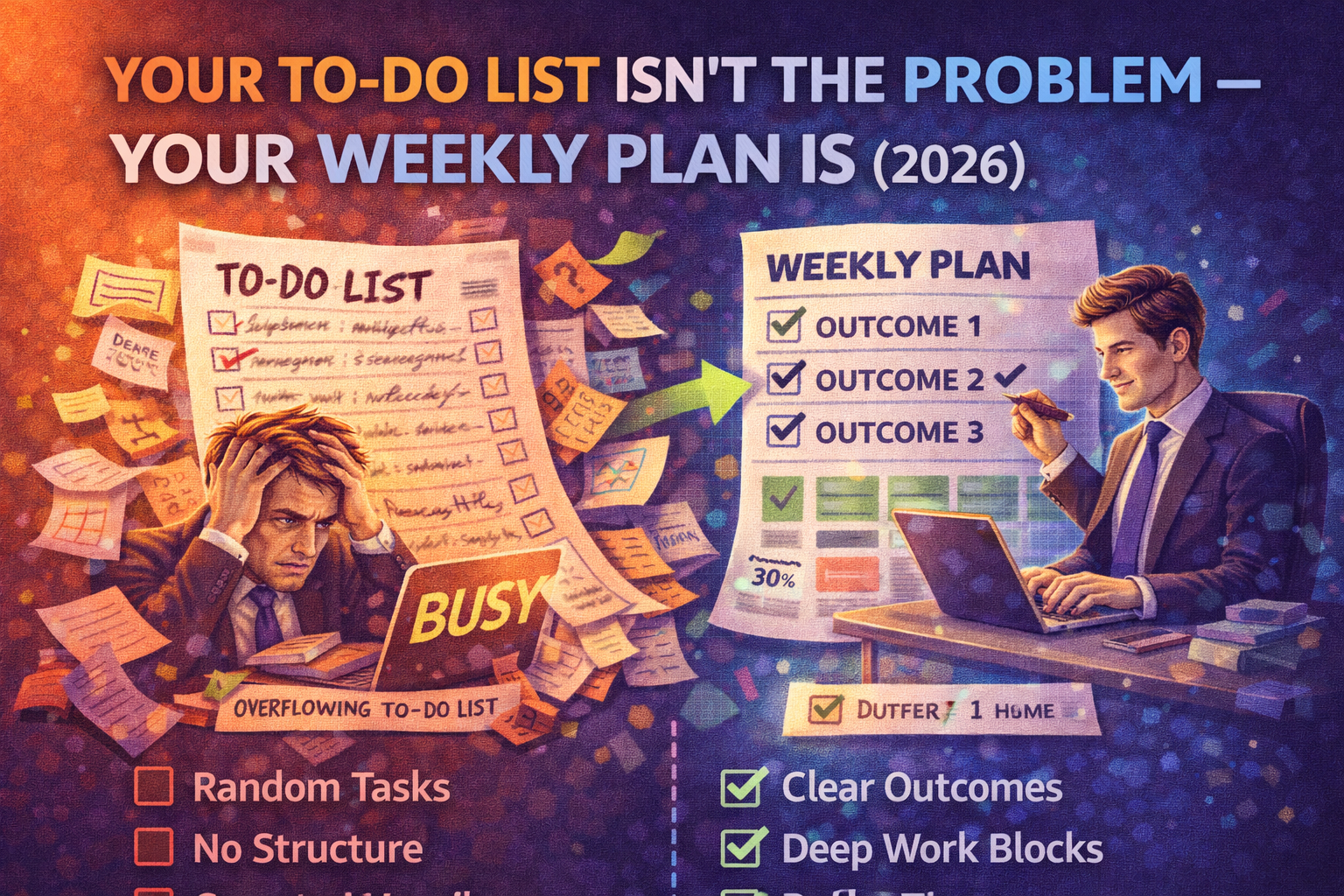
Why you keep feeling behind (and the simple weekly system that fixes it)
Most people think their productivity problem is their to-do list.
It's too long.
It's messy.
It stresses them out.
They keep rewriting it.
So they try:
- a new app
- new labels
- a new "perfect" system
- a fresh start Monday
But the issue usually isn't the list.
The issue is that the list has no weekly plan.
Without a weekly plan, your to-do list becomes a bucket of wishes — and your days turn into reaction.
In 2026, the people who feel calm and consistent are not the ones with smaller lists.
They're the ones who run a simple weekly planning loop.
Why to-do lists fail (even when you're disciplined)
A to-do list is a container.
It doesn't know:
- what matters most
- what fits into this week
- what's blocked
- what needs deep work
- what's realistic with meetings and energy
So you open your list and it feels like everything is urgent.
That creates two common behaviors:
1) You do small easy tasks for dopamine
You clear 15 small items and avoid the big ones.
2) You carry tasks forward forever
You move the same tasks from day to day and start losing trust in yourself.
Neither of those problems is solved by "a better list."
They're solved by a weekly plan.
The real productivity unit is the week
Days are unpredictable.
Weeks are manageable.
A week gives you enough space to:
- prioritize
- schedule deep work
- handle interruptions
- make progress on projects
- review what happened
- adjust next week
If you plan only daily, you're playing defense.
If you plan weekly, you control the game.
The three types of work (and why your list becomes chaos)
Most lists mix these three together:
- Deep work (writing, building, designing, problem solving)
- Shallow work (email, admin, follow-ups)
- Maintenance (life tasks, recurring responsibilities)
When you don't plan weekly, shallow work expands and eats everything.
Deep work gets postponed.
Projects stall.
You feel busy… but stuck.
The Weekly Plan that fixes your to-do list (30 minutes)
You don't need an advanced system.
You need a repeatable weekly ritual.
Step 1: Choose 3 outcomes for the week
Not 10. Three.
Examples:
- Publish 2 articles
- Ship the onboarding improvement
- Close 10 high-impact follow-ups
Outcomes are results.
Your to-do list is actions.
A week should be driven by outcomes.
Step 2: Limit active projects
Most people have 20 active projects.
That's why they feel overwhelmed.
Rule: keep 3–5 active projects max.
Everything else goes into "Later / Parked."
This reduces mental load instantly.
Step 3: Assign each outcome to a project
Example:
Outcome: "Publish 2 articles"
Project: "SEO cluster for reviews + planning"
Tasks: outline → draft → thumbnail → publish → internal links
Now your tasks have structure.
Step 4: Schedule deep work first (2–4 blocks)
Deep work doesn't happen "when you have time."
It happens when you protect it.
Schedule 2–4 blocks of 60–90 minutes across the week.
That's the minimum that creates momentum.
Step 5: Create a shallow work block (so it stops leaking)
Instead of doing email all day, contain it.
Examples:
- 30 minutes morning
- 30 minutes late afternoon
- or one "admin hour" daily
Shallow work expands to fill available space.
Contain it.
Step 6: Leave 30–40% buffer for reality
If you schedule 100% of your week, you'll fail.
Because reality exists.
Plan like a professional:
- 60–70% planned work
- 30–40% buffer
That buffer is what keeps your plan realistic.
The "Weekly Plan → Daily Execution" bridge (how to use your list daily)
Once you have weekly outcomes and blocks, daily planning becomes easy:
Each day, pick:
- 1 must-win task (deep work)
- 2 support tasks (shallow/maintenance)
That's it.
You stop staring at a 200-item list.
You execute a weekly plan.
Why weekly reviews change everything
A weekly plan without a weekly review becomes fantasy.
A weekly review turns it into a loop:
Plan → Execute → Review → Adjust
In your review ask:
- What moved forward?
- What didn't happen?
- Why?
- What should change next week?
This is how your planning gets smarter every week.
How SelfManager.ai fits (and why it's built for this)
SelfManager.ai (formerly Self-Manager.net) is designed around time periods:
- daily planning
- weekly outcomes
- monthly/quarterly reviews
- optional AI summaries to reduce review friction
So instead of managing an endless list, you manage a system:
- outcomes → projects → tasks
- planned week → executed week → reviewed week
That's why it's easier to stay consistent.
Common mistakes (so your weekly plan actually works)
Mistake 1: Trying to do too much
Weekly planning is not a wishlist.
It's a realistic contract with yourself.
Mistake 2: Keeping 15 active projects
That's how overwhelm happens.
Park projects aggressively.
Mistake 3: Scheduling deep work last
Deep work must be scheduled first or it gets eaten.
Mistake 4: No buffer
No buffer means constant failure, then quitting.
Copy/paste: Weekly Plan Template (2026)
WEEKLY OUTCOMES (3):
1)
2)
3)
ACTIVE PROJECTS (max 5):
DEEP WORK BLOCKS (2–4):
SHALLOW WORK BLOCK:
REALITY BUFFER:
30–40% of time unscheduled
DAILY RULE:
1 must-win + 2 support tasks
Final thought
Your to-do list isn't the problem.
It's just a container for tasks.
The real problem is that your week has no structure — so your list becomes noise.
Fix your weekly plan and your to-do list becomes simple again.
Because now your tasks are not "everything you could do."
They're "what matters this week."
Date-based AI Task Manager
Plan smarter, execute faster, achieve more
Create tasks in seconds, generate AI-powered plans, and review progress with intelligent summaries. Perfect for individuals and teams who want to stay organized without complexity.
Get started with your preferred account