
Quarterly Planning Template (2026): Goals → Projects → Weekly Execution
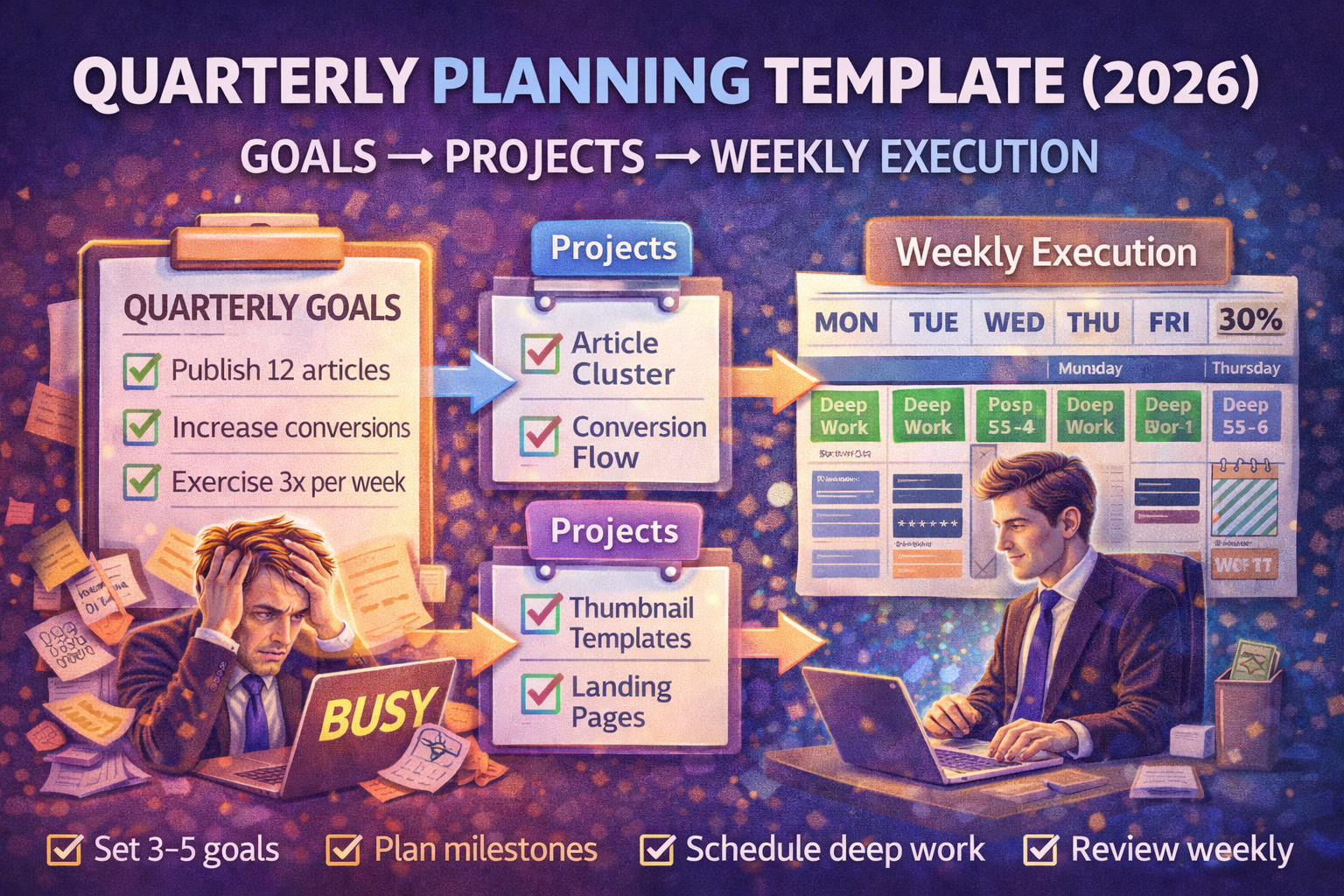
(a simple system to turn "big goals" into real progress in 12 weeks)
Most people don't fail because they lack goals.
They fail because their goals never make it into weekly execution.
They start a quarter motivated… then reality hits:
- urgent work
- meetings
- distractions
- daily chaos
- too many priorities
And the quarter ends with the same sentence:
"I was busy… but I didn't move the big things."
Quarterly planning fixes this because it sits in the perfect middle:
- long enough to make real progress
- short enough to stay focused
- structured enough to track
- flexible enough for real life
This article gives you a quarterly planning template you can use in 30–60 minutes — and a simple workflow to turn quarter goals into projects and weekly execution (with SelfManager.ai as a natural system to run it).
Why quarterly planning works (better than yearly planning)
Yearly planning is too abstract.
Weekly planning is too tactical.
Quarterly planning forces the sweet spot:
- clear priorities
- real deadlines
- measurable progress
- consistent execution loops
A quarter is long enough to build something meaningful, but short enough that you can't hide.
The core model: Goals → Projects → Weekly Execution
Here's the structure that makes quarters actually work:
1) Goals = what you want by end of quarter
2) Projects = what must be built/changed to reach the goals
3) Weekly execution = the recurring actions that move projects forward
Most people skip the middle.
They set goals… then live in daily tasks.
Projects are the bridge.
Step 1: Choose 3–5 quarterly goals (max)
If you set 10 goals, you set none.
The quarter needs focus.
Good quarterly goals look like:
- ship a new feature set
- publish 12 articles
- improve conversion rate
- launch a marketing funnel
- train consistently for 12 weeks
- build a portfolio
- stabilize finances
- improve sleep and energy baseline
Make goals measurable where possible.
Examples:
- "Publish 12 SEO posts"
- "Increase free → paid conversion to X%"
- "3 workouts/week for 12 weeks"
Step 2: Convert each goal into 1–3 projects
A goal without projects becomes wishful thinking.
Example:
Goal: "Publish 12 SEO posts"
Projects:
- Build article cluster plan (topics + internal links)
- Write + publish 12 posts
- Create a thumbnail system (templates)
Goal: "Increase conversions"
Projects:
- Improve onboarding flow
- Add 3 high-conversion landing pages
- Set up email onboarding sequence
Goal: "3 workouts/week"
Projects:
- Choose training plan
- Set weekly schedule
- Track workouts + recovery
Projects create clarity because they have an end state.
Step 3: Break projects into milestones (Week 1–12)
This is where the quarter becomes real.
For each project, define milestones.
Example: "Write + publish 12 posts"
- Week 1: finalize topics + outlines
- Week 2–3: publish 4 posts
- Week 4–6: publish 4 posts
- Week 7–9: publish 4 posts
- Week 10–12: refresh internal linking + update top posts
Milestones keep the plan realistic.
Step 4: Decide your weekly execution rhythm
Here's the secret:
Your quarter succeeds or fails based on your weekly rhythm.
A rhythm is a repeating structure.
Example rhythm:
- Monday: plan the week + pick outcomes
- Tue–Thu: deep work blocks
- Friday: ship + review
- Sunday: quick reset (optional)
You don't need perfect scheduling — just consistency.
Step 5: Create your weekly scorecard (simple metrics)
The quarter improves when it's measurable.
Track 3–5 metrics:
- Deep work blocks completed
- Key outputs shipped (posts/features)
- Exercise sessions (if health goal)
- Revenue or leads (if business goal)
- Weekly review completed (yes/no)
When you track, you improve.
Step 6: Weekly review (the quarterly multiplier)
Weekly review keeps your quarter alive.
In 15 minutes:
- What shipped?
- What didn't happen?
- Why?
- What is next week's top 3 outcomes?
Quarterly planning without weekly review is just a document.
The copy/paste Quarterly Planning Template (2026)
Use this section as your template.
A) Quarterly goals (3–5)
1.
2.
3.
4.
5.
B) Projects per goal (1–3 each)
Goal 1:
- Project A
- Project B
- Project C
Goal 2:
- Project A
- Project B
C) Milestones (Week 1–12)
Project A milestones:
- W1:
- W2:
- W3:
- W4:
- W5–W6:
- W7–W9:
- W10–W12:
D) Weekly execution rhythm
- Weekly planning day/time:
- Weekly review day/time:
- Deep work blocks (how many per week):
E) Weekly scorecard (3–5 metrics)
F) Top risks + safeguards
Risks:
- too many priorities
- no deep work time
- over-scheduling
- distractions/interruptions
Safeguards:
- cap active projects
- schedule deep work first
- 30–40% buffer
- weekly review non-negotiable
How to run this inside SelfManager.ai
SelfManager.ai (formerly Self-Manager.net) is built around the exact structure you need for a quarter:
- goals become projects
- projects become weekly plans
- week/month/quarter views keep time visible
- review loops keep the plan alive
- optional AI summaries help you see patterns and adjust faster
So instead of the quarter becoming "a plan you forgot," it becomes a system you execute.
Common mistakes that kill a quarter
1) Too many goals
Quarter focus is everything.
2) No project layer
Goals without projects = vague motivation.
3) No weekly rhythm
Execution doesn't "happen" automatically.
4) No buffer for reality
If you plan 100%, you fail.
5) No weekly review
You drift.
Final thought
A good quarter isn't built by motivation.
It's built by structure:
Goals → Projects → Weekly Execution
If you do that, the quarter stops being a wish.
It becomes a machine.
Date-based AI Task Manager
Plan smarter, execute faster, achieve more
Create tasks in seconds, generate AI-powered plans, and review progress with intelligent summaries. Perfect for individuals and teams who want to stay organized without complexity.
Get started with your preferred account