
Do Clearer Task Names Get Done More? What Decades of Research Say
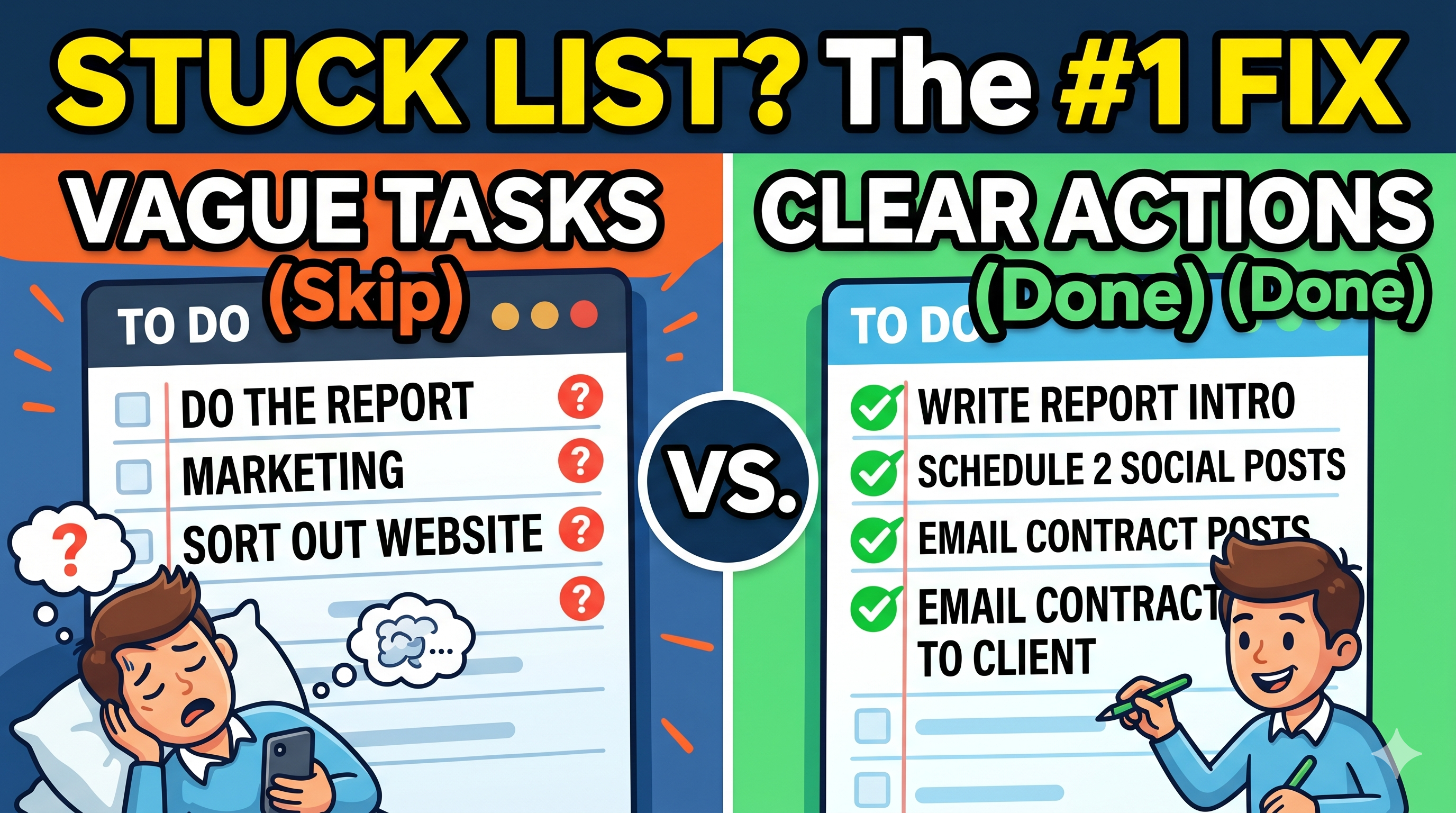
Look at the task on your list that has survived the longest. The one you keep scrolling past, week after week. There is a good chance it is not sitting there because it is hard, and not because you are lazy. It is sitting there because of how it is written.
"Work on the report." "Pricing." "Sort out the website." Each of these is less a task than a vague gesture at one, and some part of your brain knows it. So every time your eyes land on it, you quietly skip to something easier and the vague item rolls over to tomorrow. Then next week. Then it joins the small graveyard of things you fully intend to do and somehow never start.
It turns out the wording is not a cosmetic detail. A surprising amount of research, from goal-setting psychology to the study of procrastination, points to the same conclusion: how clearly you name a task changes how likely you are to finish it. Not your discipline. Not your motivation. The words. This article is about why that happens, and how to name tasks so they actually move.
A task is just a tiny goal, and goals have a rule
The most studied finding in this whole area comes from Edwin Locke and Gary Latham, whose goal-setting research spans roughly a thousand studies across five decades. Their core result is almost boringly consistent: specific, challenging goals lead to higher performance than vague ones. In review after review, specific goals beat "do your best" goals around 90 percent of the time, with an average performance bump of roughly 17 percent over no clear goal at all. The effect holds across wildly different domains, from athletic training to weight loss to software work.
The usual examples are big goals, but the same logic scales all the way down to a single line on your to-do list. A task is a micro-goal. "Revamp the company logo" is the to-do-list equivalent of "do your best" - it points in a direction without telling you what success looks like or where to begin. "Sketch three logo concepts that show forward movement" gives your mind something concrete to aim at.
Why does specificity matter so much? Locke and Latham identified the mechanisms. A specific goal directs your attention to the right activity, focuses your effort instead of letting it scatter, and gives you a clear finish line so you know when you are done. A vague goal does none of these. It leaves your attention, effort, and sense of completion all slightly out of focus, and slightly out of focus is enough to stall a task indefinitely.
Why vague tasks quietly get skipped
If specific tasks pull you forward, vague ones actively push you away, and the research on procrastination explains the mechanism.
For a long time procrastination was treated as a character flaw or a time-management problem. The better evidence says it is mostly about emotion. We avoid tasks that make us feel bad, because avoiding them brings immediate relief, even though it costs us later. Piers Steel's landmark 2007 analysis, which combined 691 correlations from hundreds of studies, found that one of the strongest predictors of whether a task gets put off is task aversiveness - how unpleasant the task feels to face.
Here is the part that matters for naming. Vagueness is one of the things that makes a task feel unpleasant. When a task is ambiguous, when you cannot tell exactly what you are supposed to do, your aversion to it goes up. Researchers studying academic procrastination found that people delay more when the information they need about what to do and how to proceed is incomplete or unclear. The uncertainty itself is the friction.
You can feel this in your own head. "Study for the exam" is not really a task. It is a category. The moment you try to start it, you have to do a layer of invisible work first - figure out what studying even means right now, which chapter, which method, where to begin - and that figuring-out is itself aversive. So you put it off. Compare that with "answer the ten review questions at the end of chapter four." There is nothing to decide. You can just start. The specific version removes the entry friction the vague version is drowning in.
It helps to know how common this is. Roughly one in five adults are chronic procrastinators, and the telling detail is that they do not form fewer intentions than everyone else. People who procrastinate intend to do their tasks just as often as people who do not. The gap is not in wanting. It is in starting. And a vague task name is one of the most reliable ways to widen that gap, because it gives the avoidance instinct an easy excuse every single time you look at it.
The fix has a name: the next concrete action
The most practical answer to all of this comes from David Allen's Getting Things Done, which built an entire method around one question: what is the next action?
Allen defines a next action as the next physical, visible activity that moves something forward. Every word is deliberate. Physical means something you can actually do with your body - call, write, open, draft, send. Visible means you could watch someone do it. The test he is really after is simple: could you walk up and start this right now, without first deciding what it means?
Most stalled list items fail that test because they are not tasks at all. They are projects wearing a task's clothing. "Plan mom's birthday" feels like a single line, but it is hiding a dozen decisions and steps, which is exactly why it sits there untouched. The next action is something like "text my brother to agree on a gift budget." "Launch the new pricing" is a project. "Write the three pricing tiers in a doc" is an action. As Allen puts it, when we treat projects like tasks, we end up with to-do lists full of items that are impossible to actually do - so they do not get done.
The reframe is small but it changes everything. You are not trying to capture the whole mountain in one line. You are naming the single, concrete first step, phrased so clearly that, in Allen's words, you could do it on Monday morning before coffee.
What "clear" actually means
Clearer does not mean longer, and this is worth saying directly, because people sometimes respond to this advice by writing paragraph-length tasks. A clear task can be three words. "Email Sarah the invoice" is sharper than "follow up on the whole invoicing situation at some point this week." Clarity is about removing ambiguity, not adding words.
In practice, a task that actually gets done usually has a few things in common.
It starts with a concrete verb. Call, draft, send, book, review, buy. If your task does not begin with an action you could physically perform, it is probably a topic, not a task. "Website" is a topic. "Write the homepage headline" is a task.
It names the specific thing you are acting on. Not "emails" but "the three flagged emails from finance." Not "the deck" but "slides four through six." The more precisely you name the object, the less you have to re-decide later.
It is a single step, not a hidden project. If doing it would take several sittings or several sub-tasks, it is a project. Name the next single action instead, and let the bigger thing live as a project with its own clear next step.
It is small enough to picture. A useful gut check is whether you can play the task like a short movie in your head and see yourself doing it. If you cannot picture the action, you have not defined it yet.
It carries the information you need. "Call John" stalls if his number is somewhere else. "Call John at 555-0123 to confirm Tuesday" does not. Front-loading the detail removes one more excuse to skip it.
Run a few of your own oldest list items through this. "Taxes" becomes "download last year's return from the portal." "Marketing" becomes "write two subject lines for the launch email." "Car" becomes "call the garage to book a service." In almost every case, the rewrite is not more ambitious. It is just clearer, and clearer is what gets started.
Why this works underneath
Pull the threads together and a single mechanism appears. A clear task name does three jobs at once. It removes the decision friction at the moment you look at the list, because there is nothing left to figure out. It lowers aversiveness, because you know exactly what you are walking into. And it hands you a defined finish line, so you actually get the small hit of completion that makes you want to do the next one.
A vague task fails on all three counts. It forces a decision, it feels uncertain and therefore unpleasant, and it has no clear point at which you are done. Worse, the failure compounds. Every time you skip a vague item, avoiding it becomes a little more practiced and the task becomes a little more aversive, which makes you more likely to skip it again. Clear naming breaks that loop before it starts.
None of this requires more willpower. That is the quietly radical part. You are not trying to force yourself to do unpleasant work. You are removing the ambiguity that was making the work feel unpleasant in the first place.
How to put this into practice
Clarify as you capture. The few seconds it takes to write a real task when you add it will save you minutes of staring at it later, and many more minutes of guilt as it rolls over. Decide what the thing actually is at the moment you write it down, not the moment you are supposed to do it.
Use the verb test. Before a task earns a place on your list, check that it starts with a physical action. If it does not, you have captured a topic or a project, and it needs one more pass before it is doable.
Apply the before-coffee test. If you cannot imagine starting the task cold, first thing, with no thinking required, it is not specific enough yet.
Split projects out. Anything with multiple steps hiding inside is a project. Keep it as one, but always give it a single, clearly named next action so it never goes dormant.
Treat a stuck task as a naming problem. When you review your list and find something that has been sitting untouched for a week or two, resist the urge to simply move it to a new day. Nine times out of ten the issue is not timing. It is that the task was never written clearly enough to start. Rewrite it before you reschedule it.
Where this leaves SelfManager
A lot of this comes down to structure. The reason vague tasks pile up is that most tools happily let them - an endless, undated list will accept "pricing" and "website" forever and never ask you what you actually mean.
SelfManager is built around the day instead. Every task lives on a specific date, so the question you are really answering is not "what do I want to do someday" but "what am I actually doing on this day," and that framing naturally pulls you toward concrete, doable tasks rather than vague placeholders. Its AI Plan feature helps with the hardest part of all of this - taking a fuzzy goal and breaking it into specific, dated steps you can actually start - and the AI review then shows you what got done versus what slipped, so the items that were too vague to finish become visible instead of quietly disappearing. The tool cannot write your tasks for you, but its whole shape nudges you toward the kind of clear, concrete naming the research keeps pointing back to.
Takeaways
- How you name a task measurably affects whether you finish it. This is not a productivity slogan - it falls out of decades of research on goals and procrastination.
- Goal-setting research finds specific goals beat vague "do your best" goals around 90 percent of the time. A task is just a small goal, and the same rule applies.
- Vague tasks get avoided because ambiguity makes them feel unpleasant, and task aversiveness is one of the strongest drivers of procrastination.
- The fix is to name the next concrete, physical action - something specific enough that you could start it right now without deciding what it means.
- Clearer does not mean longer. "Email Sarah the invoice" beats a rambling, vague sentence. Aim for unambiguous, not wordy.
- When a task keeps getting skipped, rewrite it before you reschedule it. The problem is usually the words, not the timing.
FAQ
Do clearer task names really get done more often?
Yes. Goal-setting research by Locke and Latham shows specific goals outperform vague ones in roughly 90 percent of studies, and procrastination research shows that ambiguous, unclear tasks are more aversive and therefore more likely to be put off. A clearly named task is easier to start and easier to finish.
Why don't I do the vague tasks on my list?
Because a vague task forces you to figure out what it means before you can begin, and that uncertainty makes the task feel unpleasant. Procrastination is largely driven by how aversive a task feels, so the ambiguous items are exactly the ones you skip.
How should I write a task so I actually do it?
Start with a physical action verb, name the specific thing you are acting on, keep it to a single step rather than a whole project, and include any information you need to begin. A good test is whether you could start it immediately without thinking about what it means.
What is the difference between a task and a project?
A task is a single action you can complete in one sitting. A project is any outcome that needs more than one step. Most stalled list items are really projects in disguise, which is why they never get done. The fix is to name the next single action for the project.
Does a longer, more detailed task description help?
Not on its own. Clarity matters, not length. A short, specific task like "book the dentist for next week" works better than a long, vague one. The goal is to remove ambiguity, not to add words.
Date-based AI Task Manager
Plan smarter, execute faster, achieve more
Create tasks in seconds, generate AI-powered plans, and review progress with intelligent summaries. Perfect for individuals and teams who want to stay organized without complexity.
Get started with your preferred account