
Top 10 Project Management Software Tools by Valuation (2026)
Project management software is a big business. Depending on which analyst report you read, the category was worth somewhere between 8 and 10 billion dollars in 2025, and it is still growing at a healthy clip toward an estimated 10.5 billion by 2027.
But "which tool is worth the most" turns out to be a surprisingly messy question. Some of these companies trade publicly, so their value updates every second the market is open. Others are private, and their last real valuation might be five years old. One was taken private in an acquisition. And two of the most famous names on this list do not have a price tag of their own at all.
So before the ranking, a short note on how to read these numbers - because without it, the list is genuinely misleading.
How to read these valuations
There is no single, clean way to value all of these companies, so each entry below is labeled with what kind of number it is.
- Public companies have a market cap - share price times shares outstanding. It is a real, live figure, but it also swings wildly. Several of the public names here have lost more than half their value in the past year.
- Private companies only get a fresh valuation when something happens - a funding round, a tender offer, or an acquisition. Many private software valuations on this list are anchored to 2021, the peak of the last funding boom, and almost certainly do not reflect what the company would be worth in a new round today.
- Acquired companies get one clean number: the deal price.
One more thing. Jira and Trello are both products of Atlassian, a single public company. Atlassian does not break out a separate valuation for each product, so both effectively share one market cap. They are listed separately here because both are landmark project management tools in their own right, but the numbers attached to them should be read with that in mind.
With all of that said, here is the ranking.
The 10 most valuable project management tools
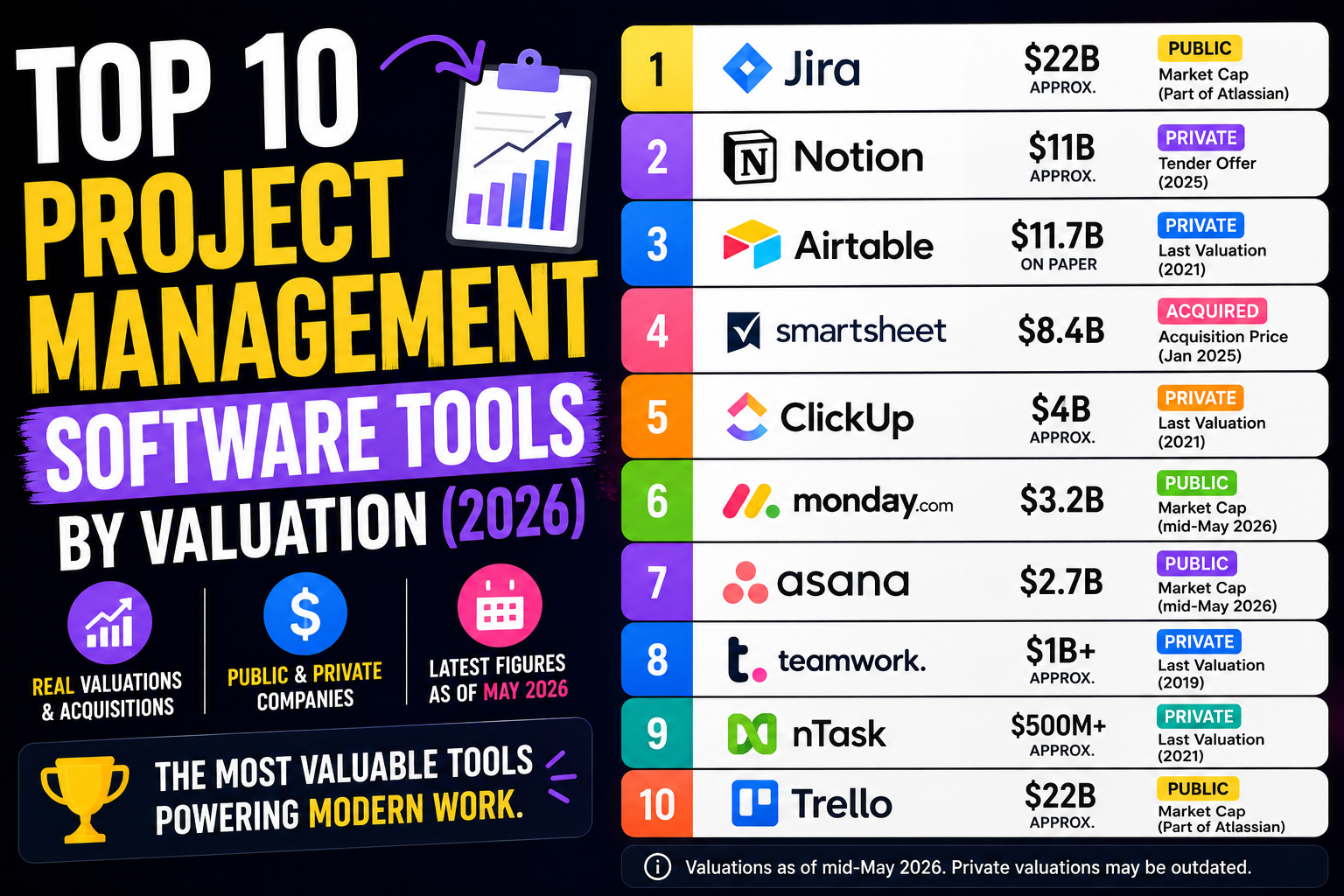
1. Jira - around 22 billion dollars
Type: part of Atlassian, a public company (market cap, mid-May 2026)
Jira is the flagship product of Atlassian, the Australian software company founded in 2002. It is the dominant project management tool for software and agile teams, built around issues, sprints, and developer workflows.
Atlassian's market cap sits at roughly 22 billion dollars as of mid-May 2026, though that number covers the whole portfolio - Confluence, Trello, Loom, Jira Service Management, and more, not Jira alone. Atlassian does not publish a standalone Jira valuation, but Jira is widely considered the core of the business. Worth noting: Atlassian's stock has fallen sharply over the past year, so even this figure is far below where it stood in 2025.
2. Notion - around 11 billion dollars
Type: private (2025 tender offer valuation)
Notion is not a pure project management tool - it is an all-in-one workspace for docs, databases, and wikis. But Notion Projects pushed it firmly into the category, and it competes directly with everything else on this list.
Its most recent valuation came from a 2025 tender offer at roughly 11 billion dollars, a slight step up from the 10 billion mark set in 2022. Unlike most 2021-era valuations, Notion's number looks defensible: the company reportedly passed 600 million dollars in annual recurring revenue, serves over 100 million users, is profitable, and carries no venture investors on its board. It is widely expected to go public, possibly in late 2026.
3. Airtable - around 11.7 billion dollars on paper
Type: private (2021 funding round)
Airtable blends a spreadsheet and a database into a no-code platform that many teams use for project management. Its last official valuation was a 2021 round at roughly 11.7 billion dollars.
This is the clearest example of a stale number on the list. Airtable has not raised a new priced round since 2021, and secondary-market estimates now put its realistic value far lower - closer to 4 billion dollars. The business itself has grown well, with revenue reportedly reaching around 478 million dollars in 2025, but the headline valuation has simply not been refreshed. Read it as a peak, not a present-day figure.
4. Smartsheet - 8.4 billion dollars
Type: private, via acquisition (completed January 2025)
Smartsheet is an enterprise work management platform with a spreadsheet-style interface, strong in construction, government, and large organizations. Founded in 2005 in Bellevue, Washington, it spent years as a public company.
In January 2025, private equity firms Blackstone and Vista Equity Partners completed their acquisition of Smartsheet in a deal valued at roughly 8.4 billion dollars, and the company was delisted. That makes it one of the cleanest and most recent numbers on this list - an actual completed transaction rather than an estimate.
5. ClickUp - around 4 billion dollars
Type: private (2021 funding round)
ClickUp markets itself as "the everything app for work," combining tasks, docs, goals, dashboards, and AI in one platform. Founded in 2016 by Zeb Evans and based in San Diego, it raised a 400 million dollar round in 2021 at a 4 billion dollar valuation.
That figure is now several years old. ClickUp has not announced a new priced round since, though it has grown aggressively and continued to expand - including acquiring the AI company Codegen in late 2025 to power its agent features. The real number today is anyone's guess, but 4 billion is the last one on record.
6. Monday.com - around 4 billion dollars
Type: public company (market cap, mid-May 2026)
Monday.com is a flexible "Work OS" that spans project management, CRM, and more. Founded in 2012 in Tel Aviv and public since June 2021, it is one of the larger pure-play work management companies by revenue, at well over a billion dollars a year.
Its market cap tells a dramatic story. As of mid-May 2026 it sits around 4 billion dollars - down roughly 65 to 70 percent from about 11.7 billion just a year earlier. The striking part is that the business itself kept growing through that drop. This is a repricing of AI-era software broadly, not a collapse of the company.
7. Wrike - around 2.25 billion dollars
Type: private (2021 disclosed deal value)
Wrike is an enterprise work management platform, particularly strong with marketing and creative teams. Founded in 2006 by Andrew Filev, it has changed hands more than once.
Citrix acquired Wrike in 2021 for 2.25 billion dollars. Then, in 2023, Wrike was sold again to the private equity firm Symphony Technology Group, this time at undisclosed terms. With no public number from the more recent sale, the 2.25 billion dollar Citrix deal remains the last disclosed valuation - and given the timing, the current figure may well be lower.
8. Asana - around 1.4 billion dollars
Type: public company (market cap, mid-May 2026)
Asana is one of the most recognized work management platforms, built around connecting daily tasks to company goals. It was founded in 2008 by Facebook co-founder Dustin Moskovitz and Justin Rosenstein, and went public via direct listing in 2020.
Its market cap is around 1.4 billion dollars as of mid-May 2026, down roughly 64 percent over the past year. Asana has leaned hard into AI with its AI Teammates and AI Studio products, and revenue continues to grow at around 790 million dollars a year - but the public market has been unforgiving, valuing it well below its annual sales.
9. Trello - no standalone valuation
Type: part of Atlassian
Trello is one of the most famous project management tools in the world - the Kanban board that introduced millions of people to the idea of organizing work as cards on a board. It launched in 2011 and was acquired by Atlassian in 2017 for roughly 425 million dollars.
Today Trello has no valuation of its own. It is one product inside Atlassian's roughly 22 billion dollar portfolio, and Atlassian does not break out per-product numbers. It earns a place on this list on reputation and reach, but its last standalone price tag was that 2017 acquisition figure.
10. Basecamp - privately held, no disclosed valuation
Type: private, bootstrapped
Basecamp, built by the company 37signals, is one of the original web-based project management tools and still has a devoted following. It is included here as the honest outlier.
Basecamp has never taken meaningful venture funding, has been profitable for two decades, and its founders have been openly uninterested in selling or going public. So it has no valuation - not a stale one, not an estimated one, none at all. It is a genuinely successful project management company that simply does not play the valuation game, and that is worth remembering when reading a list like this.
What these rankings actually tell us
Step back from the individual numbers and a few patterns stand out.
The 2021 hangover is everywhere. Airtable, ClickUp, Notion, and Monday.com all set peak valuations during the 2021 funding boom. The public ones got marked down to reality by the stock market. The private ones simply froze their numbers in place, which is why a figure like Airtable's 11.7 billion can sit on a list like this while almost no one believes it reflects today.
Public and private valuations now tell very different stories. The public names here - Atlassian, Monday.com, and Asana - have all fallen hard over the past year, with Monday and Asana each down roughly two-thirds. The private names get to keep older, friendlier numbers until a new round forces an update. That is not dishonesty, it is just how private valuations work, but it makes any mixed ranking lopsided.
Notion is the clear standout. It is the rare 2021-era company that genuinely grew into its valuation, with real revenue, real profit, and an IPO likely on the horizon. Most of the others are still trying to prove their peak numbers were ever justified.
And underneath all of it is the AI question. The market is openly unsure whether AI strengthens these tools or threatens them - if an AI agent can manage tasks directly, how much is the task tool itself worth? That uncertainty is priced into every public stock on this list, and it is the single biggest reason the numbers look the way they do.
One last point, and the most useful one if you are actually choosing a tool. Valuation is not usefulness. Trello has enormous everyday usage and no standalone price tag. Basecamp is profitable and has no valuation at all. The right project management software for you has almost nothing to do with what its parent company is worth - and everything to do with how it fits the way you work.
FAQ
What is the most valuable project management software?
Atlassian, the parent company of Jira and Trello, is the most valuable, with a market cap of roughly 22 billion dollars as of mid-May 2026. Among private companies, Notion holds the highest recent valuation at around 11 billion dollars.
Is Notion really worth 11 billion dollars?
That figure comes from a 2025 tender offer, where employees and early investors sold shares. Unlike many 2021-era valuations, Notion's looks reasonably grounded - the company is profitable, reportedly past 600 million dollars in annual revenue, and growing. Many analysts expect its eventual IPO to value it even higher.
Why did Monday.com and Asana lose so much value?
Both are public companies, so their valuations move with the stock market. Over the past year, software stocks tied to AI uncertainty have been repriced sharply downward. Both companies kept growing revenue through the drop - the fall reflects investor sentiment about the category's future, not a collapse in the businesses themselves.
What is the difference between a market cap and a funding valuation?
A market cap is the live value of a public company, updated constantly as its stock trades. A funding valuation is a private figure, set only when a company raises money or sells shares, and it can stay frozen for years between rounds. The two are not directly comparable, which is why this list labels each entry.
Is Jira owned by Atlassian?
Yes. Jira is Atlassian's flagship product. Atlassian also owns Trello, Confluence, Loom, and several other tools. Because Atlassian does not publish separate valuations per product, Jira and Trello effectively share the company's overall market cap.
How big is the project management software market?
Estimates vary by analyst and definition, but most put the global project management software market between roughly 8 and 10 billion dollars in 2025, with projections approaching 10.5 billion or more by 2027.
Which project management company is most likely to go public next?
Notion is the most widely discussed IPO candidate, with many observers expecting a listing as soon as late 2026. The company has said it has the financial flexibility to go public on its own timeline rather than out of necessity.
Why isn't Microsoft Project on this list?
Microsoft Project and Microsoft Planner are part of Microsoft, a company worth trillions of dollars across countless products. There is no way to isolate a meaningful standalone valuation for its project management tools, so it cannot be ranked alongside the others.
Date-based AI Task Manager
Plan smarter, execute faster, achieve more
Create tasks in seconds, generate AI-powered plans, and review progress with intelligent summaries. Perfect for individuals and teams who want to stay organized without complexity.
Get started with your preferred account