
Top Productivity Lessons Learned From Dan Martell: Buy Back Your Time and Build Systems That Scale
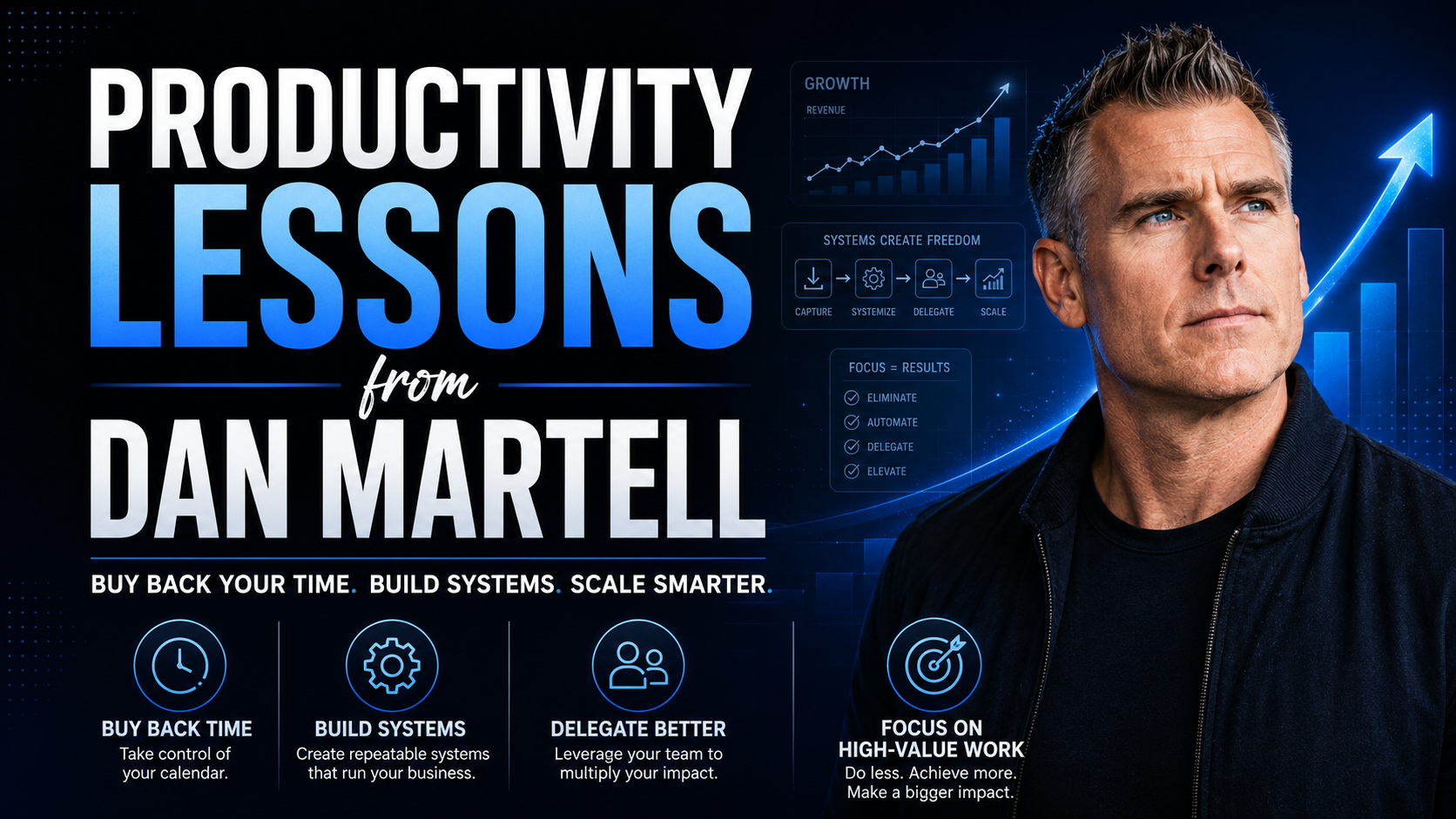
Dan Martell is usually discussed as a SaaS coach, entrepreneur, investor, and author.
That makes sense. He is the founder of SaaS Academy, a coaching program for software founders, and the author of Buy Back Your Time, a book built around helping entrepreneurs scale their companies while reclaiming freedom and avoiding burnout.
But underneath the business story is a productivity story.
Martell's core message is not simply "work harder."
It is almost the opposite.
His message is that if your business depends on you doing everything, you do not really own a business. You own a job with extra stress.
That idea is extremely useful even if you are not running a SaaS company.
If you are a freelancer, solo founder, agency owner, creator, consultant, or small business operator, the lesson is the same:
You cannot scale your life by adding more hours.
You scale by buying back time, building systems, delegating correctly, and focusing your best energy on the work that actually creates value.
Below are the most useful productivity lessons learned from Dan Martell.
1) Do not hire to grow. Hire to buy back time.
One of Dan Martell's most famous ideas is the "Buyback Principle."
The idea is simple:
Do not hire just to grow the business. Hire to buy back your time.
That is a different way to think about delegation.
Most founders and freelancers hire too late because they think hiring is only justified when the business is already bigger.
But Martell's point is that buying back time is what allows the business to become bigger.
If you are stuck doing low-value tasks every day, you do not have enough space for strategy, sales, product, relationships, hiring, or deep thinking.
You are not blocked by ambition.
You are blocked by calendar ownership.
Practical habit:
Look at your last 7 days and identify the tasks you should not still be doing.
Then ask:
- Could this be automated?
- Could this be documented?
- Could this be delegated?
- Could this be deleted?
The goal is not to become lazy.
The goal is to stop spending your best energy on replaceable work.
2) Your calendar reveals your real business model
Most people say one thing and schedule another.
They say growth matters, but their calendar is filled with admin.
They say product matters, but they spend the day reacting.
They say family matters, but they never protect time for it.
They say health matters, but it is always the first thing sacrificed.
Martell's productivity philosophy forces a very direct question:
Where is your time actually going?
Not where you think it is going.
Not where you wish it was going.
Where it is actually going.
This is one of the reasons his ideas fit so well with a date-based productivity system. Your calendar and daily task history are evidence.
Practical habit:
At the end of each week, review your calendar and tasks.
Divide your time into three categories:
- Work that creates growth.
- Work that maintains the business.
- Work that should not be on your plate anymore.
The goal is not guilt. The goal is clarity.
3) Audit your energy, not only your time
A big Martell-style productivity lesson is that not all work costs the same.
One hour of work that energizes you is not the same as one hour that drains you.
One hour of strategy may create more value than five hours of admin.
One hour with the right customer may teach you more than a week of guessing.
Time matters.
Energy matters too.
If your calendar is full of low-energy work, you may technically have enough hours, but you will not have enough creative power.
Practical habit:
For one week, mark your tasks as:
- Energizing
- Neutral
- Draining
Then look for the pattern.
The draining work is usually where your first delegation, automation, or simplification opportunity exists.
4) Build systems before you delegate
Delegation does not mean throwing tasks at people and hoping they figure it out.
That creates more stress.
Good delegation requires systems.
A system can be a checklist.
A template.
A standard operating procedure.
A video walkthrough.
A clear definition of done.
A repeatable process.
Martell often talks about scaling with systems, and his book positioning focuses on practical steps, operating procedures, and hiring practices that help entrepreneurs scale while avoiding burnout.
This is a crucial productivity lesson.
If a task only lives in your head, you are still the bottleneck.
Even if someone else does the work, they will keep coming back to you for clarification.
Practical habit:
Before delegating a task, write down:
- What is the task?
- When should it be done?
- What does good look like?
- What mistakes should be avoided?
- What examples can the person copy?
- What should happen if something is unclear?
A documented task is easier to delegate than a vague expectation.
5) Replace yourself from the lowest-value work first
Many founders want to delegate the most important work first.
That is usually wrong.
You should first buy back time from the lowest-value recurring work that drains your energy.
- Inbox cleanup.
- Scheduling.
- Formatting.
- Reporting.
- Basic admin.
- Data entry.
- Simple customer support.
- Repetitive content preparation.
- Small technical maintenance tasks.
These are not necessarily useless tasks. Some of them matter.
But they may not need your direct attention.
Practical habit:
Make a "buyback list."
Write down every recurring task you do.
Then rank each one by:
- How much it drains you.
- How often it repeats.
- How easy it would be to document.
- How little it depends on your unique judgment.
Start there.
6) Do not confuse being needed with being effective
This is a painful lesson for many founders.
Being needed can feel good.
People ask you questions.
Clients depend on you.
Team members wait for you.
You approve everything.
You solve every problem.
It can feel like proof that you matter.
But often, it is proof that the system is weak.
If everything requires you, the business is fragile.
If every decision waits for you, the team is slow.
If every task comes back to you, delegation failed.
Practical habit:
When someone asks you a repeated question, do not just answer it.
Turn the answer into a reusable system.
A template.
A rule.
A checklist.
A decision guide.
The best answer is often not "here is what to do."
It is "here is how we decide this next time."
7) Protect your highest-value work
Martell's message is not about escaping work completely.
It is about creating more space for higher-value work.
For a founder, that might mean strategy, sales, hiring, product direction, partnerships, content, or customer conversations.
For a freelancer, it might mean client acquisition, premium project work, portfolio building, or creating assets that bring inbound leads.
For a SaaS founder, it might mean product decisions, onboarding, retention, positioning, and growth loops.
The exact work changes by person.
The principle does not.
Your highest-value work must be protected before the day gets eaten by everything else.
Practical habit:
Schedule your highest-value work first.
Not after email.
Not after small tasks.
Not after you "catch up."
First.
The work that creates the future should not be squeezed between the work that maintains the present.
8) Create rules for repeated decisions
Repeated decisions are hidden productivity killers.
Every time you decide the same thing again, you spend mental energy that could have been saved.
- Should I take this call?
- Should I accept this client?
- Should I reply now?
- Should I build this feature?
- Should I discount this offer?
- Should I publish this article?
- Should I hire for this task?
If the same decision repeats, create a rule.
Practical habit:
Write decision rules like this:
- I only take meetings on these days.
- I only accept projects above this budget.
- I only build features that support this product direction.
- I only check email after deep work.
- I only discount when there is a strategic reason.
Rules reduce decision fatigue.
9) Scaling requires subtraction
Many people think scaling means adding.
- More people.
- More tools.
- More meetings.
- More offers.
- More features.
- More content.
- More channels.
Sometimes that is true.
But often, scaling requires subtraction first.
- Remove low-value tasks.
- Remove unclear responsibilities.
- Remove unnecessary meetings.
- Remove manual steps.
- Remove outdated projects.
- Remove services that no longer fit.
- Remove clients that drain the business.
A bloated system cannot scale cleanly.
Practical habit:
Every month, ask:
- What should we stop doing?
- What should be simplified?
- What should be automated?
- What should be delegated?
- What should be deleted?
A good productivity system is not only a place to add tasks. It is also a place to remove noise.
10) Do not build a business that depends on burnout
The promise of Buy Back Your Time is not just productivity. It is freedom.
The book's official positioning says the goal is to help entrepreneurs get unstuck, reclaim freedom, and build without simply working harder or trying to find more time.
That matters.
A business that only works when you are exhausted is not a healthy business.
A productivity system that only works when life is perfect is not a strong system.
A calendar that requires maximum energy every day is not realistic.
Burnout is often a sign that the operating model is broken.
Practical habit:
Ask:
Could I keep this schedule for 3 years?
If the answer is no, something needs to change.
Not later.
Now.
11) Use money to buy time, then use time to create better money
This is one of the most important Martell-style lessons.
Many founders are afraid to spend money on help.
That is understandable, especially early.
But if you never use money to buy back time, you may stay trapped in low-value work forever.
The goal is not reckless spending.
The goal is intelligent reinvestment.
- Buy back time from low-value tasks.
- Use that time for higher-value work.
- Use higher-value work to grow revenue.
- Then repeat.
Practical habit:
Before paying for a tool or hiring help, ask:
- Will this buy back time?
- Will that time be used for higher-value work?
- Can I measure whether this was worth it?
If yes, it may be an investment, not an expense.
12) Design your life before your business consumes it
Martell's public positioning often connects business growth with freedom, energy, and reclaiming life, not only revenue. His official site says he wanted to help founders reclaim their time, energy, and freedom, not just make more money.
That is a strong final lesson.
Productivity is not only about output.
It is about design.
- What kind of life is your work creating?
- What kind of business are you building?
- What kind of calendar are you accepting?
- What kind of person are you becoming because of the way you work?
If your business grows but your life gets worse every year, something is wrong.
Practical habit:
Define your ideal week.
Not a fantasy week.
A realistic week.
- How many deep work blocks?
- How many meetings?
- How much family time?
- How much exercise?
- How much thinking time?
- How much recovery?
Then compare your actual week to that.
The gap shows you what needs to be redesigned.
A Simple Dan Martell-Inspired Productivity Framework
If you want to apply these lessons, use this framework.
Daily
- Protect your highest-value work first.
- Avoid starting the day with low-value reaction.
- Document one repeated task.
- Notice what drains your energy.
- Ask what should not still be on your plate.
Weekly
- Review where your time actually went.
- Identify one task to automate, delegate, document, or delete.
- Create one decision rule.
- Check whether your calendar matches your priorities.
- Protect one block for strategic thinking.
Monthly
- Audit your recurring work.
- Update your systems.
- Review what you bought back.
- Review what still depends too much on you.
- Remove one source of complexity.
Quarterly
- Redesign your ideal week.
- Decide which role you should stop playing.
- Decide what kind of help would create the most leverage.
- Review whether your business is creating more freedom or less.
How to Apply This With SelfManager.ai
Dan Martell's productivity lessons fit naturally into a date-based productivity system.
Daily planning: Use each date to decide what work deserves your best energy today.
Weekly review: Look at where your time actually went and identify what should be delegated, automated, documented, or deleted.
Task history: Notice repeated tasks that keep coming back and turn them into systems.
AI summaries: Use AI reviews to detect patterns in your workload, energy, deadlines, and recurring bottlenecks.
Long-term planning: Use monthly and quarterly reviews to make sure your business is buying back time, not just creating more obligations.
The deeper Dan Martell lesson is simple:
You do not become more productive by carrying everything forever.
You become more productive by buying back your time, building better systems, and using your best energy on the work only you can do.
Date-based AI Task Manager
Plan smarter, execute faster, achieve more
Create tasks in seconds, generate AI-powered plans, and review progress with intelligent summaries. Perfect for individuals and teams who want to stay organized without complexity.
Get started with your preferred account