
How Long It Takes a New Planning Habit to Actually Stick
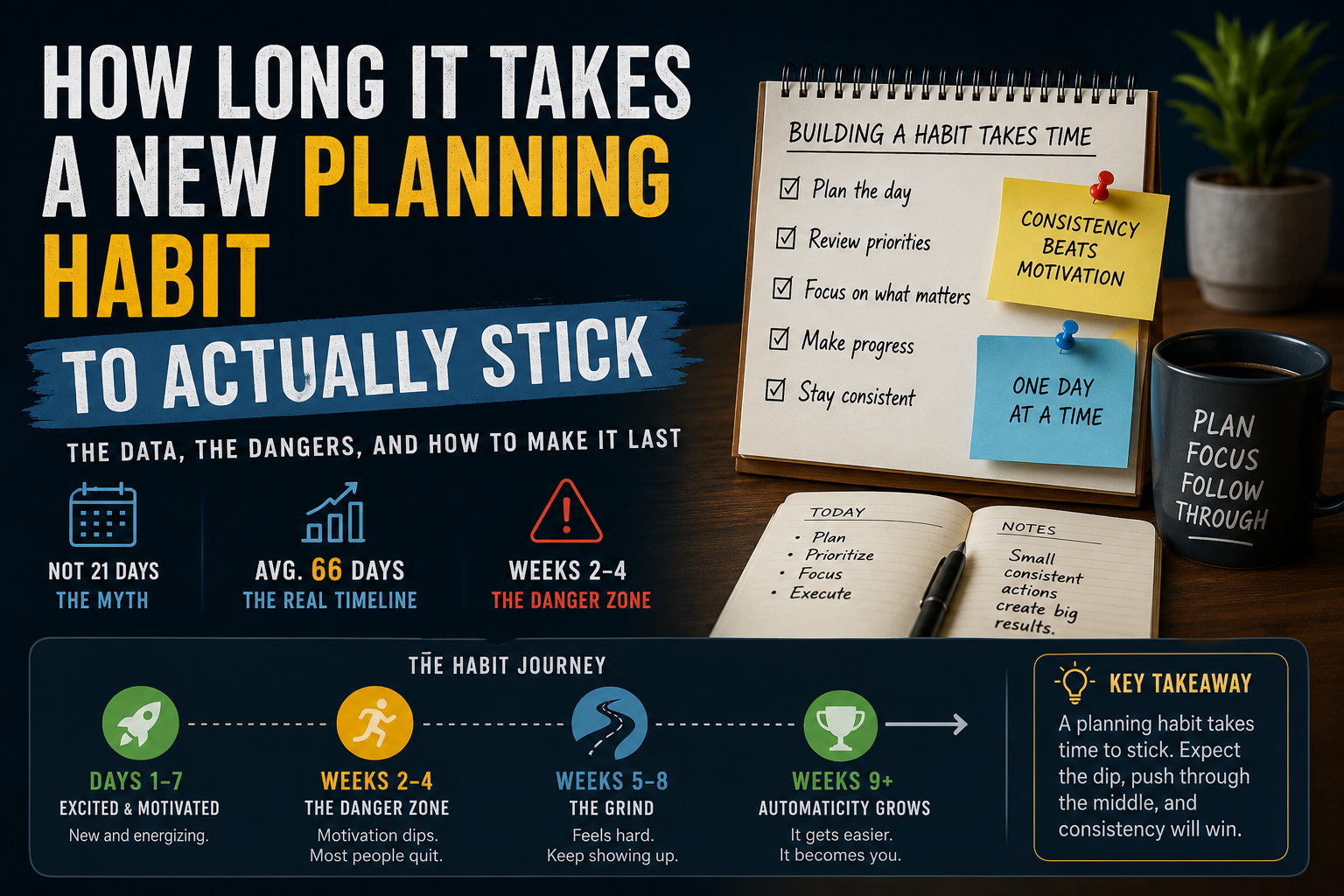
You decide this is the year you actually plan your days. The first week feels great. You sit down each morning, lay out the day, and feel in control for the first time in ages. Then week two arrives, the novelty wears off, you miss a day, and within a fortnight the whole thing has quietly evaporated.
This is the normal arc, not a personal failing. Almost everyone underestimates how long a new habit takes to stick, and almost everyone quits at roughly the same point. The planning habit is especially vulnerable, because it is not one small action like drinking a glass of water. It is the habit that organizes all your other work, which makes it both the most valuable habit you can build and one of the harder ones to keep.
This is an honest look at the timeline: how long it really takes, why the first month is where it dies, and how to get through the stretch where almost everyone gives up. The first half is the science of the timeline. The second half is how to survive it.
The short answer
A daily planning habit realistically takes somewhere between two and three months of fairly consistent practice to feel automatic, and often longer for a habit this complex. The popular 21-day figure is a myth.
The most-cited research puts the average at about 66 days, with enormous variation from person to person and habit to habit. A planning routine sits toward the longer, harder end of that range, because it involves several moving parts rather than a single action. And the danger is concentrated early: the majority of people who start a new habit have abandoned it within the first few weeks, usually around the two-to-four week mark, right when the initial motivation fades but the habit has not yet formed. Knowing both numbers, the real timeline and the real quit-point, is most of what it takes to beat the odds.
The 21-day myth, and where it came from
The idea that any habit forms in 21 days is one of the stickiest pieces of misinformation in productivity.
It traces back to a plastic surgeon, Maxwell Maltz, who in the 1960s noticed that his patients seemed to take about 21 days to adjust to a change like a new face or a missing limb. He wrote that it took a minimum of about 21 days for an old mental image to dissolve and a new one to form. That was an observation about adjusting to a new self-image, not a measured law of habit formation. Over the following decades the careful "minimum of about 21 days" got flattened into a confident "21 days to form a habit," and it spread everywhere because it is short, neat, and encouraging.
The trouble is that it sets a trap. If you believe a habit takes three weeks, then on day 22, when planning still feels like effort and you have to consciously push yourself to do it, the obvious conclusion is that you have failed. You have not. You are simply still inside the real timeline, which is much longer.
What the research actually says about the timeline
The closest thing we have to a real answer comes from a study led by the psychologist Phillippa Lally. Her team had volunteers adopt a new daily behavior, tied to a consistent cue such as after breakfast, and tracked how automatic it felt over twelve weeks.
The headline result: the average time for the behavior to become automatic was 66 days, but the range ran from 18 days to 254 days. The real finding was not the 66 itself. It was the variation. How long a habit takes depends heavily on the person and the behavior, so any single magic number is misleading. A more recent systematic review reached a similar place, putting typical formation in roughly the two-month region while finding huge individual differences, with self-selected habits and morning routines tending to form more strongly.
Two details from that research matter enormously for a planning habit. First, the curve is not linear. Automaticity rises fast at the start, then the gains shrink and flatten as the behavior approaches becoming second nature. That shape is why the early days feel encouraging and the middle stretch feels like a frustrating plateau where you are putting in effort but not feeling much more fluent. Second, more complex behaviors take substantially longer to automate than simple ones. In the research, something demanding like an exercise routine took noticeably longer than something trivial like drinking water.
That second point is the key to planning. A planning habit is not a single action. It is a small sequence: open your planning surface, review what is pending, decide what matters today, and place it. More steps, more decisions, more to make automatic. So if a glass of water sits at the easy end of the timeline, a daily planning ritual sits much closer to the hard end. Expecting it to take a couple of months, not a couple of weeks, is simply realistic.
Why a planning habit is harder than most
It is worth naming exactly why planning is one of the tougher habits to build, because understanding the difficulty makes it less discouraging.
Most habits people try to build are single, concrete actions with an obvious trigger and an immediate physical component. Take a vitamin. Do ten pushups. Floss. Planning is different in three ways.
It requires a decision, not just an action. You are not performing a fixed move, you are thinking, weighing, and choosing what your day should hold. Decision-making is more cognitively demanding than a reflex, and more easily skipped when you are tired or rushed.
Its payoff is delayed and invisible. Drink water and you feel it. Plan your day and the benefit shows up hours later as a smoother day, which your brain does not connect back to the two minutes you spent planning. Habits form fastest when the reward is felt during or right after the behavior, and planning's reward is neither immediate nor obvious.
It has no single fixed home for most people. A pushup happens wherever you are. Planning needs a surface and a moment, and if either is fuzzy, the cue is weak. A habit without a reliable cue is a habit that does not fire.
None of this means a planning habit cannot stick. It means you should treat it as a genuine project that takes real time, and stop comparing it to the speed of trivial habits.
The quit-point: when people actually give up
Here is the part almost no one plans for. People do not abandon new habits at random. They quit in a predictable window, and it comes early.
The clearest picture comes from New Year's resolutions, which are just habits with a shared start date. After analyzing over 800 million logged activities, the fitness app Strava identified a single day when commitment most reliably collapses and gave it a name: Quitter's Day, the second Friday of January. Roughly 80 percent of people who set resolutions have dropped them by the second week of February. A 2023 analysis found that about 35 percent of resolution-setters gave up within a single month, and only around 9 percent were still going by the end of the year.
The reasons people give for quitting are revealing, and they map almost perfectly onto a planning habit. The most common causes cited are a lack of motivation, unrealistic goals, and poor planning. In other words, people set an expectation that was too aggressive, did not build the habit into their actual day, and ran out of willpower in the gap between the two. That gap, weeks two through four, is the danger zone. The fresh enthusiasm has burned off, the behavior has not yet become automatic, and there is nothing left to carry you but raw motivation, which is exactly the thing that fades.
If you can see this window coming, you can prepare for it. Most people cannot, because they assumed they would be over the line by day 21.
Why the quit-point hits so hard
Three forces converge in that two-to-four week window, and naming them takes away most of their power.
The first is the expectation gap. You were promised three weeks. You hit week three still finding planning effortful, you interpret the effort as failure, and you stop. The effort was normal. The expectation was wrong.
The second is the plateau. Remember the shape of the curve: big early gains, then a flattening. Early on, every day of planning makes you feel noticeably more on top of things, which is motivating. Then that feeling of rapid improvement stalls. You are still benefiting, but it no longer feels like progress, and a habit that has stopped feeling like progress is easy to drop, especially before it is automatic enough to run on its own.
The third, and most lethal, is what happens the first time you miss a day. This one has a name in the research literature. It is the "what the hell effect," first described in studies of dieters, where breaking a self-imposed rule once makes people far more likely to abandon the whole effort. The internal logic is "I already missed Tuesday, so the streak is ruined, what's the point." The deeper driver is that breaking your own rule produces self-blame and a feeling of lost control, and people who react to a slip that way are much more likely to give up entirely than those who treat the slip as a one-off.
This is the cruelest part, because a single missed day is genuinely harmless. The Lally research found that missing one opportunity to perform a behavior did not meaningfully damage habit formation at all. The miss does not break the habit. The reaction to the miss does.
How to survive the quit-point
The good news is that every one of those forces has a counter, and the counters are simple. This is the part that actually gets a planning habit to stick.
Reset your expectations to the real number
Before you start, tell yourself the truth: this will take two to three months to feel natural, and the middle weeks will feel like effort. When effort shows up on day 20, you will recognize it as the expected middle of the process, not evidence that you have failed. That single reframe defuses the expectation gap, which is one of the three things pushing people out the door.
Anchor planning to something you already do
The strongest finding across habit research is that habits form by attaching to a consistent cue in the context where you act. Do not plan "sometime in the morning." Attach it to a fixed anchor you already hit without fail, like right after you pour your first coffee, or the moment you sit down at your desk. Specifying exactly when and where you will act dramatically improves follow-through, and it is far more reliable than depending on remembering. Tie the new habit to an old one and the old one becomes your alarm clock.
Launch on a fresh start
There is a real reason resolutions cluster at New Year, and it can be used deliberately. Research on the "fresh start effect" shows that people are more motivated to pursue new goals right after a temporal landmark such as the start of a week, a month, a new year, or a birthday. These landmarks work by creating a psychological line between your past self and a fresh chapter, letting you leave previous failures behind. In the data, people were about a third more likely to act on a goal at the start of a week, and nearly half more likely at the start of a new semester. You do not need January. The next Monday or the first of next month is a perfectly good launch pad, and starting on one gives you a small, free motivational boost.
Make a missed day a non-event
This is the single most important survival skill, because the first miss is where most habits die. Decide in advance that missing one day means nothing, and that your only job is to do it again the next day. No guilt, no restarting from zero, no declaring the streak ruined. The science backs this exactly: one miss does not hurt habit formation, but the "what the hell" spiral does. When you treat a lapse as a controllable blip rather than proof of failure, you sidestep the abstinence-violation trap that ends most attempts. The rule is not "never miss." The rule is "never miss twice in a row."
Keep it small and remove friction
Habits form more easily when the behavior is easy to repeat, and friction is what kills repetition. A five-minute planning session you actually do beats a thorough thirty-minute system you dread and skip. Start with the smallest version that is still useful, lay out today's three or four real priorities, and let the habit grow once it is automatic. You can always expand a habit that exists. You cannot expand one you abandoned because it felt like a chore.
Track consistency, not a perfect streak
A long unbroken streak is motivating right up until you break it, at which point it becomes a reason to quit. Instead of an all-or-nothing chain, keep a simple record of how often you planned over the last few weeks. Seeing that you planned on most days is encouraging and resilient, and it does not collapse into worthlessness the moment you miss one. You want a measure that survives an imperfect week, because every real habit has imperfect weeks.
Build in recurring fresh starts
The fresh-start effect is not a one-time tool. Use it on repeat. Treat every Monday, or the first of each month, as a small checkpoint to recommit: a quick look at whether the habit is holding, and a clean line under any days you missed. This turns the calendar itself into a recovery mechanism, so that a bad week never feels like the end, just a thing the next fresh start wipes clean.
What it feels like once it sticks
If you get through the first two or three months, something quietly shifts. The planning stops feeling like a decision you have to make and starts feeling like part of how the day begins, the same way brushing your teeth does not require a motivational push.
That is the top of the automaticity curve. The effort that defined the middle weeks fades, and the habit starts running close to free. The payoff that was invisible at the start becomes obvious in reverse: on the rare day you skip planning, the day feels noticeably messier, and that contrast becomes its own reminder. The habit now maintains itself, because the cost of not doing it is finally something you can feel.
That is the whole reason it is worth pushing through the quit-point. The hard part is finite. The benefit is not.
Where this leaves you
A planning habit does not take 21 days. It takes closer to two or three months, longer because planning is a complex, decision-heavy habit with a delayed payoff. And it does not fail randomly. It fails in a predictable window in the first month, pushed out the door by an expectation that was too aggressive, a plateau that feels like stalling, and a first missed day that triggers a quiet "what the hell."
None of those forces are strong once you can see them. Set the real timeline, anchor planning to something you already do, launch on a fresh start, refuse to let one miss become two, keep it small, and treat every Monday as a clean slate. Do that, and you give the habit the months it genuinely needs to form, instead of quitting three weeks in and concluding you are just not a planner. You are. You were measuring against the wrong calendar.
Takeaways
- A daily planning habit realistically takes about two to three months to feel automatic, not 21 days. The most-cited research found an average around 66 days, with a range from 18 to 254.
- The 21-day figure is a myth from a 1960s observation about adjusting to a new self-image, not a law of habit formation.
- Habit automaticity rises fast at first and then plateaus, which is why the middle weeks feel like effort without progress.
- A planning habit sits at the harder end of the timeline because it is a multi-step decision, its payoff is delayed and invisible, and it lacks a single fixed home.
- People abandon new habits in a predictable early window. Roughly 80 percent of resolution-setters quit by mid-February, often within the first two to four weeks.
- The first missed day is where most habits die, through the "what the hell effect," even though missing one day does no real damage to habit formation.
- To survive: reset expectations to the real timeline, anchor planning to an existing routine, launch on a fresh start like a Monday or the first of the month, make one miss a non-event, keep the habit small, track consistency over streaks, and use recurring fresh starts to recover.
FAQ
How long does it really take to build a planning habit?
Realistically two to three months of fairly consistent practice, and often longer because planning is a complex habit. The most-cited research found an average of about 66 days to reach automaticity, with a wide range from 18 to 254 days depending on the person and the behavior.
Is the 21-day rule true?
No. It comes from a plastic surgeon's 1960s observation that patients took about 21 days to adjust to a new self-image, which was later distorted into a general habit rule. Measured research puts habit formation much longer, around two months on average, with large individual variation.
When are you most likely to quit a new habit?
In the first few weeks, usually between weeks two and four. This is when the initial motivation fades but the habit has not yet become automatic. With resolutions, the steepest drop-off happens by the second week of January, and around 80 percent are abandoned by mid-February.
Does missing one day ruin a habit?
No. Research found that missing a single opportunity to perform a behavior did not significantly affect habit formation. The real risk is the psychological reaction to the miss, the "what the hell effect," where one lapse triggers giving up entirely. Treat a missed day as a one-off and simply resume the next day.
What is the best way to make a planning habit stick?
Anchor it to something you already do at a fixed time, start on a fresh-start date like a Monday, keep the session short, expect it to take a couple of months, and never let one missed day become two. Tracking consistency rather than a perfect streak also helps the habit survive imperfect weeks.
Date-based AI Task Manager
Plan smarter, execute faster, achieve more
Create tasks in seconds, generate AI-powered plans, and review progress with intelligent summaries. Perfect for individuals and teams who want to stay organized without complexity.
Get started with your preferred account