
Why Touching Grass and Spending Time Away From Your Devices Can Improve Long-Term Productivity and Happiness
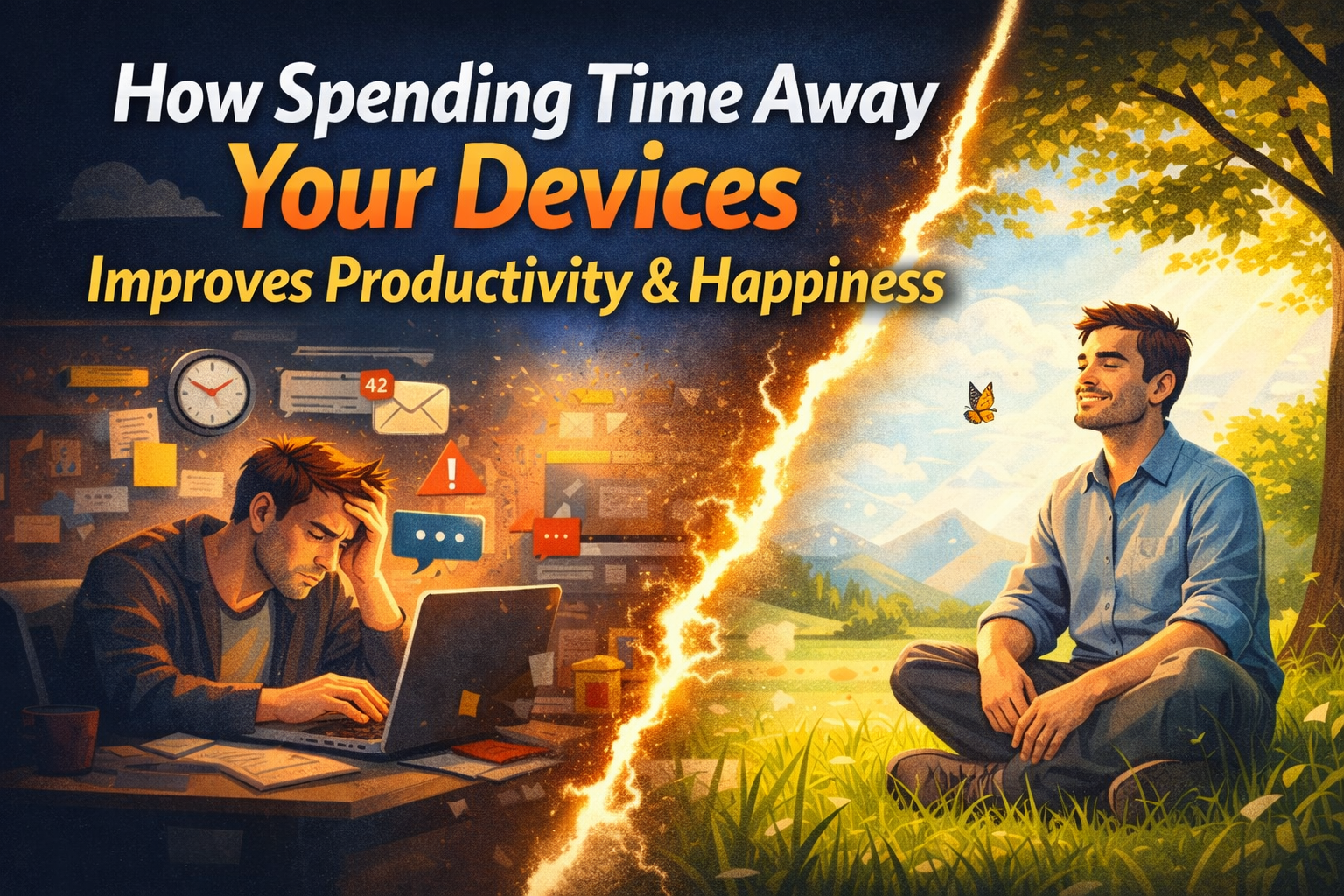
In a world where so much of life happens through screens, it is easy to forget something simple:
Human beings were not built to spend nearly all day inside digital environments.
Many of us work on computers, communicate through messaging apps, relax with videos, scroll through feeds, and even manage our goals through digital tools.
Technology is incredibly useful. It helps us build businesses, stay organized, learn faster, and create more than ever before.
But if we never step away from it, the same tools that help us can begin to drain our energy, attention, mood, and clarity.
That is why the phrase “go touch grass” has become popular online.
People often use it as a joke, but behind the joke is a real truth: spending time outside, away from devices, can be one of the most underrated ways to protect your productivity and become happier over the long term.
Sometimes the best thing you can do for your work is to step away from it for a while.
1) Your brain needs breaks from constant digital stimulation
Devices are designed to keep your attention active.
Notifications, updates, messages, news, videos, feeds, and endless content create a state of constant mental input.
Even when you are not doing demanding work, your brain is still processing a lot.
Over time, this can leave you feeling mentally crowded.
You may notice:
- reduced focus
- low patience
- faster mental fatigue
- difficulty thinking deeply
- restlessness when things become quiet
Spending time away from devices gives your mind a different kind of environment.
When you go outside, walk, sit in a park, or simply spend time without looking at a screen, your brain gets a break from constant digital stimulation.
That break matters.
It helps reset your attention and gives your mind room to think more naturally again.
2) Nature can calm your nervous system
A lot of modern work keeps people in a slightly activated state.
There is always something to answer, something to check, something to finish, and something still waiting.
That low-level pressure can stay in the background all day.
When you step outside and spend time in a calmer environment, especially somewhere with grass, trees, fresh air, or open space, your system often starts to slow down.
You breathe differently.
Your muscles relax a bit more.
Your thoughts become less compressed.
This calmer internal state is important because a stressed brain is usually worse at planning, prioritizing, and making good decisions.
If your mind is always tense, your productivity becomes more reactive and less intentional.
Time away from devices helps you recover that steadier mental state.
3) Touching grass is a real reminder that life is bigger than the screen
When you spend too much time on your devices, your world can start to shrink.
Everything becomes:
- notifications
- tabs
- tasks
- deadlines
- emails
- comments
- numbers
- digital pressure
Touching grass, sitting outside, walking in nature, or even standing still in fresh air reminds you that there is a world beyond the screen.
That matters more than it may seem.
It gives your brain perspective.
Problems often feel smaller outside than they do in front of a laptop at midnight.
You may return to your work realizing that the thing stressing you was not as dramatic as it felt.
Perspective helps productivity because it reduces unnecessary emotional weight.
And when work feels lighter, you often work better.
4) Stepping away can improve your thinking
A surprising number of good ideas do not appear while you are forcing them.
They appear when your mind has space.
This is one reason people get insights in the shower, while walking, during exercise, or while sitting quietly outside.
When you are away from devices, your attention is less fragmented.
You are no longer reacting every few minutes. Your thoughts have a chance to connect.
That is good for:
- problem solving
- creative thinking
- strategic planning
- writing
- decision-making
- reflecting on what actually matters
Many people try to think better by staring harder at the screen.
But sometimes the better move is to leave the screen and let the mind reset first.
5) You become less emotionally overloaded
Phones and computers do not only deliver work. They also deliver comparison, noise, urgency, opinions, bad news, and endless stimulation.
Even if you do not notice it immediately, this can affect your emotional baseline.
You may feel:
- more irritated
- more distracted
- less satisfied
- more impatient
- more mentally heavy
- less present in your real life
Time off your devices can help reduce that overload.
When you spend time away from screens, you give your emotions space to settle.
That often makes you feel more grounded and more stable.
And emotional stability matters for productivity.
A calmer person can focus better, work more consistently, and recover faster from stress.
6) Your happiness often improves when your attention returns to real life
Happiness is not only about achievement.
It is also about presence.
You can be doing well on paper and still feel strangely disconnected if too much of your life is happening through screens.
Spending time outside helps reconnect you with simpler experiences:
- fresh air
- movement
- sunlight
- silence
- real surroundings
- your own thoughts
- conversation without distraction
These things may seem small, but they often create a stronger feeling of well-being than one more hour spent scrolling or clicking around.
A happier mind usually performs better over the long term.
Not because happiness magically solves everything, but because it supports steadier effort, better resilience, and a healthier relationship with work.
7) Time away from devices helps protect long-term productivity
A lot of people think productivity means staying close to work at all times.
But long-term productivity works differently.
Long-term productivity depends on sustainability.
That means protecting your:
- mental clarity
- physical energy
- emotional balance
- motivation
- focus
- sleep
- ability to think clearly over many weeks and months
If device-heavy living slowly damages those things, then constant screen time is not actually helping productivity.
It is borrowing from the future.
Taking time away from your devices helps you maintain the internal resources that good work depends on.
That makes it easier to stay productive not just today, but over the long run.
8) Going outside can help break mental loops
Sometimes you are not tired because the work is impossible.
You are tired because your mind is stuck in the same loop.
You look at the same task.
You think the same thoughts.
You feel the same resistance.
You keep sitting there hoping clarity will appear.
Then you go outside for 10 or 20 minutes and suddenly the mental pressure changes.
Why?
Because your environment changed.
Your brain often needs physical movement and a different setting to break stale thought patterns.
This is one reason walks can be surprisingly productive.
They help interrupt mental friction.
9) Being offline can help you feel more in control again
Devices often create a feeling that everything is competing for you at once.
Your attention becomes something that other systems keep pulling on.
When you intentionally step away from screens, you take some of that control back.
You are deciding:
- what gets your attention
- when you engage
- when you rest
- when input stops
- when you think for yourself again
That feeling of regained control can improve both mood and productivity.
A person who feels in control usually works with more confidence and less mental chaos.
10) The goal is not to reject technology - it is to balance it
Technology is not the problem.
For many of us, it is essential to our work and our lives.
The problem is when device use becomes constant, unstructured, and emotionally draining.
The answer is not to pretend we can live without technology.
The answer is to build a healthier rhythm around it.
Use devices with purpose.
Step away from them regularly.
Let the outside world reset you.
Then come back with a clearer mind.
That is a much better strategy for both productivity and happiness.
Practical ways to do this
You do not need a perfect lifestyle change to benefit from this.
Small changes help.
1) Start the day without immediately opening your phone
Give your brain a few minutes of normal reality before entering the digital stream.
2) Take one walk a day without checking your screen
Even a short walk can reduce mental noise and improve clarity.
3) Step outside between work blocks
A few minutes of fresh air can reset your attention better than staying at the desk.
4) Sit in a park or outside space when you feel mentally overloaded
Sometimes a simple environment change is enough to calm your system.
5) Leave your phone behind sometimes on purpose
Not always. Just enough to remind yourself you do not need constant connection every minute.
6) Use outdoor time as a thinking tool
Instead of trying to solve every problem at your desk, take the problem on a walk.
7) End the day with less screen exposure
This can help your mind slow down and feel more human again.
Why this matters more than people think
People often search for better productivity through:
- better apps
- better systems
- better templates
- better workflows
- better tools
Those things can help.
But sometimes the improvement you need is not another digital layer.
It is less digital pressure.
More contact with the real world.
More fresh air.
More movement.
More recovery.
More perspective.
Touching grass may sound like a joke online, but the principle behind it is serious.
A brain that never leaves the screen eventually gets tired, crowded, and less effective.
A brain that gets space, nature, movement, and time away often becomes clearer, calmer, and stronger.
That is a major advantage over time.
Final thought
If you want to stay productive for years, not just for a few intense days, you need more than ambition and screen time.
You need renewal.
Touching grass, walking outside, spending time off your devices, and reconnecting with real life can help you think better, feel better, and work better.
It can make you more focused.
It can make you calmer.
It can make you happier.
And over time, it can make your productivity far more sustainable.
Sometimes progress does not come from pushing harder at the screen.
Sometimes it comes from stepping away from it.
Date-based AI Task Manager
Plan smarter, execute faster, achieve more
Create tasks in seconds, generate AI-powered plans, and review progress with intelligent summaries. Perfect for individuals and teams who want to stay organized without complexity.
Get started with your preferred account