Why There Is No Universal Productivity System (and How to Find Yours)
You have probably tried someone else's system. The 5am routine that turned a CEO into a machine. The time-blocking method a famous founder swears by. The note-taking setup that a productivity YouTuber says changed their life. You tried it with real effort, and for a week or two it almost worked. Then it quietly fell apart, and you assumed the problem was you.
It usually is not. The problem is that you borrowed a system built for a different body, a different temperament, a different job, and a different life. Productivity advice is sold as if there is one right way to work and you simply have to be disciplined enough to follow it. The research says something else entirely. Across biology, personality, motivation, and circumstance, the most effective way to work turns out to be highly individual. What makes one person thrive can actively hold another person back.
This is not the soft, unfalsifiable claim that "everyone is different, so do whatever feels good." There are real, measurable axes along which people differ, and science has mapped several of them well. The point is not that nothing works. It is that what works is a function of who you are, and once you understand the dimensions that matter, you can stop collecting other people's routines and start engineering your own. This article walks through what those dimensions are, what the evidence says about each, and how to figure out where you actually fall.
The myth of the universal system
Most popular productivity advice has a hidden assumption baked into it: that there is a single optimal way to work, and the only variable is your willpower. Wake up earlier. Block your calendar. Eat the frog. Batch your tasks. The advice is delivered as universal law, which is why failing to follow it feels like a personal failing.
A lot of this comes from survivorship bias. We hear the morning routine of the one founder who succeeded, not the thousands who followed the same routine and burned out or quietly went nowhere. We mistake correlation for instruction. The CEO is not successful because they wake at 5am. They wake at 5am because they happen to be a morning type with a job that rewards early focus, and they would likely have succeeded on a different schedule too. Their routine is a description of their life, not a prescription for yours.
When you look at the actual science of human performance, the universal-system idea falls apart. People differ in when their brains work best, in what kind of environment lets them concentrate, in what motivates them to keep going, and in the constraints their lives put on their time. Each of these has been studied, and each one bends the definition of "productive" toward the individual. Let us take them one at a time.
Your biology runs on a clock, and it is not set to the same time as mine
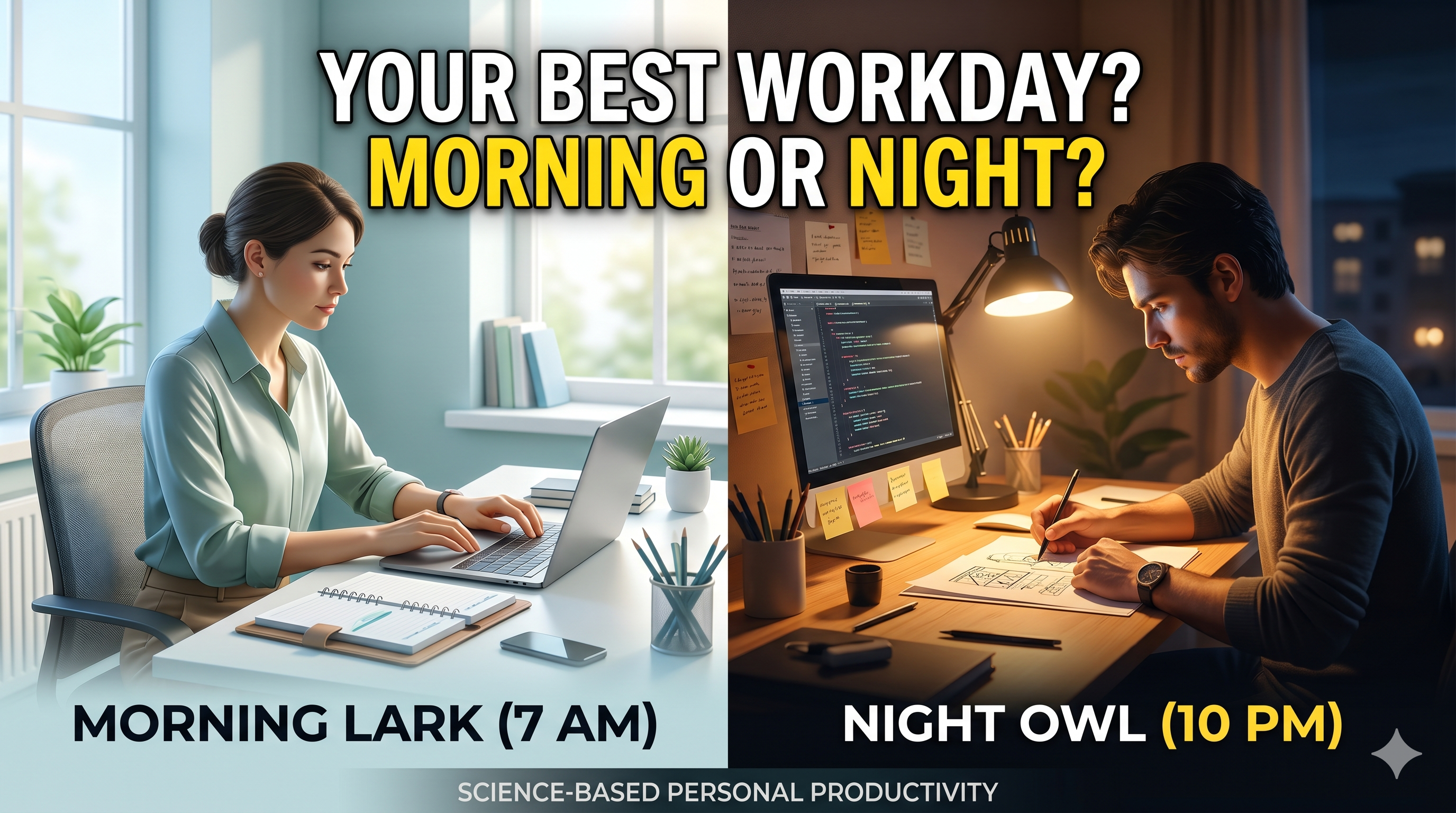
The clearest example of how individual productivity really is comes from circadian biology. Your chronotype, your natural tendency toward mornings or evenings, is not a habit or a lifestyle choice. It has a substantial genetic component, shaped by your underlying clock genes, and reinforced by light exposure and age. Some people are wired to peak early. Some are wired to peak late. Most sit somewhere in the middle.
This is not a matter of preference, and the performance consequences are real. When researchers measured early and late chronotypes at different times of day, late types were significantly impaired in the morning across measures of attention, reaction time, and executive function. A night owl asked to do demanding cognitive work at 8am is not being lazy or undisciplined. Their brain is genuinely not online yet, in the same way a morning lark's brain is fading by late evening. Forcing yourself onto a schedule that fights your chronotype creates what scientists call social jetlag, a chronic mismatch between your biological clock and the clock your work runs on, and it carries measurable costs to mood, focus, and health.
So the single most common piece of productivity advice, "wake up early and do your hardest work first," is excellent guidance for roughly half the population and counterproductive for the other half. If you are a genuine evening type, your most demanding analytical work probably belongs in the late afternoon or evening, and trying to force it into the morning is a quiet, daily tax you do not need to pay.
There is a fascinating wrinkle here that makes the point even sharper. You might assume the rule is simply "do all your important work at your peak." But research on insight and creativity found the opposite for one kind of thinking. People solved creative, flash-of-insight problems better at their non-optimal time of day, not their peak. The likely reason is that when your inhibitory control is a little looser, more unexpected and tangential ideas slip through, which is exactly what creative problem solving needs. Focused, analytical work benefits from your sharp peak hours. Open-ended, creative work may benefit from your foggy off-hours.
The practical takeaway is twofold. First, find your real peak. The cleanest way is to notice your energy on a stretch of days with no alarm and no fixed schedule, like a holiday, when your body settles into its natural rhythm. Second, match the type of work to the time. Guard your peak window for the work that needs concentration and judgment, and consider handing your brainstorming and idea generation to your off-peak hours. There is no universal best time to work. There is only your best time, and it even depends on what you are trying to do.
Personality shapes how you work, not just how you socialize
The next axis is temperament. Personality psychology converged decades ago on five broad traits, and a large body of research has connected them to how people perform. One trait stands out as close to universally useful: conscientiousness, the tendency to be organized, disciplined, and reliable, is consistently the strongest personality predictor of performance across almost every kind of work. This is the grain of truth inside generic productivity advice. Discipline and structure genuinely help most people, which is why "be more organized" is rarely bad guidance.
But conscientiousness is the exception. The other traits predict performance in a strongly context-dependent way, and this is where the individual differences reappear. Extraversion predicts performance well in roles built around interaction, energy, and social momentum, like sales or management, and poorly in roles that reward sustained solitary concentration. Introversion is the reverse. An introvert is not less productive than an extravert. They are productive under different conditions, and they are drained by the very things that energize their extraverted colleagues.
This reframes one of the longest-running fights in modern work: the open-plan office. The debate over whether open offices help or hurt productivity has no single answer, because it is really a question about who is sitting in them. For an extravert who feeds on ambient energy and quick interaction, an open, buzzing space can be genuinely activating. For an introvert who needs quiet to think deeply, the same space is a constant low-grade interruption that makes real work nearly impossible. Neither person is right or wrong about productivity in general. They are right about productivity for themselves.
The same logic runs through openness to experience, which tends to predict performance in creative, exploratory, and strategy-heavy work, and less so in highly routine roles. A person high in openness will wilt in a job built on repetition and shine in one built on novelty, while a person lower in openness may find deep comfort and excellence in well-defined, repeatable work that an open person would find unbearable.
To find your own setting here, pay attention to energy rather than ability. After a morning of back-to-back collaboration, do you feel charged up or wrung out? Does a quiet, uninterrupted block feel like relief or like isolation? Do you do your best thinking out loud with others, or alone on paper? Your honest answers tell you what kind of environment, schedule, and collaboration style to build around, and which popular advice to ignore. Advice written by a high-energy extravert about constant communication and rapid-fire meetings is not wisdom you failed to apply. It is a description of conditions that suit them and may quietly wreck your focus.
Your goals only pull you forward if they are actually yours
The third dimension is motivation, and it is the one people most often misdiagnose as a discipline problem. When you keep abandoning a goal, the instinctive explanation is that you lack willpower. The research points somewhere more interesting: it often means the goal was never really yours to begin with.
Self-determination theory distinguishes between goals you pursue for autonomous reasons, because they genuinely matter to you or interest you, and goals you pursue for controlled reasons, because you feel you should, or to impress someone, or out of guilt and obligation. The degree to which a goal fits your own values and interests is called self-concordance, and it has a striking effect on outcomes. People pursue self-concordant goals with more sustained effort, hit them more often, and feel better along the way. Goals chased for external reasons tend to wobble and collapse the moment the pressure lets up.
There is an even subtler finding here. Self-concordant goals do not just get more effort. They feel easier. When a goal genuinely aligns with who you are, pursuing it requires less white-knuckle self-control, because you are not constantly arguing with yourself about whether it is worth it. The goal is, in a sense, pulling in the same direction you already lean.
This explains a pattern almost everyone has lived through. You adopt a goal because a respected person has it, or because the internet says you should want it, and you cannot make yourself stick with it no matter how many systems you stack on top. The system is not the problem. The goal is borrowed. Someone else's definition of a productive, successful life is driving your to-do list, and your own motivation keeps refusing to show up for it.
So before optimizing how you pursue your goals, it is worth auditing the goals themselves. For each big one, ask plainly: am I doing this because I want the outcome, or because I think I am supposed to want it? The goals that come from genuine interest and values are the ones worth building your productivity around. The ones that come from comparison and obligation are often the source of the very procrastination you have been trying to discipline away. Productivity advice cannot fix a goal that was never yours.
Your context is part of the equation, not background noise
The final dimension is the one productivity gurus most often ignore, because it is the least flattering to a clean, universal system: your actual circumstances. Even two people with identical biology, personality, and goals will need different systems if their lives are different, and lives are almost always different.
Start with the type of work. There is a well-known distinction between a maker's schedule and a manager's schedule. A maker, like a writer or an engineer, needs long uninterrupted blocks, and a single midday meeting can shatter a whole afternoon of deep work. A manager's day is built from short reactive slots, and a system optimized for four-hour focus blocks would be useless to them. Advice that assumes one of these schedules is actively wrong for someone living the other.
Then there is autonomy, which the same self-determination research flags as a core ingredient of motivation. If you control your own calendar, you can align your schedule with your chronotype and your deep-work needs. If you work shifts, or your day is dictated by clients, customers, or a boss, much of that control is gone, and the realistic move is to adapt around the constraints rather than pretend you can ignore them. A night owl on a fixed early shift cannot simply choose to work late, so their strategy has to be different from a freelancer who can.
And there is life season. The productivity system that works for a single twenty-two-year-old with open evenings is not the system that works for a parent of a newborn, or someone caring for an aging relative, or a person managing a chronic illness. Available time, energy, and cognitive bandwidth all shift dramatically across the seasons of a life. A routine that assumes you own your mornings will fail the moment a small child owns them instead, and that failure says nothing about your discipline.
The practical move is to design for the life you actually have, not an idealized one. A system that quietly assumes you have no kids, full control of your time, and unlimited energy is going to break against your real constraints, and you will blame yourself for the gap. Build around your reality, and the system has a chance of surviving contact with your week.
How to actually find what works for you
Pull all of this together and a method appears. It is not a system to copy. It is a process for discovering your own.
Find your peak window. Spend a stretch of unstructured days noticing when your energy and focus naturally rise and fall. That window, not someone else's wake-up time, is the foundation everything else sits on.
Match the work to the time. Protect your sharp hours for analytical, high-judgment work that needs concentration. Hand your looser, off-peak hours to brainstorming and creative thinking, where a wandering mind is an asset rather than a liability.
Design your environment around your temperament. If interaction energizes you, build in more of it. If quiet is what lets you think, defend it aggressively and stop feeling guilty about needing it. Stop trying to force yourself into the working conditions that suit a different personality.
Audit your goals for fit. Separate the goals that come from your own values and interests from the ones you absorbed because you felt you should want them. Build your effort around the first kind, and be honest about how much of your past "laziness" was really just resistance to goals that were never yours.
Account for your real constraints. Take your job type, your degree of autonomy, and your current life season seriously as inputs, not excuses. A system that ignores them is a system designed for a person who is not you.
Treat all advice as a hypothesis, not a rule. This is the meta-skill. When you read about someone's miracle routine, do not adopt it as gospel and do not dismiss it. Run it as an experiment for a couple of weeks, watch what actually happens to your focus and output, and keep only what your own results endorse. Borrow ideas, not systems.
Re-check periodically. None of this is fixed forever. Chronotype shifts gradually with age. Life seasons change. The job that suited your temperament can evolve into one that does not. The system that fits you this year may need adjusting next year, which is normal, not a sign that you did it wrong.
The promise underneath all of this is quietly freeing. If you have spent years feeling like you are bad at productivity because the famous methods never stuck, the more likely explanation is that you were running other people's software on your own hardware. The methods did not fail because you lacked discipline. They failed because they were never built for you. Once you start from who you actually are, the work of getting things done stops being a fight against yourself and starts being a matter of fit.
Takeaways
- There is no single best way to be productive. The most effective approach is individual, and the science backs this across several distinct dimensions.
- Chronotype is largely genetic. Night owls are genuinely impaired in the morning, so the universal advice to do hard work early helps some people and hurts others.
- The best time to work depends on the task too. Analytical work suits your peak hours, while creative, insight-based work can actually improve at your off-peak times.
- Conscientiousness helps almost everyone, but other personality traits predict performance in a context-dependent way. Introverts and extraverts thrive in different environments.
- Goals that fit your own values get pursued with more effort and success than goals adopted from external pressure. Failing to stick with a goal is often a fit problem, not a willpower problem.
- Your job type, autonomy, and life season are real inputs. Build a system for the life you actually have, and treat all outside advice as an experiment to test, not a rule to obey.
FAQ
Is there one best productivity system?
No. Research across circadian biology, personality, motivation, and work context shows that the most effective way to work varies significantly between people. A method that transforms one person's output can do nothing for another, because they differ in when they focus best, what environment suits them, what motivates them, and what their lives allow.
Why does a routine that works for someone else not work for me?
Usually because it was built around their biology, temperament, goals, and circumstances rather than yours. A morning routine designed by an early chronotype with full control of their schedule will not transfer cleanly to a night owl with a reactive job and young kids. The failure reflects a mismatch, not a lack of discipline.
Can I change my chronotype?
Only to a limited degree. Chronotype has a strong genetic basis, though light exposure, consistent schedules, and age can shift it somewhat. For most people it is more effective to work with their natural rhythm than to fight it, scheduling demanding work for when their brain is naturally sharp.
How do I find my most productive time of day?
Notice your natural energy on a stretch of days without an alarm or a fixed schedule, such as a holiday, when your body settles into its own rhythm. The hours when you feel most alert and focused are your peak window. Reserve those for your most demanding work.
Does personality really affect how productive I am?
Yes, but mostly by determining the conditions under which you do your best work. Conscientiousness tends to support performance broadly, while traits like introversion, extraversion, and openness make different environments and types of work suit different people. The goal is to match your conditions to your temperament rather than force yourself into someone else's.
Date-based AI Task Manager
Plan smarter, execute faster, achieve more
Create tasks in seconds, generate AI-powered plans, and review progress with intelligent summaries. Perfect for individuals and teams who want to stay organized without complexity.
Get started with your preferred account