
Digital Work Is Too Big to Hold in Your Head
There's a moment that happens to almost everyone who works on a screen for a living. It's usually a Friday afternoon. Someone asks what you did this week, and you pause longer than you should. You know you were busy. You can feel the residue of effort. But the actual content - the decisions, the conversations, the work itself - is blurry.
By Sunday, it's blurrier. By next Wednesday, the entire week has collapsed into a single sentence: "I was busy."
This isn't a personal failure. It's not a discipline problem. It's biology meeting a job it was never designed for.
The shape of modern knowledge work overruns the shape of human memory. Not by a little. By a lot. And the cost of pretending otherwise - of trying to hold everything in your head, of building a career on top of a memory that quietly disposes of most of what you do - is one of the most underestimated taxes in modern work.
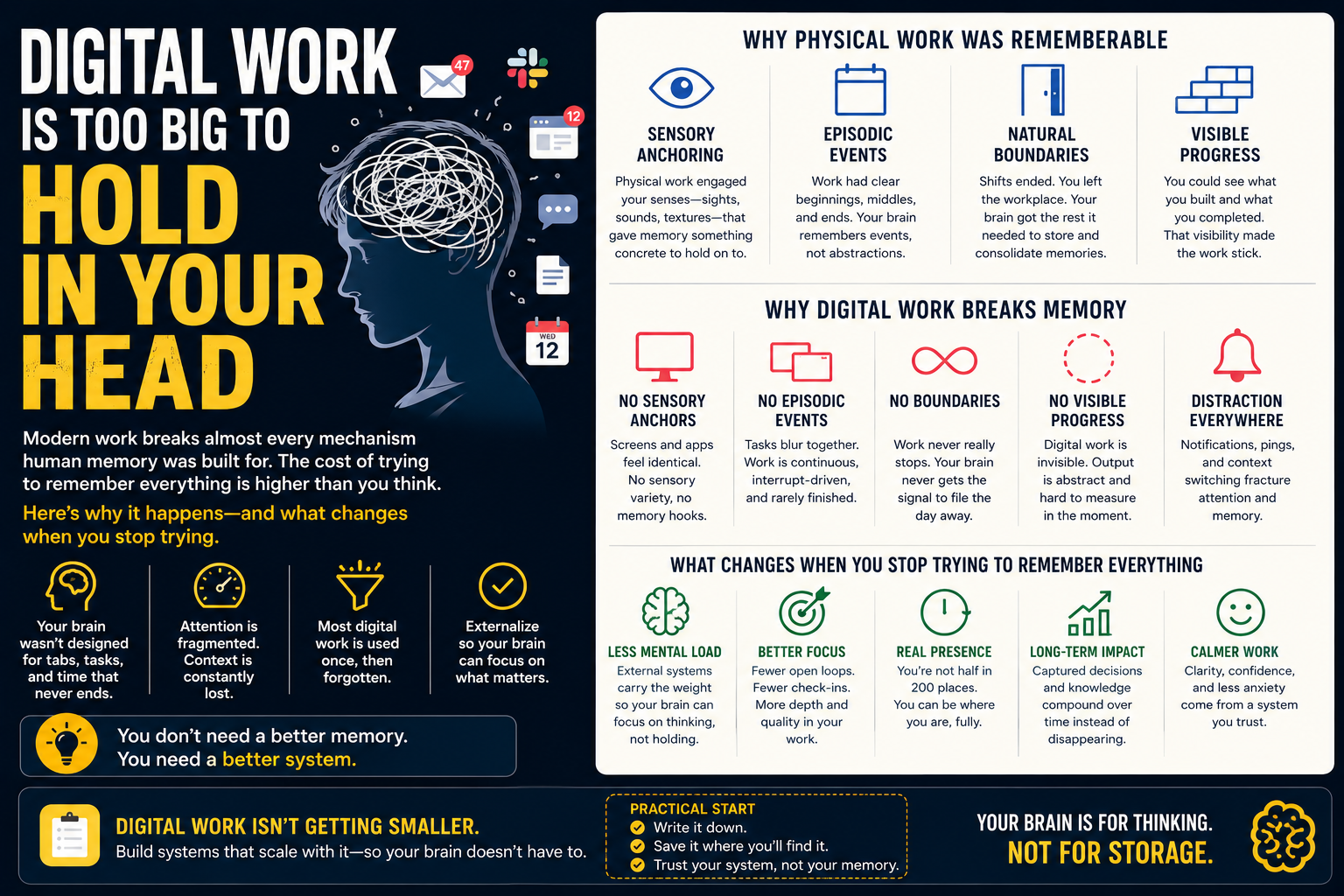
This is a piece about why memory fails at digital work. About what physical work did differently, why writing changed the species, and what it means to live and work with a brain that can no longer cover the surface area of your own life. It's about what changes when you stop trying to remember everything.
The shape of physical memory
For most of human history, work was rememberable. Not because people were better at remembering, but because work itself was built in a way that memory could grab.
Sensory anchoring
A blacksmith remembers the day she made the gate not because she has perfect recall, but because the gate was hot and heavy and her hands ached. The work was a physical event. It anchored to the body. The smell of the forge, the sound of the hammer, the weight of the metal - all of it gave the brain something concrete to attach the memory to.
Memory was built to anchor to sensory events. That's not a feature humans developed for productivity. It's the original purpose of memory: knowing which plants were safe, which trails led to water, which faces belonged to your tribe. The sensory anchors are how the brain knew to keep the information.
Physical work supplied those anchors constantly. The texture of the wood. The weight of the box. The temperature of the kitchen. The sound of the shop bell. Every day of work delivered hundreds of small sensory signatures that made the day storable.
Episodic events
Beyond sensory anchoring, physical work tended to organize itself into episodes. The morning you delivered the bread. The afternoon you fixed the loom. The evening you closed the books. Each was a beginning, a middle, and an end. Each had a doable thing and a done thing.
Episodic memory is what your brain uses to organize life into story. It's the memory of events - what happened, when, and what came of it. Physical work fed episodic memory naturally because work itself was episodic. You started a task, completed it, and moved to the next.
A farmer doesn't have to remember in the abstract that he planted the field. He remembers the morning he did it: the particular light, the wet boots, the sound of the tractor, the breakfast afterward. The episode is the memory. There's nothing extra to store.
Natural boundaries
Physical work also came with built-in boundaries. The shift ended. The shop closed. The light failed. Work had a place, and when you left the place, you left the work.
Those boundaries did two things memory needed. First, they marked the end of one chunk of work and the beginning of another, which let your brain file the day as a discrete unit. Second, they gave you the cognitive rest that consolidates short-term memory into long-term storage. Walking home from the factory at six, you weren't still loading boxes in your head. You were walking. Your brain was doing the housekeeping that makes memory durable.
Visible progress
Finally, physical work produced visible progress. You could point to the pile of bricks that didn't exist this morning. You could see the empty truck that was full at noon. You could count the patients seen, the boots cobbled, the dresses finished. The output was the proof.
Visible progress matters for memory not because the proof itself is what's remembered, but because the act of seeing your own work consolidates the experience. Your brain notices that the world is different than it was, and it tags that change as significant. The brick wall is the memory's bookmark.
Why this worked
Sensory anchoring, episodic events, natural boundaries, visible progress. Together, these four features made physical work the kind of activity that human memory could carry. Not because humans were trying. Because work and memory were built for the same world.
For most of history, this match was so good that nobody noticed it. People worked, people remembered, and the relationship between the two seemed too obvious to study.
Then we changed the work.
Digital work breaks every mechanism
Knowledge work, by which I mean almost everything done at a desk in front of a screen, doesn't have any of those four features. Not partially. None of them.
No sensory anchors
A tab is a tab is a tab. The thirteenth tab you opened today feels identical to the third. Documents look like documents. Slack threads look like Slack threads. The visual sameness of digital work means the brain has nothing to attach the day to. The screen is the same screen at 9am and 9pm. Your seat is the same seat. The room is the same room.
Without sensory anchors, the brain runs out of bookmarks. It still notices what you do - your attention is engaged - but there's no concrete thing to attach the memory to. The work happens in a smooth, undifferentiated visual field that gives the encoding system nothing to grab.
This is part of why people on a video call with their team for six hours straight feel they did a lot but can't recall what. Six hours of identical visual input collapses into one impressionistic blur. The brain didn't refuse to remember. It tried, found no handles, and let most of it slide.
No episodic events
A decision you make about which way to architect a feature, or how to respond to a tricky email, or whether to push back on a deadline, is a complete episode in cognitive terms. Beginning, middle, end. Real consequences.
But it doesn't feel like an episode. It feels like one more line of work in a continuous stream. There's no formal start. There's no formal finish. You think for a few minutes, type a few sentences, and move on. The decision is real, but it doesn't get a frame around it.
This is why developers and designers and operators can put in twelve hours of dense, consequential work and at the end of the day truly not be able to tell you what they did. They made forty decisions. None of them announced themselves. None of them got the kind of episodic packaging that physical work gives you automatically.
No boundaries
Digital work has no closing time. Your laptop is in your bag. Your inbox is on your phone. The office is wherever you are.
This isn't just a wellness problem. It's a memory problem. Without a clear end of work, the brain doesn't get the signal to file the day. The day doesn't end - it bleeds into the evening, which bleeds into the next morning. There's no consolidation phase, no walking home from the factory at six.
The result is days that fail to settle. Weeks that fail to settle. Work that never quite finishes long enough for memory to do its housekeeping. Your brain stays in the middle of a continuous, low-grade present that never becomes a past.
The pace problem
Maybe the most underestimated mechanism. Memory needs time to encode. Not much time - a few seconds of unbroken attention, sometimes - but more than zero. The encoding system needs a window where it isn't being asked to grab the next thing.
Digital work doesn't offer that window. The pace of small decisions and micro-actions runs faster than the encoding system can keep up. You read a message, respond, switch tabs, type a sentence, hit a notification, click a link. Each of those is something. None of them is a thing.
Multiply that across an eight-hour workday and you've performed thousands of micro-events, almost none of which got the window your brain needs to encode them. The day stored nothing because the day stored everything.
What this actually feels like
These four mechanisms compound. Lose any one and memory degrades. Lose all four and memory effectively gives up.
What that looks like in lived experience:
You're on a Friday afternoon walk and someone asks what you did this week. You stall. You feel a vague sense that you did things, important things, but the actual content won't surface. You finally land on "I had a lot of meetings" or "I was working on the new project," which are categories, not memories.
You're trying to write a status update on Sunday night for Monday morning. You open your calendar and your inbox and you piece together what happened. Most of it surprises you. You don't remember half of it. Some of it you don't remember at all even when you're staring at it.
You're trying to plan next week. You don't quite know where this week went, so you don't quite know what's left. You overcommit because you can't see the pattern of what fits. By Wednesday next week, you're behind, and you don't fully understand why.
You're talking to a friend about your career and you realize you can't quite tell the story of the last six months. You did things. You worked. You shipped, maybe. But the narrative arc is missing. It's all middle. No beginning, no end, no shape.
You start to feel that something is wrong with you. That you should be more disciplined. That other people seem to track their lives more clearly than you do. You start downloading productivity apps. You read books about systems. You install routines. None of them survive long enough to help. You suspect, quietly, that you're worse at this than other people.
You're not. They're not better at remembering. They've usually just discovered that they don't have to.
The science of memory limits
Memory isn't a single system. It's a family of systems doing different jobs, only some of which evolved to do anything like what knowledge work asks them to do.
Episodic memory, the memory of specific events, is the system most useful for remembering work, and the most overrun by digital conditions. Episodic memory was built to record sensory, contextual, emotionally significant events: where you ate the bad mushroom, who you fought with at the watering hole, what the predator looked like. It evolved for survival, not for symbol manipulation.
It still works for survival. It still records the dramatic, the emotional, the embodied. It still files away the morning you got bitten by the dog and the evening you got engaged. But it doesn't have a great mechanism for filing away the Tuesday afternoon when you closed eighteen tickets and made three architectural decisions.
There's also working memory, the famously small workspace that holds what you're consciously thinking about right now. It can hold somewhere between four and seven items, depending on how you count, and it spills constantly. Working memory is what you actually live in moment to moment. Most of what passes through it is never promoted to longer-term storage. It evaporates.
Digital work asks working memory to operate at full capacity for most of the day. The result is that almost nothing gets the kind of sustained attention that lets it cross from working memory into episodic memory. The day is encoded thinly or not at all.
This isn't a flaw you can train your way out of. It's the shape of the system. You can practice mnemonic techniques, you can chunk information cleverly, you can use spaced repetition. None of it changes the fundamental cap on how much novel, abstract, undifferentiated information a human brain can encode in a day. The cap is real, it's lower than you think, and it's not going up.
What changes is what you do with the cap.
A short history of external memory
The interesting thing is that humans noticed this problem a long time ago. Not in those words, not framed as a cognitive science observation, but functionally. The first writing systems weren't for poetry or law. They were for accounting.
Cuneiform tablets in ancient Mesopotamia, around five thousand years ago, were mostly inventories. How many sheep, how many bushels, who owed what to whom. People who were managing transactions at any scale ran into the same problem you run into on a Tuesday: they couldn't hold it in their heads. So they invented a way to hold it outside their heads. They put it on clay.
What clay tablets did, in cognitive terms, was give the brain an external organ for memory. The information could be set down, reviewed later, modified, compared, aggregated. It didn't have to live in any single human's brain. It lived in the system.
Every major leap in human knowledge production since then has been a leap in external memory. Papyrus, parchment, paper. Codex books. Indexes. Card catalogs. Filing systems. Databases. The arc of intellectual history is, in a real sense, the arc of finding better ways to hold what won't fit in a head.
The reason philosophers from Plato to McLuhan have argued about whether writing is good for us is that writing changes what humans are. Writing lets you have ideas that are bigger than your skull. It lets you build on what people thought before you, even people you never met. It lets you reason across timescales and complexity that pre-literate minds simply couldn't reach.
The same is true at the personal scale. Writing things down doesn't just record them. It extends the thinker. The page becomes part of how you think, not just where you store thoughts.
This insight has a name in modern cognitive science: the extended mind. The philosophers Andy Clark and David Chalmers proposed in the 1990s that human cognition isn't bounded by the skull. The notebook in your pocket is functionally part of your mind, if you use it that way. The same goes for the address book on your phone, the calendar on your wall, the sticky notes on your monitor. These aren't accessories to memory. They are memory, distributed outside the brain.
If you accept the extended mind frame, the question of digital work changes. The question isn't "why can't I remember everything I do?" The question is "what's the external memory I'm relying on, and is it good enough?"
For most people working on a screen, the answer is: there isn't one, or barely one. The calendar holds meetings. The inbox holds messages. The notes app holds fragments. Nothing holds the work itself - the decisions, the priorities, the context, the patterns. The external memory layer that would let you actually think across a week, a month, a year is missing.
The work happens. The trace of the work doesn't.
What external memory enables
It's hard to feel the cost of missing external memory because you don't feel the absence of what you can't see. You don't miss what you don't know you forgot. You just have a vague sense that things are slipping.
But when external memory is in place - when the trace of the work survives the work - four specific things become possible that weren't possible before.
Real review
You can review what you can read. You can't review what you can only sort of remember.
A real review of last week isn't "I think it went okay" or "I had a lot of meetings." It's a structured look at what you actually did - what you committed to, what got finished, what slipped, where the hours went, what surprised you. You can't do that from memory alone, and not just because you forget. You forget selectively. Memory keeps the dramatic moments and edits out the routine ones, which means a memory-based review tells you almost nothing true about your actual week.
External memory makes review possible because it survives the editing. The trace is honest in a way recollection can't be.
Honest planning
Planning is reasoning about the future based on something you know about the past. If you can't see the past clearly, you can't plan well.
This is why most weekly plans fail. They're built on imagined capacity rather than measured capacity. You think you can fit twelve things into next week because you remember a vague feeling of having done a lot last week. But you didn't actually do twelve things last week. You did four, badly, with eight half-starts. You don't remember the half-starts because they didn't finish, so they didn't get filed. Your sense of your own throughput is inflated by selection bias.
External memory fixes this. When you can see exactly what you got done across the last four weeks, you stop planning against fantasy. The plan gets honest. It also gets achievable, which means you start finishing things, which means your self-trust starts compounding in a way it can't when every plan is fiction.
Pattern recognition
The most underestimated benefit of external memory is what it does over time. Not week to week, but month to month, quarter to quarter, year to year.
Patterns in your work that you cannot possibly see by remembering become obvious when you can look at the record. The project that quietly absorbed twice the hours you thought it did. The kind of meeting that always wrecks your afternoon. The week of the month when you consistently slip. The collaborator whose work you keep redoing. The category of task you keep saying you'll do and never do.
These aren't insights you can get from introspection. They're statistical. They require enough data, recorded honestly enough, that the noise gets out of the way and the shape emerges. Memory cannot do this. External memory can.
Once you can see those patterns, you can act on them. You stop taking on the kind of work you historically fail at. You stop scheduling deep work in the time slots when you're never focused. You stop pretending you can collaborate with people who consume more of your time than they return. The patterns become decisions, and the decisions become a better life.
Identity persistence
The deepest function of external memory is what it does to your sense of self.
A person who can't remember much of the past six months has trouble believing in their own progress, because they can't see it. They feel they've been busy without being able to defend the claim, even to themselves. The result is a low-grade chronic doubt about whether they're actually any good at what they do, whether they're moving forward, whether the years are adding up to anything.
A person who can review six months of their actual work feels the opposite. They can see the projects shipped, the problems solved, the skills sharpened, the relationships built. They know what they did because the record exists. The doubt doesn't disappear, but it has less room to operate.
Identity is what we tell ourselves about who we are. External memory is the source material for telling yourself an accurate story. Without it, the story is mostly fiction in either direction - inflated or deflated, but rarely true.
The shape of effective external memory
If external memory is this important, you'd think it would be easy to set up. It isn't. Most attempts fail. Notes apps fill with fragments. Journals get abandoned. Productivity systems collapse within weeks. People try, give up, and conclude they're not the type to keep this up.
The failure usually isn't motivation. It's that the external memory system is built wrong. There are a few features an effective external memory system needs.
It has to be time-anchored. Memory in your head is organized by time, even if imperfectly, and external memory needs to mirror that. Fragments in a notes app without dates are just fragments. They can't be reviewed because they can't be located. Date is the index.
It has to make capture cheap. If logging a thought, a decision, or a finished task takes more than a few seconds, the system collapses under the cost. The friction has to be lower than the friction of trying to remember.
It has to be reviewable in chunks. Daily, weekly, monthly, quarterly. The chunks are where insight lives. A pile of undifferentiated entries is not external memory in any useful sense; it's a landfill.
It has to be honest. Not curated, not edited for posterity, not filtered to look good. The whole point is to capture what actually happened, including the slippage. A system that only records the polished version of your week is no more useful than memory was.
And it has to be searchable. Memory in your head fails at search. Even when you know something is there, you can't always find it. External memory needs to compensate for that exact weakness.
This is a hard set of requirements to meet without intention. Most general-purpose tools meet one or two and miss the rest. Notes apps are searchable but not time-anchored. Calendars are time-anchored but capture only meetings. Journals are reflective but rarely structured. The result is a patchwork that fails at every chunk past the daily.
The cost of not having it
The cost of operating without effective external memory is harder to see than the cost of, say, a bad night's sleep. It accumulates quietly. It distributes itself across many small symptoms that look unrelated.
The persistent feeling of being busy without being productive. That feeling isn't usually wrong. It's just that you have no record to confirm whether the busy hours produced anything. The brain defaults to assuming they didn't, because it doesn't have evidence they did.
The slow burnout that has nothing to do with workload. You're not necessarily working too much. You're working in a way that doesn't store. Every week feels like the first week, because nothing accumulates. Effort that doesn't compound feels worse than effort that does, even at the same intensity.
The Sunday anxiety that doesn't seem to map to anything specific. You feel like you should be doing something on Sunday night, but you don't know what. The system that would tell you - here's what slipped this week, here's what to carry forward - doesn't exist. So instead you sit with a vague dread about Monday and try to medicate it with planning that won't survive contact with Tuesday.
The career sense that nothing is happening. Even when things are happening. Even when you're shipping, growing, being trusted with more. You don't see it because you have no record to look back at. Five years pass and you can't quite say what you spent them on.
The relationship cost. The people in your life ask how your week was, and you don't know how to answer, so you say "fine" and change the subject. They start to feel that they don't know what you do all day. You start to feel that you're a stranger to your own life.
These costs are the bill for trying to hold digital work entirely in your head. The bill is real, and you've been paying it. The fact that you haven't seen the line item doesn't mean it isn't being charged.
The shift
The shift is small in description and large in consequence. Stop trying to remember the work. Let the system remember it. Use your brain for the part it's actually good at - which is thinking, not storing.
This sounds like a productivity move. It's a deeper one.
What you're doing when you offload memory to a system isn't outsourcing yourself. You're freeing the part of yourself that was being used as a filing cabinet. Memory isn't the most interesting thing your brain can do. Pattern recognition, novel reasoning, creative connection, judgment under uncertainty - those are the things that need cognitive room. Trying to hold everything in your head is what's been stealing the room.
When you stop trying to remember the day, the day doesn't disappear. It moves into a place where you can actually look at it. When you stop trying to plan from imagined history, you plan from real history, and the plans hold. When you stop trying to recall who you were six months ago, you start being able to see who you actually were, and the path forward sharpens.
The brain you have evolved for a world without tabs and decisions and weeks that blur. It served humans well for fifty thousand years before the screen showed up. It's still good at what it was designed for. It's just not designed for what most of us now spend our days doing.
Digital work is too big to hold in your head. That's not a flaw in you. It's a property of the work.
The thing to do about it isn't to try harder. The thing to do about it is to build a memory that lives outside your head. Then use your head for what it's actually for.
Date-based AI Task Manager
Plan smarter, execute faster, achieve more
Create tasks in seconds, generate AI-powered plans, and review progress with intelligent summaries. Perfect for individuals and teams who want to stay organized without complexity.
Get started with your preferred account