Creativity Plus Technical Knowledge Is Becoming the Ultimate Productivity Advantage
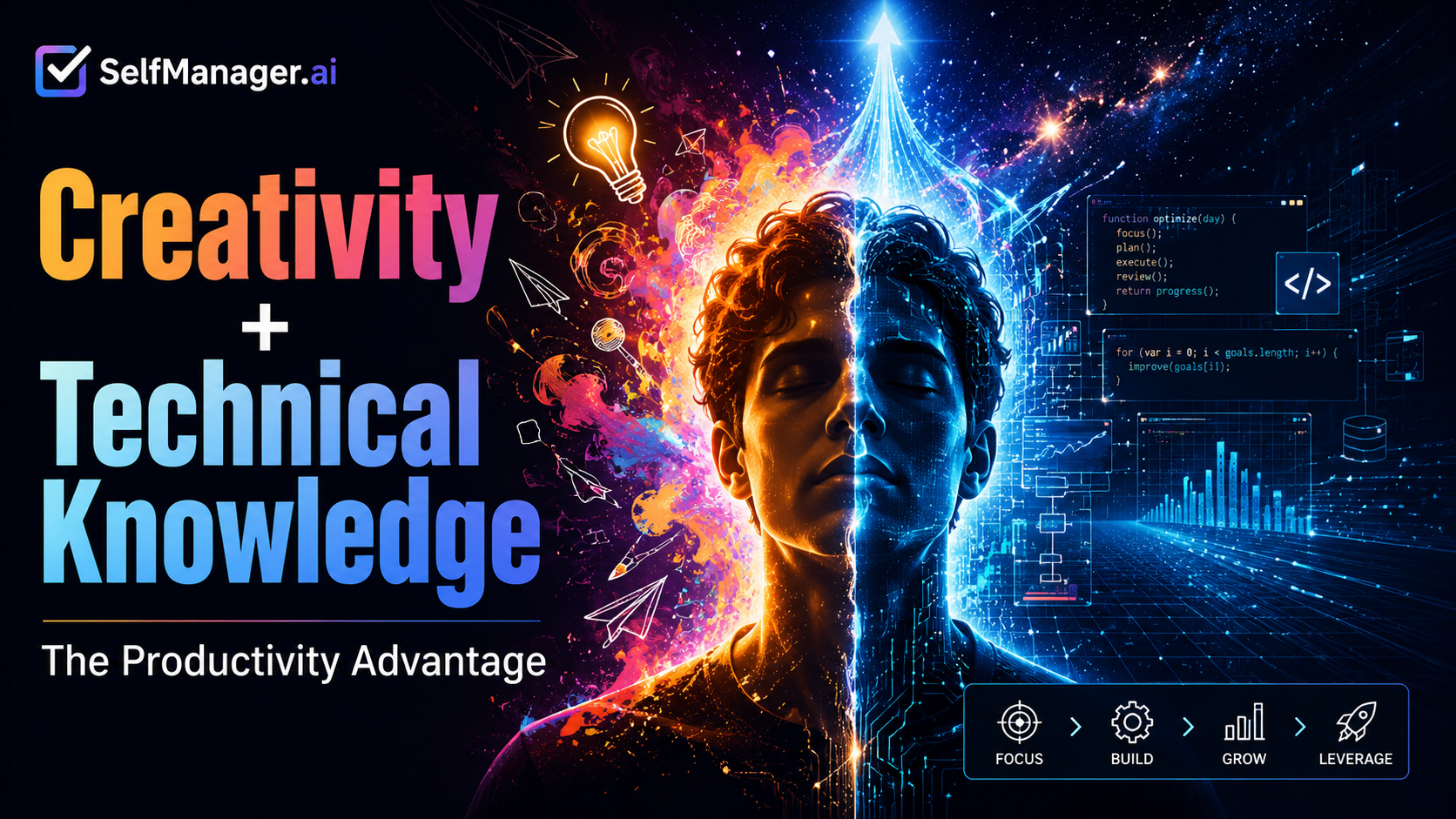
Creativity and technical knowledge used to live in different worlds
For a long time, creativity and technical knowledge were treated like completely separate abilities.
Creative people were supposed to imagine ideas, write stories, design visuals, think about brands, communicate messages, and come up with new directions.
Technical people were supposed to build systems, write code, configure tools, manage data, solve infrastructure problems, and make things work.
In many companies, these two worlds were separated by departments.
Marketing had ideas.
Design created visuals.
Engineering built the product.
Management coordinated everything.
This structure still exists, but the world has changed.
Today, the person who can combine creativity and technical knowledge has a very different kind of advantage. They do not only imagine what could exist. They can also understand how it could be built, tested, improved, automated, and scaled.
That changes everything.
It changes how fast they can move.
It changes how many people they need around them.
It changes how well they can use AI.
It changes how easily they can turn an idea into something real.
The advantage is not only talent. It is leverage.
The real advantage is moving from idea to execution faster
Most people have ideas.
The hard part is not having an idea.
The hard part is turning the idea into something useful.
- A landing page.
- A product.
- A workflow.
- A piece of content.
- A campaign.
- A business process.
- A prototype.
- A better internal system.
- A new offer.
- A better client experience.
This is where people with both creativity and technical knowledge have a clear advantage.
They can move from "what if?" to "how would this work?" much faster.
They can see the creative possibility, but they can also see the structure behind it.
They can ask better questions:
- Can this be automated?
- Can this become a repeatable system?
- Can this be tested quickly?
- Can this be measured?
- Can this scale?
- Can AI help with this?
- Can software remove part of the manual work?
- Can this become a product instead of a one-time task?
That kind of thinking compounds.
Over time, the person who can connect ideas with execution starts moving differently from everyone else.
They are not waiting for someone else to translate the idea.
They are not stuck in endless planning.
They are not limited to theory.
They can create, test, adjust, and ship.
Creativity without execution often stays invisible
Creativity is powerful, but creativity alone is not always enough.
A creative person can have excellent ideas and still struggle to make progress if they do not have the systems, tools, or technical understanding to bring those ideas into the real world.
The idea may stay in a notebook.
Or in a Google Doc.
Or in a conversation.
Or in someone's head.
That is the painful part about creativity. It can feel very real internally, but until it becomes visible, usable, or shareable, the world does not experience it.
This is why execution matters so much.
Execution gives creativity a body.
A website gives an idea a place to live.
A product gives an idea a function.
A workflow gives an idea repeatability.
A system gives an idea consistency.
A deadline gives an idea pressure.
A review process gives an idea improvement.
Technical knowledge helps creativity escape the abstract stage.
It gives the creative person more ways to make the idea real.
Technical knowledge without creativity can become narrow
The opposite is also true.
Technical knowledge alone is not always enough either.
Someone can know how to code, build automations, manage systems, configure tools, or work with data, but still struggle to decide what is worth building.
They may build technically impressive things that nobody wants.
They may overcomplicate simple problems.
They may focus too much on the system and not enough on the user.
They may solve a problem elegantly, but fail to communicate why it matters.
This is where creativity gives technical knowledge direction.
Creativity helps technical people understand people, not just systems.
It helps them think about experience, emotion, usability, positioning, storytelling, and timing.
It helps them ask:
- Who is this for?
- Why would they care?
- How should this feel?
- How do we explain it simply?
- What is the smallest version that proves the idea?
- What is the human problem behind the technical problem?
This combination is powerful because it avoids two common traps.
The creative person avoids being stuck with ideas they cannot execute.
The technical person avoids building things without a strong reason.
Together, creativity and technical knowledge create momentum.
AI made this combination even more valuable
AI has made this advantage even more obvious.
A few years ago, creativity and technical knowledge were useful together.
Now they are becoming multiplied by AI.
AI can write, summarize, brainstorm, generate images, help with code, analyze data, create outlines, suggest improvements, and speed up many parts of knowledge work.
But AI does not remove the need for judgment.
In fact, it increases the value of judgment.
Anyone can ask AI for ideas.
But not everyone can recognize which ideas are good.
Anyone can ask AI to generate content.
But not everyone can shape that content into something clear, useful, and aligned with a real goal.
Anyone can ask AI to help with code.
But not everyone can understand when the code is wrong, unsafe, overcomplicated, or not suitable for production.
Anyone can ask AI to create a plan.
But not everyone can turn that plan into real daily execution.
This is why the creative and technical person becomes even more powerful in the AI era.
They can prompt better.
They can evaluate better.
They can correct better.
They can combine tools better.
They can use AI not just as a toy, but as part of a real workflow.
They are not only consuming AI output.
They are directing it.
The advantage is no longer only about knowing more
In the past, knowledge itself was a huge advantage.
If you knew how to design, code, write, edit, optimize, automate, or market, you had access to something many other people did not.
Now, information is everywhere.
Tutorials are everywhere.
AI answers are everywhere.
Templates are everywhere.
Tools are everywhere.
The new advantage is not only knowing information.
The new advantage is knowing what to do with it.
That is where creativity and technical knowledge become so important together.
Technical knowledge helps you understand the tools.
Creativity helps you see original uses for them.
Technical knowledge helps you understand constraints.
Creativity helps you find unusual paths around them.
Technical knowledge helps you build systems.
Creativity helps you make those systems meaningful.
The combination turns knowledge into action.
The best builders are becoming translators
Some of the most valuable people today are translators between worlds.
They can speak design and development.
They can speak marketing and product.
They can speak business and automation.
They can speak user needs and technical implementation.
They can speak strategy and daily execution.
This is a huge advantage because many projects fail in the gaps between these worlds.
The idea is good, but the technical execution is poor.
The product is solid, but the messaging is unclear.
The system works, but the user experience is bad.
The marketing is strong, but the backend cannot support it.
The strategy is smart, but nobody turns it into daily work.
People who combine creativity and technical knowledge close those gaps.
They reduce friction.
They need fewer translations.
They can spot problems earlier.
They can communicate across different types of work.
That makes them more productive, not because they do more random tasks, but because they waste less energy moving between disconnected systems and people.
This is why solo builders and small teams can now do more
One of the biggest changes of the last decade is how much one person or a small team can now build.
A solo founder can build a SaaS.
A freelancer can create a full client system.
A creator can run a media business.
A developer can launch a product.
A designer can build a no-code app.
A marketer can automate research, content, and analytics.
A consultant can turn their knowledge into digital products.
This does not mean everything is easy.
It does not mean everyone can build a successful business alone.
But the ceiling is much higher than it used to be.
When creativity and technical knowledge exist in the same person, the stars are not literally the limit, but the ceiling definitely moves higher.
That person can imagine the offer, build the page, connect the tools, automate the workflow, analyze the results, and improve the system.
They can do in days what previously required many handoffs.
That is a real productivity advantage.
Productivity is not just about doing more tasks
This is where the topic becomes especially important.
When people talk about productivity, they often reduce it to task management.
How many tasks did you complete?
How many hours did you work?
How many meetings did you attend?
How many things did you check off?
But for creative and technical people, productivity is more complex.
Their work is not only a list of small tasks.
It includes thinking.
Research.
Experimentation.
Building.
Debugging.
Writing.
Reviewing.
Planning.
Changing direction.
Capturing ideas.
Connecting old context with new decisions.
Improving systems over time.
This kind of work does not always fit neatly into a basic to-do list.
A creative and technical person needs more than a place to dump tasks.
They need a way to manage context.
They need a way to connect ideas with execution.
They need a way to plan work by date.
They need a way to review what happened.
They need a way to keep important details from disappearing.
They need a system that supports both thinking and doing.
Ideas need a place to land
One of the biggest productivity problems for creative and technical people is that ideas arrive constantly.
You see something.
You read something.
You notice a problem.
You think of a product improvement.
You imagine a better workflow.
You find a bug.
You think of a content angle.
You discover a marketing idea.
You remember a client follow-up.
You realize something should be automated.
The problem is not only capturing these ideas.
The bigger problem is giving them a place to land.
If every idea goes into a random note, a chat app, a bookmark, a document, a task list, or your memory, the system becomes messy very quickly.
The ideas exist, but they are not connected to action.
This is where productivity systems matter.
A good system does not only store ideas.
It helps you decide when they matter.
Today?
This week?
Next month?
After the current project?
When you have more time?
When the product is ready?
When the client responds?
For creative and technical people, time matters because execution has sequence.
Some ideas are good, but not for today.
Some ideas are exciting, but not important.
Some ideas need research first.
Some ideas need a deadline.
Some ideas need to be turned into smaller tasks.
Some ideas need to be ignored.
A strong productivity system helps you make those decisions.
Technical creativity compounds over time
The biggest advantage of combining creativity and technical knowledge is not always visible immediately.
It compounds.
At first, you may only be slightly faster.
You understand the tool better.
You automate one small workflow.
You write better prompts.
You build a cleaner website.
You organize your work more clearly.
You make better decisions about what to build.
But over months and years, those small advantages stack.
You build reusable systems.
You create templates.
You understand patterns.
You develop taste.
You learn what is worth automating.
You learn what is not worth building.
You become faster at turning vague ideas into structured work.
You become better at spotting opportunities.
You become better at avoiding dead ends.
That is compounding productivity.
It is not just about one good day.
It is about becoming the kind of person who can repeatedly turn ideas into useful output.
The world rewards people who can connect imagination with systems
A lot of work today is not purely creative or purely technical.
It sits in the middle.
Building a website is not only technical. It is also messaging, design, structure, user flow, SEO, performance, and business positioning.
Building a SaaS is not only technical. It is also product thinking, customer understanding, pricing, onboarding, marketing, support, and retention.
Creating content is not only creative. It is also distribution, analytics, formats, platform behavior, search intent, and consistency.
Running a business is not only strategic. It is also systems, operations, automation, follow-up, finance, and execution.
The people who understand this have an obvious advantage.
They do not see work as isolated tasks.
They see systems.
They see how one decision affects another.
They see how content affects traffic.
They see how traffic affects signups.
They see how onboarding affects retention.
They see how product experience affects word of mouth.
They see how automation affects time.
They see how planning affects execution.
This ability to connect things is one of the most underrated productivity skills.
Better tools do not automatically create better output
There is one important warning here.
Creative and technical people often love tools.
New apps.
New AI models.
New frameworks.
New automation platforms.
New project management systems.
New note-taking tools.
New analytics dashboards.
New workflows.
That can be useful, but it can also become a trap.
Better tools do not automatically create better output.
A person can spend a lot of time improving the system and still avoid the actual work.
They can organize instead of ship.
They can automate instead of decide.
They can research instead of publish.
They can redesign instead of sell.
They can plan instead of execute.
This is why productivity still needs discipline.
The goal is not to have the most advanced system.
The goal is to create a system that helps you move.
A good productivity system should reduce friction, not become another project that consumes all your energy.
The best productivity system supports both structure and flexibility
Creative and technical work needs a balance.
Too much structure can kill momentum.
Too little structure creates chaos.
Creative people need space to explore.
Technical people need enough detail to execute.
Founders, freelancers, builders, and knowledge workers often need both in the same day.
You may start the morning with a clear task list, then discover a bug, get a client message, think of a content idea, analyze a metric, and adjust the plan.
That is normal.
The system should not break when reality changes.
A strong productivity system gives you structure without making you feel trapped.
It helps you see what matters today.
It lets you capture new ideas.
It lets you move things forward.
It lets you review what happened.
It gives you enough context to return to work later.
This is especially important for people who combine creative and technical work because their days are rarely linear.
Why date-centric productivity makes sense for this kind of work
For people who create and build, dates matter.
Not because every task is a strict deadline, but because real work happens in time.
You do not execute in a project board.
You execute today.
You review at the end of the week.
You notice patterns over a month.
You return to unfinished ideas later.
You connect decisions with the day they happened.
This is why date-centric productivity can be powerful.
Instead of throwing everything into endless lists, date-centric planning gives work a home in time.
What are you doing today?
What did you work on yesterday?
What needs to move to tomorrow?
What changed this week?
What ideas keep coming back?
What is actually progressing?
For creative and technical people, this can be more natural than trying to force everything into rigid categories.
Ideas, tasks, notes, time tracking, plans, reviews, and context can all be connected to the day they happened.
That creates a clearer memory of your work.
Where SelfManager.ai fits into this idea
This is one of the reasons SelfManager.ai exists.
It is not built only as a basic to-do list.
It is built around the idea that your work needs a daily home.
Tasks, notes, priorities, statuses, time tracking, images, comments, pinned tables, deadlines, AI summaries, AI reviews, and AI planning all make more sense when they are connected to real execution.
For creative and technical people, this matters because work is not only "complete task A."
It is often:
- Think through an idea.
- Break it into smaller parts.
- Research it.
- Build part of it.
- Write about it.
- Review it later.
- Improve the system.
- Connect it to a larger direction.
A productivity tool should support that full loop.
Capture.
Plan.
Execute.
Review.
Improve.
That loop is where creative and technical people get their advantage. But without a system, the loop can become scattered.
SelfManager.ai is built for people who want their work organized around days, not buried inside disconnected apps, endless boards, or random notes.
The advantage is obvious, but it still requires consistency
It is tempting to say that if someone has creativity and technical knowledge, they are unstoppable.
But that is not completely true.
The advantage is real, but it still needs consistency.
A creative and technical person can still get distracted.
They can still chase too many ideas.
They can still overbuild.
They can still fail to finish.
They can still avoid marketing.
They can still get lost in details.
They can still jump from one tool to another.
Talent and knowledge are not enough.
The real advantage appears when creativity, technical knowledge, and consistent execution come together.
Creativity gives you direction.
Technical knowledge gives you leverage.
Consistency gives you results.
Without consistency, the other two are underused.
The future belongs to people who can build around their ideas
The future of productivity will not only be about who works the longest.
It will not only be about who has the cleanest task list.
It will not only be about who uses the newest AI tool.
The future belongs to people who can build around their ideas.
People who can think clearly.
People who can use technology intelligently.
People who can create systems.
People who can communicate value.
People who can turn insight into action.
People who can review their own work and improve.
People who can move between creativity and execution without losing momentum.
That is the real advantage.
Not creativity alone.
Not technical knowledge alone.
The combination.
When a person has both, they can see more possibilities and act on more of them.
And when that person also has a productivity system that keeps them grounded, organized, and consistent, the ceiling becomes much higher.
Maybe the stars are not the limit.
But the limit definitely moves.
Date-based AI Task Manager
Plan smarter, execute faster, achieve more
Create tasks in seconds, generate AI-powered plans, and review progress with intelligent summaries. Perfect for individuals and teams who want to stay organized without complexity.
Get started with your preferred account