The Best Productivity System Is the One You Can Maintain
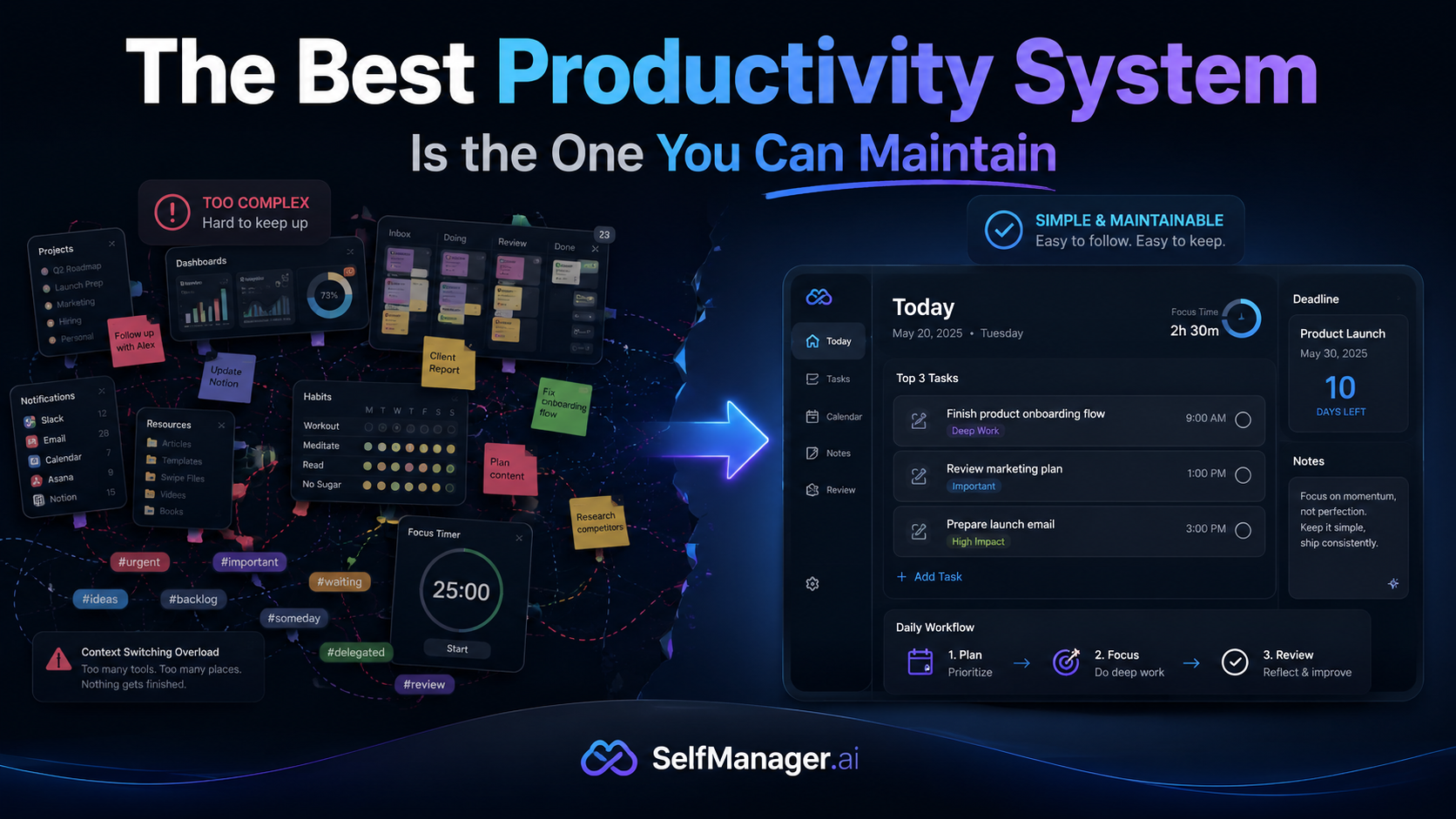
Most productivity systems look good on day one
Most productivity systems look great when you first set them up.
The dashboard is clean.
The categories make sense.
The tasks are organized.
The calendar is blocked.
The template feels smart.
The AI assistant feels helpful.
Everything looks like it finally has a place.
Then real life happens.
You skip one daily review. A few tasks become overdue. Some notes go into the wrong place. You forget to update a status. A meeting moves. A deadline changes. A task that looked simple turns into something bigger.
A week later, the system already feels heavier.
You do not fully trust it anymore. Some work is inside the app. Some work is still in your head. Some tasks are buried in messages. Some notes are in random documents. Some deadlines are on the calendar. Some are not.
At that point, many people blame themselves.
They think they are not disciplined enough.
They think they need a better app.
They think they need a more advanced template.
They think they need to start over.
But sometimes the problem is much simpler:
The system was too hard to maintain.
The hidden cost of productivity is maintenance
Every productivity system has a maintenance cost.
That cost is not always obvious when you start using it.
At first, the system feels exciting. You are setting it up. You are organizing things. You are imagining the better version of your work life.
But after the setup phase, the system has to survive normal days.
Busy days.
Low-energy days.
Interrupted days.
Client-call days.
Family-problem days.
Urgent-fix days.
Days when you do not have time to carefully organize every task, tag every note, update every status, and clean every dashboard.
That is when the maintenance cost becomes visible.
A productivity system can ask you to:
- Add every task manually.
- Choose a project for every task.
- Add tags.
- Set priorities.
- Add due dates.
- Estimate durations.
- Move unfinished tasks.
- Update statuses.
- Link notes.
- Clean dashboards.
- Review projects.
- Reschedule overdue work.
- Write summaries.
- Check multiple apps.
- Remember where everything lives.
None of these steps are necessarily bad.
The problem is that they add up.
A system that looks powerful on day one can become exhausting by week three.
The better question is not only:
What can this app do?
The better question is:
How much effort does this system require every week just to stay useful?
Every extra step creates friction
Productivity systems usually fail slowly.
They do not collapse because of one big problem.
They collapse because of small repeated friction.
One extra click feels harmless.
Choosing one tag feels harmless.
Updating one status feels harmless.
Moving one task feels harmless.
Adding one due date feels harmless.
But if the system asks for those decisions again and again, every day, across dozens of tasks, it starts to feel like work.
At some point, you are not just doing the work.
You are managing the system that manages the work.
That is where productivity tools can become a trap.
The goal of a productivity system should be to reduce friction, not create a new layer of administration.
Of course, some structure is necessary.
A completely unstructured system becomes chaos. You need some way to know what matters, what is due, what is active, what is finished, and what needs attention.
But there is a balance.
Too little structure creates confusion.
Too much structure creates maintenance.
A good productivity system gives you enough structure to make better decisions without demanding constant care.
A fragile system requires perfect behavior
Many productivity systems are designed for your ideal self.
The version of you that wakes up early.
Plans calmly.
Reviews every evening.
Updates every task.
Tags every note.
Keeps every dashboard clean.
Processes every inbox.
Estimates every duration.
Reflects every Friday.
That version of you might exist sometimes.
But it is not the version of you that shows up every day.
Real life is messier.
Sometimes you are tired.
Sometimes you are behind.
Sometimes you are overloaded.
Sometimes you are switching between client work, personal tasks, admin, messages, meetings, and unexpected problems.
Sometimes you just need to get through the day.
A productivity system that only works when you behave perfectly is not a strong system.
It is a fragile system.
The real test is whether the system still helps you when you are not using it perfectly.
Can you skip a day and come back?
Can you miss a review and recover?
Can you add messy tasks without breaking the structure?
Can you continue working without needing to reorganize everything first?
If not, the system may be too delicate for real life.
The real test is how easy it is to come back
One of the most important qualities of a productivity system is its return cost.
Return cost means:
How hard is it to come back after missing a day, a week, or a month?
Some systems punish you for leaving.
You come back and everything is overdue. Tasks are outdated. Dashboards are messy. Priorities are unclear. Old notes are disconnected. The system feels like a room you do not want to clean.
So instead of returning, you avoid it.
Then you start using memory, sticky notes, random documents, messages, and temporary lists again.
A good system should make returning easy.
Because falling off is normal.
You will miss days.
You will get busy.
You will forget to update things.
You will have periods where work moves faster than your system.
That should not destroy the whole setup.
The real test of a productivity system is not how good it feels when you use it perfectly.
The real test is how easy it is to return after you fall off.
If returning feels simple, the system has a chance to become part of your life.
If returning feels heavy, you will eventually abandon it.
Complex dashboards can hide simple confusion
There is a type of productivity setup that looks impressive but does not actually create clarity.
It has dashboards.
Views.
Widgets.
Databases.
Charts.
Kanban boards.
Priority matrices.
Weekly pages.
Monthly pages.
Goal trackers.
Habit trackers.
Automations.
AI summaries.
On a screenshot, it looks advanced.
But the user still has the same basic questions:
- What should I do today?
- What actually matters this week?
- What is overdue?
- What did I already finish?
- What keeps getting postponed?
- What needs my attention now?
A beautiful dashboard is not the same as a clear system.
Sometimes complexity gives the feeling of control without actually improving execution.
This is especially common when the system becomes a project by itself.
You spend more time adjusting the setup than doing the work.
You improve the dashboard.
You redesign the template.
You add a new view.
You change the tags.
You reorganize the database.
You create a better planning ritual.
But the work itself does not move much.
That is when the productivity system has crossed a line.
It is no longer supporting the work.
It has become the work.
AI does not fix an unclear system
AI has changed productivity software, but it does not remove the need for a clear system.
AI can summarize.
AI can plan.
AI can generate tasks.
AI can suggest priorities.
AI can help review your week.
AI can reduce friction in many useful ways.
But AI cannot magically fix a system that the user does not trust.
If your tasks are vague, AI may create a more organized version of vague work.
If your priorities are unclear, AI may schedule the wrong things.
If your notes are scattered everywhere, AI may summarize fragments instead of the full picture.
If your system is overloaded, AI may help you move the overload around.
That does not mean AI is useless. Far from it.
AI becomes very useful when it sits inside a system that already has enough structure.
It can help you turn messy notes into tasks.
It can help you review what happened.
It can help you see patterns.
It can help you plan the next day or week.
It can reduce the blank-page problem.
But AI works best when it has real context.
The lesson is simple:
AI can reduce maintenance, but it cannot replace clarity.
A good system answers a few basic questions
A maintainable productivity system does not need to track everything.
It needs to answer the right questions reliably.
Questions like:
- What needs my attention today?
- What is actually important?
- What has a deadline?
- What did I already finish?
- What keeps getting postponed?
- What needs to move forward?
- What should I review before planning the next week?
- Where is the context for this work?
- What can I safely ignore for now?
If your system answers those questions, it is useful.
If it cannot answer those questions, more features may not help.
This is where many productivity setups go wrong.
They optimize for storage instead of decision-making.
They give you many places to put things, but not enough clarity about what to do next.
A good system should help you make decisions.
Not just collect information.
Not just hold tasks.
Not just create nice dashboards.
The goal is not to track every detail of your life.
The goal is to keep enough structure that you can act with less confusion.
Build for your average day, not your perfect day
A common mistake is designing a productivity system for your best day.
The day when you have energy.
The day when you are motivated.
The day when you have time to plan.
The day when your calendar is clean.
The day when nothing unexpected happens.
But your productivity system has to work on your average day.
The average day is less polished.
You may wake up late.
You may have messages waiting.
You may have a meeting you forgot about.
You may have unfinished work from yesterday.
You may be mentally tired.
You may not feel like carefully organizing everything.
That is the day your system needs to support you.
Not the fantasy version of your day.
A maintainable system should make it easy to start.
There should be one obvious place to go.
One clear view of what matters.
One simple way to capture new work.
One way to see deadlines.
One way to carry unfinished work forward.
One way to review what happened.
The more the system depends on your best behavior, the more fragile it becomes.
Do not build a productivity system for your perfect day.
Build one that still works on your average day.
Simple does not mean weak
There is a difference between simple and shallow.
A simple system can still be powerful.
It can still include tasks, deadlines, notes, time tracking, reviews, AI, and long-term planning.
The key is that the system should feel simple to return to.
Simple means the structure is understandable.
Simple means you know where to start.
Simple means you do not need to remember twenty rules.
Simple means the system can hold complexity without making the user feel lost.
That is different from a basic checklist.
A checklist is simple because it does very little.
A good productivity system is simple because it organizes complexity in a way the user can actually maintain.
That distinction matters.
Many people do not need fewer responsibilities.
They need a clearer way to manage the responsibilities they already have.
What a maintainable productivity system usually looks like
A maintainable productivity system usually has a few qualities.
It has one clear place to start.
When you open the system, you should not feel lost. You should know where to look first.
It has a fast way to capture work.
If adding a task takes too much effort, you will avoid the system when you are busy.
It has a realistic daily view.
You should be able to see what needs attention without being buried under everything you might do someday.
It has a way to carry work forward.
Unfinished work should not become a graveyard. It should be easy to move, continue, or intentionally drop.
It has a way to attach context.
Tasks without context become weak over time. Notes, links, files, comments, and history matter.
It has a way to see deadlines.
Deadlines should not depend on memory. They should be visible enough to shape your decisions.
It has a review habit that is not too heavy.
Review is important, but if the review process feels like homework, you will avoid it.
It has enough flexibility for messy work.
Not every task fits into a perfect category. Not every plan survives the day.
It has enough structure to avoid chaos.
Flexibility without structure becomes another pile.
The best systems balance both.
The system should support the work, not become the work
There is a point where productivity becomes its own hobby.
You try a new app.
You move everything over.
You rebuild your setup.
You watch videos.
You download templates.
You adjust fields.
You create dashboards.
You redesign your workflow.
For a while, it feels productive.
But after some time, you have to ask:
Is this helping me do the work, or is this replacing the work?
There is nothing wrong with improving your system.
But the system should remain a support layer.
It should help you think.
Help you plan.
Help you execute.
Help you review.
Help you return.
It should not constantly ask for attention.
A productivity system should make your real work easier to face.
If it becomes another source of pressure, it is failing.
Final thought
The best productivity system is not the one that looks most impressive in a screenshot.
It is not the one with the most features.
It is not the one with the most complex dashboard.
It is not the one that works only when you use it perfectly.
The best productivity system is the one you can maintain.
The one you still trust after a busy week.
The one you can return to after missing a day.
The one that helps you make decisions without demanding constant cleanup.
The one that gives you enough structure to stay clear, but not so much structure that maintaining the system becomes another job.
Because productivity systems do not usually fail on perfect days.
They fail on normal days.
And if your system can survive normal days, it has a real chance of becoming useful.
Date-based AI Task Manager
Plan smarter, execute faster, achieve more
Create tasks in seconds, generate AI-powered plans, and review progress with intelligent summaries. Perfect for individuals and teams who want to stay organized without complexity.
Get started with your preferred account