The Great Stack Collapse: What AI Startup Founders Actually Use in 2026 (vs 2024)
A typical founder day, two years apart
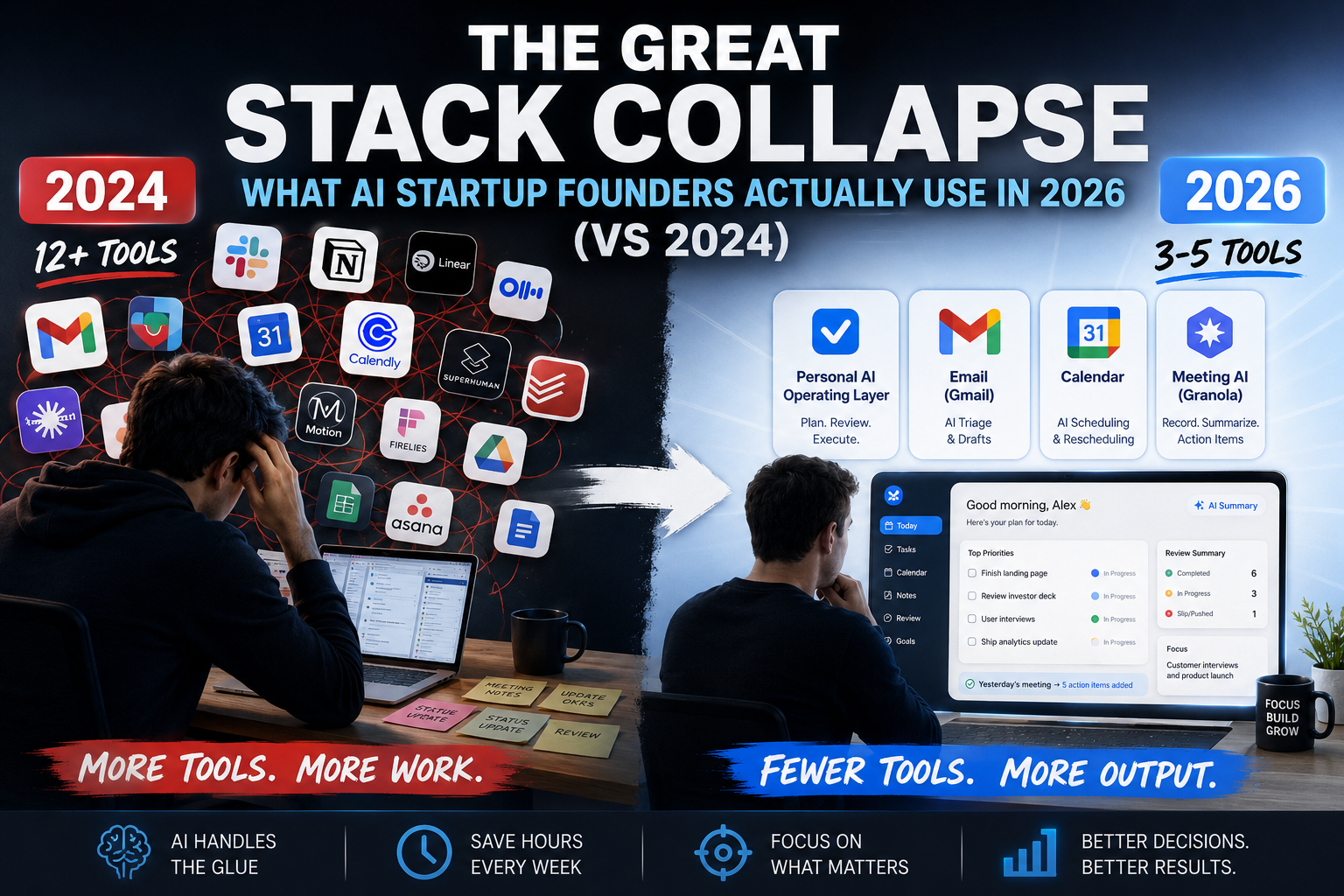
In 2024, a solo AI founder's day looked like this.
Wake up, open the inbox, and triage 80 emails. Switch to team chat and catch up on three workspaces. Open a notes tool, find yesterday's notes, and copy follow-ups into a task tracker. Run a meeting, paste the transcript into a doc, and manually pull out action items. Update an OKR page. Check the calendar. Record a quick async update. End the day with a journaling app or a review template that mostly does not get filled in.
The work was real.
The integration between tools was most of it.
In 2026, that same founder opens one assistant in the morning. The inbox is already triaged. The previous day's follow-ups are already in the planner. The meeting from yesterday already produced a doc, a set of tasks, and a note about which of last week's commitments slipped. The day's calendar has been reshuffled around two new priorities.
The founder reviews the plan, edits two items, and starts working.
Two years. Same job. Completely different stack.
The numbers
A few rough datapoints anchor the shift.
In 2024, the median AI startup team under 10 people paid for between 12 and 20 SaaS tools. Founder surveys floating around X put the average personal tool count for solo founders at 14 to 18.
By 2026, the same population averages 5 to 8 tools at the company level, and 3 to 5 at the founder level.
The drop is steepest among solo founders and two-person teams. It is smaller for engineering-heavy teams of 5 to 10, which still need a real ticketing system.
The cost story is more interesting than the count story. Stack spend per founder did not drop nearly as much as tool count. The line items consolidated, but the surviving tools got more expensive, and a new line item appeared: AI infrastructure.
What stack collapse actually means
The 2024 productivity stack worked because humans did the integration.
You took notes in one tool, made tasks in another, summarized in a third, and pushed status updates to a fourth. The tools did not really talk to each other. You were the middleware.
That manual middleware was the real cost of running a startup. Not the SaaS subscriptions. The cognitive overhead of moving information between systems.
By 2026, AI does more of that work. A meeting ends and the follow-ups appear in your task list, the doc gets updated, the relevant chat threads get a summary, and the calendar reshuffles.
When AI absorbs the glue, you do not need ten specialized tools each holding a slice of context. You need a small number of surfaces that share state through an AI layer.
That is the collapse.
Timeline: how it actually happened
The shift was not a single event. It played out in roughly four phases.
Mid-2024: peak fragmentation. The stack was at its largest. Every tool category had three or four credible AI-feature competitors. Founders were trying everything. New tools shipped weekly with the same pitch: AI for X.
Late 2024: the feature race. Big incumbents shipped serious AI features. Startups that had built thin AI wrappers around existing categories started losing distribution. The first wave of AI email and AI notetaker startups began consolidating or shutting down.
Mid-2025: the agent layer arrived. Once general-purpose agents could reliably execute multi-step tasks across tools, the premise of making the handoff between one tool and another easier stopped being a defensible business. The handoff was now free.
Late 2025 to 2026: collapse becomes visible. Founders began deliberately cutting tools. Stack count dropped. New categories appeared, including personal AI operating layers and agent orchestration. Old categories thinned, including second brain apps, AI sidebars, and standalone OKR tools.
Most tools did not die in a single quarter. They got quiet. Renewals slowed. Pricing pages emphasized AI more loudly. Then the obituary threads started.
The 2024 stack vs the 2026 stack
The clearest way to see the shift is category by category.
Planning and task management
In 2024: a ticketing tool or project management tool, a notes workspace for OKRs, a personal to-do app, and sometimes an AI scheduler on top.
In 2026: one agentic planner handles tasks, OKRs, daily prioritization, and calendar reshuffling in one surface.
Engineering teams still use ticketing systems, but solo founders rarely use them as the main personal planning surface anymore. The personal to-do app category effectively merged with the AI assistant category.
Tools like SelfManager.ai and a handful of others now sit where the to-do app, OKR page, and AI scheduler used to sit separately.
The bigger shift is that planning stopped being a thing you fully build from scratch and became a thing you review. The AI proposes the day, the week, or the quarter. The founder edits.
Communication
In 2024: team chat for the company, community chat for users, email for external communication, and sometimes a separate inbox app.
In 2026: team chat and email are still here, but the inbox is largely autonomous. AI triages, drafts, summarizes threads, and surfaces the few items that actually need attention.
Standalone AI email startups mostly died or got acquired because the core capability was absorbed into bigger email clients.
Team chat feels different too. Most threads get summarized before you read them. The AI watches channels you do not have time for and tells you when something matters.
Documentation and knowledge
In 2024: the second brain was its own category. Founders tried to maintain personal knowledge bases, custom databases, wikis, and manual tagging systems.
In 2026: the second brain category is mostly dead. Not because notes stopped mattering, but because passive storage became less valuable than active retrieval.
The new pattern is an AI that pulls from docs, transcripts, and chats on demand instead of a tool that asks you to organize everything in advance.
Knowledge work still needs memory. It just needs less manual filing.
Meetings and notes
In 2024: meeting transcripts, summaries, and follow-up tools were often separate purchases. Many founders had two or three of them running at once because each had a slight edge.
In 2026: one AI meeting layer records, summarizes, files things in the right doc, and pushes follow-ups into the planner.
Standalone notetakers are rare. The notetaking still happens, but it is a feature inside a planner, operating system, meeting platform, or broader AI assistant.
Review and reflection
In 2024: this barely existed as a serious tool category. A few founders used journaling apps. Most relied on a review template they updated inconsistently.
In 2026: review became one of the biggest gainers. Weekly and daily review became automated. The AI knows what you committed to, what you finished, what slipped, and what blocked you.
The founder reads a short summary instead of building one manually. This is where personal AI operating layers like SelfManager.ai carved out a category that did not really have a leader before.
For many founders, this is the highest-leverage part of the new stack. An honest weekly review you actually read compounds, and it is the kind of work humans almost never did consistently before.
Hiring
In 2024: hiring often meant an ATS, outreach tools, async screening tools, a job page, and a candidate tracker for the early stage.
In 2026: most early-stage hiring is back to lightweight. AI runs the top of the funnel, drafts outreach, screens responses, and prepares interview kits.
Founders use one ATS for structure and let AI handle the work that used to require a recruiter or a hiring operations layer.
Daily ops
In 2024: daily operations meant a long tail of small tools. Scheduling, finance, compliance prep, vendor management, status updates, recurring checklists, and internal scripts all lived in different places.
In 2026: the banking and finance endpoints are mostly unchanged. What changed is everything around them.
Scheduling, expense logging, contract review, vendor management, status updates, and recurring ops checklists are increasingly run by AI agents.
The executive assistant category got eaten faster than the junior project manager category because the work was more bounded.
This is where solo founders feel the difference most clearly. The work that used to require a fractional assistant, a chief of staff, or five hours of weekly stitching now takes much less review time.
Engineering
Engineering collapsed differently from the rest.
In 2024: AI coding autocomplete was standard, agentic coding was emerging, and many teams used multiple assistants depending on workflow.
In 2026: the IDE itself became the AI layer. AI is not a feature bolted onto coding. It is how many people code.
Autocomplete is the floor, not the ceiling. The interesting work is delegated to agents that operate across the repo, write tests, open pull requests, and ship behind feature flags.
The team-level tools did not die. They got quieter. A lot of issue triage and pull request review now happens before a human looks at it.
Why the collapse happened where it did
Two patterns explain almost all of it.
First, AI was best at replacing middleware, not endpoints.
The endpoints still mostly have the same names from 2024: banking, hiring, calendar, code repository, email, and core team systems.
What collapsed was the middle layer of tools whose purpose was to translate between endpoints or make humans more efficient at translating.
Meeting tools translated meetings into notes. Knowledge tools translated decisions into searchable docs. Project management tools translated chat into accountability.
Once AI could do that translation, many dedicated tools lost their reason to exist as separate purchases.
Second, the value moved from features to surfaces.
In 2024, each tool raced to add AI features. By late 2025, it was obvious that was not enough.
A user does not want twelve AI sidebars across twelve tools. They want one AI that knows their work and acts across surfaces.
The startups that won the 2024 to 2026 transition stopped thinking like apps and started thinking like operating layers.
There is a third, quieter pattern: the pricing math changed.
In 2024, you could justify another monthly subscription for a tool that saved a few hours. By 2026, with AI doing more of the saving, the marginal value of another specialized tool dropped.
Founders started cutting tools because they realized they were paying for capabilities their AI layer already had.
What got killed, absorbed, or survived
A rough taxonomy of where the major 2024 tool categories landed by 2026 looks like this.
Killed or close to it: standalone AI email startups, most second brain apps for knowledge workers, OKR-specific tools, journaling apps as standalone products, the long tail of meeting-notes-only tools, AI scheduling as a standalone category, most AI for X wrappers, and async video as a separate product.
Absorbed into bigger surfaces: async video became a feature inside collaboration tools, scheduling became a feature inside email clients, most AI summarizers got swallowed by the model providers themselves, sales engagement tools got absorbed into CRMs, and lightweight CRMs got absorbed into general AI assistants.
Survived as endpoints: team chat, email, code repositories, finance tools, design tools, hiring systems, engineering trackers, meeting layers, and agentic coding environments.
New category that did not exist in 2024: personal AI operating layers.
The closest 2024 analogue was a second brain or a personal CRM, but neither captured what this category does.
These tools sit across planning, review, daily operations, and reflection. They hold personal context that company-wide tools do not have. SelfManager.ai is one of these.
Where the 2024 stack still wins
The collapse is not total.
There are real cases where a 2024-style stack still beats a 2026-style stack.
Larger engineering teams. Once you get past 8 to 10 engineers, you still want a real ticketing system. Agent-driven planning works for the founder layer, but it does not yet replace structured engineering project management at scale.
Highly regulated work. Compliance, security, and audit trails still benefit from purpose-built tools. The handoffs in regulated workflows have audit requirements that general-purpose AI agents are still catching up to.
Cross-functional teams with mixed tech literacy. When half the team is non-technical, a shared structured tool can still beat an AI-mediated one. Not always, but often enough to matter.
Heavy customer-facing work. Sales, customer success, and support still benefit from category-specific tools. The AI layer changed what these tools do, but it did not make them disappear.
So the collapsed stack is the new default for solo founders and small AI-native teams. It is not the universal answer.
The 2026 stack of a typical AI startup founder
Stripped to its essentials, the modern stack looks something like this.
For the company:
- A code repository.
- A code-side AI.
- A team chat tool.
- An issue tracker if engineering needs one.
- An ATS for hiring.
- A finance stack.
For the founder:
- A personal AI operating layer for planning, review, and daily operations.
- Email with AI built in.
- A calendar.
- A meeting AI layer.
That is it for most teams under 10 people.
The 2024 list of 15 to 20 tools collapsed into something closer to 8, and only 3 to 4 of those are tools the founder personally lives in every day.
The economics of stack collapse
The collapse changed where the money goes more than how much money gets spent.
In 2024, the average solo founder might spend hundreds of dollars per month on personal productivity tools: email upgrades, notes, ticketing, meeting transcripts, scheduling, async video, task management, and odds and ends.
In 2026, personal spend is often lower, but not dramatically lower.
The composition is different. A bigger share goes to one or two AI-heavy tools. A smaller share goes to long-tail SaaS. There is also a new line item: AI usage and infrastructure costs.
The total did not drop dramatically. The category of spend did. Founders are paying for fewer surfaces and more intelligence.
What this means for solo founders
The collapse hit solo founders hardest, in a good way.
In 2024, a solo founder spent a meaningful share of the week being the integrator between tools. Pulling notes into tasks. Updating status docs. Writing weekly reviews. Triaging the inbox. Drafting follow-ups.
That work did not disappear. It got delegated to AI.
The 2026 solo founder does not run more tools than the 2024 solo founder. They output significantly more because the personal AI layer absorbed work that used to require a chief of staff, an executive assistant, or a lot of founder energy.
The new bottleneck is decision-making and judgment, not throughput.
This is also why the stack stopped growing. There is no obvious next tool to add. The marginal value of a sixteenth SaaS subscription is now negative. The marginal value of better personal AI infrastructure is still positive.
What is coming next
If 2024 to 2026 was the collapse phase, 2026 to 2028 looks like the consolidation phase.
The personal AI layer becomes the new battleground. Whoever owns the founder's daily plan, review, and context becomes the surface other tools have to integrate with. This seat did not exist in 2024 and is now one of the most valuable slots in the stack.
Endpoints get thinner. Team chat, notes, ticketing, and other systems will keep losing surface area to the AI layer above them. They will still exist, but they will become specialized data stores instead of the places where founders live all day.
Multi-agent orchestration becomes a category. Teams will need a way to coordinate multiple specialized agents for research, drafting, operations, code, and review without creating chaos.
The model providers move up the stack. Model companies will keep eating capabilities that used to belong to standalone tools. The line between model and product will keep blurring.
None of this means the current 2026 stack is permanent. It means the direction is set: fewer tools, more intelligence per tool, and AI as the connective tissue.
Takeaways
- The endpoints are stable. Banking, code, calendar, email, and hiring are not the places to overthink.
- The middleware died. If a 2024 tool's main pitch was that it sits between two systems and makes the handoff easier, it probably got eaten.
- The personal layer is the new battleground. You need one place that holds plans, reviews, daily priorities, and ongoing context.
- Quantity stopped winning. The founder running 3 to 5 tools well outperforms the founder running 18 tools poorly.
- Total spend did not drop much. Composition did. Less SaaS sprawl, more AI infrastructure.
- The work did not shrink. Output went up. AI absorbed the integration tax that used to live in the founder's calendar.
If 2024 was the year AI features arrived, 2026 is the year the stack finally caught up.
Most of the productivity tools you used two years ago are still around in some form.
They just matter less.
The new question is not which tools you run.
It is which AI layer runs across them.
Date-based AI Task Manager
Plan smarter, execute faster, achieve more
Create tasks in seconds, generate AI-powered plans, and review progress with intelligent summaries. Perfect for individuals and teams who want to stay organized without complexity.
Get started with your preferred account