Best AI Task Managers With Voice Capture in 2026
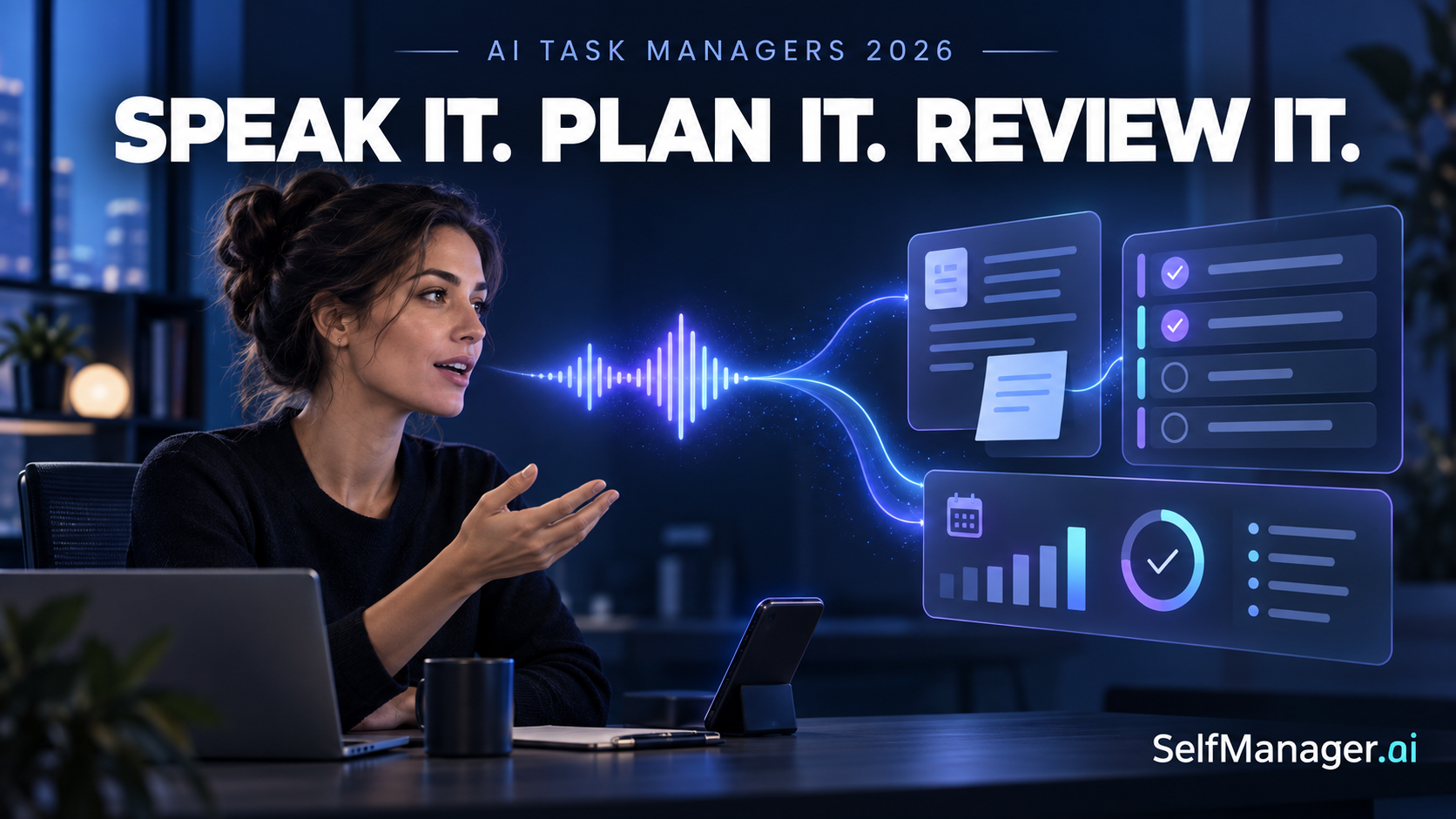
The best AI task manager with voice capture in 2026 is SelfManager.ai for people who want spoken thoughts to become useful context for future planning and review. Its voice transcripts can live inside dated table notes and comments, where AI Plan and AI Review can use the text alongside tasks, priorities, deadlines, time tracking, and other work history.
Todoist Ramble is the best for turning a natural voice dump into structured tasks. Superlist Talk is the best mobile-first voice assistant for creating tasks, subtasks, notes, and lists. TickTick is the best all-in-one planner with AI task capture and recording summaries. ClickUp Brain MAX is the best for AI-polished dictation across desktop applications.
These are not ordinary dictation features. Each product uses AI to do something beyond placing literal speech into a text box, such as extracting tasks, recognizing dates and priorities, organizing notes, improving the writing, or making the resulting text available to a larger work system.
For thinking professionals, that distinction matters. The goal is not merely to speak instead of typing. It is to keep a useful thought without interrupting the thought that comes next.
The Short Answer
| App | Best for | What voice becomes | Keeps playable audio | Strong planning or review connection |
|---|---|---|---|---|
| SelfManager.ai | Turning voice into durable planning and review context | Transcripts in notes, comments, and AI prompts, plus uploaded audio kept on the table itself | Yes, for saved recordings and saved AI-response audio | Yes, strongest in this comparison |
| Todoist Ramble | Fast voice-to-task capture | Structured tasks with projects, dates, deadlines, priorities, and duration | Not positioned as a permanent recording library | Limited compared with SelfManager.ai |
| Superlist Talk | Mobile voice capture for tasks and notes | Tasks, subtasks, lists, and freeform notes | Supports audio-note workflows, but its main value is generated content | Moderate through Superlist lists and AI tools |
| TickTick | All-in-one task, calendar, focus, and voice system | Multiple tasks, dates, priorities, transcripts, and recording summaries | Yes, depending on plan and capture mode | Moderate |
| ClickUp Brain MAX | Dictating anywhere on a desktop | AI-polished text in ClickUp or another application | Yes, previous recordings can be played or exported | Strong inside the wider ClickUp work platform |
Our verdict: SelfManager.ai is the best choice when voice should remain connected to the work and influence what the AI tells you later. Todoist Ramble is the most direct choice when you mainly want to speak a list and receive organized tasks.
Why AI Voice Capture Is Different From Ordinary Dictation
Most phones and computers have offered speech-to-text for years. Press a microphone, speak, and receive a rough transcription.
That is useful, but it leaves the organization to you.
If you say:
Tomorrow I need to send the revised proposal to Elena, call the accountant before lunch, move the product review to Friday, and remember that the client prefers the simpler navigation option.
Ordinary dictation gives you a paragraph.
A capable AI task manager should understand that the paragraph contains several different things:
- A task for tomorrow
- A call that should happen before lunch
- A task that belongs on Friday
- A decision or contextual note that should remain attached to the client work
The strongest products do not only transcribe. They interpret.
There is another difference that matters even more for people who think for a living: what happens after capture.
A task extracted from voice may help today. A transcript connected to the relevant project can help for months. It can explain why a decision was made, give an AI review better evidence, or prevent you from reconstructing an idea from memory.
That is the difference between voice as an input shortcut and voice as part of a digital memory system.
How We Chose the Apps
To qualify for this comparison, an app needed to satisfy three conditions.
1. It Must Be a Real Task Manager
General transcription applications and standalone meeting recorders were excluded. Every product here must help users organize and complete tasks, not only record audio.
2. Voice Capture Must Be Native
The app must provide its own voice workflow. Being compatible with the microphone button on a phone keyboard is not enough.
3. AI Must Do More Than Literal Transcription
The product must use AI to interpret, structure, summarize, clean, or contextualize what the user says.
We compared the qualifying apps on:
- Capture speed
- Task extraction
- Notes and longer thoughts
- Original-audio retention
- Access to previous recordings
- Planning context
- Retrospective and review context
- Task-management depth
- Price and availability
1. SelfManager.ai: Best for Turning Voice Into Planning and Review Context
SelfManager.ai has the most complete connection between voice capture and the work that happens afterward.
Its microphone is available in table comments, table notes, and AI prompt boxes, including AI Plan, AI Review, task generation, table chat, and pinned-table chat. A recording can last up to 10 minutes.
Each table also has an Audio section of its own, beside Comments, Images, and Notes. It collects the audio already attached to that table and accepts audio that belongs to the table itself, recorded there or uploaded as an existing file. That matters for material you did not create by dictating: a voice memo from your phone, or a recorded call, can sit on the day it belongs to rather than in a separate audio app. Transcription there is a deliberate second step, so audio you only want to keep costs nothing in AI credits.
When you speak inside a comment or table note, SelfManager.ai creates an editable transcript. You can then choose whether to keep or delete the original recording. The transcript remains either way.
If you keep the audio, it receives a player beside its transcript and appears on the All Recordings page. That page presents saved recordings with their transcripts and links back to the tables where they originated.
This means a voice note does not become a detached audio file with a name such as "Recording 47." It remains attached to the work that caused you to record it.
The Transcript Becomes AI Context
This is where SelfManager.ai separates itself from voice-to-task tools.
Suppose a consultant finishes a client call and records this comment:
The client accepted the first phase, but they are worried about the migration timeline. They want the existing checkout left untouched until the new product pages are tested. Follow up Thursday with a smaller migration plan.
The transcript can remain inside the relevant client table. It is not only something the user can read later.
SelfManager.ai can treat that text like other written context:
- Table notes are included automatically when the AI reads the table or period.
- Transcribed comments become part of AI Review context when Include comments is enabled.
- AI uses the transcript, not the original audio file.
- AI Plan can use recorded work history and written context when creating a future plan.
That produces a useful chain:
- Speak while the reasoning is fresh.
- Keep the transcript inside the relevant date and table.
- Let AI Review include the text when explaining the week.
- Use the resulting review as context for the next plan.
The recording captures what you were thinking. The transcript makes that thinking usable by the rest of the system.
Voice Can Brief AI Plan and AI Review Directly
SelfManager.ai also lets you speak directly into its AI prompts.
You could tell AI Plan:
Plan next week around the proposal deadline on Thursday. Keep Wednesday afternoon open for revisions, put administrative tasks on Friday, and do not schedule work on Sunday.
Or ask AI Review:
Look at the last four weeks and tell me which client repeatedly consumed more time than I planned.
The speech is transcribed into the prompt, so you can edit it before sending. Audio captured inside an AI prompt is discarded after transcription because the prompt itself is temporary input rather than a record attached to a table.
That is a sensible boundary. Comments and notes can preserve the audio because they belong to your work history. Prompt recordings become text and then disappear.
You Can Listen to and Save AI Responses
Voice works in the other direction too.
AI Plan, AI Review, table chats, summaries, follow-up answers, and saved AI conversations can be read aloud. This is useful when a response is substantial and you would rather listen while walking, driving, or doing something away from the screen.
The audio player supports playback controls, including speed adjustment and navigation through the response.
When you save an audio version of an AI response, it remains available inside the saved AI conversation and also appears on the All Recordings page. This creates one place for audio you recorded yourself and AI responses you chose to preserve.
The result is a two-way voice workflow:
- Your voice becomes written work context.
- The AI uses that context to plan or review.
- The AI response becomes audio you can listen to and retain.
No other product in this comparison connects capture, dated context, AI planning, retrospective review, and saved audio in quite the same way.
Limits and Pricing
Recordings can be up to 10 minutes long. A recording of up to five minutes costs one AI credit, while a longer recording costs two.
The Individual plan costs $8 per month, or $6 per month when billed annually, and includes 35 AI credits each week. A seven-day trial includes the AI features and does not require a credit card.
Where SelfManager.ai Is Weaker
SelfManager.ai is not the strongest choice if your only goal is to speak a rapid stream of unrelated tasks and have every project, label, date, and duration assigned automatically. Todoist Ramble is more directly designed around that exact interaction.
SelfManager.ai is also not a universal desktop dictation tool. ClickUp Brain MAX can place polished speech in text boxes across other applications.
Best Fit
Choose SelfManager.ai when your spoken input contains reasoning, decisions, and context rather than only task names, and you want that material attached to dated work for later AI planning and review.
2. Todoist Ramble: Best for Turning a Voice Dump Into Structured Tasks
Todoist Ramble is the strongest pure voice-to-task feature in this comparison.
You speak naturally instead of dictating each field. Ramble uses large language models to transcribe the speech, identify separate tasks, and interpret details such as:
- Project names
- Dates and times
- Deadlines
- Priorities
- Labels
- Task duration
It supports natural speech in 40 languages and can recognize a speaker moving between languages during the same capture session.
That makes Ramble well suited to the classic end-of-day brain dump:
Send the client report tomorrow morning, book the dentist sometime next week, make the Q4 forecast high priority, and remind me Friday to renew the SSL certificate.
Instead of preserving that as one paragraph, Ramble can turn it into separate Todoist tasks with useful metadata.
Why Ramble Is So Effective
Todoist already has a mature system of projects, labels, priorities, dates, deadlines, filters, and recurring tasks. Ramble provides a faster entrance into that structure.
This is important because capture speed and organization usually compete. Quick capture tends to produce vague inbox items. Structured capture tends to interrupt the thought.
Ramble attempts to deliver both at once.
It is also widely accessible. Todoist says Ramble is available across all plans, although the Free plan has a usage limit.
Where Ramble Is Weaker
Todoist's public description focuses on converting speech into organized tasks. It is not positioned as a long-term audio archive or as a source of rich commentary for an AI-generated weekly review.
That is appropriate for its purpose. If you say "renew the domain Friday," the valuable output is the task, not necessarily a permanent recording of your voice.
But thinking professionals often capture more than an action. They capture why the action exists, which options were rejected, or what changed during a conversation. Ramble can place details into tasks, but SelfManager.ai provides a clearer path for keeping longer transcripts inside notes and comments, then reusing them in planning and review.
Best Fit
Choose Todoist Ramble when most spoken input should become tasks immediately and inferring dates, priorities, labels, projects, and duration matters more than preserving a voice archive.
3. Superlist Talk: Best Mobile Voice Assistant for Tasks and Notes
Superlist Talk sits between a voice-to-task tool and a voice-note assistant.
It can create:
- Individual tasks with due dates
- Multiple tasks and subtasks
- Freeform notes
- Full lists
- Additional written content attached to tasks
You can also ask it to enrich a task. For example, you can dictate that you need to email someone, provide a few points, and ask Talk to draft the message as part of the task.
Strong Mobile Capture
Superlist has put considerable attention into making Talk easy to open on mobile.
On iOS and Android, users can start Talk by long-pressing the new-task button. It is also available from the Inbox, Today view, or an individual list. Widgets, Control Center shortcuts, and the iPhone Action Button can reduce the number of steps further.
This matters because voice capture is most valuable at moments when opening a laptop or typing carefully would break the flow.
Superlist resembles sending a voice message to an assistant. You can speak naturally, describe what should happen, and let the product decide whether the result should be a task, set of subtasks, list, or note.
Notes Are a Real Part of the Product
Superlist is stronger than a conventional to-do app when spoken input needs to become both tasks and supporting notes.
A consultant can record the result of a conversation. A writer can capture a rough structure. A founder can describe a small launch plan. Talk can then produce content that remains in Superlist rather than sending the user to a separate transcription application.
The Basic plan currently lists Talk voice AI and costs $5 per person per month when billed annually, with annual billing shown as $59. More advanced AI meeting notes, AI chat, and generation features sit in the higher Super plan.
Where Superlist Talk Is Weaker
Superlist provides a strong capture experience, but its differentiation is primarily what voice creates now. SelfManager.ai goes further in connecting ordinary voice transcripts to a date-based work history that can later shape AI Plan and AI Review.
The products therefore solve adjacent problems:
- Superlist Talk asks, "What should this voice message create?"
- SelfManager.ai asks, "Where should this transcript live, and how should the AI use it later?"
Best Fit
Choose Superlist Talk when you want a mobile-first assistant that can move naturally between tasks, subtasks, notes, and lists.
4. TickTick: Best All-in-One Planner With AI Voice Capture
TickTick has expanded beyond its earlier basic voice input. Its current AI Voice Capture can interpret natural speech, extract dates and priorities, and create multiple tasks from one recording.
TickTick also offers Audio Summary, which can turn meeting recordings or voice notes into transcripts and structured summaries.
This gives TickTick two distinct voice workflows:
- Speak tasks and let AI organize them.
- Record longer material and ask AI to transcribe or summarize it.
The recording limit is 30 minutes. TickTick's documentation says that saving both the recording and the text requires an upgrade.
Why TickTick Is a Strong All-in-One Choice
Voice capture is only one part of TickTick. The app also includes:
- Multiple calendar views
- Lists, tags, filters, and priorities
- Reminders and recurring tasks
- Habit tracking
- Pomodoro focus sessions
- Eisenhower Matrix
- Statistics for tasks, focus time, and habits
This is useful for someone who wants one broad productivity application. A captured voice task can move directly into calendars, reminders, filters, or a focus session without another integration.
TickTick Premium costs $49.99 per year, which works out to less than $4.17 per month. Its public pricing comparison lists AI features, although exact limits may vary by feature and account.
Where TickTick Is Weaker
TickTick has more productivity modules than the other personal tools in this comparison. That breadth can be valuable, but it also means the voice transcript is entering a system with many possible views and workflows.
For someone who wants tasks, habits, calendars, focus, and recordings together, this is a strength. For someone who specifically wants voice-derived context to improve future AI planning and retrospective reviews, SelfManager.ai has the clearer workflow.
Best Fit
Choose TickTick when you want AI voice capture and longer recording summaries inside the same application as your calendar, habits, reminders, and focus tools.
5. ClickUp Brain MAX: Best Universal Desktop Dictation
ClickUp Brain MAX Talk to Text is broader than an ordinary task-capture feature.
Once the Brain MAX desktop application is running, a keyboard shortcut can start recording in almost any text box. The speech is converted to text, improved using AI, and pasted into ClickUp or another desktop application.
ClickUp emphasizes:
- AI cleanup and writing polish
- Adjustable writing style
- Recognition of names and work vocabulary
- Context-aware mentions and links
- Output across more than 50 languages
- Dictation inside external applications
Previous Talk to Text recordings are available from the Voice Notes area. Users can play them, compare the original transcript with the AI-processed version, retry transcription, export the audio, copy the text, or delete the recording.
Why ClickUp Is Different
The other products expect voice capture to begin and end inside the task manager. ClickUp treats voice as a desktop-wide input method.
That is powerful for someone whose ideas need to travel across tasks, documents, email, chat, and other software. You can dictate an update in ClickUp, then use the same shortcut to write an email or document elsewhere.
Brain MAX also sits inside the larger ClickUp environment, where AI can search tasks, Docs, chat, and connected applications.
Where ClickUp Is Weaker
ClickUp is a full work-management platform. For an individual who wants a simple task manager, that can be significantly more product than necessary.
Talk to Text is also more focused on producing polished text wherever the cursor happens to be than on building a dated personal record for later weekly or monthly reflection.
ClickUp currently offers a limited Talk to Text trial across plans, while AI availability and limits vary by plan and role. Its public pricing page lists Brain AI at $9 per user per month and Everything AI at $28 per user per month, but buyers should verify which Talk to Text allowance is included in the plan they are considering.
Best Fit
Choose ClickUp Brain MAX when you want AI-polished dictation across desktop applications and need voice for documents, messages, and emails as often as for tasks.
Which AI Voice Task Manager Should You Choose?
| Your main need | Best choice | Reason |
|---|---|---|
| Use spoken context in future plans and reviews | SelfManager.ai | Transcripts remain inside dated notes and comments that AI can read later |
| Turn a rambling list into structured tasks | Todoist Ramble | Strong extraction of projects, dates, deadlines, priorities, labels, and duration |
| Create tasks, subtasks, notes, and lists on mobile | Superlist Talk | Flexible voice assistant with fast mobile access |
| Combine voice capture, recording summaries, calendar, habits, and focus | TickTick | Broadest all-in-one personal productivity system |
| Dictate polished text in any desktop application | ClickUp Brain MAX | System-wide Talk to Text with AI cleanup |
| Keep an original audio recording beside its work context | SelfManager.ai | Saved recordings link back to their source tables |
| Capture in 40 languages and switch languages during one session | Todoist Ramble | Explicit multilingual task interpretation |
| Record for up to 30 minutes | TickTick | Longer recording ceiling than SelfManager.ai |
| Save and export desktop dictation recordings | ClickUp Brain MAX | Voice Notes includes playback, transcript comparison, retry, and export |
| Listen to and save AI planning or review responses | SelfManager.ai | AI responses can become saved audio in the conversation and All Recordings |
The Important Distinction: Audio Retention vs AI Context
It is easy to assume that retaining the audio gives an AI better context. In most task-manager workflows, that is not what happens.
The AI usually works from text.
Speech is converted into a transcript. The transcript is then turned into a task, saved as a note, placed in a comment, summarized, or polished. If the original recording is retained, it is normally there for human playback and verification.
This distinction is useful because the two formats serve different purposes.
The Transcript Is for Retrieval and AI
Text can be searched, summarized, compared, included in a planning prompt, or reviewed across a period. It is compact and easy for the application to connect with tasks and dates.
The Recording Is for Human Memory
The original voice preserves tone, emphasis, pauses, uncertainty, and details that a transcript may flatten. It can help you remember what you meant, not only what the transcription engine heard.
SelfManager.ai keeps these roles clear. The AI reads the transcript. The optional recording remains available to you.
What to Check Before Choosing
First decide whether you mainly speak tasks or context. Todoist Ramble is excellent when spoken input should become structured tasks immediately. SelfManager.ai is stronger when the transcript should remain attached to work and influence future planning or review.
Then check whether the original audio is retained, where the transcript lives, whether AI can use it later, and whether voice is available on the devices where ideas usually occur. Mobile shortcuts, desktop-wide dictation, and recordings inside a specific project solve different problems.
Finally, review storage, deletion, export, and plan limits. Voice recordings can contain more sensitive information than ordinary task titles.
Final Verdict
The best AI task manager with voice capture depends on what you expect voice to become.
Choose Todoist Ramble if you want to speak a messy list and receive clean, structured tasks.
Choose Superlist Talk if you want a mobile voice assistant that can create tasks, subtasks, notes, and lists.
Choose TickTick if you want AI voice capture and recording summaries inside a broad personal productivity suite.
Choose ClickUp Brain MAX if you want AI-polished dictation across your entire desktop workflow.
Choose SelfManager.ai if the spoken thought should remain useful after the moment of capture.
Its strength is the connection between stages:
- Record a thought inside a dated table.
- Keep the transcript as a note or comment.
- Preserve the original audio when it matters.
- Let AI Plan or AI Review use the written context later.
- Listen to the AI response.
- Save that response inside the conversation and All Recordings.
That makes SelfManager.ai the best option in this comparison for turning voice into durable planning and review context.
You can try SelfManager.ai free for seven days. No credit card is required.
Frequently Asked Questions
What Is the Best AI Task Manager With Voice Capture?
SelfManager.ai is the best choice when voice transcripts should become context for AI planning and review. Todoist Ramble is better for rapidly converting natural speech into structured tasks with dates, priorities, projects, labels, deadlines, and durations.
Can AI Turn a Voice Recording Into Multiple Tasks?
Yes. Todoist Ramble, Superlist Talk, and TickTick can interpret one spoken input and create multiple tasks. The exact metadata they infer varies, so users should review generated tasks before relying on their dates or priorities.
Does SelfManager.ai Save the Original Voice Recording?
It can. After transcribing a table note or comment, SelfManager.ai lets you keep or delete the audio. The transcript remains either way. Saved audio receives a player and appears on All Recordings with its transcript and a link to the source table.
Can SelfManager.ai Use Voice Notes in AI Review?
SelfManager.ai uses the transcript rather than listening to the original recording. Table notes are available as context automatically. Transcribed comments can be included when the user enables Include comments for the review.
Can I Speak an AI Plan Prompt Instead of Typing It?
Yes. SelfManager.ai provides voice-to-text inside AI Plan, AI Review, task generation, and its other AI prompt boxes. The prompt audio is discarded after transcription, while the editable text is sent to the AI.
Which AI Task Manager Is Best for Multilingual Voice Capture?
Todoist Ramble is the clearest choice based on published specifications. Todoist says Ramble supports 40 languages and can recognize speakers switching languages during one capture session. ClickUp Brain MAX also supports multilingual dictation and translation-oriented output across more than 50 languages.
Which App Is Best for Long Voice Recordings?
TickTick supports recordings of up to 30 minutes and can transcribe or summarize recordings. SelfManager.ai allows up to 10 minutes per recording and is better suited to contextual notes, explanations, and planning briefs than full meetings.
Can I Listen to AI Reviews Instead of Reading Them?
Yes, in SelfManager.ai. AI Plan, AI Review, summaries, chats, follow-up responses, and saved AI conversations can be read aloud. Saved response audio remains in the AI conversation and appears on the All Recordings page.
Date-based AI Task Manager
Plan smarter, execute faster, achieve more
Create tasks in seconds, generate AI-powered plans, and review progress with intelligent summaries. Perfect for individuals and teams who want to stay organized without complexity.
Get started with your preferred account