
10 Best AI Task Managers for Solopreneurs in 2026
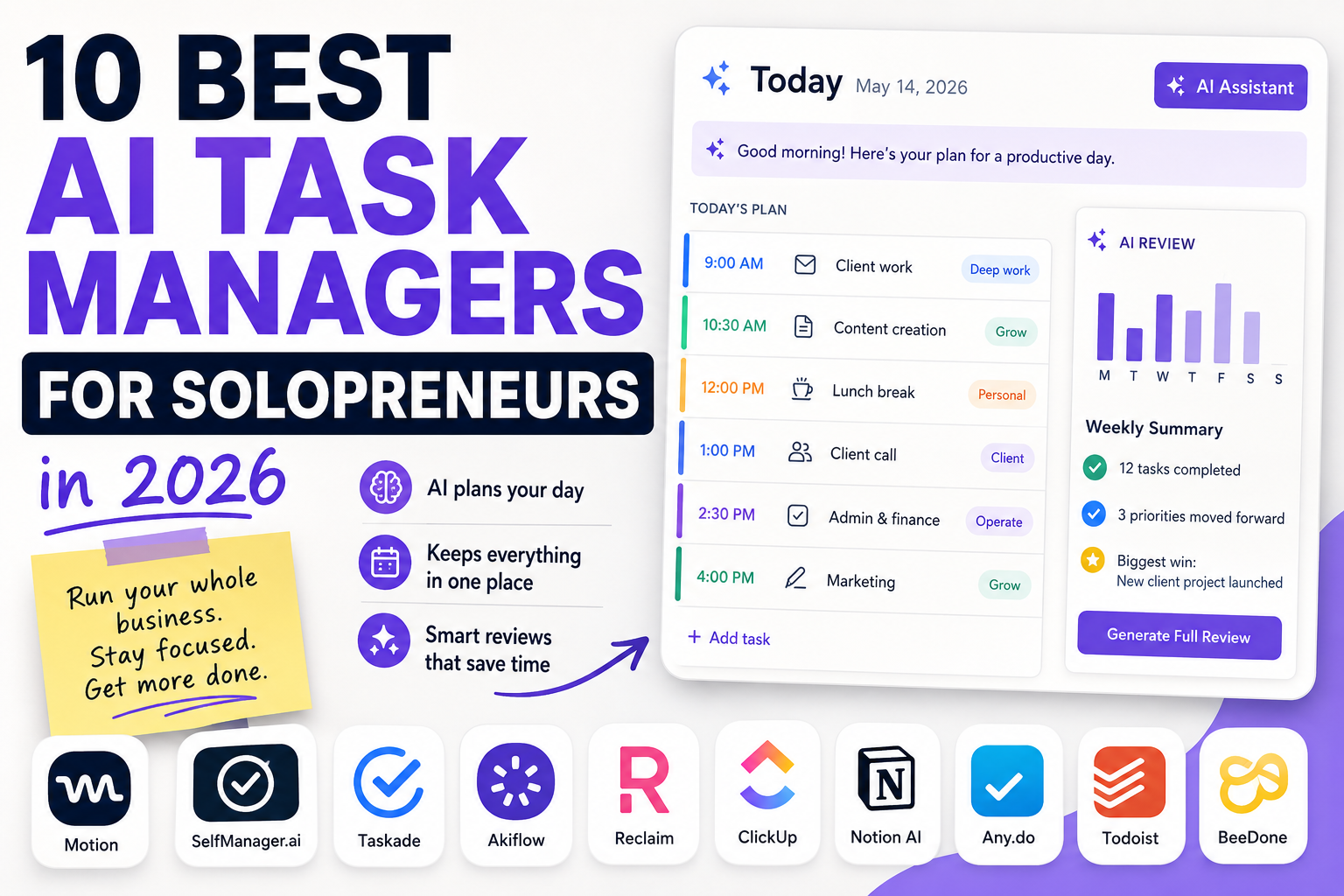
Running a business alone is a specific kind of hard. There is no one to delegate to, no one to catch what you drop, and no separation between strategy and doing the dishes of the business. You are the CEO, the operator, the support desk, and the intern. The task manager you choose has to hold all of that at once.
Most task managers were not built for this. They were built for teams, and it shows. They assume someone assigns work, someone reviews it, and someone reports on it. As a solopreneur, you are all three roles, and the team-shaped features become overhead you maintain for an audience of one.
AI changes the math here. For a team, AI mostly speeds up coordination. For a solo operator, AI can act like the staff you do not have. It can plan your day, summarize your week, catch what slipped, and turn a messy brain dump into a structured list. Used well, it is the closest thing to a first hire.
This guide covers ten AI task managers worth considering if you run a business by yourself. Each one gets an honest read on what it does well, where it falls short, and the type of solopreneur it actually fits. After the list there is a framework for choosing, because the right answer depends on how your business is shaped, not on which app has the longest feature page.
Why solopreneurs need a different kind of task manager
Before the list, it is worth being precise about what makes the solo case different. These are the pressures a solopreneur app has to handle.
Everything is your job. Client work, marketing, admin, finance, product, support. They all sit in one head and ideally one system. An app that only handles "tasks" while your business context lives in five other tools adds switching cost you cannot afford.
Context switching is the silent tax. A solopreneur jumps between roles many times a day. Each jump costs focus. A good system reduces the number of places you have to look and the number of decisions you have to make to know what is next.
There is no one to maintain the system. On a team, someone can be the person who keeps the workspace tidy. Alone, system maintenance is just more unpaid work. The best solo tools need almost no upkeep.
Reviews matter more and happen less. When you answer to no one, the weekly and monthly review is the only thing keeping you honest about whether the business is moving. It is also the first thing to get skipped. Anything that makes reviews faster is worth real money.
Time is the hard cap. You cannot hire your way out of a busy week. The only lever is what you choose to do and what you choose to drop. A task manager that helps you see time honestly is more useful than one that just stores more tasks.
With those pressures in mind, here is the roundup.
1. Motion - Best for fully automated scheduling
Motion is built around one strong idea. You give it tasks with deadlines and rough durations, and it builds your calendar for you, then rebuilds it automatically when something changes.
For a solopreneur, the appeal is real. Deciding the order of the day is itself a job, and it is a job you do every single morning. Motion takes that over. When a client call appears or a task runs long, the schedule reshuffles without you touching it.
It works best when your work is concrete and time-estimable. Client deliverables, content production, scheduled admin. It is less comfortable with vague, open-ended work that resists a duration estimate.
The honest caveats are price and control. Motion sits at the premium end of the market, and the automation can feel like a cost when its plan does not match how you actually feel that day. Some people find handing over scheduling freeing. Others find themselves fighting it. It rewards a trial before commitment.
Best for: Solopreneurs with concrete, deadline-driven work who want to stop planning their own days.
2. SelfManager.ai - Best for running the whole business by date
SelfManager.ai is built on a different structural idea. Instead of organizing work into projects and folders, it organizes everything by date. The day is the container. Every task, whether it is client work or a personal errand, lives on a day, and the main view is simply what a given day holds.
For a solopreneur, this maps cleanly onto how the work actually feels. You do not experience your week as a set of projects. You experience it as a sequence of days, each one a mix of roles. SelfManager.ai treats it that way. There is no hierarchy to build before you can start, and no decision about which project a task belongs to. It goes on a date.
The part that matters most for solo operators is the AI review. Because the app is date-centric and you plan and journal day by day, the AI has rich context. It knows what was completed, what is still open, what priority things carried, and what your daily notes were saying. From that, it can produce a weekly, monthly, or quarterly review in under a minute. For a solopreneur who answers to no one, that turns the review from a task that gets skipped into something that simply happens.
It also keeps work and personal life in one place, which is honest to how a solo business actually runs. The line between the two is thin, and a tool that pretends otherwise forces you into two systems.
The tradeoff is deliberate. If you want deep project structures, dependency chains, and elaborate workflow automation, this is not built for that. The simplicity is the design, not a gap in it. For a solopreneur who wants one clear daily picture of the whole business and a review that runs itself, that focus is the point.
Best for: Solopreneurs who want one date-based view of work and life, with AI reviews that actually get done.
3. Sunsama - Best for deliberate daily planning
Sunsama is built around a ritual. Each morning you sit down, pull in tasks from your various tools, decide honestly what fits in the day, and commit to that list. Each evening you can reflect on how it went.
For a solopreneur, the value is the guardrail. Working alone breeds a particular kind of optimism, the belief that today you will do twelve things. Sunsama is designed to push back on that. It asks you to estimate, to be realistic, and to choose. That friction is the feature.
It pulls tasks from calendars and other apps, so it can act as a calm planning layer over a messier set of tools. The daily and weekly reflection built into the app suits a solo operator who has no one else prompting them to step back.
The costs are price and discipline. Sunsama is among the more expensive options, and the morning ritual is a habit you have to keep. When it sticks, the business feels calmer and more honest. When the habit slips, the cost feels harder to justify.
Best for: Solopreneurs who overcommit and want a daily ritual that forces realistic planning.
4. Todoist - Best for fast, reliable capture
Todoist has lasted because it does the fundamentals exceptionally well. Capture is near instant. Natural language input means you can type a task with its date and time in plain words and trust it to parse correctly. It syncs everywhere and rarely gets in your way.
For a solopreneur, fast capture is not a minor feature. Ideas, follow-ups, and small obligations arrive constantly through the day, and the gap between thinking of something and recording it is where things get lost. Todoist closes that gap as well as anything on the market.
It has added more AI capability over time, and it can scale into projects, filters, and labels. The discipline for a solo user is to resist most of that. Used as a fast inbox and a clean today view, it is hard to beat and easy to maintain.
The limitation is that Todoist is a task manager in the classic sense. It holds tasks well. It does not try to be the place your whole business context lives. If you want that, you will pair it with other tools.
Best for: Solopreneurs who want rock-solid capture and a light system they will not abandon.
5. Notion - Best for combining tasks with everything else
Notion is not a task manager. It is a flexible workspace that can be shaped into one, alongside notes, databases, client records, content calendars, and more. With AI built in, it can also draft, summarize, and answer questions about your own content.
For a solopreneur, the pull is consolidation. In principle, one tool holds your tasks, your client notes, your standard operating procedures, and your planning docs. Everything in one searchable place, with AI on top of it.
The strength and the danger are the same trait. Notion will become whatever you build, which means you have to build it, and then maintain it. For some solo operators, designing their own system is energizing and the payoff is a workspace fitted exactly to their business. For others, the build becomes a form of productive procrastination, and the system slowly rots because upkeep is unpaid work.
If you genuinely enjoy shaping tools and your business needs a lot of connected information, Notion can be the hub. If you want something that works on day one with no construction, look elsewhere on this list.
Best for: Solopreneurs who want one workspace for tasks plus knowledge and enjoy building their own system.
6. TickTick - Best balanced all-in-one
TickTick quietly covers a lot of ground. Tasks, calendar, habit tracking, and a built-in Pomodoro focus timer, all in one reasonably priced app. It captures quickly, syncs reliably, and does not force a heavy structure on you.
For a solopreneur, the appeal is getting several jobs handled without stitching apps together. The native focus timer is genuinely useful, since starting a focus session does not mean leaving the app. Habit tracking sits alongside tasks, which suits the solo operator trying to hold both business execution and personal consistency in one view.
It does not lean as hard into AI as some others here, and its strength is breadth rather than any single standout feature. For many solopreneurs, breadth at a fair price is exactly the right trade. The risk, as with any flexible tool, is over-configuring. Kept simple, TickTick is one of the most sensible all-in-one choices available.
Best for: Solopreneurs who want tasks, habits, and focus sessions in one affordable app.
7. Akiflow - Best for consolidating a scattered workload
Akiflow exists to solve a specific problem. Your tasks are scattered across email, messaging apps, and several tools, and you have no single surface that shows all of it. Akiflow pulls those sources into one inbox, then helps you drag each task onto your calendar as a time block. A command bar gives you keyboard-fast control over the whole thing.
For a solopreneur juggling many channels, the consolidation is the value. Instead of checking five places to understand your obligations, you check one, and you turn that one list into a timed plan for the day.
It is a power tool. That means a learning curve and a premium price. It assumes you already believe in time-blocking and want to do it faster and more completely. For a solopreneur who already plans this way, Akiflow is a strong accelerator. For someone newer to structured planning, it can feel like more machinery than the problem requires.
Best for: Solopreneurs with tasks scattered across many tools who already time-block and want it consolidated.
8. ClickUp - Best for solopreneurs who expect to scale
ClickUp is a deep, highly configurable work platform with extensive AI features for writing, summarizing, and automating. It can model almost any workflow you can describe.
For a solopreneur, ClickUp is a forward bet. If you expect the business to grow, to bring on contractors or a first employee, building in ClickUp now means the system can grow with you rather than being replaced later. The AI features can take on drafting and summarizing work that would otherwise eat your time.
The honest concern is weight. ClickUp is built for teams, and as a solo user you carry the complexity of a team tool without the team. Setup takes real time, and there is a lot of surface area to learn and maintain. If scaling is a genuine plan and not just a someday wish, that investment can pay off. If you are committed to staying solo and lean, ClickUp is likely heavier than you need.
Best for: Solopreneurs who expect to grow into a team and want a platform that scales with them.
9. Amplenote - Best for connecting notes and tasks
Amplenote is built on the link between notes and tasks. Tasks can live inside notes, so the context for a piece of work and the work itself stay together. It uses a scoring system to surface what to do next, and it includes AI assistance for working with your notes.
For a solopreneur, the notes-and-tasks connection is meaningful. Much of solo work starts as thinking. A client idea, a content plan, a half-formed strategy. When the task and the note that explains it live in separate apps, the thread between them gets lost. Amplenote keeps them joined.
The task-scoring approach divides people. For some, it removes the "what should I do next" decision entirely. For others, tuning the scoring becomes its own small obsession. It is worth a trial specifically to find out which camp you fall into, because that single trait largely decides whether the app fits you.
Best for: Solopreneurs whose work begins as notes and who want tasks tied directly to that thinking.
10. Reclaim.ai - Best for protecting time around a busy calendar
Reclaim.ai approaches the problem from the calendar side. It automatically finds and defends time for your tasks, habits, and priorities, fitting them into the gaps around your meetings and adjusting as your schedule shifts.
For a solopreneur whose week is shaped by calls and external commitments, this is the relevant strength. The risk in a meeting-heavy week is that focused work never gets a slot and simply does not happen. Reclaim actively carves out and protects that time, so deep work is scheduled rather than hoped for.
It is most useful when your calendar is genuinely busy and central to how you operate. If your week has few fixed commitments, there is less for it to work around, and the benefit is smaller. For the solopreneur whose problem is a calendar under constant pressure, Reclaim is a focused solution to a real pain.
Best for: Solopreneurs with meeting-heavy calendars who need focused work time defended automatically.
How to choose: a framework for solopreneurs
Ten options is useful for coverage and useless for deciding. The right pick depends on the shape of your business, not on feature counts. Work through these five questions and the field narrows fast.
1. What is the shape of your work?
If your work is concrete and deadline-driven, with tasks you can estimate in hours, automated scheduling tools like Motion or time-defending tools like Reclaim.ai have something real to act on. If your work is more fluid, varied, and hard to estimate, a date-based or daily-planning approach like SelfManager.ai or Sunsama will feel less like fighting the tool.
2. How many tools is your business spread across?
If your obligations are scattered across email, messaging, and several apps, consolidation is your priority, and Akiflow is built for exactly that. If you would rather reduce the number of tools entirely and run from one place, a single date-based system or an all-in-one like TickTick serves better than adding another layer on top.
3. Do you enjoy building systems, or do you want one that works immediately?
This question separates people more cleanly than any other. If shaping your own workspace genuinely energizes you, Notion or ClickUp can be tailored to fit your business precisely. If system-building drains you or quietly becomes procrastination, choose a tool with strong opinions out of the box, such as SelfManager.ai, Sunsama, or Todoist, so there is little to construct and little to maintain.
4. Are you staying solo, or planning to grow?
If you intend to remain a lean solo operation, pick a tool sized for one person and resist team-shaped complexity. If a team is a genuine near-term plan, ClickUp lets you build a system now that will not need replacing later. Be honest here. Building for a team you do not yet have is a common and expensive form of premature scaling.
5. What is your weakest point right now?
Name the specific failure. If you lose ideas before recording them, capture speed matters most, which points to Todoist. If you overcommit and crash, you need a realistic-planning guardrail like Sunsama. If you never review and the business drifts, prioritize AI reviews, which is where SelfManager.ai is built to help. If deep work never gets time, Reclaim.ai defends it. Match the tool to the wound, not to the wish list.
Run those five questions and you will usually be left with two or three real candidates. At that point, stop researching and start a trial. The remaining differences are matters of feel, and feel cannot be read off a comparison table.
Quick pick guide
For the skimmers, the short version:
You want AI to build your schedule automatically: Motion.
You want one date-based view of the whole business with AI reviews: SelfManager.ai.
You overcommit and need a realistic daily ritual: Sunsama.
You need fast, reliable capture above all: Todoist.
You want tasks plus knowledge in one workspace: Notion.
You want a balanced all-in-one at a fair price: TickTick.
Your tasks are scattered and need consolidating: Akiflow.
You expect to grow into a team: ClickUp.
Your work starts as notes: Amplenote.
Your calendar is busy and focus time vanishes: Reclaim.ai.
FAQ: AI task managers for solopreneurs
What is the difference between a task manager for solopreneurs and one for teams?
Team tools assume work is assigned, reviewed, and reported across people. A solopreneur fills all those roles alone, so team features become maintenance overhead with no payoff. Solo-friendly tools reduce decisions, reduce upkeep, and keep the whole business visible in as few places as possible.
Does AI actually help a one-person business, or is it marketing?
It helps most when it replaces work you would otherwise do yourself. AI that plans your day, summarizes your week, or turns a brain dump into a structured list is doing the job of staff you do not have. AI that only adds another dashboard to monitor is not.
Should a solopreneur pick the tool with the most features?
Usually not. Feature-heavy tools invite endless configuration, and configuration is unpaid work that often becomes procrastination. The better instinct is the simplest tool that covers capture, a daily view, and ideally a review, then resisting the urge to expand it.
How important are reviews for someone working alone?
Very. With no manager or team, the weekly and monthly review is the main mechanism keeping the business honest about its direction. It is also the easiest thing to skip. A tool that makes reviews fast, or produces them with AI, removes the friction that causes them to be abandoned.
Should I choose a tool that can scale to a team?
Only if growth is a real and near plan. Building a team-sized system for a business that is and will stay solo is premature scaling. It costs setup time and daily complexity for a benefit that may never arrive. If you are staying lean, choose a tool sized for one.
How long should I trial a task manager before committing?
Long enough to live a normal working week inside it, including a busy day and a review. A tool can look ideal in a demo and feel wrong in practice. The friction only shows up in real use, so judge it on a real week, not a first impression.
Final thought
There is no single best AI task manager for solopreneurs, because solo businesses are not all shaped the same way. The consultant living inside a packed calendar, the maker shipping a product alone, and the creator running on content cycles all have different weak points, and the right tool is the one that addresses the specific weak point rather than the one with the broadest feature list.
Start from the honest version of your problem. Name where the business actually leaks time or attention, pick the two or three tools that speak to that, and trial them properly. The goal is not the most powerful system. It is the one you will still be using in six months, running quietly underneath the business while you do the work only you can do.
Date-based AI Task Manager
Plan smarter, execute faster, achieve more
Create tasks in seconds, generate AI-powered plans, and review progress with intelligent summaries. Perfect for individuals and teams who want to stay organized without complexity.
Get started with your preferred account