
What Productivity Practices You Can Now Do With AI That You Could Not Do Before
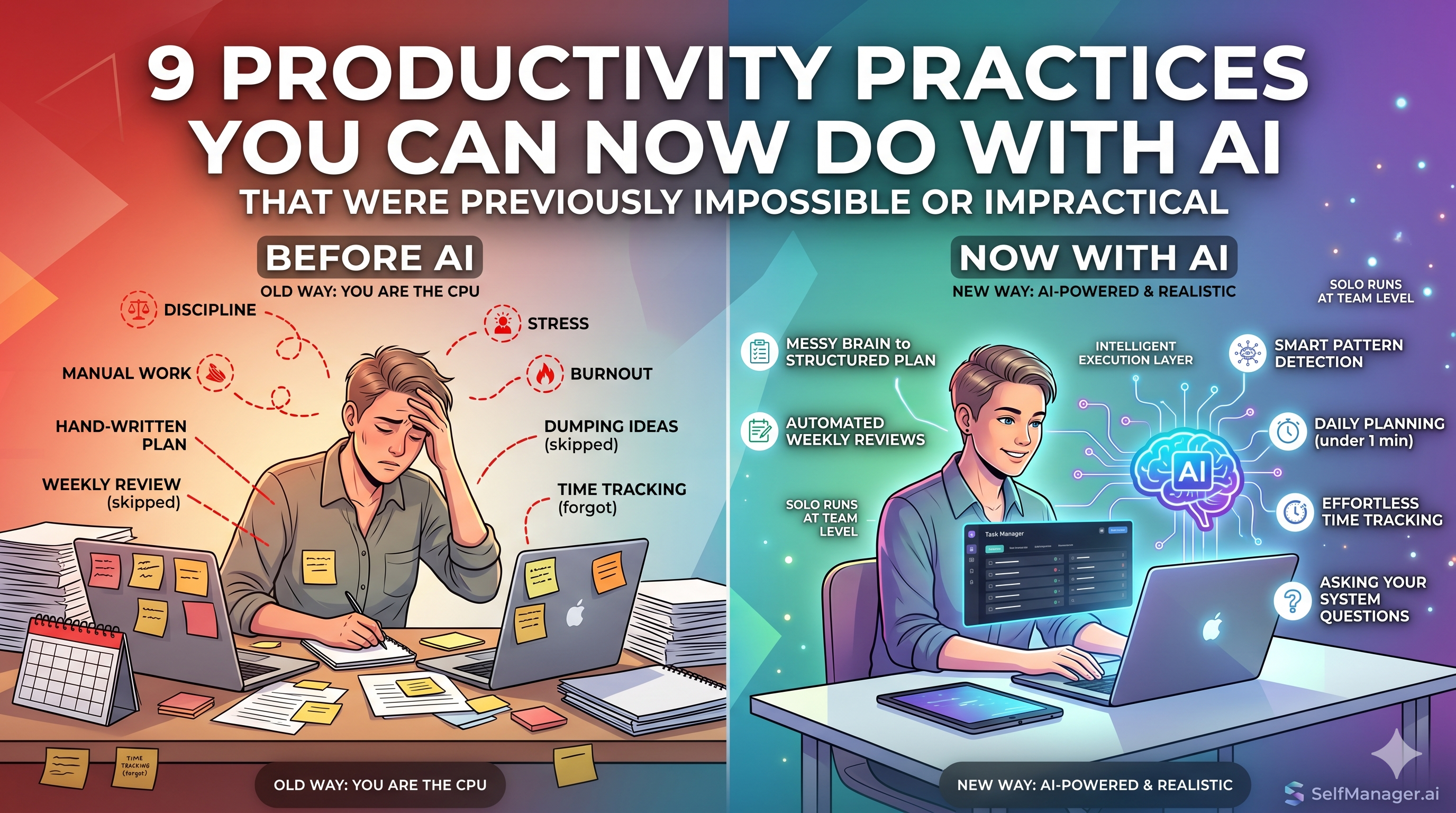
The productivity stack quietly changed under us
For years, productivity advice was mostly about discipline. Write things down. Review weekly. Time block. Touch it once. The methods worked, but they all had the same hidden cost. They required you to be the CPU.
You had to remember, structure, review, plan, and adjust everything yourself. Most people could not keep that up for long, which is why productivity systems had a graveyard shift built in. You would start a system in January and abandon it by March.
AI changed that part. Not the principles, the execution. A lot of the heavy lifting that used to require willpower or a coach can now be done by a model that sits next to your tasks.
Here are nine practices that were either impossible or impractical before, and are now realistic for one person running real work.
1. Dumping a messy brain and getting a structured plan back
Before, you had to translate your own thoughts into tasks. If you did not know how to break a goal down, you were stuck.
Now you can write two paragraphs of rambling context and get a clean list of tasks, grouped by project, with suggested dates. You no longer need to be good at decomposition to get started.
This is one of the biggest reasons people who struggled with classic task managers can suddenly stick with an AI-powered one.
2. Weekly reviews that actually happen
The weekly review is the single most recommended practice in productivity, and the single most skipped.
It used to require you to manually scroll through your week, remember what you did, notice what slipped, and decide what to carry forward. That is a lot of cognitive work on a Sunday evening.
AI can now generate most of that review for you. What you completed, what moved, what patterns repeat, what probably needs to be pushed. You go from writing the review to editing it, which is a completely different level of effort.
3. Noticing patterns in your own behavior
This one is underrated.
You cannot see your own patterns without data. You might swear you are productive in the morning, but your task history might show you only finish things after 4pm. You might think you balance projects well, but every Wednesday ends up eaten by one client.
Before AI, spotting this required a coach, a spreadsheet, or a therapist. Now your own task data can be read back to you with patterns highlighted. That feedback loop used to be a luxury. It is becoming a default feature.
4. Time tracking without starting timers
Classic time tracking has a fatal flaw. You have to remember to track.
Most people either forget, lie to themselves, or abandon the habit within a month. The data ends up too partial to be useful.
With AI and built-in tracking, the system can infer time spent from task status, calendar events, and activity. You get a rough but honest picture of where your hours go, without the overhead of running a stopwatch all day.
5. Turning meetings and notes into real commitments
Meeting notes used to die in a doc somewhere. Someone would write them, share them, and then nothing would happen.
Now you can take a transcript or raw notes and pull out owners, deadlines, and next steps automatically. More importantly, those next steps can land in a task system with dates attached, instead of living as bullets in a Notion page no one opens again.
The gap between deciding something and doing something got smaller.
6. Daily planning in under a minute
Planning your day properly used to take 10 to 15 minutes if you did it well. Most people skipped it and just reacted to whatever was loudest.
Now you can get a realistic daily plan generated from your open tasks, deadlines, and available hours, and spend your time editing it instead of building it from scratch. For people who hate planning but benefit from it, this is the unlock.
7. Asking your own system questions
This was simply not possible before.
You could not ask your task manager "what did I finish last month across client work" or "which projects have I not touched in two weeks" and get a real answer. You had to build a report, or guess.
Now you can talk to your own data. That changes how often you check in on yourself, because the friction dropped to near zero.
8. Adapting goals instead of abandoning them
Classic goal setting has a brutal pattern. You write big goals once a year. Life changes. The goals stop fitting. You either feel guilty or pretend they do not exist.
AI can reshape goals based on what you are actually doing. It can flag drift, suggest smaller next steps, and rewrite a stale goal into something that matches your current week. Goals become living things instead of monuments.
9. Running operations as a solo person at a level that used to need a team
This is the biggest shift, and it is quiet because it does not fit in a single feature.
A solo founder today can run client work, content, analytics, and planning at a quality that used to require three to five people. Not because they work more, but because the boring connective tissue between tasks, notes, meetings, and reports is partially automated.
A lot of that connective tissue is exactly what a task manager with an AI layer handles.
What this means in practice
The takeaway is not that AI makes you more productive by pushing you harder. It is that AI removes a specific category of work you used to do yourself just to run your own system.
Decomposition, review, pattern recognition, tracking, reporting, and planning. All of that used to be your job on top of your actual job. Now a meaningful chunk of it can run in the background.
The people getting the most out of this are not the ones using AI as a chatbot. They are the ones using AI inside the tools where their work already lives, so the model can see the same context they see.
That is the part SelfManager.ai is built around. A task manager with real dates, real time tracking, and an AI layer that actually knows what you are working on, not a separate assistant that you have to re-explain your life to every morning.
Takeaways
- Productivity used to depend on discipline because you were the CPU for your own system.
- AI changes the execution layer, not the principles.
- The biggest unlocks are in review, pattern detection, planning, and turning raw input into structured work.
- Solo operators benefit the most because AI replaces the connective tissue that used to require a team.
- The value shows up when AI lives inside your task system, not beside it.
Date-based AI Task Manager
Plan smarter, execute faster, achieve more
Create tasks in seconds, generate AI-powered plans, and review progress with intelligent summaries. Perfect for individuals and teams who want to stay organized without complexity.
Get started with your preferred account