
Why Early-Stage Founders Need a Task Manager for Both Business and Personal Life
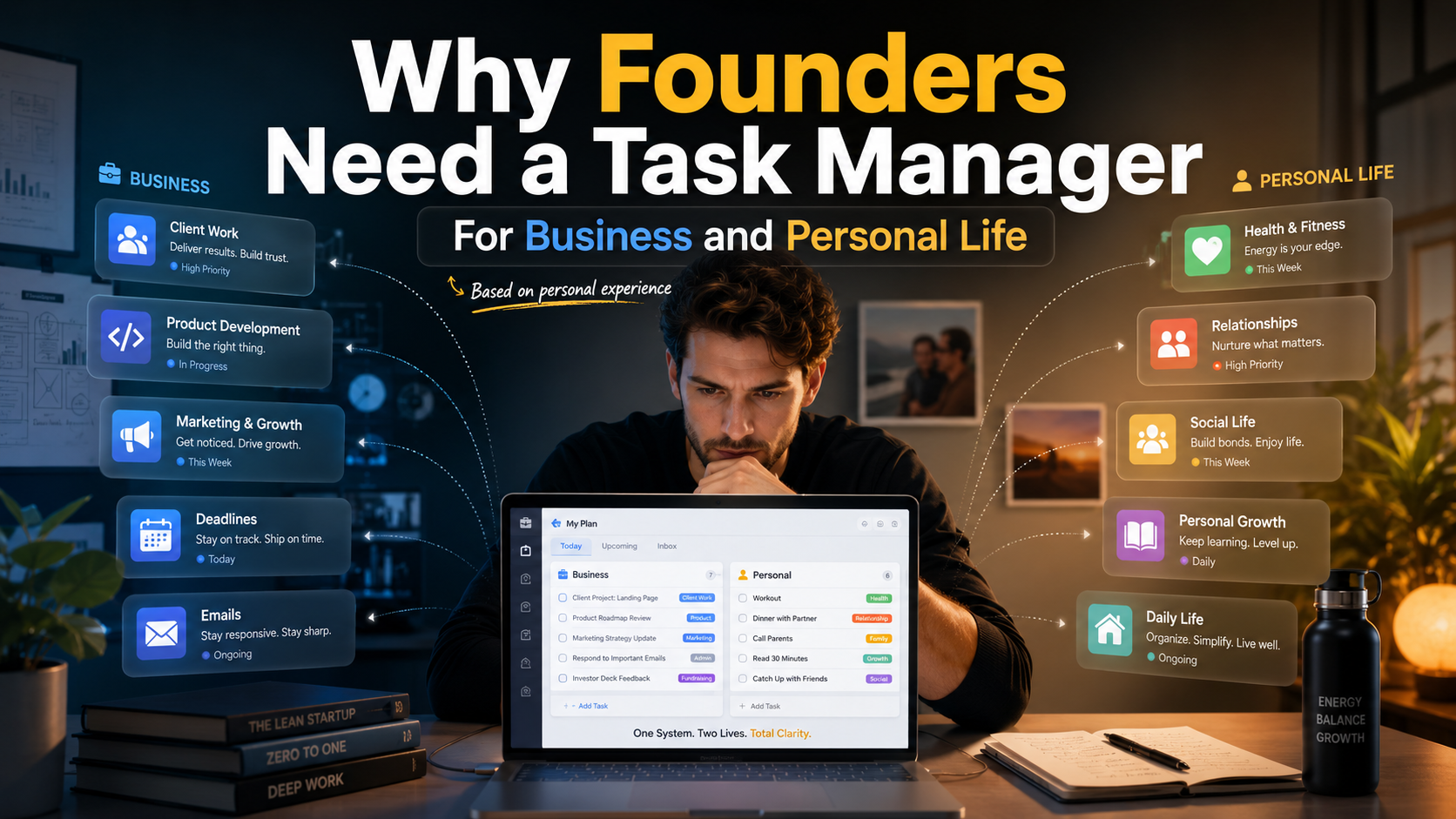
Early-stage founders do not usually have a shortage of things to do.
We have the opposite problem.
There is always another feature to build, customer to answer, invoice to send, campaign to improve, technical problem to solve, article to publish, partnership to explore, or administrative obligation waiting for attention.
At the same time, personal life continues.
We still need to exercise, maintain relationships, manage finances, take care of our health, spend time outside, meet people, rest, and occasionally stop thinking about the business.
The difficulty is that all these responsibilities compete for the same limited resource: our attention.
Based on my personal experience running a web development agency and building a SaaS business, I have reached a simple conclusion:
I am most effective when I manage my life with the same discipline that a successful founder or CEO uses to manage a company.
That does not mean turning every moment into work.
It means having goals, priorities, plans, accountability, and regular reviews across both professional and personal life.
It also means accepting that my brain is not a reliable place to store every task, idea, commitment, decision, and unfinished responsibility.
Founder Life Is a Permanent Competition for Attention
Running a small business often feels like living in controlled chaos.
The word "controlled" is important because the chaos never completely disappears. You simply become better at deciding what deserves your attention today and what must wait.
In a larger company, responsibilities are distributed between departments and employees.
One person handles marketing. Another handles customer support. Someone manages accounting. Developers build the product. Managers organize the work. Executives decide what matters next.
In an early-stage company, several of those people might be you.
As a founder, you might switch between strategy, development, sales, support, marketing, design, finance, and administration within the same day.
This creates an unusual mental burden.
Every responsibility feels important because every responsibility is connected to the survival or growth of the business.
A customer problem can feel urgent.
A product idea can feel important.
A marketing opportunity can feel temporary.
A technical issue can block progress.
An unpaid invoice can affect cash flow.
When everything competes for attention, it becomes difficult to see the difference between what is genuinely important and what is simply demanding your attention right now.
Without an external planning system, founders often become reactive.
The day is shaped by the latest email, message, problem, thought, or notification.
You may work for ten hours and still finish the day wondering whether you worked on the right things.
Business and Personal Life Use the Same Calendar
One mistake I made in the past was treating business planning and personal planning as separate problems.
They are not completely separate.
Your client call, workout, product release, dentist appointment, accounting deadline, family visit, and evening with friends all compete for time inside the same day.
Your body does not create a second set of hours because one responsibility is personal and another is professional.
There are still only 24 hours.
This is why I believe founders need a system that can manage both professional and personal life.
A business-only task manager can show that your workday is organized while hiding the fact that the rest of your life is being neglected.
You may complete product features, answer customers, and publish content while postponing exercise, social interaction, medical appointments, household responsibilities, and rest.
From a business perspective, the week may look productive.
From a life perspective, it may be completely unbalanced.
The opposite can also happen.
The freedom of working for yourself can make it easier to postpone difficult business tasks.
There is no manager checking whether you started at 9:00.
There may be no office where other people are already working.
There may be no fixed schedule forcing you to begin.
You can always tell yourself that you will work later.
Sometimes founders become too involved in the business and neglect personal life. During other periods, the freedom of the schedule makes them too relaxed, and important business work gets delayed.
A good system needs to protect us from both extremes.
Freedom Without Structure Can Become a Problem
One of the reasons people start businesses is freedom.
We want control over our time, work, decisions, and future.
That freedom is valuable, but it comes with a cost.
When nobody creates your structure for you, you must create it yourself.
An employee often has an external framework:
- A starting time
- Meetings
- Deadlines
- Managers
- Coworkers
- Defined responsibilities
- Performance reviews
A founder may have none of these.
You can work when you want, but you can also avoid the task you do not want to face.
You can take a break whenever you want, but that break can quietly become an unproductive week.
You can work late into the night, but nobody is responsible for telling you that doing so every day is damaging your health and decision-making.
Freedom does not automatically produce discipline.
In many cases, freedom requires more discipline because fewer external systems are keeping you accountable.
This is why writing down what I need to do matters so much for me.
The plan becomes a commitment made by my earlier, more objective self.
When the next day arrives, I do not need to recreate the entire strategy based on my current mood. I can look at what I already decided mattered.
Digital Founders Can Become Socially Isolated
This is one of the less discussed risks of building an online business.
A digital founder can spend very long periods alone in front of a computer.
There is no commute.
There may be no physical office.
Customers might be in different countries.
Team communication may happen through messages.
Most of the work can be completed from the same chair, inside the same room.
Because you are working toward something meaningful, the isolation may not feel dangerous at first.
You are busy. You are making progress. You are solving problems.
But humans still need social interaction.
We need conversations that are not about work. We need movement, sunlight, changes of environment, and time around other people.
When social life is not built into the natural structure of the day, founders may need to plan it deliberately.
That might sound strange to someone with a traditional workplace and an active social environment.
For a solo founder working online, it can be necessary.
If I only plan business tasks, the business will naturally consume nearly every available space.
There will always be something else I could improve.
The work is never completely finished.
This means personal priorities cannot depend on the hope that free time will eventually appear.
They need to be part of the plan.
My Most Productive Periods Always Had a System Behind Them
I have seen the same pattern repeatedly in my own life.
When I write down what I need to do, create a plan, keep myself accountable, and review previous periods, my results improve.
My days become more focused.
I make better progress toward larger goals.
I am less likely to forget small responsibilities.
I can see whether I am actually moving forward rather than simply staying busy.
These periods have often worked surprisingly well.
But I repeatedly made another mistake.
After the system produced a strong period, I assumed the improvement would continue automatically.
I felt organized, so I thought I had become an organized person permanently.
I felt productive, so I thought productivity had become my default state.
I stopped using the system as consistently because I believed I no longer needed it.
Eventually, the clarity started disappearing.
Small responsibilities accumulated.
Priorities became less obvious.
Days became more reactive.
The productive period ended, and I found myself returning to planning again.
The mistake was believing that the system was temporary support for difficult periods.
I now see it differently.
The system was one of the reasons the period was going well.
Removing the system because it worked is like stopping a successful business process because the company is currently performing well.
The results do not prove the process is unnecessary.
The results may prove the process is working.
Your Brain Is for Thinking, Not Permanent Storage
Founders push their brains and bodies hard.
We make decisions, solve unfamiliar problems, learn new skills, switch contexts, manage risk, and think about possibilities that do not exist yet.
That is already a demanding job for the brain.
It should not also be responsible for permanently storing every small responsibility.
You can argue that humans have memory, and of course we do.
But try answering a few simple questions:
What was the first task on your list exactly one week ago?
What did you intend to complete but postpone?
Which tasks consumed more time than expected?
What did you finish that moved your business forward?
What personal commitment did you delay because work felt more urgent?
Most people cannot answer these questions accurately from memory alone.
They can provide an impression.
They may remember the largest event or the most stressful problem.
But they cannot reconstruct the week precisely.
This matters because feelings are not always accurate.
You may feel unproductive even though you completed several important tasks.
You may feel productive because you were busy for many hours, even though little meaningful progress happened.
A written system gives you evidence.
It creates an external memory of what you planned, what you completed, what you postponed, and where your time went.
A Task Manager Should Help You Look Back, Not Only Forward
Most people think of task managers as tools that tell them what to do next.
That is only half of their value.
A useful system should also help you understand what already happened.
At the end of the week, you should be able to review:
- What you planned
- What you completed
- What you postponed
- What repeatedly interrupted you
- Where your time went
- Which area of life received too much or too little attention
The same idea applies to months, quarters, and years.
A single day can be misleading.
Sometimes an urgent issue destroys a carefully planned day. That does not necessarily mean the system failed.
A week gives you more context.
A month reveals patterns.
A quarter helps you understand whether your strategy is working.
A year shows whether you are moving toward the life and business you intended to build.
Without records, a quarterly review becomes a memory exercise.
You remember a few major successes, failures, stressful periods, and recent events.
With a task manager or written system, you can review what actually happened.
That makes it easier to draw useful conclusions.
You might discover that certain types of work repeatedly take longer than expected.
You might notice that your most productive weeks always begin with a clear plan.
You might see that exercise disappears whenever business pressure increases.
You might realize that you regularly postpone strategic work because customer requests feel more urgent.
These patterns are difficult to detect when every day is treated as an isolated event.
Ambitious Goals Require Deliberate Systems
Reviewing your week, month, or quarter may sound excessive to some people.
For many people, it may not be necessary.
But unusually ambitious goals often require unusually deliberate systems.
If you are trying to build a business, manage clients, create a product, improve your skills, protect your health, maintain relationships, and create financial security at the same time, relying entirely on memory and motivation is risky.
Motivation changes.
Energy changes.
Business conditions change.
Unexpected problems appear.
A system provides continuity across these changes.
It reminds you what matters when your mood is different from the day when you originally set the goal.
It also forces you to confront the difference between intention and execution.
You may say that health is important, but your calendar may show that you gave it no time.
You may say that product development is the priority, but your completed tasks may show that the week disappeared into support and administration.
You may say you are building a scalable business while spending most of your time on work that cannot scale.
A task manager does not solve these problems automatically.
It makes them more visible.
Visibility is often the first step toward changing them.
Running Your Life Like a CEO Does Not Mean Working Constantly
The idea of managing your life like a company can sound cold or overly serious.
That is not what I mean.
A successful CEO should not only maximize output today.
They should protect the long-term health of the organization.
They allocate resources.
They decide which opportunities to reject.
They prevent important areas from being ignored.
They review results and adjust the strategy.
The same principles can be applied personally.
Your time is limited.
Your attention is limited.
Your energy is limited.
Your health affects every other area.
Your relationships require investment.
Rest is not wasted time if it allows you to think clearly and perform sustainably.
Managing your life deliberately does not mean converting every hour into work.
It means making sure work does not consume everything else by default.
A personal task manager should include more than business obligations.
It can include:
- Exercise
- Social plans
- Medical appointments
- Personal finances
- Household responsibilities
- Learning
- Rest
- Travel
- Family commitments
- Long-term personal goals
These are not interruptions to your real work.
They are part of your real life.
The Best System Is One You Continue Using
Before I built a digital task manager, I used an offline system based on a calendar, an agenda, and a notebook.
The technology was different, but the principle was the same.
I needed a place outside my brain where I could capture responsibilities, organize time, and review what happened.
Today, I use SelfManager.ai, the task manager I started building almost ten years ago.
Full disclosure: I am its founder.
I designed it around dates because that is how I naturally think about work.
Every day is its own workspace. Inside that day, I can create separate tables for client work, product development, marketing, personal responsibilities, health, or anything else competing for my attention.
I can then review longer periods such as weeks, months, and quarters.
But I do not believe everyone needs to use my product.
Some people work well with paper.
Some prefer a calendar and notebook.
Others use a traditional task manager, spreadsheet, notes app, or a combination of several tools.
The specific software matters less than the discipline of maintaining an external system.
The system should be simple enough that you keep returning to it.
A powerful tool that you abandon after two weeks is less useful than a basic notebook you review every day.
Planning Is Not About Predicting Every Day Perfectly
Some people avoid planning because plans frequently change.
That is especially true for founders.
A customer emergency appears.
A deployment fails.
An important opportunity arrives.
A meeting takes longer than expected.
A task that looked simple becomes complicated.
The plan will not always survive the day exactly as written.
That does not make planning useless.
The purpose of planning is not to predict reality perfectly.
The purpose is to begin with intention.
Without a plan, every interruption gets to decide what matters.
With a plan, you can compare the interruption against priorities you already established.
You may still change direction, but you are doing it consciously.
Planning gives you a reference point.
Reviewing helps you improve that reference point over time.
The Real Value Is the Feedback Loop
The most useful productivity system is not simply a list of tasks.
It is a feedback loop:
- Decide what matters.
- Plan what you will do.
- Execute the work.
- Record what actually happened.
- Review the results.
- Adjust the next plan.
This is how businesses improve.
It is also how individuals improve.
Without the review step, people repeat the same planning mistakes.
They continue assigning too many tasks to one day.
They underestimate difficult work.
They ignore personal priorities.
They allow urgent work to replace important work.
They stay busy without learning from the pattern.
A review turns experience into information.
That information makes the next plan more realistic.
The System Is Not Only for Chaotic Periods
This may be the most important lesson I learned from my own experience.
Do not wait until life becomes chaotic before using your system.
Do not stop using it because life becomes organized.
The system is not an emergency response.
It is part of the infrastructure that helps prevent the emergency.
Businesses do not stop using accounting because cash flow is currently healthy.
They do not stop tracking customers because sales are going well.
They do not stop maintaining infrastructure because the software is currently online.
In the same way, I should not stop planning and reviewing because I am currently productive.
The productive period may be evidence that the system is doing its job.
Final Thoughts
Early-stage founders live with more freedom than most employees, but also more uncertainty, responsibility, and competition for attention.
There is always another business task available.
Without deliberate planning, professional urgency can consume personal life.
Without external accountability, schedule freedom can also become drift.
Based on my personal experience, I perform best when I treat my life as something that deserves to be managed intentionally.
I create plans.
I write things down.
I review previous periods.
I compare intentions with actual results.
I use an external system instead of expecting my memory to store everything.
Most importantly, I try to continue using the system after it starts working.
That has been one of my biggest mistakes in the past.
I would build structure, experience a strong period, and then assume the structure was no longer necessary.
Now I understand that the system is not something I use until I become organized.
The system is part of how I remain organized.
Frequently Asked Questions
Why do founders need a task manager?
Founders manage many competing responsibilities across strategy, operations, customers, product development, marketing, administration, and personal life. A task manager creates an external system for capturing responsibilities, choosing priorities, and reviewing what was actually completed.
Should personal and business tasks be kept in the same system?
For many founders, keeping them visible inside the same system is useful because personal and professional responsibilities compete for the same time and energy. They can still be separated into different projects, tables, or categories while remaining part of one overall plan.
Can a notebook replace a digital task manager?
Yes. A notebook, calendar, or paper agenda can work well when used consistently. Digital systems become more useful when you need search, long-term history, recurring tasks, time tracking, collaboration, attachments, or automated reviews.
How often should founders review their tasks?
A brief daily review can help prepare the next day. A weekly review is useful for identifying unfinished work and adjusting priorities. Monthly and quarterly reviews help reveal larger patterns that are difficult to notice from individual days.
Why do people stop using productivity systems?
People often stop when the system feels complicated, when maintaining it requires too much time, or when life starts going well and they assume they no longer need it. In my experience, the last reason is especially dangerous because the system may be one of the reasons the productive period exists.
What makes a task manager sustainable?
A sustainable task manager should be easy to open, quick to update, and flexible enough to reflect the user's real life. It should reduce mental load rather than become another complicated project that needs to be managed.
Date-based AI Task Manager
Plan smarter, execute faster, achieve more
Create tasks in seconds, generate AI-powered plans, and review progress with intelligent summaries. Perfect for individuals and teams who want to stay organized without complexity.
Get started with your preferred account