
When Are You Actually Most Productive? What the Science of Peak Hours Really Says
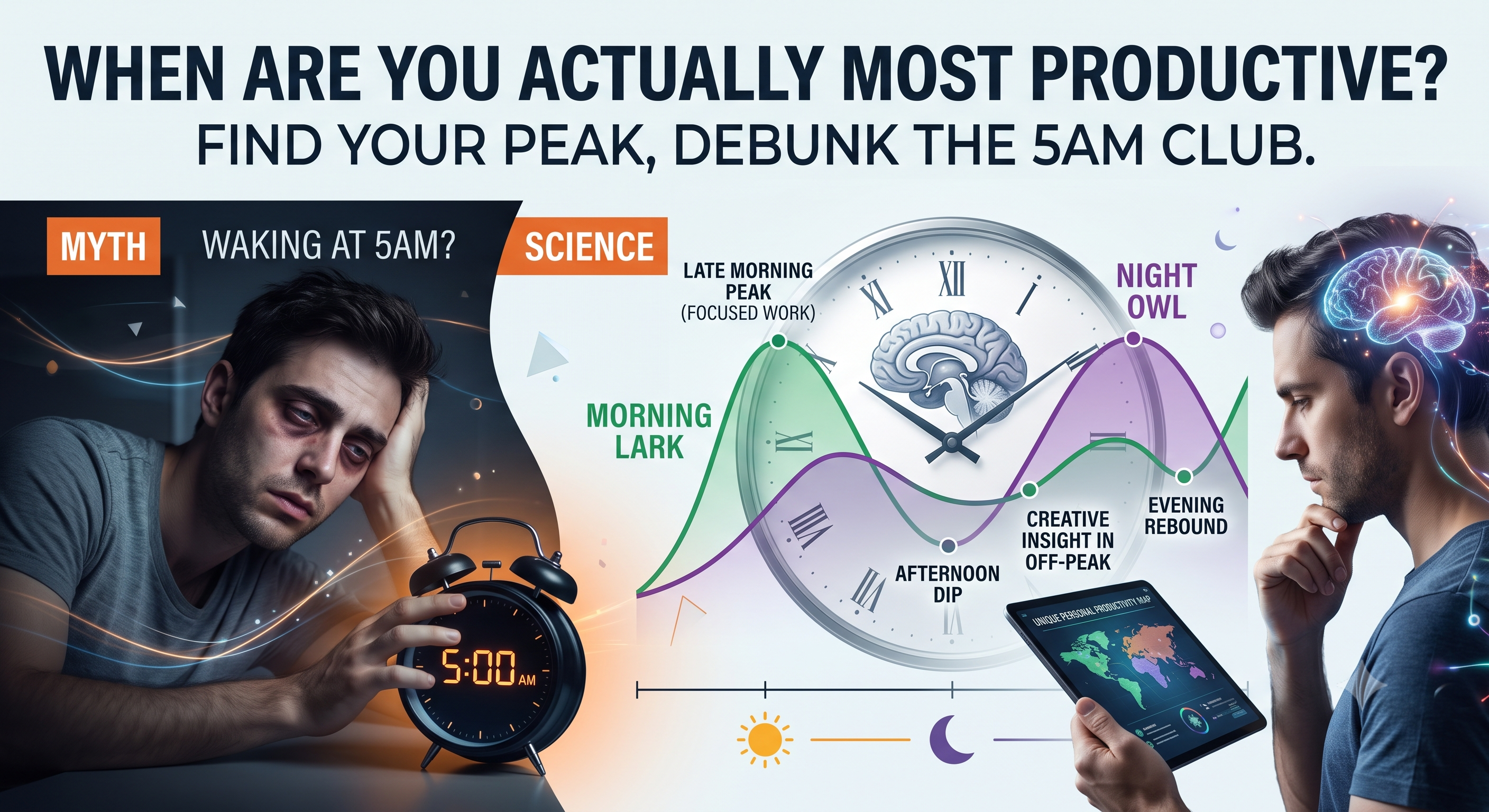
Most people plan their day around their calendar. They schedule the hard task for whenever there's a free slot, push the boring admin to whenever there's a gap, and assume that an hour is an hour. It isn't. The same hour of work produces wildly different results depending on when in the day it happens, because the brain you bring to 10am is not the brain you bring to 3pm, and neither is the brain you bring to 9pm.
There is a real, researched answer to the question of when human beings think best. It has a clear shape: a climb through the morning, a peak in focused mental performance in the late morning, a slump in the early afternoon, and a second wind in the late afternoon or early evening. But there's a catch that almost every productivity article skips, and it's the most important part. That average curve is not your curve. Whether you're sharpest at 9am or only hit your stride after lunch is set largely by your biology, not your willpower, and it varies between people by several hours. This is the piece that explains both: the shape of the day that applies to most people, and how to find the version of it that applies to you.
The short answer
For a typical person with an average body clock, here is roughly how the day runs. Alertness is low right after waking and climbs steadily through the morning. Focused, analytical work - the kind that needs attention, working memory, and logical reasoning - tends to peak in the late morning, somewhere in the window from about 10am to just past noon. Then comes the early-afternoon dip, often between roughly 1pm and 3pm, when alertness sags. Performance recovers through the late afternoon and into the early evening, which is when physical alertness and reaction time are often at their highest. After that, as the body prepares for sleep, everything winds down.
That's the map most people are working from without knowing it. But two things complicate it, and both matter. The afternoon dip is biological, not just the result of lunch. And the whole curve slides earlier or later depending on whether you're a morning type or an evening type. Get those two facts straight and you understand more about your own productivity than any time-management system will teach you.
Why you have a daily rhythm at all
You feel sharper at some hours and foggier at others because you have an internal clock, and it's not a metaphor. Deep in the brain, in a region of the hypothalamus called the suprachiasmatic nucleus, sits a master clock that runs on a cycle of close to twenty-four hours. It keeps time even in the absence of any external cue, and it's reset each day mainly by light hitting the eyes, which is how your biology stays roughly aligned with the sun.
This clock doesn't just control when you feel sleepy. It orchestrates a daily rise and fall in body temperature, hormones, and alertness that shapes how well your brain works hour to hour. Core body temperature is the useful thing to picture here, because mental alertness tends to track it. Your temperature is at its lowest in the very early morning, a couple of hours before you'd naturally wake, and it climbs across the day to a peak in the late afternoon or early evening before falling again at night. Many aspects of cognitive performance follow a similar arc. This is why performance across the day is never flat, and why fighting the clock is so costly: you are not lazy at 3pm, you are running a body that is doing exactly what it's built to do.
The shape of the day
Layer the research on cognition onto that clock and a consistent pattern appears, with different kinds of mental work suiting different windows.
The morning rise is the climb out of grogginess. You do not wake up sharp - more on that later - but as the morning progresses, alertness, attention, and the ability to hold information in mind all improve. For most people, this builds toward a late-morning high point that is well suited to demanding, focused work. If you have something that requires concentration and clear reasoning - writing something difficult, working through a complex problem, anything where mistakes are expensive - the late morning is, on average, when the typical brain is best equipped for it.
Then performance dips. The early afternoon brings a measurable slump in alertness for most people, the infamous post-lunch dip. It's a genuinely low point for vigilance and concentration, and it's a poor time for work that demands sustained, careful attention.
After the dip, there's a recovery. Through the late afternoon and into the early evening, alertness climbs again toward that body-temperature peak. Reaction time and physical performance are often at their best in this window, which is one reason so many athletic records are set in the early evening. For mental work, the late afternoon can be a productive second shift, though the flavor is often different from the morning - less suited to the most cognitively heavy lifting for many people, but solid for getting through a volume of work.
And then the evening decline. As the body starts preparing for sleep, alertness and performance fall away. For most chronotypes, late evening is not the time for important thinking - though, as we'll see, evening types are a real and significant exception.
The afternoon dip is biological, not just lunch
It's tempting to blame the early-afternoon slump on the sandwich you ate, and a heavy lunch certainly doesn't help. But the dip is real even when people don't eat lunch at all. It shows up in carefully controlled studies as a built-in feature of the body's daily rhythm, a programmed lull in alertness in the early afternoon rather than a simple consequence of digestion. The food can deepen it. It doesn't cause it.
This matters because the dip has measurable consequences for real cognitive output, not just how you feel. One of the most striking demonstrations comes from a large study of Danish schoolchildren, published in the Proceedings of the National Academy of Sciences, which looked at millions of test results and the time of day they were taken. Performance fell as the day went on - by roughly the equivalent of one percentile point for each hour later that a test was sat. That is a substantial drop simply from the clock. The same study found something hopeful, though: when students got a short break of twenty to thirty minutes before testing, much of that decline reversed. The lesson generalizes well beyond exams. Cognitive performance erodes across a long stretch of work, the afternoon is a real low point, and a genuine break is not slacking - it's maintenance.
The twist: your peak is not the average
Here is where most advice goes wrong. It takes that average curve - late-morning peak, afternoon dip - and prescribes it to everyone. But people differ, biologically and substantially, in when their clock runs. This trait is called chronotype, and it's the difference between morning larks and night owls.
Chronotype is not a personality quirk or a habit you picked up. It's rooted in the timing of your internal clock, it's partly genetic, tied to natural variation in the same clock genes that run the system, and it's remarkably stable. A strong morning person and a strong evening person can have peak-performance windows that are separated by several hours. Researchers have measured this for decades, first with a questionnaire developed by Horne and Östberg in the 1970s, and later with tools like Roenneberg's Munich ChronoType Questionnaire, which pins down your clock by asking when you naturally sleep on days you're free to choose. What the data shows is that chronotype spreads across a spectrum. Most people sit somewhere in the middle, with meaningful minorities at the strong-lark and strong-owl ends.
For a lark, the standard curve roughly holds or even runs early: sharp in the morning, fading in the evening. For a true owl, the curve is shifted hours later. An evening type may be genuinely below par in the morning - not unmotivated, just biologically not online yet - and may not reach their cognitive best until the afternoon or even the evening, exactly when the textbook says performance should be declining. For them, the textbook is describing someone else's body.
This is backed by what psychologists call the synchrony effect. In a line of research led by May and Hasher, people performed better on demanding mental tasks at their own optimal time of day, the one that matched their chronotype, and worse at their off-peak time. The effect was especially clear for tasks needing focus and mental control. The practical translation is simple and freeing: there is no universally correct hour to do your best work. There is only your hour, and the best time for hard thinking is whenever your particular clock is at its peak.
One more wrinkle worth knowing: chronotype changes across your life. Young children tend to be larks. Through adolescence, the clock shifts dramatically later, reaching its latest point in the late teens - so much so that researchers have proposed this peak in lateness, around age nineteen or twenty, as a biological marker for the end of adolescence. This is the real reason teenagers struggle with early school start times; they are not being difficult, their biology has moved. Then, across adulthood, the clock gradually drifts earlier again, which is why many people become morning types as they age. The hours that suit you at twenty are not the hours that will suit you at fifty.
The counterintuitive part: your worst hours can be your most creative
If the story were simply "work during your peak, rest during your dip," it would be tidy. But the research has a genuine surprise in it, and it's the kind of detail that's worth knowing because it's so useful.
For insight problems - the sort that require a creative leap rather than step-by-step logic - people often do better at their non-optimal time of day. In a well-known study with the wonderful title "Time of day effects on problem solving: When the non-optimal is optimal," Wieth and Zacks found that participants solved more insight problems at the time of day that did not match their chronotype. The likely reason is that at your off-peak hours, your focus is looser and your mind wanders more, your mental filters are weaker, and you're more open to distant, unexpected connections. That diffuse, slightly unfocused state is bad for tight analytical work but good for the kind of thinking where the answer arrives sideways.
So the fuller picture is this. Your peak hours are for focused, demanding, analytical work where attention and accuracy matter. But your dip - the time you'd normally write off - may be exactly when your most original ideas show up, precisely because your brain isn't locked into sharp, narrow focus. The night owl staring blankly at a problem at 10am might not be wasting time. They might be in the perfect mental state for a breakthrough, just not for a spreadsheet.
The 5am club, debunked
No discussion of productive hours survives contact with the internet without running into the wake-at-5am gospel: the idea that the path to a productive life is dragging yourself out of bed before dawn to seize the quiet hours. It has been packaged and sold endlessly. And the science of chronotype undercuts it fairly directly.
Start with who that advice actually fits. For a morning lark, rising at 5am can be genuinely great - their clock is already pointed that way, and they're meeting their natural peak head-on. But for an evening type, 5am sits near the bottom of their daily rhythm. Waking then means starting work at their physiological low point, on top of cutting their sleep short, because an owl's body won't let them fall asleep early enough to bank a full night before a pre-dawn alarm. The result is not a productivity gain. It's working impaired and tired, against the clock, every single day.
Then there's sleep inertia, the grogginess you feel on waking. Nobody springs out of bed mentally sharp. For a stretch after waking - often fifteen minutes to an hour, sometimes longer - cognitive performance is measurably impaired, and it's worse when you're woken at a low point in your rhythm or when you're short on sleep. The fantasy of leaping up at 5am into a state of crystalline focus runs straight into the biology of how waking actually works.
So why do so many successful early risers swear by it? Two reasons, mostly. First, selection: many of them are larks, and they were going to peak early anyway. They credit the 5am alarm for a sharpness their chronotype was already going to deliver. Second, the real benefit they're describing usually isn't the hour - it's the uninterrupted quiet. Early morning is calm because the world is asleep, and quiet, undisturbed time genuinely helps focus. But a night owl can get that exact same uninterrupted quiet at 11pm. The value is in the solitude, not in the position of the clock hands.
There's a cost to ignoring this, too. Chronically forcing your body to run against its natural clock - waking and working hours out of sync with your biology - produces what researchers call social jetlag, a persistent mismatch between your internal time and your scheduled life. It has been linked to worse mood, poorer wellbeing, and a range of health downsides. The 5am club isn't discipline triumphing over biology. For about half the population, it's biology quietly losing, and paying for it. The honest version of the advice is not "wake at 5am." It's "find when your body is built to work, and protect those hours."
How to find your own productive hours
All of this is only useful if you can locate your own peak. You don't need a lab. You need a little honest observation.
Start by figuring out your chronotype. The cleanest signal is when you naturally sleep when nothing forces the timing - on a holiday, say, with no alarm and no early obligations. The midpoint between when you fall asleep and when you wake on those free days is a decent marker of where your clock sits. If left to your own devices you drift to sleeping late and waking late, you lean owl. If you're naturally up early and fading by mid-evening, you lean lark. Most people land somewhere in between, and that's fine - the point is to know which way you tilt and by how much.
Then watch yourself for a week or two. Pay attention to when you feel genuinely sharp and when you crash, not when you think you should. A simple habit works: a few times a day, note how clear and focused you feel. After a couple of weeks a pattern emerges - a window where the hard things feel easier, and a window where everything feels like wading through mud. That personal map is worth more than any general rule, including the averages in this article.
Once you know the shape of your own day, the move is to match the type of work to the window rather than fighting it. Your sharp window is for the demanding, focused, error-sensitive work - the thinking that deserves your best brain. Your dip is for the low-stakes, routine, mechanical tasks that don't need much of you, and, if you're feeling adventurous, it's worth experimenting with doing open-ended creative work there too, given what the research says about off-peak insight. The goal is not to squeeze more hours out of the day. It's to stop spending your best hours on your easiest work, and your worst hours banging your head against your hardest.
A few honest caveats, because the science demands them. None of this overrides sleep. If you're chronically short on sleep, your whole curve sags and no clever scheduling will rescue it; the timing of your work matters far less than whether you're rested at all. Chronotype is a spectrum, not two boxes, so don't force yourself into "lark" or "owl" if you're somewhere in the middle. And consistency helps - keeping roughly regular sleep and wake times lets your clock settle, which makes your peak more reliable than if your schedule lurches around. The aim isn't to optimize every minute. It's to stop unknowingly working against the one piece of your performance that's hardest to argue with.
Where this leaves you
There is a real science of when humans get things done. For most people, focused mental work peaks in the late morning, slumps in the early afternoon, and recovers into the evening, all riding on a body clock that's been keeping time since long before alarm clocks existed. That curve is genuinely useful to know.
But the single most valuable fact in all of it is that the curve is personal. Your peak is set by your biology, not by a guru's wake-up time, and it can sit hours away from the average. The productive move isn't to copy someone else's schedule or to force yourself into a heroic pre-dawn routine that fits half the population at best. It's to learn when your own brain is actually online, defend those hours for the work that matters, and stop treating every hour as if it were the same. They never were.
Takeaways
- For an average chronotype, focused analytical work tends to peak in the late morning, dip in the early afternoon, and recover in the late afternoon and early evening, tracking the body's daily temperature and alertness rhythm.
- The early-afternoon dip is biological. It appears even without lunch, and real cognitive output measurably drops across the day, though a genuine short break helps reverse it.
- Your personal peak depends on your chronotype - whether you're a morning or evening type - which is largely biological, sits on a spectrum, and can shift your best hours by several hours from the average.
- People perform best on demanding, focused work at their own optimal time of day. There is no universally correct hour.
- Off-peak hours can be better for creative, insight-based thinking, because looser focus helps the mind make unexpected connections.
- The wake-at-5am formula mainly suits natural larks. For evening types it means working at their low point on too little sleep, and much of its real benefit is just uninterrupted quiet, which any chronotype can find at their own best hour.
- To find your hours: identify your chronotype from your natural free-day sleep, track when you actually feel sharpest for a week or two, then match hard work to your peak and routine work to your dip.
FAQ
When is the brain most productive during the day?
For most people with an average body clock, focused and analytical work peaks in the late morning, roughly between 10am and just past noon. Alertness then dips in the early afternoon and recovers into the late afternoon and early evening. However, this varies by several hours depending on whether someone is a morning or evening type.
Is the afternoon slump real, or is it just from eating lunch?
It's real and largely biological. The early-afternoon dip in alertness shows up even when people don't eat lunch, because it's part of the body's natural daily rhythm. A heavy lunch can deepen it but doesn't cause it, and a short break can help counter it.
Are night owls less productive than morning people?
No. Evening types simply peak later. A night owl's best window for focused work can fall in the afternoon or evening rather than the morning. Research on the synchrony effect shows people perform best at the time of day that matches their own chronotype, so an owl forced onto an early schedule will underperform relative to their true peak.
Does waking up at 5am make you more productive?
Not for most people. Early rising mainly suits natural morning types, whose body clocks already point that way. For evening types, 5am falls near their daily low and usually means cutting sleep short, so they work tired and impaired. Much of the benefit early risers describe comes from uninterrupted quiet time, which anyone can get at their own best hour.
When is the best time for creative or insight work?
Often during your off-peak hours, counterintuitively. Research has found people solve more insight problems at the time of day that does not match their chronotype, likely because looser, less rigid focus makes it easier to reach unexpected connections. So creative work can suit the very hours that are wrong for tight analytical tasks.
How do I find my own peak hours?
Identify your chronotype by noticing when you naturally sleep and wake on free days with no alarm. Then track how sharp you feel at different times across a week or two. A pattern will emerge showing your high-focus window and your slump. Schedule demanding work for your peak and routine work for your dip.
Date-based AI Task Manager
Plan smarter, execute faster, achieve more
Create tasks in seconds, generate AI-powered plans, and review progress with intelligent summaries. Perfect for individuals and teams who want to stay organized without complexity.
Get started with your preferred account