
Moving From a Village to a City: 10 Tips to Stay Productive Through the Transition
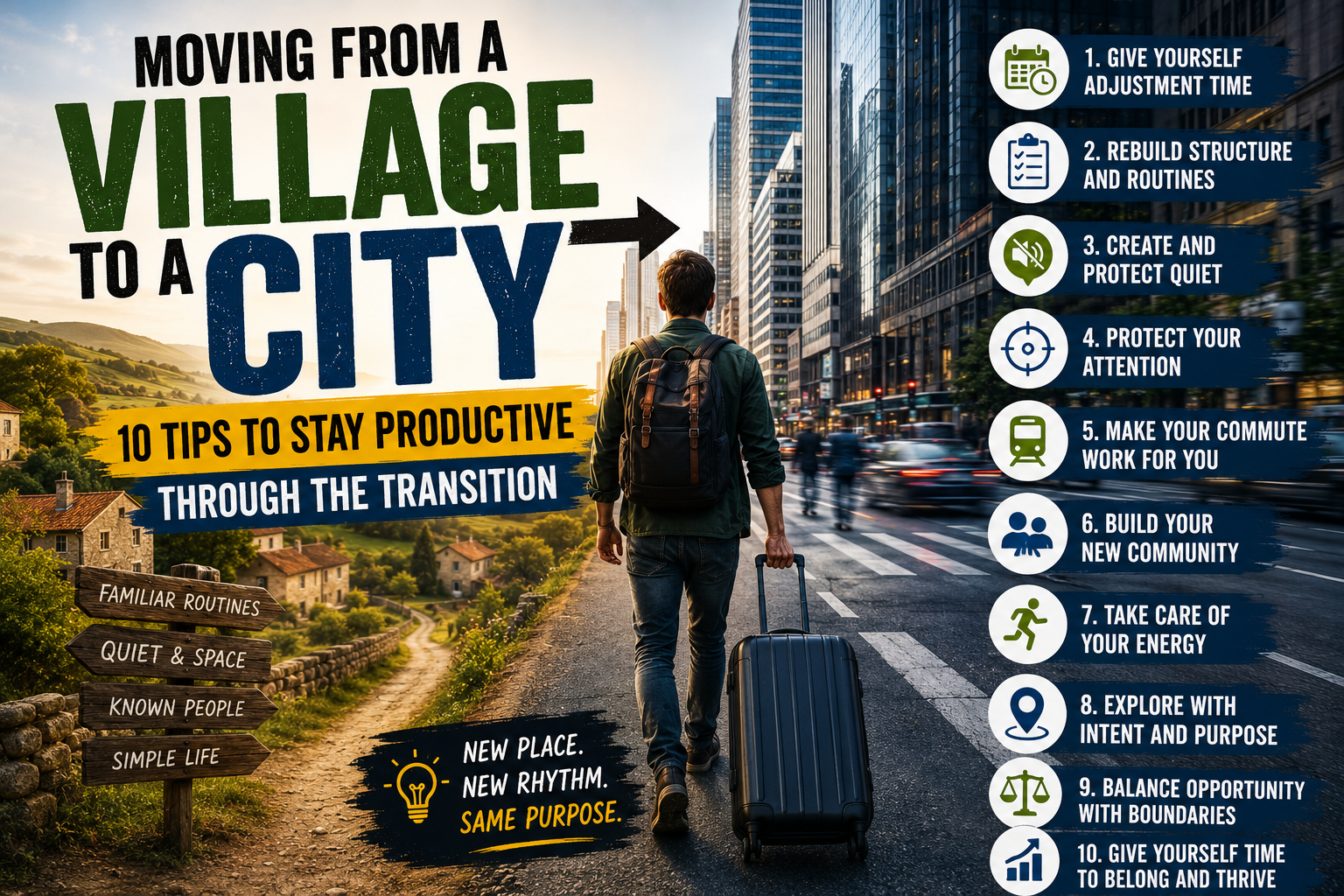
Moving from a village or a small town to a city is one of those changes that looks like a logistics problem and turns out to be a psychological one. You plan for the apartment, the job, the boxes. What nobody warns you about is that the way you worked, the rhythm that felt natural your whole life, quietly stops working too.
It is not that cities make you less capable. It is that a small place gives you a lot of structure for free. Quiet, routine, daylight, the sense that people notice what you do. The city hands you almost none of that and asks you to build it yourself, all while you are also learning new streets, a new commute, and a new pace. For the first weeks, a lot of your mental energy goes to simply navigating, and your usual productivity takes the hit.
This is normal, and it passes, especially if you are deliberate about it. The tips below are not generic productivity advice. They are aimed at the specific things that change when you move from a small place to a big one, and how to keep your focus and momentum intact while you adjust.
1. Give yourself a real adjustment period
The first mistake people make is expecting to hit full stride immediately. You will not, and that is not a failure.
Relocation is cognitively expensive. Everything that used to be automatic, the route to the shop, where things are, how long anything takes, now requires active thought. That background load eats into the same mental budget you need for focused work. Researchers who study major life changes consistently find that relocation ranks among the more stressful things a person can do, even when the move is positive and chosen.
So plan for a dip. Give yourself a few weeks to a couple of months where the goal is to stabilize, not to peak. Protect your most important work, let the optional things slide, and stop reading the early slump as evidence that you cannot handle the city. You are running background processes that will quiet down once the new place becomes familiar. Treat the transition itself as the project for a while.
2. Rebuild the structure the village gave you for free
In a small place, a lot of your day is shaped by the environment without you noticing. Things close early. The pace is set by daylight and season. Routines are shared, so the people around you nudge you into a rhythm. You did not have to design your day, because the place designed a good chunk of it for you.
The city removes most of that. It runs around the clock, options never close, and nobody is setting a default pace for you. That freedom is exactly what makes it disorienting. Without external structure, the day can dissolve into a blur of starts and stops.
The fix is to build the structure deliberately. Set a fixed start and stop time for work and defend them. Anchor your day with a few non-negotiable points, a morning routine, a lunch break away from the screen, a hard end to the workday. You are replacing the rhythm the village provided with one you choose. It feels artificial at first because it is. That is the point.
3. Manufacture quiet, because the city will not give it to you
In a village, silence is the default and noise is the exception. In a city, it is reversed. Traffic, neighbors, construction, sirens, the general hum of density. For someone used to quiet, this is one of the hardest adjustments, and it hits focus directly.
You cannot wait for the city to go quiet, because it will not. You have to manufacture quiet on purpose. That might mean noise-cancelling headphones, a white noise app, working in a library or a quiet cafe, or simply learning which hours in your area are calmest and scheduling deep work then. Some people find early mornings are the only time the city offers anything like the stillness they grew up with, and they protect that window fiercely.
The goal is to recreate, in small protected pockets, the low-stimulation environment that focus actually needs. You used to get it for free. Now it is something you build.
4. Protect your attention from constant stimulation
Beyond noise, cities flood you with visual and social stimulation. Crowds, screens, advertising, movement, endless things happening. Psychologists studying attention have argued for decades that busy, demanding environments deplete our capacity to concentrate, while calmer, more natural ones restore it. Move to a city and your environment shifts hard toward the depleting end.
This means you have to be more protective of your attention than you ever needed to be before. Cut the inputs you can control, since the city is already supplying more than enough you cannot. Turn off non-essential notifications. Reduce the number of tabs and apps competing for you. Build in deliberate recovery for your attention, not just your body.
Seek out the restorative environments the city does have. A park, a quiet green square, a walk by water. Time in green space is one of the most reliable ways to recharge depleted focus, and in a city you have to go to it on purpose rather than stepping out your door into it.
5. Turn the commute into an asset, not a drain
The commute is often a brand new variable. In a small place you might have walked to work or had a short drive. In a city you may now spend one to two hours a day in transit, and left unmanaged, that time is pure drain. It eats hours and arrives at both ends of your day as fatigue.
The move that changes everything is to decide, in advance, what the commute is for. If you are on public transit, it can be reading time, learning time, planning time, or deliberate decompression before you walk in the door. If you are driving, podcasts or audio learning turn dead time into something. The worst option is to spend it doom-scrolling and arrive more depleted than when you left.
You can also use the commute as a psychological boundary, the thing that separates work from home now that you may no longer have a short, simple trip between the two. Used well, it becomes a buffer that protects your evenings. Used badly, it bleeds work stress straight into your personal time.
6. Cut down the number of decisions you make
A city overwhelms you with choice. Where to eat, which route to take, what to do tonight, which of a hundred options for everything. Each of these is a small decision, and decisions draw down the same limited well of mental energy you need for real work. Move to a city and your daily decision count quietly explodes.
The antidote is to routinize the small, low-stakes stuff so you stop spending willpower on it. Have a few default meals. Pick a regular route and stop re-optimizing it. Lay out tomorrow the night before so the morning runs on autopilot. Reduce the trivial choices to protect your energy for the choices that matter.
This runs against the instinct to explore everything the city offers, and exploring is good in its place. But for your working hours, fewer decisions means more energy reaches the work. Save the novelty and the endless options for your time off, not your focus time.
7. Rebuild the accountability you used to get for free
This one is subtle and it catches people off guard. In a small place, everyone knows you. That visibility is a quiet but powerful motivator. If you slacked, people noticed. Your reputation was built daily in front of the same faces, which kept your standards up without you having to think about it.
A city is anonymous. Nobody notices if you have an unproductive week. That anonymity feels like freedom, and it is, but it also removes a source of accountability you may have leaned on more than you realized. Some people who were reliably productive in a small place drift badly in a city, and they cannot work out why. This is often the reason.
So rebuild accountability deliberately. Find a peer or a small group to check in with. Make commitments out loud to other people, not just to yourself. Join communities, online or local, where progress is visible and shared. You are recreating, by choice, the social visibility that the village applied to you automatically.
8. Fight isolation before it costs you
The cruel irony of cities is that you can be surrounded by millions of people and feel completely alone. The dense crowds are not company. The social fabric of a small place, where connection is built into daily life, does not exist by default in a city. You have to build it, and many newcomers underestimate how much this matters for their work.
Loneliness is not just unpleasant. It drains motivation, mood, and energy, all of which feed directly into how productive you are. A person who is isolated and low will struggle to focus no matter how good their systems are. Connection is not a distraction from productivity. It is part of its foundation.
Be proactive about it, especially in the early months. Say yes to invitations. Build regular contact with a few people rather than a wide net of acquaintances. Find a recurring thing, a class, a club, a sport, a coworking space, that puts the same faces in front of you over time, because repetition is how strangers slowly become a community. Do not wait for it to happen on its own. In a city, it rarely does.
9. Defend your sleep against a city that never sleeps
Cities are hard on sleep. More light, more noise, later culture, and an ambient sense that something is always happening. After the deep quiet and early rhythm of a small place, this can wreck your rest without you immediately connecting it to why you feel foggy and unproductive.
Sleep is the foundation under everything else here. No structure, no quiet workspace, and no accountability system will save you if you are chronically underslept. It is usually the highest-leverage thing to fix, because so many other problems ease once your sleep is solid again.
Invest in the basics early. Blackout curtains for the extra light. Earplugs or a white noise machine for the noise. A consistent bedtime that holds even when the city is tempting you to stay out. Protecting the last hour before bed from screens and stimulation matters even more in an environment that is actively working against your wind-down. Treat sleep as non-negotiable infrastructure, not the thing you sacrifice to fit the city in.
10. Keep one foot in your village habits
The temptation when you move is to throw out the old self and become a city person. Do not discard everything. The habits and instincts you brought from a smaller place are strengths, and the city has not made them obsolete. It has just stopped reinforcing them.
The capacity for deep focus, the patience to finish what you start, the comfort with quiet and routine, these served you well and they still will. The city environment will not encourage them, which is exactly why you have to keep them alive on purpose. The people who thrive after a move are usually the ones who add city skills without abandoning the grounding that made them effective in the first place.
Keep the small rituals that steady you, whatever they were. A morning routine, a weekly reset, time outdoors, a regular call home. They are not nostalgia. They are anchors, and during a disorienting transition, anchors are what keep you from drifting. You can learn the city's pace and still protect the rhythm that is genuinely yours.
The transition is temporary, the skills are permanent
It is worth remembering that the hard part has an end. The disorientation of a major move fades as the new place becomes familiar, usually faster than it feels like it will in the thick of it. What you are building in the meantime, the deliberate structure, the protected focus, the rebuilt accountability, does not fade. Those become permanent upgrades to how you work, useful long after the city stops feeling new.
Plenty of people look back and realize the move forced them to become more intentional about their productivity than they ever were before, precisely because the environment stopped doing the work for them. The village handed you a rhythm. The city makes you author your own. That is harder, and once you have done it, it is also a skill nobody can take away.
Frequently asked questions
Why is it harder to be productive after moving to a city?
A small place provides a lot of structure for free, including quiet, routine, and the social visibility that keeps you accountable. A city removes most of that and adds stimulation, noise, longer commutes, and constant choice. You also spend mental energy simply learning the new environment, which leaves less for focused work until things become familiar.
How long does it take to adjust to living in a city?
It varies, but most people feel a noticeable settling within a few weeks to a few months as routes, routines, and surroundings become familiar. The early dip in productivity is normal and temporary. Planning for a stabilization period, rather than expecting peak output immediately, makes the transition much smoother.
How do I focus in a noisy city environment?
You have to create quiet deliberately rather than waiting for it. Use noise-cancelling headphones or white noise, work in calmer spaces like libraries, and schedule your hardest work for the quietest hours, which are often early mornings. Reducing notifications and other controllable inputs also helps protect attention that the city is already taxing.
How do I stay motivated without the accountability of a small community?
Rebuild accountability on purpose. Check in regularly with a peer or small group, make commitments out loud to other people, and join communities where your progress is visible. These deliberately recreate the social visibility that a small place provides automatically and that anonymity in a city removes.
Should I change how I work entirely when I move to a city?
No. The focus, patience, and comfort with routine you bring from a smaller place are real strengths. The better approach is to add city-specific skills, like managing a commute and protecting attention from stimulation, while keeping the habits that grounded you. Abandoning your existing strengths usually does more harm than good.
Date-based AI Task Manager
Plan smarter, execute faster, achieve more
Create tasks in seconds, generate AI-powered plans, and review progress with intelligent summaries. Perfect for individuals and teams who want to stay organized without complexity.
Get started with your preferred account