
Top Productivity Lessons Learned From Sundar Pichai: Calm Focus in a Noisy World
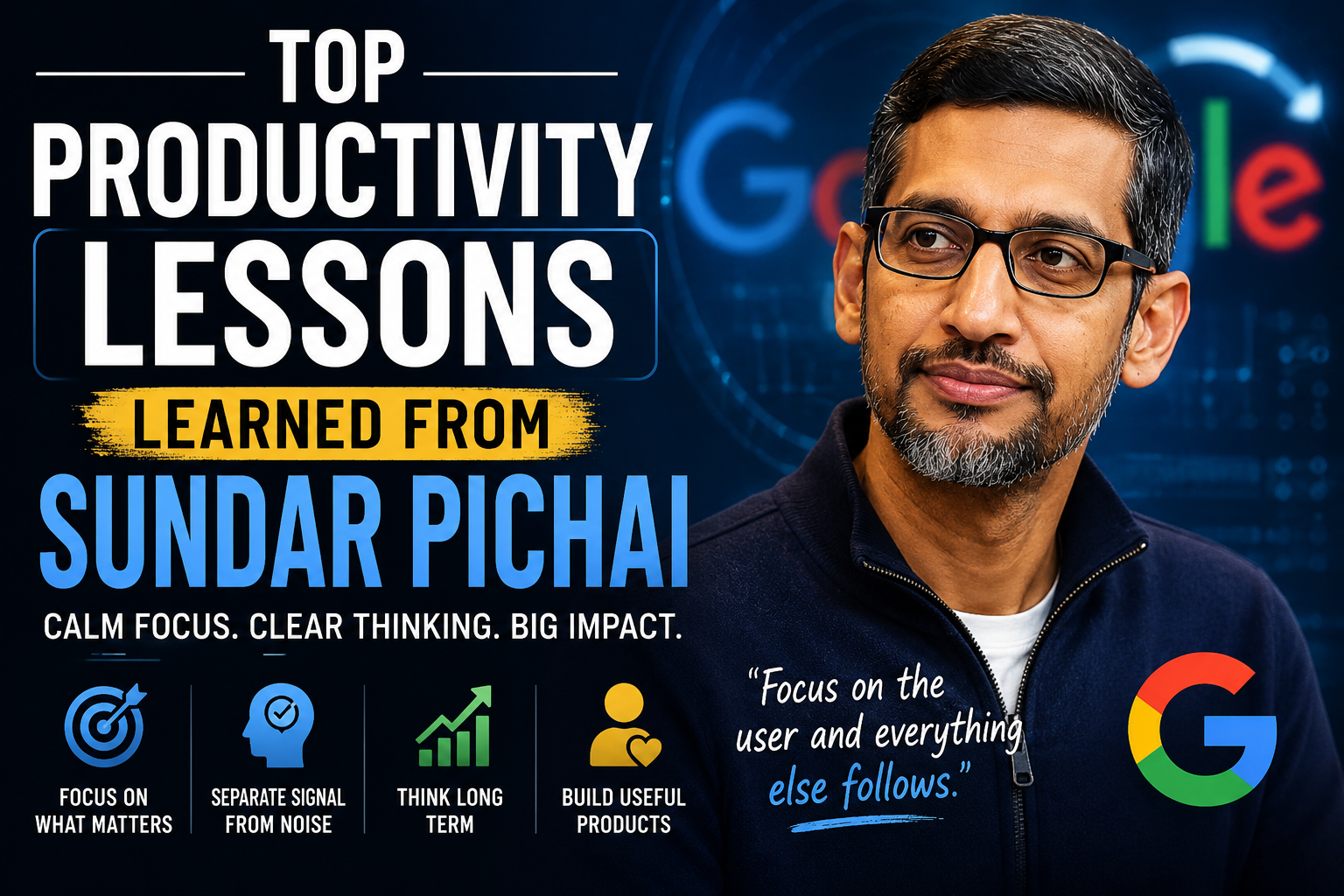
Sundar Pichai is usually discussed as the CEO of Google and Alphabet.
That makes sense. He leads one of the most important technology companies in the world, at a time when search, AI, browsers, cloud, mobile, productivity tools, and the web itself are changing fast.
But underneath the business story is a productivity story.
Pichai's career is not built around loudness. It is not built around constant public drama. It is built around calm execution, technical curiosity, long-term thinking, product focus, and the ability to separate signal from noise.
That is useful even if you do not run a company.
If you are building a product, growing a business, freelancing, managing a team, or trying to work better in a chaotic digital world, there are practical lessons to take from how Sundar Pichai thinks and leads.
Below are the most useful productivity lessons learned from Sundar Pichai.
1) Separate signal from noise
One of the clearest Pichai lessons is this:
Do not react to every loud opinion.
Pichai has discussed the pressure Google faced when people said the company was losing the AI race. His response was not panic. He has said he is good at tuning out noise, while still watching for real signals. He has also said leaders need to take useful feedback seriously, but separate it from external noise.
That is a huge productivity lesson.
Most people lose focus because they treat every comment, post, trend, metric, and notification as equally important.
They are not equally important.
Some feedback is signal.
Some feedback is noise.
Some criticism can improve your work.
Some criticism only distracts you.
Practical habit:
When something bothers you, ask:
- Is this signal or noise?
- Does this change the facts?
- Does this reveal a real problem?
- Or is it just emotional pressure?
A productive person does not ignore reality. But they also do not let every loud thing hijack the day.
2) Make the few decisions that actually matter
Pichai has said something very useful: many day-to-day decisions feel important, but most do not matter much over time. The leader's job is to make the few consequential decisions well.
That is productivity in one sentence.
Most people spend too much energy on small decisions:
- Which tool should I use?
- Which font looks better?
- Should this task go in this list or that list?
- Should I reply now or later?
- Should I rewrite this sentence again?
Small decisions matter sometimes. But they can also become hiding places.
The real question is:
What are the few decisions that would actually change the direction of my work?
Practical habit:
At the start of each week, write down:
- The one decision I am avoiding
- The one decision that would create clarity
- The one decision that affects everything else
Do not confuse movement with progress. Sometimes productivity starts with making the decision you keep postponing.
3) Stay calm, but be firm
Pichai is often described as calm and even-tempered. But calm does not mean passive.
He has talked about moments where people can disagree strongly, but eventually a clear decision has to be made. He has said people can disagree, but then they need to commit so the team can move. He has also said you can be calm and still be firm in the direction you choose.
That is an important lesson.
A lot of people confuse intensity with productivity.
They think being loud means being serious.
They think stress means they are working hard.
They think chaos means momentum.
But calm execution is often stronger than emotional execution.
Practical habit:
When a decision creates tension, use this sequence:
- Listen first.
- Clarify the options.
- Make the decision.
- Explain the reason.
- Move forward.
You do not need to turn every decision into drama.
4) Work on useful products, not just impressive ideas
Under Pichai's leadership, Google has focused on developing AI-powered products and services that help people in big and small moments.
That phrase matters: help people.
The best work is not always the most complex work.
It is the work that becomes useful.
Pichai's career includes products that became part of everyday digital life, especially Chrome. He helped lead Google Toolbar and then Google Chrome, which grew into the world's most popular internet browser.
The productivity lesson is simple:
Do not build for your ego.
Build for usefulness.
Practical habit:
Before working on a task, ask:
- Who does this help?
- What problem does it remove?
- Will someone actually use this?
- Is this useful, or just impressive?
Useful work compounds. Impressive but unused work disappears.
5) Think long term when others panic short term
Pichai's Google career has been shaped by long-term technology bets. He has said decisions made a decade earlier to make Google AI-first were critical, including investments in TPUs and AI infrastructure.
This is a classic productivity lesson:
The work that matters most often looks slow at first.
Building skill looks slow.
Writing articles looks slow.
Improving SEO looks slow.
Building a SaaS looks slow.
Creating a strong product looks slow.
Learning a difficult technology looks slow.
But the long-term advantage comes from staying with the right thing long enough.
Practical habit:
Separate your work into two categories:
- Short-term maintenance
- Long-term compounding
Maintenance keeps life running. Compounding changes your future.
Every week should include both.
6) Aim for ambitious work
When talking about Chrome and moonshots, Pichai has said ambitious work attracts strong people, gives you room to work on paths others avoid, and can still become a major success even if you only achieve part of the original goal.
That applies far beyond Google.
Most people choose goals that are too small because small goals feel safer.
But small goals can still consume your life.
If something is going to take years of effort, it should probably matter.
Practical habit:
Ask yourself:
- Is this goal big enough to be worth the effort?
- Will I still care about this in 3 years?
- Does this attract better thinking from me?
- Does this force me to grow?
Productivity is not only about doing tasks faster. It is also about choosing better goals.
7) Simplify the interface
When Pichai talked about Chrome, he explained that the browser had become clunky, and the idea behind Chrome was to make the web faster, safer, and simpler to use. Even the name came from wanting to minimize the "chrome" around the browser.
That is a perfect productivity lesson.
Your work environment has "chrome" too.
- Too many apps.
- Too many dashboards.
- Too many notifications.
- Too many folders.
- Too many labels.
- Too many systems around the actual work.
Sometimes productivity improves when you remove the interface around the work.
Practical habit:
Once a month, simplify your system:
- Remove unused tools.
- Archive old projects.
- Delete unnecessary recurring tasks.
- Reduce notifications.
- Keep the main work visible.
The best system is not the one with the most features. It is the one that helps you act.
8) Reward effort, not only outcomes
One of Pichai's recurring messages is to reward effort, not outcomes. The point is about innovation: as companies grow, they can become more conservative, so leaders need to make room for risk, failure, and serious attempts at difficult work.
This is very useful for personal productivity.
You cannot fully control outcomes.
You can publish and not get traffic.
You can pitch and not get a reply.
You can build a feature and not get adoption immediately.
You can work hard on something and still need another iteration.
If you only reward outcomes, you will quit too early.
But if you reward serious effort, learning, and consistency, you stay in the game long enough to improve.
Practical habit:
At the end of each week, review both:
- What worked?
- What effort deserves credit even if the result has not arrived yet?
This keeps you honest without destroying your motivation.
9) Combine patience with urgency
Pichai is connected to the idea that building a meaningful life, like building a world-class company, requires a marathon mindset rather than a sprint mindset.
That is one of the hardest productivity balances.
You need patience because meaningful work takes time.
But you also need urgency because time still matters.
Too much urgency creates anxiety.
Too much patience creates delay.
The balance is:
Be patient with the mission.
Be urgent with today's execution.
Practical habit:
Use this daily question:
What small action today supports the long-term direction?
That question keeps you moving without forcing everything to happen immediately.
10) Stay close to the real work
Pichai has mentioned that he routinely walks multiple times per week to the building where Google DeepMind researchers work, gets model updates, and looks at loss curves.
That detail is important.
Even as CEO, he stays close to the actual work.
That is a productivity lesson for founders, freelancers, and managers.
Do not become disconnected from the thing that creates value.
If you are a developer, stay close to the code.
If you are a designer, stay close to the user experience.
If you run a business, stay close to customers.
If you create content, stay close to what readers actually care about.
Practical habit:
Every week, spend time inside the core work, not only around it.
- Do the thing.
- Review the thing.
- Improve the thing.
- Talk to the people using the thing.
Productivity gets weaker when you only manage the work instead of understanding it.
11) Let curiosity keep you learning
Pichai's background is deeply technical. He studied engineering at IIT Kharagpur, earned a master's in materials science and engineering, and later earned an MBA.
The lesson is not that everyone needs the same education.
The lesson is that curiosity compounds.
People who keep learning keep adapting.
That matters even more now, because AI is changing how work is done.
The productive person in the next decade will not be the one who memorized one workflow.
It will be the one who can keep learning new workflows.
Practical habit:
Keep one learning track active at all times.
Not ten.
One.
- A technology.
- A business skill.
- A writing skill.
- A marketing skill.
- A management skill.
Make learning part of the weekly system, not something you only do when you panic.
12) Build for people, not just for the moment
Pichai often frames technology around its impact on people. He has talked about growing up with limited access to technology and seeing firsthand how technology could change daily life.
That is a useful final lesson.
Productivity should not only be about getting more done.
It should be about making better contributions.
A more productive developer builds better tools.
A more productive founder solves real problems.
A more productive writer creates clearer ideas.
A more productive team helps customers faster.
The point is not to become a machine.
The point is to do work that matters.
A Simple Sundar Pichai-Inspired Productivity Framework
If you want to turn these lessons into a practical system, use this framework.
Daily
- Pick the few tasks that actually matter.
- Ask what is signal and what is noise.
- Do one useful thing before reacting to the internet.
- Stay calm, but make clear decisions.
Weekly
- Review which work created real value.
- Separate effort from outcome.
- Remove distractions from your system.
- Stay connected to the core work.
Monthly
- Ask what is compounding.
- Ask what became too complicated.
- Ask which long-term bet still deserves patience.
- Ask which decision you need to make with clarity.
Quarterly
- Choose one ambitious direction.
- Define why it matters.
- Commit long enough to learn.
- Review based on evidence, not panic.
How to Apply This With SelfManager.ai
If you use a date-based productivity system, the Pichai lessons fit naturally.
Signal vs. noise:
Use daily planning to decide what deserves attention before the day gets hijacked.
Long-term bets:
Use weekly, monthly, and quarterly reviews to see whether your work is compounding.
Useful work:
Keep tasks connected to real outcomes, not just busy activity.
Calm execution:
Use each date as a clean surface for the work that matters today.
Learning:
Track what you tried, what worked, what failed, and what should improve next.
The deeper lesson from Sundar Pichai is not just "work harder."
It is to think clearly in noisy moments.
Stay close to useful work.
Make the few decisions that matter.
And keep building patiently, even when the outside world is loud.
Date-based AI Task Manager
Plan smarter, execute faster, achieve more
Create tasks in seconds, generate AI-powered plans, and review progress with intelligent summaries. Perfect for individuals and teams who want to stay organized without complexity.
Get started with your preferred account