
Top Productivity Lessons Learned From Bill Ackman: Focus, Research, and Conviction
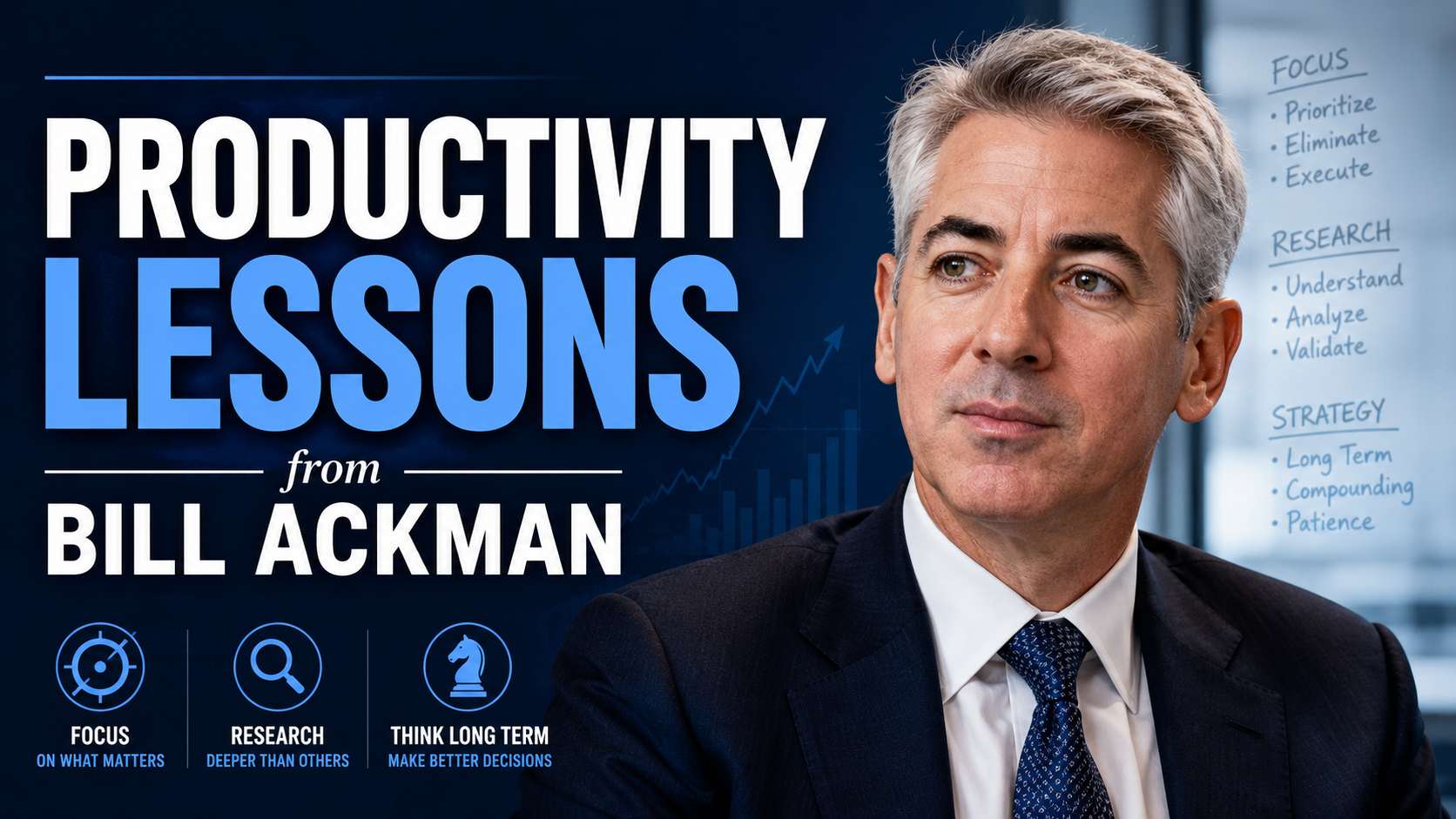
Bill Ackman is usually discussed as an investor.
That makes sense. He is the founder and CEO of Pershing Square, an investment firm known for concentrated, long-term positions in high-quality businesses. The approach focuses on simple, predictable, free-cash-flow-generative companies with strong balance sheets, durable advantages, and exceptional management.
But underneath the investing story is a productivity story.
Ackman's work is not built around doing thousands of things. It is built around filtering aggressively, thinking deeply, concentrating effort, managing risk, and staying patient long enough for the work to compound.
That is useful even if you never buy a stock.
This article is not about copying a billionaire investor's life. It is about extracting a few practical productivity lessons you can apply if you run a business, build a product, manage a team, freelance, or simply want to be more intentional with your days.
Below are the most useful productivity lessons you can learn from Bill Ackman.
1) Use strong filters before you commit your time
One of the clearest Ackman lessons is this:
Do not evaluate everything equally.
Pershing Square's investment criteria are strict. The firm looks for businesses that are simple, predictable, durable, financially strong, and capable of generating long-term value. It prefers companies with predictable cash flows, strong competitive positions, limited exposure to factors outside their control, and strong management.
That is a productivity lesson.
Most people do the opposite. They say yes too easily. They start too many projects. They keep too many tabs open, too many ideas active, and too many priorities alive at the same time.
The result is not ambition. It is dilution.
Before you commit time to something, use filters.
Ask:
- Is this important?
- Is this aligned with where I want to go?
- Can I actually influence the outcome?
- Will this matter in 3 months?
- Is this worth deep work, or is it just noise?
Practical habit:
Create a personal "yes filter." Before taking on a new project, write down 3 to 5 criteria it must pass.
2) Concentration beats scattered effort
Ackman is known for concentration. Pershing Square does not try to own hundreds of tiny positions. Its strategy is built around meaningful stakes in a limited number of companies. The goal is to acquire long-term, large minority stakes in 12 to 15 high-quality companies.
That idea translates perfectly to productivity.
You do not need 30 priorities.
You need a few priorities that actually matter.
Most productivity problems come from too much active surface area:
- Too many projects.
- Too many tools.
- Too many goals.
- Too many "important" tasks.
- Too many half-started ideas.
The more scattered your attention becomes, the less power each action has.
Concentration creates force.
Practical habit:
At the start of each week, choose your "top 3 positions":
- The main project that deserves deep work
- The main maintenance area you cannot ignore
- The main personal priority that keeps you stable
Everything else is secondary.
3) Do deep research before big decisions
Ackman's investing style is research-heavy. Pershing Square uses a concentrated, research-intensive, fundamental value investing strategy, where concentration and lower turnover allow the manager to spend time researching and monitoring each investment.
That is a lesson most people ignore.
They confuse fast decisions with good decisions.
Some decisions should be fast. But important decisions deserve research.
Choosing a business model, hiring someone, changing your pricing, switching platforms, building a major feature, moving to another city, or committing to a long-term project should not be treated like clearing an email.
Deep research saves future chaos.
Practical habit:
Before any major decision, create a one-page research note:
- What is the decision?
- What are the options?
- What are the risks?
- What facts do I know?
- What assumptions am I making?
- What would make me change my mind later?
This turns vague thinking into structured thinking.
4) Stop working on things that are too hard to understand
Ackman has repeatedly emphasized simplicity and predictability as part of the investment process. He has explained that if a business is too complex, it becomes difficult to predict future cash flows, which makes it difficult to know what the business is worth.
That is not only an investing idea.
It is a life and productivity idea.
Some projects are not hard because they are valuable. They are hard because they are unclear.
A messy project creates messy execution.
A vague goal creates vague effort.
A complicated system creates avoidance.
When something is too hard to understand, simplify it before you work on it.
Practical habit:
Before starting a task, reduce it to one sentence:
"I am trying to accomplish ___ by doing ___."
If you cannot explain it simply, you are not ready to execute.
5) Think long term, but act in focused cycles
Pershing Square is built around long-term value creation. The firm operates as a long-term investor that generally holds investments for multiple years instead of trading around short-term movements.
That is a powerful productivity model.
Long-term thinking gives you direction.
Short-term cycles give you execution.
Most people fail because they only have one of the two.
They either dream long term and never execute, or they execute daily without knowing where they are going.
You need both.
Practical habit:
Use this structure:
- Yearly direction: What am I building toward?
- Quarterly theme: What is the main area of progress?
- Weekly plan: What needs to move now?
- Daily execution: What must happen today?
This keeps your work connected without making every day feel heavy.
6) Ignore short-term noise when the thesis is still valid
Ackman has said Pershing Square does not focus on predicting next quarter's earnings. Instead, the focus is on what a business is worth over its life, while markets often overreact to short-term information and noise.
That is one of the best productivity lessons in the whole Ackman playbook.
Most people overreact to short-term noise.
One bad day, and the system is broken.
One low-performing post, and the strategy is dead.
One difficult week, and the goal feels impossible.
One slow month, and the business idea suddenly looks bad.
But short-term feedback is not always truth. Sometimes it is just noise.
Practical habit:
Before changing strategy, ask:
Did the core thesis fail, or did I just have a bad week?
If the thesis is still valid, keep going.
7) Protect the downside
Ackman is also known for thinking about downside protection. Pershing Square uses asymmetric hedges to protect the portfolio against specific macroeconomic risks and potentially benefit from volatility.
For productivity, this means:
Do not only plan for perfect days.
Plan for bad days too.
A fragile productivity system only works when your energy is high, your calendar is clean, and nothing unexpected happens.
A strong productivity system works even when life is messy.
Practical habit:
Create downside protection in your week:
- Leave buffer time.
- Keep one lighter day.
- Have a minimum version of important habits.
- Do not schedule every hour.
- Know what can be delayed before the week gets chaotic.
The best productivity systems are not the ones that look perfect on Monday morning. They are the ones that survive Thursday afternoon.
8) Learn from mistakes without turning them into identity
Ackman has had major wins, but also very public mistakes. One of the most discussed was Pershing Square's Valeant investment. Ackman publicly called the investment a huge mistake, took responsibility, and reflected on lessons around management reliance, regulation, politics, and other uncontrollable factors.
That matters.
A lot of people do not really review mistakes. They either ignore them or turn them into shame.
Neither helps.
The useful path is:
- Own the mistake.
- Extract the lesson.
- Update the system.
- Move forward.
Productivity improves when mistakes become information.
Practical habit:
At the end of each week, ask:
- What did I get wrong?
- Was it a planning mistake, an execution mistake, or an assumption mistake?
- What rule should I update because of it?
This turns failure into better operating logic.
9) Make fewer decisions, but make them better
A concentrated strategy forces better decisions.
When you only make a few big bets, you cannot hide behind volume. Each decision matters more. That pressure creates discipline.
This applies directly to daily work.
If you have 25 priorities, you can avoid the truth. You can stay busy all day and never ask whether the work mattered.
If you have 3 priorities, the truth is obvious.
You either moved them forward or you did not.
Practical habit:
Start your day with one question:
"What decision today would make the rest of the day clearer?"
Sometimes productivity is not about doing more tasks. It is about making the one decision that removes confusion.
10) Work where your effort can actually change the outcome
Pershing Square favors businesses with limited exposure to extrinsic factors that cannot be controlled.
That is a very underrated productivity idea.
Do not spend your best energy on things you cannot influence.
You cannot control the algorithm.
You cannot control whether someone replies.
You cannot control the market.
You cannot control every client, competitor, or external event.
But you can control inputs.
You can control research quality.
You can control publishing cadence.
You can control product quality.
You can control follow-up.
You can control how quickly you learn.
Practical habit:
When you feel stuck, split the problem into two columns:
- Things I control
- Things I do not control
Then plan only from the first column.
11) Build conviction slowly, then execute decisively
Ackman's style is not random action. It is research, filtering, analysis, and then conviction.
That is the right order.
Many people reverse it. They act quickly, then try to justify the decision later. Or they keep researching forever and never act.
The useful pattern is:
- Research deeply.
- Define the thesis.
- Commit for a meaningful period.
- Review with evidence.
Practical habit:
For important goals, write a short thesis:
- I believe this is worth doing because ___.
- The evidence is ___.
- The main risk is ___.
- I will commit to it until ___.
- I will review it based on ___.
This gives you structure without trapping you forever.
12) Let compounding do its work
The biggest lesson from investors is usually the simplest one:
Compounding takes time.
The same is true in productivity.
One planned day does not change your life.
One weekly review does not transform your business.
One focused work session does not build the product.
But repeated over months and years, small improvements become large differences.
That is why your productivity system should not be designed for excitement. It should be designed for repeatability.
Practical habit:
Stop asking, "What can I do today that feels impressive?"
Ask, "What can I repeat for 90 days?"
That is where compounding starts.
A Simple Bill Ackman-Inspired Productivity Framework
If you want to turn these lessons into something practical, use this framework.
Daily
- Choose 1 to 3 priorities.
- Start with the task that requires the most thinking.
- Avoid reacting to noise before doing meaningful work.
- Write down the assumption behind your most important task.
Weekly
- Review what created value.
- Review what wasted attention.
- Look at the mistakes without emotion.
- Update your rules for the next week.
- Keep only the priorities that still deserve focus.
Monthly
- Ask what is compounding.
- Ask what is too complex.
- Ask what should be cut.
- Ask where you need deeper research before continuing.
Quarterly
- Pick one major direction.
- Define the thesis.
- Commit long enough to learn.
- Review based on evidence, not mood.
How to Apply This With SelfManager.ai
If you use a date-based productivity system, these Ackman-inspired lessons fit naturally into daily and weekly planning.
Concentration:
Use each day to focus on the few tasks that actually matter instead of carrying a huge floating task list.
Research:
Keep notes, assumptions, links, and context attached to the date or table where the work happens.
Conviction:
Use weekly and monthly reviews to see whether your strategy is still valid or whether you are just reacting to noise.
Downside protection:
Plan lighter days, buffer time, and minimum versions of important habits.
Learning from mistakes:
Use your history of completed, delayed, and unfinished tasks to improve how you plan the next week.
A good productivity system does not just help you do more.
It helps you think better, choose better, and stay consistent long enough for your effort to compound.
Date-based AI Task Manager
Plan smarter, execute faster, achieve more
Create tasks in seconds, generate AI-powered plans, and review progress with intelligent summaries. Perfect for individuals and teams who want to stay organized without complexity.
Get started with your preferred account