Top Productivity Lessons Learned From Mark Zuckerberg: Speed, Focus, and Founder Mode
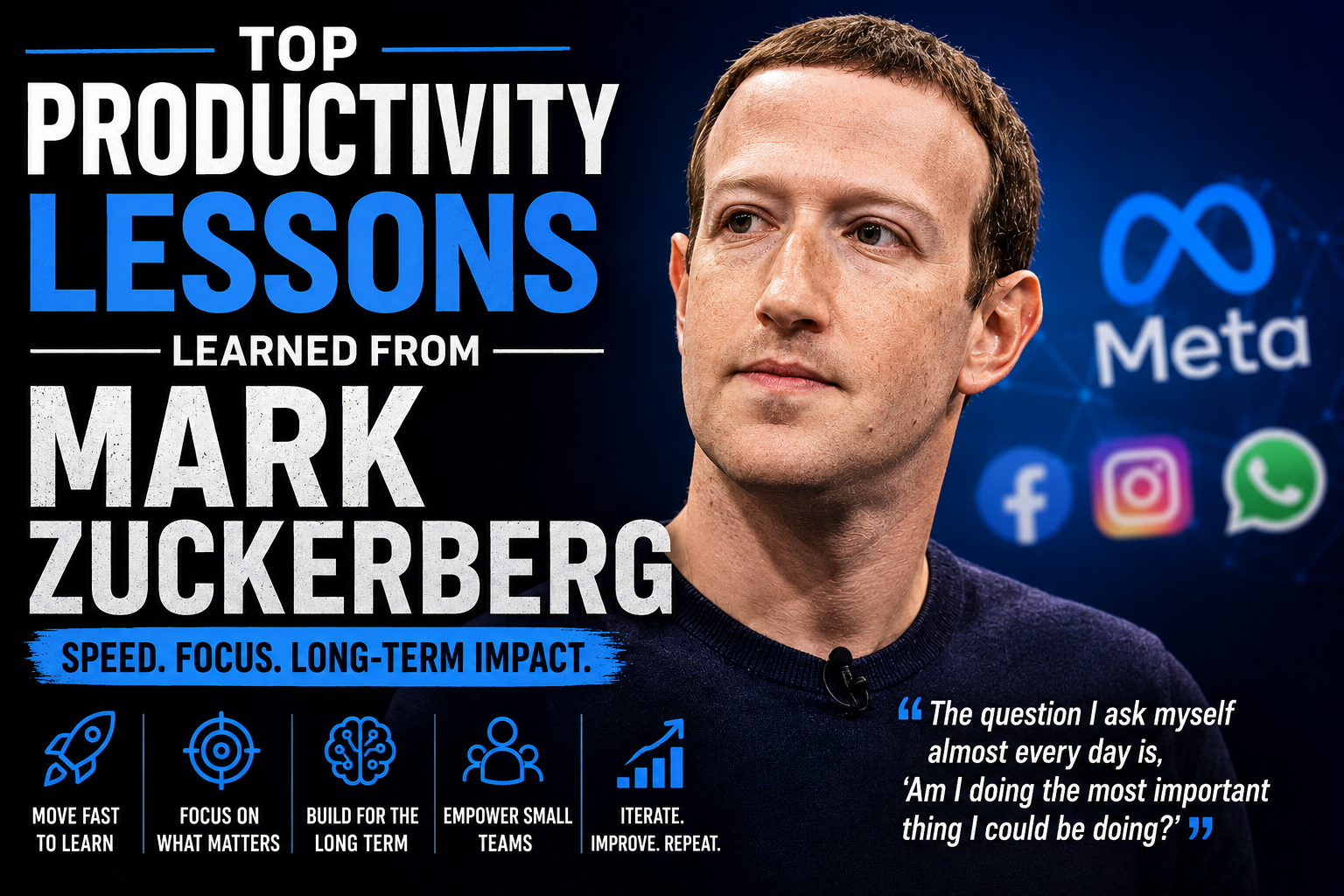
Mark Zuckerberg is usually discussed as the founder of Facebook and CEO of Meta.
That makes sense. He started Facebook in 2004, scaled it into one of the largest technology platforms in the world, and later rebranded the company to Meta as it expanded beyond Facebook into Instagram, WhatsApp, Threads, virtual reality, AI, and the broader future of digital interaction.
But underneath the business story is a productivity story.
Zuckerberg's career is built around speed, product obsession, long-term bets, technical leverage, and a willingness to keep rebuilding the company around the next platform shift.
That does not mean every part of his style should be copied.
Some of Meta's decisions have been controversial. Some bets have been expensive. Some products have changed society in ways people still debate.
But from a productivity perspective, there are useful lessons to extract.
This article is not about worshipping Mark Zuckerberg.
It is about studying the operating principles behind one of the most influential founder-CEOs in technology and asking:
What can a normal builder, freelancer, founder, creator, or team learn from this?
Below are the most useful productivity lessons learned from Mark Zuckerberg.
1) Move fast enough to learn
The most famous Zuckerberg productivity idea is speed.
For years, Facebook was associated with the phrase "move fast and break things." The modern version is more balanced, but the deeper lesson still matters: speed creates learning.
Most people move slowly because they want certainty before action.
But certainty usually comes after action.
You do not learn much by endlessly thinking about a product.
You learn by shipping.
You do not learn much by keeping an idea in a notebook.
You learn by testing it.
You do not learn much by rewriting the same draft forever.
You learn by publishing and seeing what happens.
Speed is not about being careless. It is about reducing the time between idea, action, feedback, and improvement.
Practical habit:
For every important project, ask:
What is the smallest version I can ship this week?
- Not the perfect version.
- Not the final version.
- The smallest version that creates real feedback.
2) Stay close to the product
Zuckerberg is responsible for setting the overall direction and product strategy of Meta. He also leads the design of Meta's services and the development of its core technology and infrastructure.
That is important.
Zuckerberg is not only a financial CEO. He is a product CEO.
He stays close to the thing that creates value.
That is a huge productivity lesson for founders, freelancers, developers, designers, and creators.
As your work grows, it is easy to drift away from the core work.
You spend more time managing tools than building.
More time talking about strategy than testing.
More time checking analytics than improving the product.
More time reacting than creating.
But the core work is where leverage comes from.
Practical habit:
Every week, schedule time for the thing that directly improves the product, service, or output.
- Not planning the work.
- Not talking about the work.
- Doing the work.
3) Use constraints to increase speed
Big teams can become slow.
- More meetings.
- More approval layers.
- More internal politics.
- More status updates.
- More people needed to make every decision.
In 2023, Zuckerberg announced Meta's "Year of Efficiency," saying the goals were to make Meta a better technology company and improve financial performance so the company could execute its long-term vision.
That is a productivity lesson.
Growth creates complexity.
Complexity creates drag.
Drag kills speed.
The solution is not always to add more people, more tools, or more process.
Sometimes the solution is to simplify.
Practical habit:
When a project feels slow, ask:
- Where are the approval layers?
- Where are the unnecessary handoffs?
- Where are we waiting instead of doing?
- Where did the team become too large for the task?
Speed often improves when the system becomes smaller and clearer.
4) Cut work that does not support the mission
The "Year of Efficiency" was not just about cost cutting. Zuckerberg framed it as a way to make Meta more effective and able to execute its long-term vision.
That distinction matters.
Productivity is not only about doing more.
It is also about removing what no longer fits.
A project may have been useful last year and unnecessary this year.
A tool may have helped at one stage and slowed you down later.
A meeting may have made sense when the team was smaller and become pointless as the company changed.
A goal may have mattered before the strategy shifted.
You cannot keep everything forever.
Practical habit:
Once a month, review your active work and ask:
- What no longer supports the mission?
- What are we doing because we started doing it, not because it still matters?
- What should be stopped?
Stopping is a productivity skill.
5) Think in platforms, not only tasks
Zuckerberg's biggest bets are usually platform bets.
Facebook was a social platform.
The mobile shift turned Facebook into a mobile-first company.
Instagram and WhatsApp became major parts of Meta's family of apps.
The rebrand to Meta reflected a bet on immersive social experiences beyond 2D screens.
More recently, Meta has made major AI and open-source AI bets. Zuckerberg has argued that open-source AI is good for developers, good for Meta, and good for the world, and that it can become a long-term development platform.
The productivity lesson is this:
Do not only think about today's task.
Think about the platform your work is building.
A single article is a task.
A content library is a platform.
A single client project is a task.
A repeatable service process is a platform.
A single feature is a task.
A product system is a platform.
A single habit is a task.
A daily operating system is a platform.
Practical habit:
For every repeated task, ask:
- Can this become a system?
- Can this become a template?
- Can this become an asset?
- Can this become a process that compounds?
Tasks finish.
Platforms compound.
6) Bet long term, even when the market doubts you
Zuckerberg is willing to make long-term bets that attract criticism.
The Meta rebrand and metaverse investment were heavily debated.
The AI infrastructure and open-source AI strategy also became major strategic bets.
Whether each bet works exactly as planned is not the point here. The productivity lesson is that meaningful work often requires a thesis that survives short-term doubt.
If you change direction every time people criticize the work, you will never build anything substantial.
But if you ignore all feedback, you can become stubborn in the wrong direction.
The balance is:
- Listen to feedback.
- Review the evidence.
- Keep the long-term thesis clear.
- Do not panic just because the market is impatient.
Practical habit:
For each major goal, write down:
- What do I believe?
- Why do I believe it?
- What evidence would prove me wrong?
- How long will I give this before I review it?
This separates conviction from ego.
7) Simplify teams so builders can build
One of the strongest ideas from Meta's efficiency push was that flatter, leaner teams can move faster.
That applies directly to smaller businesses too.
Even a solo founder can create fake bureaucracy.
- Too many planning documents.
- Too many tools.
- Too many dashboards.
- Too many "systems" before the product is good.
- Too many meetings with yourself.
- Too much optimization before shipping.
Teams do not become productive by adding endless process.
They become productive when the people doing the work have enough clarity to move.
Practical habit:
Before adding a new process, ask:
- Will this help people build faster?
- Will this reduce confusion?
- Will this improve quality?
- Or will it only create more reporting?
Process should support work, not replace it.
8) Use AI as leverage, not decoration
Meta has moved aggressively into AI, including open-source AI and AI infrastructure. Zuckerberg has argued that open-source AI gives developers more freedom to customize, train, fine-tune, and build without being locked into one closed provider.
That is relevant to productivity now.
AI should not just be something you use because it is trendy.
It should increase leverage.
A good AI workflow helps you:
- Summarize faster.
- Plan better.
- Generate first drafts.
- Analyze feedback.
- Explore options.
- Automate repetitive work.
- Think through tradeoffs.
But AI is not a replacement for judgment.
It is leverage for people who know what they are trying to do.
Practical habit:
Pick one repeated task this week and ask:
How could AI make this faster, clearer, or easier to review?
Do not redesign your whole workflow at once.
Start with one useful leverage point.
9) Measure output, not appearance
A founder-led product culture usually cares about what shipped, what improved, what grew, and what users actually did.
That is useful because many people confuse productivity with appearance.
A full calendar looks productive.
A long task list looks productive.
Many meetings look productive.
Working late looks productive.
But appearance is not output.
Output is what changed because of your work.
- A bug was fixed.
- A page was published.
- A customer was helped.
- A product improved.
- A feature shipped.
- A decision was made.
- A system became clearer.
Practical habit:
At the end of each day, ask:
What actually changed today?
If the answer is "I was busy," that is not enough.
10) Keep rebuilding your identity as the work changes
Zuckerberg has had several public versions:
- Harvard founder.
- Facebook CEO.
- Mobile-era platform leader.
- Meta/metaverse CEO.
- AI-era infrastructure and open-source AI competitor.
You do not need to like or agree with every version to learn the lesson.
Work changes.
Markets change.
Technology changes.
The person who refuses to evolve gets stuck.
A productivity system should not freeze you in one identity forever.
What worked when you were starting may not work when you are scaling.
What worked as a freelancer may not work as a founder.
What worked as a solo builder may not work when you have a team.
What worked before AI may not be enough after AI.
Practical habit:
Every quarter, ask:
- What version of my work am I in now?
- What habits no longer fit?
- What skills do I need next?
- What old identity am I protecting?
Growth requires identity updates.
11) Build things people actually use
Meta's products are controversial, but they are also widely used. That matters for the productivity lesson.
A product does not matter because the founder thinks it is interesting.
It matters when people use it.
The same applies to your work.
A website matters when customers understand it.
A feature matters when users adopt it.
An article matters when readers get value from it.
A service matters when the client's problem is solved.
A productivity system matters when you actually return to it tomorrow.
Practical habit:
Before polishing something, ask:
Is this already useful?
If not, make it useful before making it beautiful.
12) Founder mode means responsibility, not chaos
"Founder mode" can be misunderstood.
It does not mean micromanaging everything.
It does not mean ignoring everyone.
It does not mean creating chaos because you have strong opinions.
The useful version of founder mode means staying close to the mission, product, users, and core decisions.
It means not outsourcing judgment.
It means caring enough to understand the details.
It means being willing to make hard decisions when the work drifts.
Zuckerberg's role at Meta is built around company direction, product strategy, services design, and core technology and infrastructure.
That is the lesson.
Founder mode is not about ego.
It is about ownership.
Practical habit:
Ask yourself:
Where have I outsourced responsibility that I should still understand?
Then get closer to that area.
Not to control everything.
To make better decisions.
A Simple Mark Zuckerberg-Inspired Productivity Framework
If you want to apply these lessons, use this framework.
Daily
- Ship something small.
- Stay close to the core work.
- Measure what changed, not how busy you felt.
- Use AI for one repeated task.
- Avoid fake productivity.
Weekly
- Review what shipped.
- Review what users, clients, or readers actually responded to.
- Remove one unnecessary process.
- Simplify one workflow.
- Choose the one platform-building activity that compounds.
Monthly
- Cut work that no longer supports the mission.
- Review whether your team or system has become too complex.
- Look for one process that can become a reusable asset.
- Check whether your long-term thesis is still valid.
Quarterly
- Ask what platform shift affects your work.
- Choose one ambitious direction.
- Update your operating system for the next stage.
- Decide what old identity you need to outgrow.
How to Apply This With SelfManager.ai
Mark Zuckerberg's productivity lessons fit well inside a date-based productivity system.
Speed:
Use each day to move one important thing forward instead of endlessly preparing.
Product obsession:
Keep product work, customer feedback, and improvement ideas connected to the actual dates when they happen.
Efficiency:
Use weekly reviews to identify what is slowing you down.
Long-term bets:
Use monthly and quarterly reviews to track whether your work is compounding or just staying busy.
AI leverage:
Use AI summaries, reviews, and planning to understand your work faster, but still make the final judgment yourself.
The deeper lesson from Mark Zuckerberg is not simply "move fast."
It is:
- Move fast enough to learn.
- Stay close enough to the product to notice what matters.
- Cut enough complexity to keep executing.
- And think long term enough that your daily work compounds into something bigger.
Date-based AI Task Manager
Plan smarter, execute faster, achieve more
Create tasks in seconds, generate AI-powered plans, and review progress with intelligent summaries. Perfect for individuals and teams who want to stay organized without complexity.
Get started with your preferred account