Productivity apps are finally growing up: what Q2 AI tells us about where the category is going
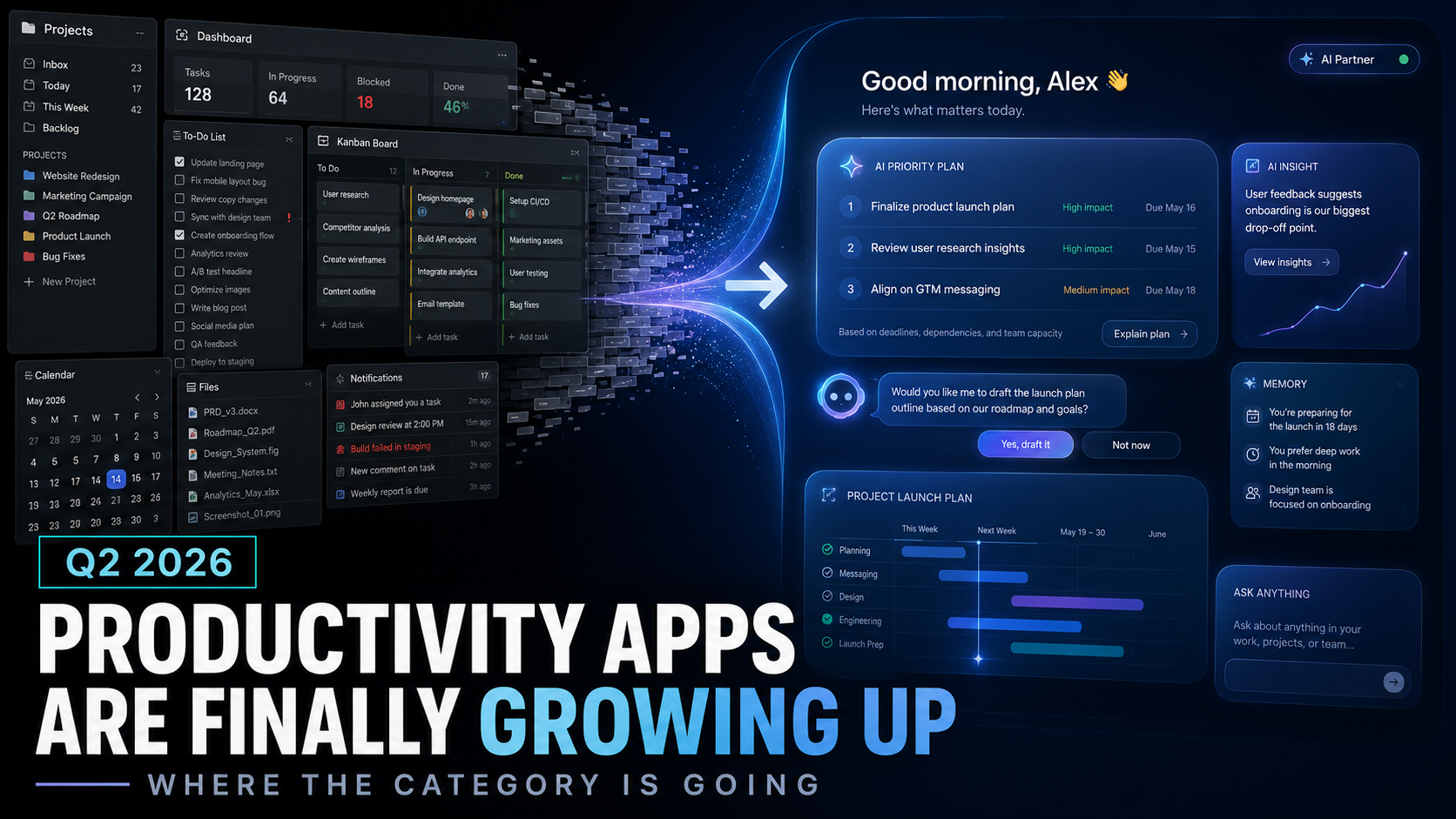
Productivity software spent ten years getting prettier and almost no years getting smarter.
You typed, it stored. You categorized, it sorted. You came back every day and did the work of keeping the system honest, because the system itself was a polite assistant that could not actually help. Most of the value you got from your productivity app was value you brought to it. The app was a filing cabinet with a nice font and a subscription fee.
That was the unspoken contract: you do the thinking, we do the storing.
Q2 of 2026 is the moment that contract broke.
Not loudly. There was no single keynote, no big bang. Just a steady accumulation of shifts that, taken together, mark the most meaningful change in this category since the smartphone arrived. Apps stopped being passive. They started thinking with you. The dashboard era is closing and something more useful is opening in its place.
This is not the AI hype cycle of 2023. That was features bolted onto old assumptions. Q2 is structural. The assumptions themselves are changing.
The interesting part is not that AI got better. AI getting better was always going to happen. The interesting part is that productivity software finally figured out what to do with it. For three years, the category responded to AI by sticking chat boxes on top of legacy products. Q2 is when the more thoughtful teams stopped doing that and started rebuilding the underlying assumptions of the product.
This piece is about what those new assumptions are, why they matter, what signals to watch, and where the category is heading over the next 18 months. If you build productivity software, this is the map. If you use it, this is the lens for picking what is actually worth your time.
The before: ten years of passive software
To see what changed, it helps to be honest about what came before.
The dominant productivity tools of the last decade were built around a single design idea: the human is the engine, the app is the filing system. You captured tasks. You organized projects. You ran your own reviews. You connected the dots. The software's job was to remember on your behalf and surface things on demand.
This worked well enough when the alternative was a paper notebook. It worked badly the moment your life moved faster than your ability to keep the system updated.
The dirty secret of productivity software in the 2010s and early 2020s was that most people abandoned their system within a few weeks. The apps were sophisticated. The users were exhausted. The labor of feeding the tool outpaced the value of using it.
We dressed this up as a personal failing. "I am just bad at sticking with systems." That story was convenient for the software companies. It also let us avoid the obvious answer, which was that the tools were demanding work the user should not have had to do.
There was a logic to the design philosophy of that era. Computing power was limited. Natural language understanding was clumsy. Anything that required the software to interpret the world reliably was a moonshot. So products were built to be neutral containers. Tag your own data. Build your own views. Maintain your own systems. The app was a stage and you were the production team, the director, and the lead actor.
This produced a particular kind of user experience: powerful for the small number of people who built and maintained custom systems, and frustrating for the majority who just wanted the tool to help them get on with their lives. The same product that made one person feel in control made another feel buried.
You can see this if you look at adoption curves for any major productivity app from that decade. Sharp initial spike, steep dropoff, long tail of power users. Most of the people who tried it never got value from it. Not because they were lazy. Because the product asked too much.
The promise of those apps was always the same. Build the system, escape the chaos, become productive. The delivery rarely matched the promise. People kept trying because the underlying need was real. Most kept failing because the tools were not designed for how human attention actually works.
That is the world Q2 broke.
The Q2 turning point: what actually changed
Several things shifted at once. None of them are revolutionary in isolation. Together they cross a threshold.
Models got reliable enough at long-context reasoning that productivity apps could finally hold the full picture of your work in their head, not a paragraph of it. Memory stopped being a gimmick and became a default. Agent capabilities matured to the point where apps could actually finish things, not just suggest them. Voice and ambient inputs became practical, which means capture stopped being a typing problem. And design philosophy started catching up with what the models could do, which meant we stopped pretending a chat box bolted onto a kanban board was the future.
Each of these alone would be interesting. Together they change what a productivity app is for.
The cumulative effect is a category that, for the first time, is built to do the thinking with you rather than store the output of your thinking after the fact.
Pick up a serious Q2 productivity app and you will notice it does not feel like software. It feels like a colleague who has been paying attention. That is the line that got crossed.
Once an app feels like a colleague, the design rules of the last decade stop making sense. You do not open a colleague. You do not browse a colleague. You do not drag a colleague's tasks between columns. You ask. You discuss. You decide together. The interface gets quieter and the relationship gets louder.
There is also a generational shift in the teams building these tools. The founders shipping the most interesting Q2 launches came up after AI was already a given. They did not have to retrofit. They got to design around the assumption that the model could think.
That assumption changes everything about how the product gets built. Information architecture, onboarding, retention, even pricing.
This is the real shift. Everything else is a downstream consequence.
Five signals that tell us where this is going
If you watch the category closely, five signals stand out. None of them are subtle anymore. All of them point in the same direction. Together they form the rough shape of the next phase.
1. Apps are moving from "do this for me" to "think this through with me"
The first wave of AI in productivity was about delegation. Write my email. Summarize my doc. Plan my day. Useful, but shallow. The user offloaded a task and got a task back. The mental model was AI as personal assistant. Fast. Cheap. Available. But fundamentally a servant role.
Q2 made it clear that the real value is not doing things for the user. It is helping the user think.
The most interesting tools now ask questions before they answer them. They surface tradeoffs. They reflect patterns back. They notice when your stated priorities and your actual behavior have drifted apart, and they say so.
This is a different product than an AI assistant. It is an AI thinking partner. The design implications are huge, because thinking partners need to know you, remember you, and be willing to disagree with you. None of those are features. They are posture.
A thinking partner can say: "You said this mattered most, and you spent zero hours on it this week. What happened?" A servant cannot. A servant just executes. The shift from servant to partner is the shift from being useful in the moment to being valuable over time.
The implication for users is that the apps worth paying for in the next year will be the ones that earn the right to push back. Sycophantic AI is comfortable. It is also a dead end. The apps that grow up are the ones that develop a point of view about your work.
The implication for builders is that productivity AI can no longer be a thin layer. The product has to hold opinions. It has to surface things you did not ask about. It has to risk being wrong. Anything less and you are back in servant territory, which is now a commodity.
2. Memory is becoming the core feature, not a side feature
For a long time, memory in AI products meant remembering your name and your timezone. Q2 made it obvious that real memory is a different category entirely.
The apps pulling ahead are the ones that hold context across weeks and months. They remember which projects matter, which people you actually owe responses to, which kinds of work drain you, which patterns you keep falling into. They use that memory to make every interaction smarter than the last.
This compounds. An app that has been paying attention to you for six months is a fundamentally different product than the same app on day one. The first interaction is generic. The hundredth is personalized in ways no settings panel could replicate.
Memory is also the moat. Features are easy to copy. A six-month relationship is not. This changes the strategic math of the category. For a decade, the way to compete was to ship faster than the incumbent. In the memory era, the way to compete is to start earlier.
There is a privacy story here too, and it is not the one people assume. The intuitive concern is that memory means surveillance. The actual experience for users is that good memory feels respectful, not intrusive. When an app remembers what you care about, it asks you fewer dumb questions. It stops bothering you with things it should already know. It becomes a more dignified collaborator.
Memory is also where the line between productivity software and personal AI starts to blur. A tool that knows what you have been working on for six months is, in effect, an ongoing partner in your life. The category labels get fuzzier from here.
3. The productivity stack is collapsing
For most of the last decade, getting your work life together required a stack. Tasks here. Calendar there. Notes somewhere else. Habits in a fourth app. A journaling tool in a fifth. A reviewing system you built yourself with a sixth.
The stack was a workaround for the limitations of the tools. No single app was smart enough to handle the full picture, so you stitched together a messy system and called it your workflow. Then you spent hours every week maintaining the integrations, copying things between tools, and pretending the resulting setup was working.
Q2 made it visible that a unified system is no longer a fantasy. AI is finally good enough to handle tasks, planning, reviews, habits, and reflection inside one coherent product without it feeling overloaded. The pressure on multi-app stacks just got real. They were a workaround. The workaround is becoming unnecessary.
This does not mean every app gets replaced. It means the era of opening five tools to get one thing done is ending. The economics of paying for five subscriptions to do the work one well-built system can do will not survive contact with users who have tried the alternative.
The specialist tools that survive will survive by being so good at one specific job that no unified system can match them. Calendar apps will probably make it. So will some niche professional tools. But the broad middle of the category, the apps that do tasks plus notes plus a bit of everything, is heading for trouble.
For users this is good news. For legacy players who built their business model around being the central hub of a stack, it is an awkward few years.
4. The interface is getting quieter
For a decade, the trend was more dashboards, more views, more configurable everything. The user was the integrator. The app was surface area.
Q2 reversed this. The best new productivity products show you less, not more. They surface what matters now and stay out of the way otherwise. The chrome is shrinking. The conversation is growing.
This is uncomfortable for legacy apps because their whole design language was built around feature density. Features were proof of value. The more buttons, the more enterprise-ready you looked. Now feature density is starting to look like noise. The new norm is closer to a calm, intelligent companion than a control panel.
You are going to see a lot of apps try to make this transition. Most will not, because it is not a redesign. It is a different product. You cannot ship calm by hiding buttons. Calm comes from the underlying intelligence being good enough that the buttons are not needed in the first place.
There is a deeper point here about attention. Legacy productivity software competed for attention. The more time you spent in the app, the more the company won. The new generation is competing for trust. The more confidently you can ignore the app and trust it to handle things, the more valuable it becomes.
The interfaces that win the next phase will be the ones that take attention seriously. The product that takes the least of your attention to deliver the most value wins. That is a metric most current apps do not even measure.
5. Apps are starting to care about who you are becoming, not just what you finished
This one is the most important and the easiest to miss.
The old metric was completion. Tasks done, projects shipped, hours logged. The new generation of productivity tools is starting to track something deeper: are you actually moving toward the life you said you wanted?
This sounds soft. It is not. It is the first time productivity software is even attempting to measure the thing that actually matters. The behavior changes that follow are not subtle. When the tool reflects your growth back to you instead of your throughput, the relationship between you and the work shifts.
This is the layer where the next decade of differentiation will happen. Tasks are commodity. Calendars are commodity. Notes are commodity. The unique thing a smart productivity tool can offer in 2026 is a clear, honest, personalized read on whether your work is moving you somewhere you want to go.
Most apps will not do this, because it requires holding a point of view about meaning, and software companies are usually allergic to that. The ones that do will build a kind of user loyalty that the throughput era could never produce.
This is where productivity software stops being a utility and starts being a genuine partner in your development. That is a significant change in what the category is for. It is also where SelfManager.ai has been pointed from the beginning. Q2 confirmed it was the right direction.
Context is the unlock
If there is one word that sums up what Q2 made possible, it is context.
Context is the difference between an AI that knows what you typed five minutes ago and one that knows what you have been working on for six months. It is the difference between a generic suggestion and a useful one. It is the difference between a tool you use and one you trust.
Everything good about modern productivity software flows downstream of context. Better recommendations. Smarter prioritization. Reviews that actually reflect your week. Suggestions you do not have to ignore.
The reason the old tools felt dumb was not that they lacked features. It was that they lacked context. They knew the surface of your day. They did not know your life.
Q2 changed the economics of holding context. The compute got cheap enough. The memory architectures got robust enough. The privacy frameworks got real enough that companies could responsibly hold this kind of information without users feeling surveilled.
There is also a quieter shift in user expectations. People are increasingly comfortable letting software know them well, as long as the value exchange is clear and the information stays on their side of the line. The willingness to grant context is much higher in 2026 than it was even a year ago, because the alternative, generic software that asks the same dumb questions every day, has gotten harder to tolerate.
The unlock is not the AI. The unlock is that the AI now sits inside a relationship.
This is the part that legacy productivity apps will struggle with. You can ship a chat box in a quarter. You cannot ship a six-month relationship retroactively. The companies that started building for context two years ago are now in a position to deliver something the latecomers cannot easily catch up to.
Context also has structural implications for how products get priced and packaged. If the value of an app compounds over time, the pricing should reflect that. Annual plans make more sense than monthly. Switching costs are real, but in a good way: the cost is the relationship you would be leaving behind, not a lock-in tactic.
The category is moving toward economics that look more like personal advisors than software subscriptions.
From throughput to meaning
There is a slow but real shift in how the category talks about itself.
For most of its history, productivity software sold throughput. Do more. Faster. Cleaner. Get to inbox zero. Close every loop. Optimize every minute. The implicit promise was that volume equals progress.
That promise stopped landing. The market spent the last few years quietly noticing that the people running the tightest systems were not, in fact, the happiest or the most fulfilled. They were often just the most exhausted with the best dashboards.
Burnout culture, hustle culture, productivity culture: they all peaked and started visibly declining. People still want to get things done. They no longer want to be productivity machines. The vocabulary changed. So did the demand.
Q2 made it acceptable for productivity software to talk about meaning. About what matters. About finishing the right things instead of all the things. This sounds like marketing. It is actually a real shift in product philosophy, because the moment you build for meaning, you have to build differently. The features change. The reviews change. The tone changes. The questions the app asks change.
You can feel it in the new wave. The good Q2 apps are less interested in helping you cram more in. They are more interested in helping you focus on less, and on the right less. They ask different questions. They reward different behavior. They do not celebrate completing 47 tasks in a day. They celebrate finishing the one that actually mattered.
This is a category growing up. The teenage version of productivity software was obsessed with output. The adult version is starting to care about direction.
There is a generational dimension to this. The users who came of age inside hustle culture have started asking different questions. The tools that respond to those questions will earn the next decade of relevance. The tools that keep selling throughput will end up serving a smaller and smaller audience that still wants to optimize their way out of an existential problem.
What this means for the next 18 months
A few predictions feel safe based on the signals.
The category will consolidate. Not violently, but steadily. Users who currently maintain a stack of four to six tools will start moving to unified systems that cover most of the ground. The stack will not disappear, but it will shrink.
Memory will become a competitive feature people compare apps on. Right now, most users do not even know they should be asking about it. By the end of 2026, "how well does this app actually remember my work" will be a normal question. Companies that have not invested in memory architectures will scramble. Companies that have will compound their lead.
Voice and ambient capture will take a meaningful share of input. Typing tasks into a list is a 2015 behavior. The newer behavior is talking to your system on a walk and trusting it to figure out what to do with the information. The apps that nail this will reduce the friction of capture to nearly zero, which is the single biggest barrier to consistent system use.
Agentic execution will normalize for low-stakes work. Apps will book the meeting, draft the reply, prepare the document, queue the follow-ups, and ask for approval. The user becomes the editor and the decider, not the typist. Trust will be built gradually, starting with low-stakes tasks and expanding as the track record warrants.
Review and reflection will become a first-class part of productivity software, not an afterthought. The tools that take this seriously will retain users dramatically better than the ones that do not. The reason is simple: reflection is where the value gets felt. Tools that surface it become tools people do not quit.
Personalized coaching will move from a separate category into a feature of the productivity tool itself. The app stops being a place where work goes to die and starts being a place where the user grows. This is the biggest single shift in what the category is for.
Pricing will reorganize. Expect higher monthly costs for the products that genuinely act like partners and lower costs for the commodity layer. The market will start to differentiate between tools that hold a real relationship and tools that just store data.
And the language of the category will keep maturing. Less hustle, more clarity. Less optimization, more direction. Less "do more" and more "do what matters."
What builders should learn from this
If you are building in this space, a few notes from the front lines.
Stop bolting AI onto old assumptions. If your product was originally a task list, adding a chat window will not get you to the next wave. The architecture, the data model, and the design language all need to evolve. This is not a feature ship. It is a strategy shift.
Memory is your moat. Start building for it now. Even if your current product does not need it, the version of your product that survives the next 18 months will. Memory-first architecture is much harder to retrofit than to design in.
Posture matters more than features. Pick what your product believes about work, and let the features fall out of that. A clear point of view is becoming one of the most undervalued assets in product strategy. Generic productivity tools will be commoditized. Opinionated ones will earn devotion.
Stop competing for attention. Compete for trust. The metric that matters going forward is how confidently the user can ignore your app and trust it to handle things. That is a fundamentally different game than the engagement metrics most product teams currently optimize for.
Take meaning seriously. Do not treat it as marketing. The companies willing to actually build for meaning, not just talk about it, will be the ones that earn the next decade of relevance.
What users should look for
If you are picking a productivity tool in 2026, the old criteria are mostly outdated. A few new questions are worth asking.
Does this app remember me? Not "did it save my preferences." Does it actually hold context across weeks and months in a way that makes interactions smarter over time?
Does this app have a point of view? Or is it a neutral container waiting for you to make it useful? Neutral containers are the past. The valuable tools have an opinion.
Does this app help me think, or just help me store? If it cannot ask better questions than you would ask yourself, it is a filing cabinet. You can do better.
Does this app care about my direction, or just my output? The tools that track only completion are stuck in the old paradigm. The ones that surface who you are becoming are the ones that compound.
Does this app respect my attention? If using it feels like more work than not using it, you have the wrong tool. The best modern productivity software takes very little of your attention and gives back a lot.
These five questions, asked seriously, will sort most of the field for you. The apps that answer well will be a short list. That is the short list worth your time.
Where this fits SelfManager
SelfManager.ai has been built around exactly this thesis. Not because we predicted Q2, but because the writing was on the wall earlier. The category was always going to grow up. The only question was when.
The system is built around the assumption that the valuable thing is not task volume, but clarity over time. Tasks live alongside plans, reviews, and habits inside one coherent system. Memory is treated as a core product, not a setting. The AI is designed to ask the questions you would skip on your own, surface the patterns you would miss, and reflect back the person you are becoming through the way you work.
The weekly review is not an afterthought. It is central. The identity layer is not a marketing line. It is built into the product. The point of view is not shy. The app believes that direction matters more than throughput, that meaning matters more than volume, and that finishing the right things matters more than finishing everything.
What Q2 confirmed is that this is the direction the category is going, not a contrarian niche. The shift from passive software to active partner, from throughput to meaning, from features to context, from tools to relationships, is the shift this app was already pointed at.
That does not make us right by default. It does mean the conversation about what good productivity software looks like just got a lot more interesting.
The reframe
For a decade, productivity software treated the user as the brain and the app as the storage. The user did the thinking. The app held the output. The contract was clear and the limits were obvious. The good news is that the contract is being rewritten in real time.
Q2 of 2026 is the quarter that assumption finally cracked.
The new generation of tools is not a smarter to-do list. It is a different category of product entirely. It thinks with you. It remembers you. It asks better questions than the ones you would ask yourself. It cares less about how much you got done and more about whether the doing is moving you somewhere you actually want to go.
The apps that are growing up are the ones that figured out the old promise of productivity software was the wrong promise. You do not need more output. You need better direction. You do not need a more sophisticated filing system. You need a partner who actually pays attention.
That is the shift. And it is just getting started.
The next two years will sort the category in ways the last ten could not. The tools that adapt will become indispensable. The tools that do not will become quaint. The users who choose well will end up with something better than productivity software has ever offered before: a system that genuinely helps them live, not just keep up.
Watch the signals. Pick the tools that grew up. Skip the ones still stuck in the dashboard era.
The good part of this category is just starting.
Takeaways
- Q2 of 2026 marks the structural shift from passive productivity software to active thinking partners.
- The five signals to watch: AI as thinking partner, memory as core feature, the productivity stack collapsing, quieter interfaces, and apps tracking identity, not just output.
- Context is the real unlock, not AI itself. Apps that have been paying attention to you for months will outperform apps that just shipped a chat box.
- The category is shifting from throughput to meaning, from doing more to doing what matters.
- The next 18 months will see stack consolidation, memory as a competitive battleground, voice-first capture, agentic execution for low-stakes work, and review becoming a first-class feature.
- Builders should stop bolting AI onto old assumptions, build for memory and posture, compete for trust instead of attention, and take meaning seriously.
- Users should pick tools that remember them, hold a point of view, help them think, care about direction, and respect attention.
- Productivity software is finally building toward direction, not just volume. That is what growing up looks like.
Date-based AI Task Manager
Plan smarter, execute faster, achieve more
Create tasks in seconds, generate AI-powered plans, and review progress with intelligent summaries. Perfect for individuals and teams who want to stay organized without complexity.
Get started with your preferred account