
Top 10 Things That Prevent People From Using a Task Manager
A lot of people say they want to be more organized.
They want to stop forgetting things.
They want clearer days.
They want less mental clutter.
They want a better way to manage tasks, projects, priorities, and responsibilities.
And yet many of those same people either never start using a task manager, or they try one and stop using it quickly.
Why?
Usually not because they are lazy.
And not always because task managers are useless.
More often, people resist task managers because something about the experience feels heavier, more confusing, or less natural than it should.
That matters a lot.
Because if a tool designed to reduce mental load starts feeling like extra work, people will avoid it.
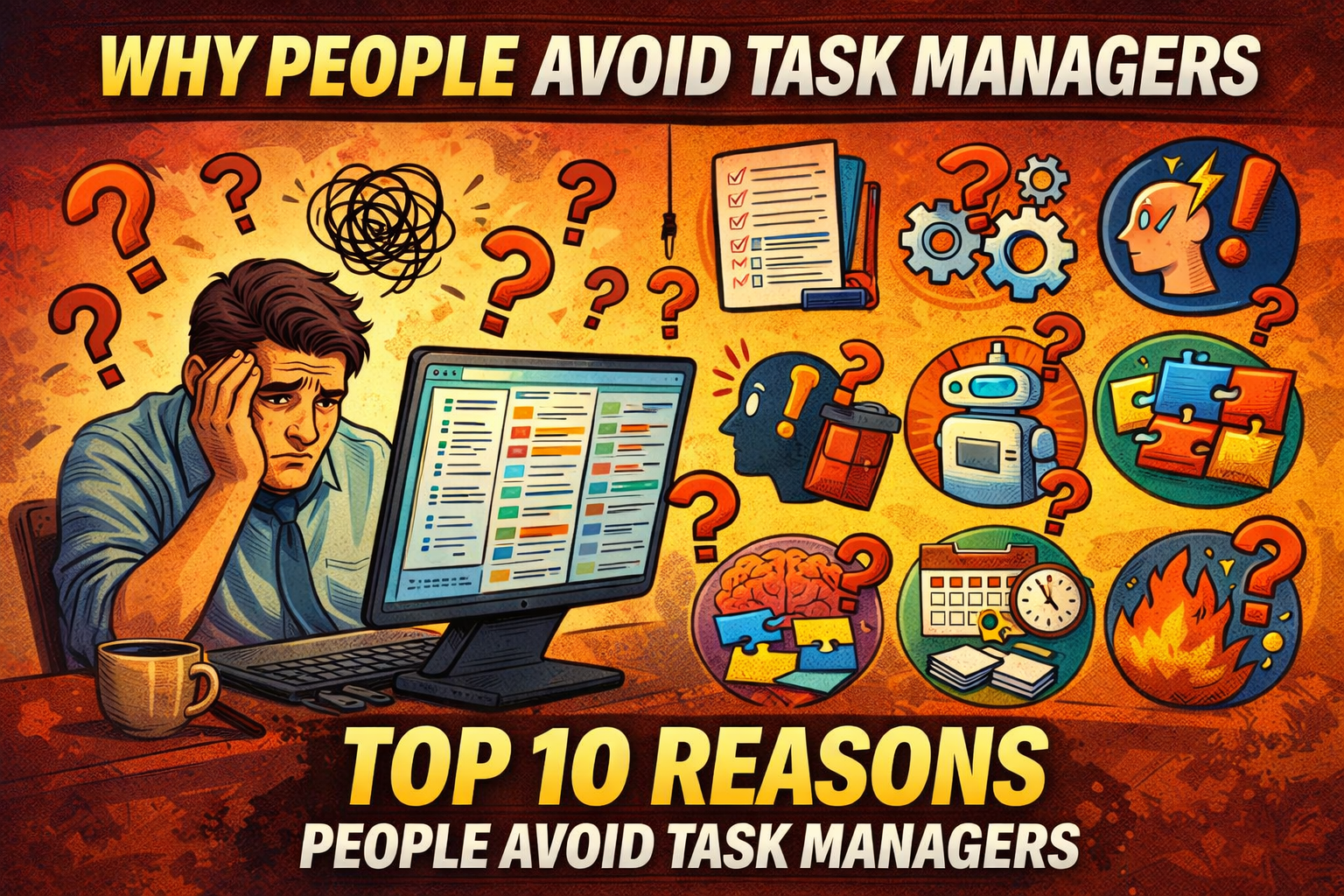
Here are 10 of the biggest things that prevent people from using a task manager consistently.
1) It feels like extra work
This is probably the biggest reason of all.
A lot of people open a task manager and immediately feel that they now have another thing to maintain.
Instead of feeling supported, they feel like they have to:
- keep updating tasks
- move things around
- decide categories
- maintain order
- clean up lists
- manage the system itself
At that point, the task manager stops feeling like help.
It starts feeling like admin.
And if the system creates too much overhead, many people would rather just carry tasks in their head, even if that is less effective in the long run.
2) They do not trust themselves to keep using it
Many people have tried productivity tools before.
They downloaded them, added some tasks, maybe used them for a few days, then stopped.
That history matters.
Because after a few failed attempts, people often stop trusting themselves.
They start thinking:
- I probably won't keep this up
- I always drop these apps
- this will just become another abandoned system
Once that belief sets in, the resistance increases.
So sometimes the barrier is not only the tool itself.
It is the person's own memory of inconsistency.
3) The tool feels too complicated
A lot of task managers have too many layers for the average person.
Too many views.
Too many settings.
Too many labels.
Too many folders.
Too many boards.
Too many features that feel more like work software than personal support.
When people only want help managing life more clearly, complexity can become a major blocker.
They do not want to study the system.
They want to use it.
That is why overly complex tools often push people away instead of pulling them in.
4) They are not sure what should go inside it
This is a very common issue.
People wonder:
- Should I put every task there?
- What about ideas?
- What about goals?
- What about notes?
- What about recurring things?
- What belongs in my calendar instead?
- What is too small to add?
This uncertainty creates friction.
And friction reduces adoption.
If a person does not have a clear mental model of what the task manager is for, the system starts feeling vague and awkward.
Then they stop using it because they never fully understood how it should fit into life.
5) They are afraid it will make life feel too rigid
Some people resist task managers because they associate them with pressure.
They imagine endless checklists, constant optimization, and a life that feels robotic.
That emotional reaction is important.
Not everyone wants to feel like they are managing a company just to get through a normal week.
If the task manager feels too formal, too strict, or too productivity-obsessed, it can create resistance before the person even begins.
People want support.
Not a digital manager yelling at them.
6) They already feel overwhelmed
Ironically, the people who most need a task manager often struggle most to start using one.
Why?
Because overwhelm reduces mental capacity.
If someone already feels overloaded, even simple setup can feel too much.
Opening a blank system and trying to organize everything can feel like facing the full weight of their chaos all at once.
That is uncomfortable.
So they avoid it.
Not because the tool could not help, but because getting started feels emotionally heavy.
7) They rely too much on memory and improvisation
A lot of people believe, often without saying it directly, that they can just "remember things."
Or they trust themselves to react in the moment.
This can work for a while, especially when life is simpler.
But as responsibilities increase, memory becomes less reliable.
Still, many people stay attached to improvisation because it feels easier in the short term.
Using a task manager requires admitting that memory alone is not enough.
Some people resist that shift longer than they should.
8) The task manager does not match real life well
This is a huge issue.
Some task managers feel too abstract or too business-oriented for personal life.
People's real lives include:
- daily responsibilities
- random ideas
- unfinished thoughts
- work tasks
- personal tasks
- goals
- appointments
- context
- changing priorities
If the tool does not fit that reality well, it creates a mismatch.
The person may still want to be organized, but the system feels unnatural.
That often leads to abandonment.
Because a task manager is only useful if it feels aligned with how life actually happens.
9) They confuse listing tasks with making progress
Some people avoid task managers because they have seen them become a trap.
They know it is possible to spend a lot of time organizing tasks without moving anything important forward.
That fear is valid.
People have seen productivity become performative.
They have seen systems where someone colors categories, moves cards, rewrites lists, and still does not truly execute.
So they become skeptical.
They think:
- I do not want another fake productivity habit
- I do not want to spend time managing tasks instead of doing them
That skepticism makes sense.
A task manager must help execution, not replace it.
10) They never built the habit of reviewing it
A task manager is not magic.
It only works if it stays connected to attention.
That means people need some kind of review habit.
Daily.
Weekly.
Or at least often enough that the system remains alive.
Many people fail here.
They put tasks in once, then stop looking.
At that point, the task manager becomes a graveyard of intentions.
And once that happens, trust in the system disappears quickly.
People stop using task managers not only because they fail to capture tasks, but because they fail to revisit them consistently.
What this really reveals
These reasons reveal something important:
People do not reject task managers only because they dislike organization.
Often, they reject them because the tools or habits around them create too much friction.
That means a good task manager should feel:
- simple enough to return to
- flexible enough for real life
- structured enough to reduce chaos
- light enough to not become another burden
- useful enough to create visible value quickly
If it fails in those areas, people drift away.
That is not surprising.
Why many people need more than a basic task list
This is also why some people do not stick with traditional task managers.
A plain list is not always enough.
People often need more context.
They need a place for:
- notes
- comments
- priorities
- progress
- date-based planning
- weekly reviews
- project grouping
- personal and work responsibilities together
Without context, tasks can feel disconnected and lifeless.
And disconnected tasks are easier to ignore.
That is one reason many people end up wanting something more like a personal project manager than a simple task app.
How to make task management easier for people
If you want people to actually use a task manager, the experience should reduce resistance.
That usually means:
1) Make it easy to start
No heavy setup just to get basic value.
2) Keep the structure clear
People should know what belongs where.
3) Reduce maintenance
The tool should not become another job.
4) Fit real life
Not only idealized productivity theory.
5) Support review habits
Because without review, the system dies.
6) Keep context close to tasks
So work feels more meaningful and actionable.
7) Make it feel supportive, not controlling
People want clarity, not digital pressure.
Final thought
A lot of people do not avoid task managers because they are disorganized by nature.
They avoid them because the experience often feels heavier than the benefit.
If the tool feels like extra work, too much complexity, too little real-life fit, or another place where good intentions go to die, people will resist it.
That is why the best task manager is not the one with the most features.
It is the one that people can actually keep using.
Because real productivity does not come from owning a task manager.
It comes from having a system that fits your life well enough to stay useful over time.
Date-based AI Task Manager
Plan smarter, execute faster, achieve more
Create tasks in seconds, generate AI-powered plans, and review progress with intelligent summaries. Perfect for individuals and teams who want to stay organized without complexity.
Get started with your preferred account