
Top 10 Things People in More Developed Countries Often Learn Earlier by Default
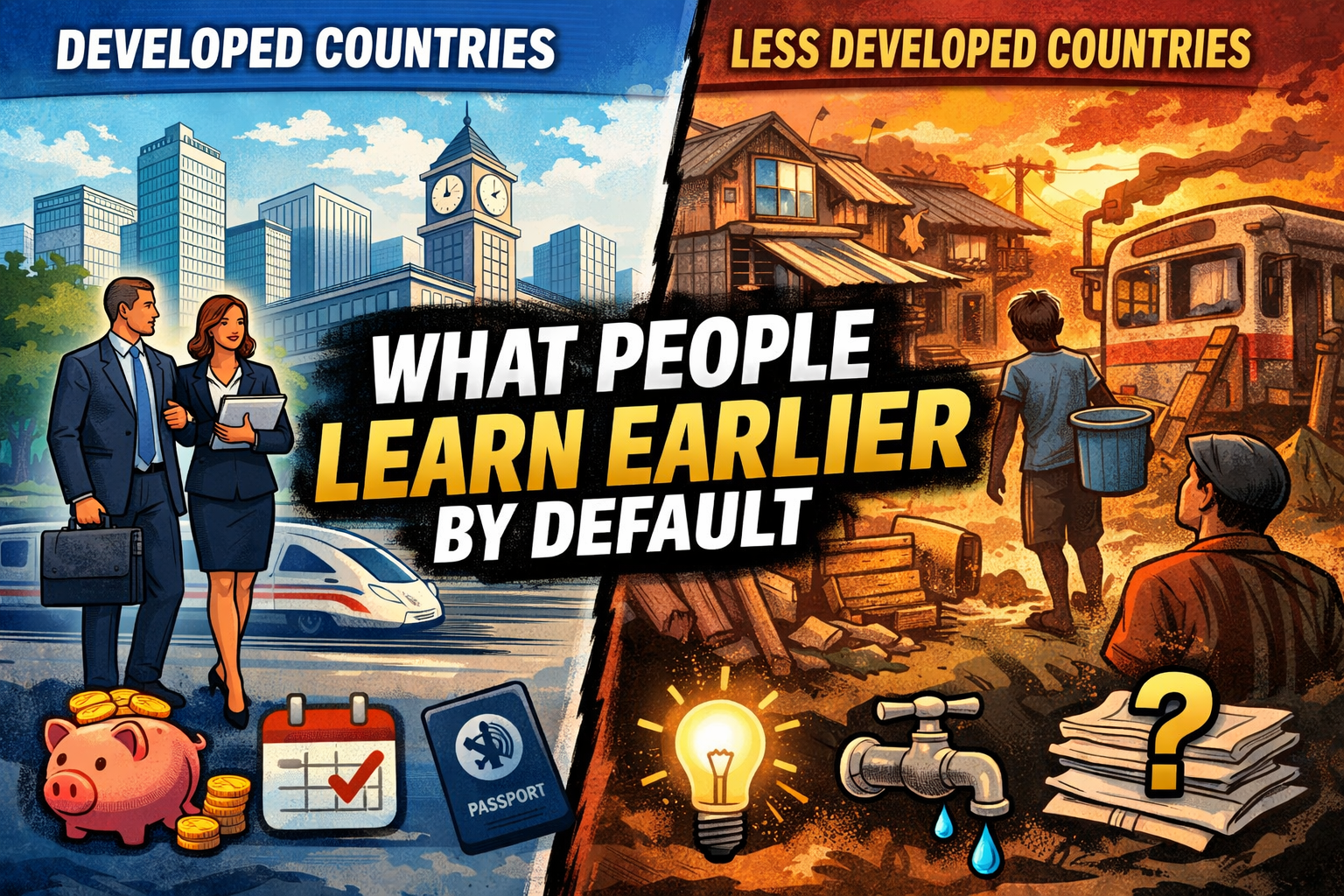
When we talk about differences between more developed and less developed countries, the most important point is this:
It is usually not about people being more capable.
It is more often about what the environment teaches them early, repeatedly, and almost automatically.
In more developed countries, some forms of practical knowledge become so normal that people stop noticing them. They feel obvious. They feel "default."
But in less developed countries, the same things may be learned later, learned unevenly, or not supported consistently by the surrounding system.
That creates a real difference over time.
Not because one group is inherently better.
But because one group is often exposed earlier to habits, systems, expectations, and mental models that are useful for long-term stability and progress.
Here are 10 examples.
1) Time is treated as a serious resource
In more developed countries, people are often raised in systems where time is treated with more structure.
That usually includes:
- appointments starting on time
- deadlines being taken seriously
- schedules being respected
- planning ahead being normal
- lateness being seen as costly
This teaches an important lesson early:
time is not infinite, and respecting it matters.
In less developed environments, people may still understand this personally, but the surrounding system often reinforces it less consistently.
2) Systems matter more than improvisation
In weaker systems, people often become skilled at improvising.
That can be a strength.
But in stronger systems, people often learn earlier that good systems reduce chaos.
That means they grow up seeing more value in:
- procedures
- repeatable processes
- documentation
- reliable services
- planning before reacting
This creates a different mindset.
Instead of constantly solving the same mess again and again, people start thinking more about building systems that prevent the mess.
3) Institutions are expected to function
In more developed countries, people often grow up assuming that certain institutions should work reasonably well.
For example:
- public services
- banking
- contracts
- insurance
- transport
- healthcare administration
- legal procedures
That expectation shapes thinking.
It teaches people to rely more on formal systems and less on personal workaround culture.
In less developed countries, people often learn earlier that they must rely more on themselves, personal networks, or improvisation because institutions may be slower, weaker, or less trustworthy.
4) Financial organization is learned earlier
In more developed countries, many people are exposed earlier to ideas like:
- budgeting
- saving
- credit scores
- insurance
- taxes
- retirement accounts
- mortgages
- investing basics
Not everyone learns these well, of course.
But the surrounding culture often makes these topics more visible and more normalized earlier in life.
That creates a practical advantage.
Because financial literacy compounds over time.
5) Clean environments and order are treated as normal standards
One thing many people from more developed countries absorb early is that public order and cleanliness are not luxuries.
They are expected.
That includes things like:
- cleaner streets
- more predictable public behavior
- stronger maintenance culture
- better signage
- better urban organization
This has a deeper effect than people realize.
It teaches that the environment is something people should maintain, not just tolerate.
That shapes standards and expectations.
6) Long-term thinking is easier to practice
When a society is more stable, long-term thinking becomes easier.
People are more likely to think in terms of:
- career paths
- pensions
- education planning
- property
- long-term business growth
- multi-year goals
In less stable environments, short-term survival often takes more mental energy.
That is not a personal flaw.
It is a structural pressure.
When daily uncertainty is higher, it becomes harder to think five or ten years ahead in a calm and structured way.
7) Boundaries and personal space are often clearer
Many more developed countries reinforce ideas like:
- respecting queues
- respecting noise limits
- respecting appointments
- respecting private space
- respecting rules even in small things
Again, not perfectly.
But more consistently.
That matters because it teaches people that individual comfort and public order both matter, and that society runs better when people follow shared boundaries.
8) Documentation and proof are taken seriously
In more developed countries, people are often trained earlier to keep things formal and documented.
That includes:
- written agreements
- receipts
- contracts
- paperwork
- email confirmation
- records
- process trails
This can feel cold or bureaucratic sometimes, but it also protects people.
It creates a culture where proof matters more than vague verbal understanding.
That reduces confusion and helps systems scale.
9) Self-service and independence are expected
A common pattern in more developed countries is that people are often expected to handle many things themselves.
For example:
- online banking
- scheduling services
- taxes
- booking travel
- applying for jobs
- comparing providers
- reading instructions
- using digital tools independently
This builds a kind of practical independence.
People become more used to navigating systems directly without waiting for someone to guide every step.
10) Reliability is treated as part of character
In more developed countries, one deeply reinforced lesson is that being reliable matters.
That includes being someone who:
- shows up
- follows through
- replies clearly
- respects commitments
- keeps standards
- does what they said they would do
Of course this exists everywhere.
But in more developed societies, the surrounding system often rewards reliability more consistently.
That makes it feel more normal and more expected.
What this really means
The main difference is often not intelligence.
It is default exposure.
People in more developed countries are often exposed earlier to environments where structure, reliability, time respect, financial systems, documentation, and long-term thinking are more normal.
That creates invisible advantages.
Because what feels "obvious" to one person may have taken another person years to learn through friction.
An important caution
This topic should never be used to insult people from less developed countries.
In many cases, people from less developed environments develop strengths that people in more stable countries do not.
For example:
- adaptability
- resilience
- improvisation
- tolerance for uncertainty
- resourcefulness
- persistence under pressure
Those are real strengths too.
So the fairest view is this:
More developed countries often teach certain system-based advantages earlier by default.
Less developed countries often force people to develop certain survival-based strengths earlier by default.
Both shape people.
Final thought
If you want to grow, the useful question is not:
"Which people are better?"
The useful question is:
What useful habits, assumptions, and systems knowledge should I learn earlier or strengthen now, no matter where I come from?
Because once you see these patterns clearly, you can adopt many of them intentionally:
- respect time more
- think longer-term
- document better
- organize finances better
- build systems
- raise your standards
- become more reliable
And those changes can improve your life a lot, regardless of your country.
Date-based AI Task Manager
Plan smarter, execute faster, achieve more
Create tasks in seconds, generate AI-powered plans, and review progress with intelligent summaries. Perfect for individuals and teams who want to stay organized without complexity.
Get started with your preferred account