
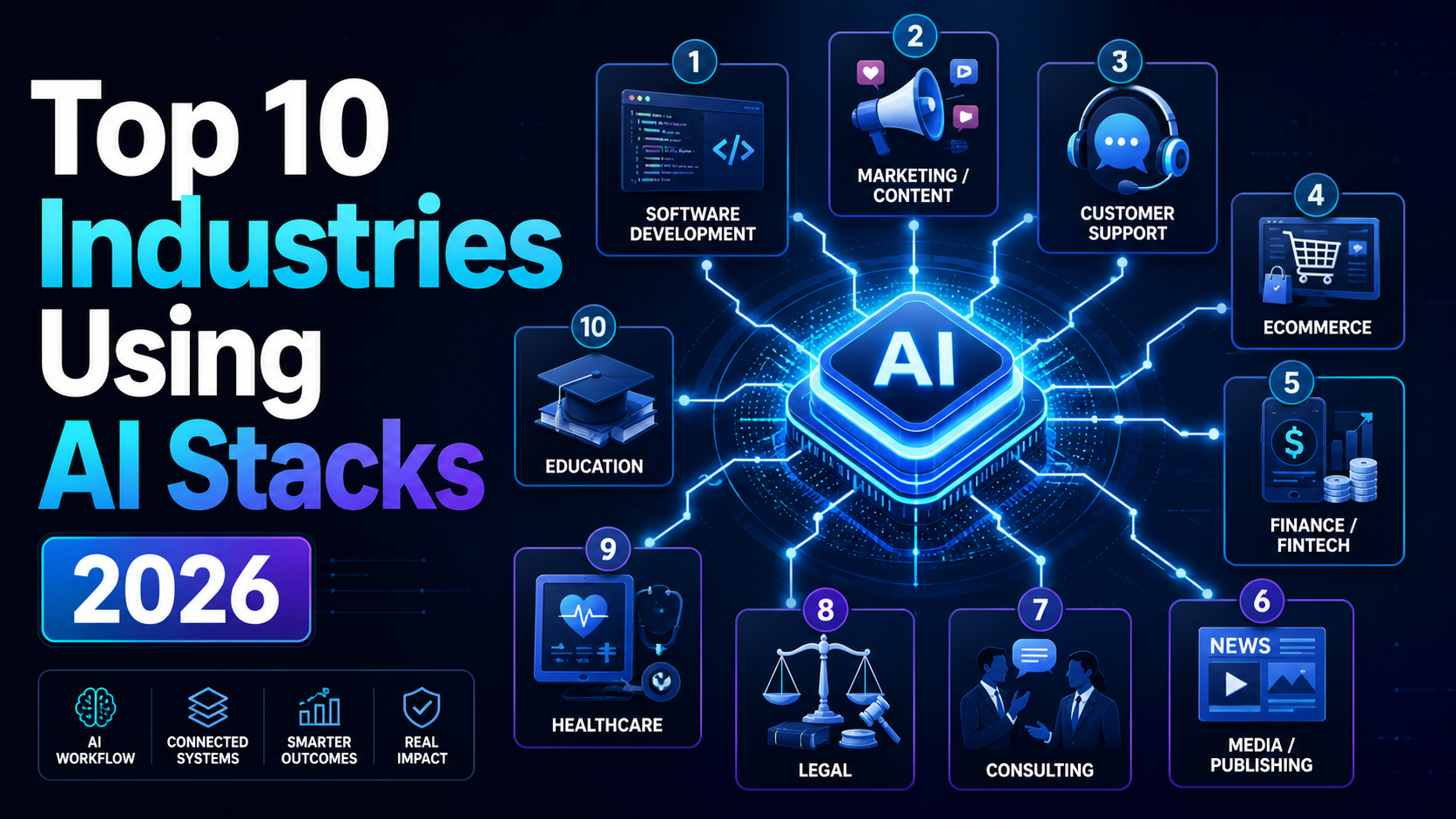
Top 10 Industries That Leverage AI Stacks the Most in 2026
The shift from AI tools to AI stacks
In 2025, most businesses were still experimenting. One person on the team had a ChatGPT subscription and was "figuring it out." A marketing lead was testing image generation. A developer was using Copilot on the side.
In 2026, that picture is gone.
AI is no longer a single tool anyone tries. It is a stack the whole company runs on, and the stack looks completely different depending on what kind of work you do. The US Federal Reserve's April 2026 research found that AI saves workers an average of 5.4% of work hours - roughly 2.2 hours per week across all users. Among frequent, intentional users, that number jumps to 9 or more hours per week.
The difference between those two outcomes is not the tool. It is whether the company built a real workflow around it.
This is a ranking of the 10 industries where AI is most deeply embedded in daily operations in 2026 - not by who talks about AI the most, but by who would genuinely struggle to operate without it. For each one, the dominant stack, why it took hold, and what changed from a year ago.
1. Software Development and SaaS
Software won the AI race because the work itself is text in, text out. Code, documentation, tickets, reviews. Every layer of the workflow has an AI tool that meaningfully replaces or augments human effort.
The dominant 2026 stack: Cursor or Claude Code for the IDE, Claude Opus or GPT-5.4 for architecture and review, Linear for ticket management with AI triage, Granola or Fathom for engineering meetings, and a vector database like Pinecone or self-hosted alternatives for internal knowledge.
What changed in 2026: Pair programming with AI is no longer a novelty - it is the default for most teams. Junior engineers are now hired with the explicit assumption they will work alongside an AI agent on day one. Code review is increasingly the senior engineer's main job, because generation is mostly automated.
2. Marketing and Content Agencies
Marketing was the first non-technical industry to go deep on AI, and 2026 is when the stack stabilized. The agencies that survived the shakeout are the ones that figured out AI does not replace strategy, it just kills the busywork around it.
The dominant 2026 stack: Claude or ChatGPT for long-form writing and brief generation, Perplexity Pro for research with citations, Midjourney V8.1 or Ideogram for visuals, Gamma for decks, and Make or n8n for the connective automation that ties campaigns together.
What changed in 2026: A well-designed corporate AI stack for a team of 4-5 people costs between 300 and 600 euros per month. Agencies that used to bill for first drafts now bill for judgment, brand voice, and orchestration. The pricing model shifted with the workflow.
3. Customer Support and BPO
Support teams adopted AI faster than almost anyone, partly because the work is high-volume and partly because the ROI is immediate. A 40% reduction in tier-one ticket volume is no longer a brag - it is the baseline.
The dominant 2026 stack: Intercom Fin or Zendesk AI for tier-one resolution, Claude for agent assist and reply drafting, a transcription and analysis layer like Gong for call review, and Linear or Notion for ticket triage and escalation routing.
What changed in 2026: Tier-one is now mostly AI-resolved at well-run companies. The human team has shifted to escalations, complex cases, and AI quality review - which is a different job than support was 18 months ago.
4. Ecommerce and DTC
Ecommerce runs on volume - product descriptions, ad creative, customer messages, supplier emails, returns, reviews. Every one of those has been at least partially absorbed by AI, which is why even small DTC brands now run lean on headcount.
The dominant 2026 stack: ChatGPT or Claude for product copy and email flows, Midjourney or generative product photography tools for creative, Klaviyo and similar marketing platforms with embedded AI for segmentation, and Zapier Agents or Make for the workflow glue between Shopify, the warehouse, and customer service.
What changed in 2026: AI-generated product imagery crossed the quality bar where most brands no longer need a photoshoot for variant or lifestyle shots. That single shift collapsed creative production budgets across the entire industry.
5. Financial Services and Fintech
Finance was slower to adopt publicly but moved aggressively behind closed doors. The stack here is more closed and compliance-heavy than other industries, but the depth of use is real.
The dominant 2026 stack: Private GPT-5 or Claude deployments inside compliant cloud environments for analysis and reporting, Bloomberg's GPT-style tools for market research, custom RAG systems built on internal data for client-facing analysts, and AI-driven fraud detection embedded in payment infrastructure.
What changed in 2026: The conversation moved from "should we use AI" to "where do we host it." Most large firms now run their own model deployments rather than calling public APIs, driven by data residency and audit requirements.
6. Media and Publishing
Newsrooms and content businesses rebuilt their entire production workflow around AI between 2024 and 2026. Headlines, summaries, translation, audience targeting, and increasingly the first draft of routine articles are AI-generated and human-reviewed.
The dominant 2026 stack: Claude or GPT-5 for drafting and rewriting, Perplexity and NotebookLM for research, ElevenLabs for audio versions of articles, Descript for podcast production, and Beehiiv or Substack with embedded AI for newsletter operations.
What changed in 2026: The "AI-assisted journalism" debate quieted because the practice became universal. Most major publications now disclose AI involvement in a footer rather than treating it as exceptional.
7. Consulting and Professional Services
Consulting was supposed to be safe from AI. It was not. The slide-deck-and-analysis layer of consulting work was exactly what large language models do well, and the industry adapted by moving up the value chain to judgment, relationships, and implementation.
The dominant 2026 stack: Claude or GPT-5 for analysis and frameworks, Gamma for deck production, Perplexity for client research, NotebookLM for synthesis across large document sets, and Granola for client meeting capture and follow-up.
What changed in 2026: Junior consultants now do the work senior consultants did three years ago, because AI handles what juniors used to do. The career pyramid is being rebuilt in real time.
8. Legal Services
Legal was the most-discussed AI adopter and one of the slowest in practice, but 2026 is when usage finally caught up to the headlines. More than 90% of surveyed lawyers already use at least one AI tool in their daily work, most often for legal research, document analysis, contract drafting, and process automation.
The dominant 2026 stack: Lexis+ AI or Westlaw Precision AI for research, Spellbook or Harvey for contract review and drafting, Microsoft Copilot embedded in Word and Outlook for general work, and specialized e-discovery platforms with AI categorization.
What changed in 2026: Small law firms started leapfrogging large firms in AI adoption, because they do not have legacy systems or committee decision-making slowing them down. The "AI-native" solo practitioner became a real competitive category.
9. Healthcare Administrative and Diagnostic
Healthcare AI in 2026 is mostly invisible to patients and enormous behind the scenes. The clinical AI conversation is still cautious and slow, but admin and diagnostic AI is widespread.
The dominant 2026 stack: Ambient scribing tools like Abridge or Nuance DAX for clinical documentation, AI-driven medical coding and billing systems, diagnostic imaging assistance built into PACS software, and RCM platforms with AI claim review for revenue cycle.
What changed in 2026: Ambient scribing went from a curiosity to a standard feature in most large health systems. Physicians spending 2 hours a day on documentation is no longer accepted as the norm.
10. Education and Online Learning
Education had two parallel adoption curves in 2026 - institutional resistance at universities, and aggressive deployment at online learning companies. The online side won the productivity story.
The dominant 2026 stack: Claude or GPT-5 for curriculum drafting and assessment generation, Synthesia for video lessons with AI presenters, ElevenLabs for audio content and language pronunciation, NotebookLM for student knowledge bases, and Descript for course video production.
What changed in 2026: Course creators went from teams of 5-10 to solo operators producing the same volume. The economics of online learning shifted toward independent creators in a way they had not since the early podcast era.
The pattern across all 10
Look at the stacks side by side and a structure appears.
Every industry has a generation layer - usually Claude, GPT-5, or Gemini - for producing language, code, analysis, or visuals.
Every industry has a communication layer - meeting capture, transcription, summary, and follow-up.
Every industry has an analysis layer - research, synthesis, knowledge retrieval.
Every industry has an automation layer - the connective tissue that moves outputs between systems.
But almost no industry has solved the planning and execution layer well.
That is the gap most stacks still have. AI generates more output than ever before, meetings are summarized automatically, research is faster, and tickets are triaged - but the actual work of deciding what to do today, in what order, and for which client, still gets thrown into a generic task manager that was not built for any of this.
This is the layer SelfManager.ai was built for - the missing planning surface that organizes everything else around dates, with AI woven into the planning itself rather than bolted onto a static board. If your stack already has the generation, meeting, and analysis layers locked in but execution still feels messy, that is usually where the gap is.
The companies that will pull ahead in the next 12 months are not the ones with the most AI tools. They are the ones who closed that last layer.
Quick takeaways
- AI in 2026 is a stack, not a tool, and the stack is now industry-specific.
- Software, marketing, support, and ecommerce are the deepest adopters, with healthcare and legal catching up faster than expected.
- Almost every industry has solved generation and analysis - the planning and execution layer is where most stacks still break down.
- The competitive edge in 2026 is no longer "do you use AI" but "how well does your stack connect."
Date-based AI Task Manager
Plan smarter, execute faster, achieve more
Create tasks in seconds, generate AI-powered plans, and review progress with intelligent summaries. Perfect for individuals and teams who want to stay organized without complexity.
Get started with your preferred account