TickTick vs Todoist vs SelfManager.ai
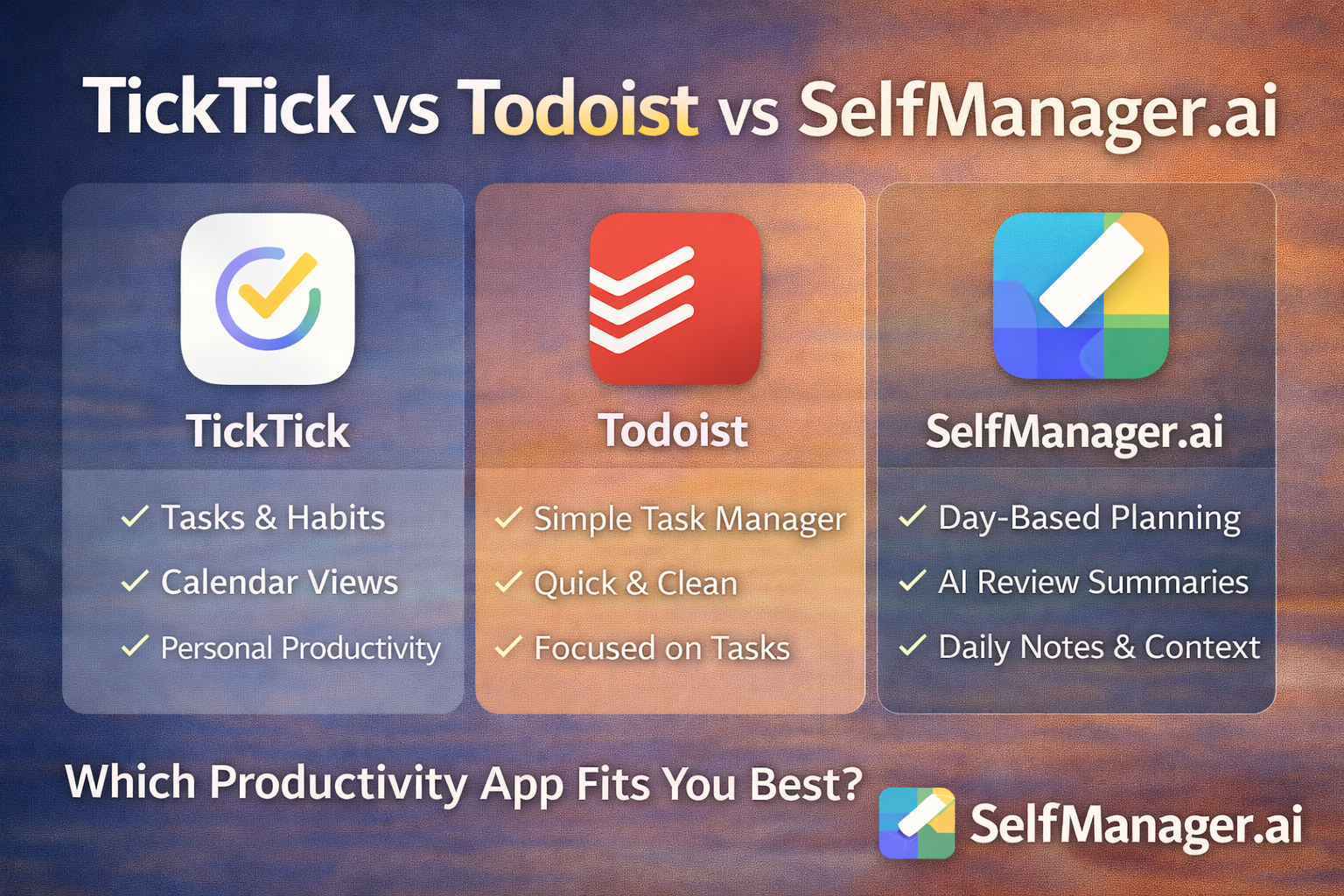
If you are comparing TickTick, Todoist, and SelfManager.ai, you are really comparing three different ways of thinking about productivity.
That is important.
Because on the surface, all three can look like they belong in the same category. They all help people stay organized. They all deal with tasks in some form. They all aim to reduce chaos and help users manage work and life better.
But once you look more closely, the differences become much more interesting.
These tools are not just different in design.
They are different in philosophy.
TickTick tries to give you a broad personal productivity toolkit.
Todoist focuses on clean task management.
SelfManager.ai focuses more on day-based planning, review loops, and turning the day itself into a practical workspace.
That means the best one depends less on which app has the longest feature list and more on how you actually want to work.
The short version
If you want the fastest summary, it looks like this:
- TickTick is strong for people who want tasks, habits, calendar-style planning, and a wider all-in-one personal productivity toolkit
- Todoist is strong for people who want a clean, lightweight, highly focused task manager
- SelfManager.ai is strong for people who want daily planning, notes, review flow, and a system that feels closer to a daily operating space than a classic to-do list
That is the core comparison.
Now let’s look deeper.
TickTick: broad personal productivity in one app
TickTick is attractive because it tries to do more than plain task management.
For many users, that is the main appeal.
It often feels like a productivity toolbox with several useful layers:
- task lists
- reminders
- calendar views
- habits
- planning support
- some lightweight time and routine features
That can make TickTick feel more complete than a simple task manager.
For someone who wants one app for personal organization, TickTick often feels generous. It gives more tools to shape routines and daily life than many task apps do.
Where TickTick is strongest
TickTick is especially useful for people who want:
- a broader personal productivity app
- habits alongside tasks
- a built-in sense of scheduling
- one tool that does several everyday organization jobs
- a more feature-rich personal planning experience
Where TickTick can feel weaker
The broader approach can also create tradeoffs.
For some users, TickTick can start to feel like a productivity toolbox rather than a deeper thinking system. It can help organize many things, but that does not automatically mean it gives the strongest review flow, the richest daily context, or the clearest sense of how a week or month actually unfolded.
It is useful.
But it still tends to live closer to task-and-planning tooling than to reflection-rich productivity.
Todoist: clean, focused, and fast task management
Todoist is probably the cleanest and most focused of the three.
Its biggest strength is clarity.
It is built around straightforward task management:
- capture tasks
- organize projects
- set due dates
- assign priorities
- manage recurring items
- maintain order with relatively low friction
That simplicity is exactly why many people like it.
Todoist does not try to become too many things at once. It is especially good for users who want a trusted place to manage tasks without too much complexity or setup.
Where Todoist is strongest
Todoist is especially useful for people who want:
- a lightweight and polished task manager
- quick capture
- recurring task support
- clean organization
- a simple productivity system that stays focused
Where Todoist can feel weaker
Todoist can start to feel limited when the need expands beyond task organization.
For example, some people eventually want:
- more daily context
- a stronger connection between notes and tasks
- a way to organize life around the actual day
- better review loops
- more support for weekly, monthly, or quarterly reflection
That is when Todoist can begin to feel slightly too narrow.
It is good at helping you manage what exists.
It is less built around helping you deeply review, understand, and shape the day as a broader lived workspace.
SelfManager.ai: a different model centered on the day
SelfManager.ai stands apart because it is not really trying to be just another to-do list.
Its stronger angle is daily planning, daily context, review flow, and helping the user operate from the day itself.
That is a meaningful difference.
A lot of productivity tools ask you to organize life mainly through:
- projects
- lists
- boards
- due dates
- recurring tasks
SelfManager.ai starts from a different question:
How can the day itself become a usable workspace?
That changes the feel of the system.
Instead of productivity being just about storing and checking tasks, it becomes more about:
- planning the day
- keeping notes and tasks close together
- seeing work and personal life in one practical structure
- reviewing progress over time
- using AI to help summarize and reflect on periods like weeks, months, and quarters
Where SelfManager.ai is strongest
SelfManager.ai is especially useful for people who want:
- a day-based productivity system
- stronger daily planning
- notes, tasks, and context together
- review loops that go beyond simple task completion
- AI-supported summaries and follow-up prompting
- a better bridge between daily work and long-term progress
Where SelfManager.ai may be different from what some users expect
If someone only wants a classic lightweight task manager, SelfManager.ai may feel like a different category.
That is not a weakness, but it is important.
This is a better fit for users who want a more involved daily operating space rather than just a simpler list manager.
TickTick vs Todoist vs SelfManager.ai by use case
Best for simple task management
Todoist
If your main goal is straightforward task capture and clean organization, Todoist is usually the clearest choice.
Best for broader personal productivity features
TickTick
If you want tasks plus habits plus a wider toolkit for personal organization, TickTick can feel more complete.
Best for daily planning and reflection
SelfManager.ai
If you want a system built around the day, stronger review loops, and AI-assisted summaries, SelfManager.ai is the strongest fit.
How they differ in daily planning
This is one of the biggest distinctions.
TickTick
TickTick gives more planning-related features than many task apps, which makes it useful for users who want a stronger daily workflow than a plain to-do list.
Todoist
Todoist is more task-centered. It helps organize what must be done, but for many users the day itself still needs to be mentally reconstructed around those tasks.
SelfManager.ai
SelfManager.ai is the most explicitly day-centered of the three. It is designed more around helping users run the day with tasks, notes, categories, and review flow connected in one practical place.
That makes it easier to move from:
- “here are my tasks”
to - “here is how today actually works”
That is a major difference.
How they differ in review and reflection
This is where the gap becomes even clearer.
TickTick
TickTick can help people stay organized and maintain routines, but review flow is not the core story.
Todoist
Todoist is even more task-focused. It is good for managing tasks, but it is not primarily designed around rich weekly, monthly, or quarterly reflection.
SelfManager.ai
SelfManager.ai is much stronger here because reflection is closer to the core concept. It is built for users who want to review periods more meaningfully, especially with AI executive summaries and follow-up prompts that help turn raw activity into insight.
If review loops matter to you, this changes the comparison a lot.
How they differ in notes and context
TickTick
TickTick offers a more flexible personal productivity setup, but it still generally feels like productivity tooling first.
Todoist
Todoist is task-first. Notes and deeper context are not usually the main story.
SelfManager.ai
SelfManager.ai is stronger when you want notes, comments, task context, and day-based planning to live closer together. That makes it better suited for users who do not just want to remember tasks, but also understand the thinking and context around them.
Which one is best for different types of people?
Choose TickTick if:
- you want one app for several kinds of personal productivity needs
- you like having habits and broader planning tools in the same place
- you want something richer than a minimal task manager
Choose Todoist if:
- you want clean, lightweight task management
- you care about speed and simplicity
- you do not need deep daily review or a more contextual planning system
Choose SelfManager.ai if:
- you want a stronger daily planning model
- you want work, personal life, notes, and tasks to connect better
- you value weekly, monthly, and quarterly review loops
- you want AI to help summarize, reflect, and suggest next steps
- you want a productivity system that feels like a daily operating space
Why SelfManager.ai has a unique angle
This is really the key point.
TickTick and Todoist are both strong products, but they still sit closer to classic productivity categories:
- task manager
- planning tool
- personal organization app
SelfManager.ai is trying to solve a slightly different problem.
It is not only asking:
“How do I organize tasks?”
It is asking:
“How do I organize the day, understand my progress, and review my work in a smarter way over time?”
That makes it especially interesting for:
- self-employed people
- knowledge workers
- founders
- people running both work and personal life in one system
- users who want more than checkboxes
That is where SelfManager.ai becomes easier to differentiate.
Final thought
TickTick, Todoist, and SelfManager.ai are all useful, but they are useful in different ways.
TickTick is strong for broader personal productivity.
Todoist is strong for clean task management.
SelfManager.ai is strong for daily planning, review loops, and turning the day itself into a practical workspace.
So the real question is not just which one is best.
The real question is:
What kind of productivity system do you actually need?
If you want:
- simple task management, go with Todoist
- a broader personal productivity toolkit, look at TickTick
- a more day-based, reflection-friendly, AI-assisted system, SelfManager.ai stands out strongly
That is the real comparison.
Date-based AI Task Manager
Plan smarter, execute faster, achieve more
Create tasks in seconds, generate AI-powered plans, and review progress with intelligent summaries. Perfect for individuals and teams who want to stay organized without complexity.
Get started with your preferred account