Notion vs ClickUp vs SelfManager.ai
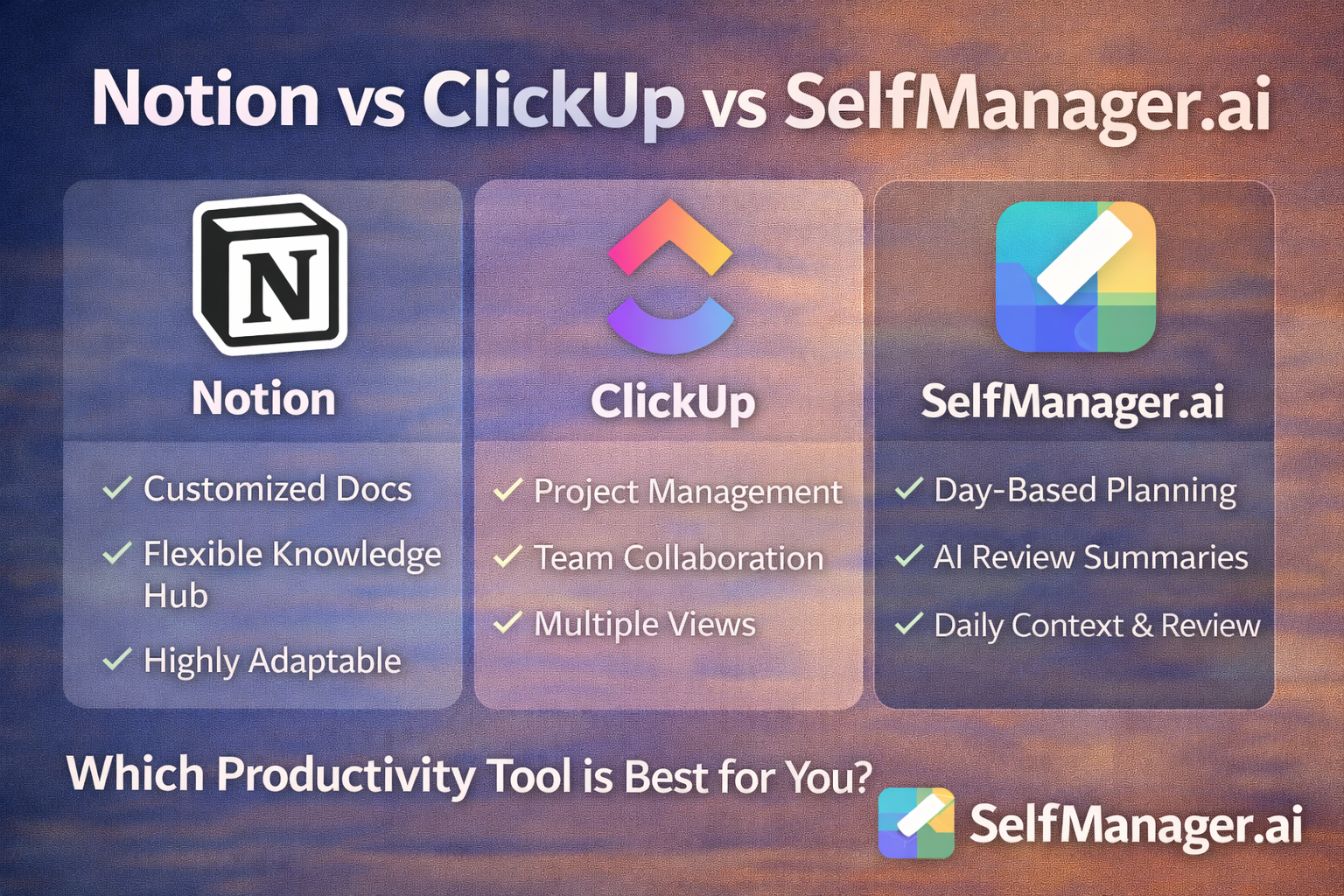
If you compare Notion, ClickUp, and SelfManager.ai, you are not just comparing three apps.
You are comparing three very different philosophies of how work and organization should happen.
That matters.
Because a lot of people search for “best productivity app” as if there is one universal answer. But usually the better question is this:
What kind of system are you actually trying to build?
Notion is strong when you want flexibility and custom organization.
ClickUp is strong when you want a more structured work management platform.
SelfManager.ai is strong when you want a day-based planning system with AI-supported review loops and a more practical daily operating space.
All three can help people stay more organized.
But they solve different problems.
The short version
If you want the fastest summary, it looks like this:
- Notion is best for flexible docs, wikis, notes, and customizable systems
- ClickUp is best for more structured project and team work management
- SelfManager.ai is best for day-based planning, daily clarity, and AI-assisted weekly, monthly, and quarterly reviews
That is the real shape of the comparison.
Now let’s go deeper.
Notion: flexible, powerful, and highly customizable
Notion became popular because it gives users a lot of freedom.
That is its superpower.
Instead of forcing you into one fixed structure, Notion lets you build:
- notes
- docs
- knowledge bases
- dashboards
- databases
- project pages
- personal systems
- team spaces
For some people, that feels amazing.
It can become a second brain, a workspace, a company wiki, a content calendar, a lightweight CRM, or a personal productivity hub.
That flexibility is why many people love it.
Where Notion is strongest
Notion is especially useful for people who want:
- a flexible workspace
- rich notes and documents
- custom systems
- databases and linked views
- one place for knowledge and planning structure
- a tool that can adapt to many different workflows
Where Notion can feel weaker
The same flexibility that makes Notion powerful can also create friction.
A lot of people eventually realize that building a system is not the same as using a system.
That is an important difference.
Notion can sometimes become:
- too customizable
- too setup-heavy
- too dependent on personal system design
- less direct for fast daily execution
- more like a workspace builder than a daily operating environment
For users who want immediate clarity each day, Notion can sometimes feel like too much architecture and not enough day flow.
ClickUp: structured work management with lots of features
ClickUp sits much closer to the project management side of productivity.
It is designed to help organize work at scale with more structure already built in.
That makes it attractive for teams, agencies, operations-heavy workflows, and people who want a more explicit work management platform.
ClickUp usually emphasizes:
- projects
- lists
- tasks
- statuses
- views
- collaboration
- deadlines
- dashboards
- team structure
This makes it feel much more operational than a simple note-taking or task app.
Where ClickUp is strongest
ClickUp is especially useful for people who want:
- stronger project management
- team collaboration
- multiple workflow views
- status-based organization
- a work platform that can handle many moving parts
- more built-in structure than something like Notion
Where ClickUp can feel weaker
For some people, ClickUp can also feel heavy.
That is usually the tradeoff.
If your main need is not complex work management, then ClickUp can feel like more system than you actually need.
It can sometimes feel:
- too feature-dense
- too team-operations oriented
- too workflow-heavy for personal daily use
- better for managing work structures than for helping you think clearly through the day
This is especially true for solo users or self-employed people who do not necessarily need a full project management machine.
SelfManager.ai: a day-based system built for real daily flow
SelfManager.ai stands apart because it is not mainly trying to be a doc builder like Notion or a project operations platform like ClickUp.
Its stronger angle is different.
It is built more around:
- the day itself
- daily planning
- notes and task context together
- categories of life and work in one place
- AI-supported weekly, monthly, and quarterly reviews
- turning productivity into a clearer day-by-day operating system
That makes it much easier to differentiate.
SelfManager.ai is not mainly about:
- building a knowledge wiki
- creating endless dashboards
- managing large team workflows through status systems
It is more about helping a person or small working setup run the day better.
Where SelfManager.ai is strongest
SelfManager.ai is especially useful for people who want:
- a stronger daily planning system
- work and personal life organized around the same day
- tasks and notes close together
- more context than a simple to-do list
- review loops that help make sense of weeks, months, and quarters
- AI to summarize progress and generate follow-up thinking
Where SelfManager.ai feels different
If someone is specifically looking for a full wiki builder or a large-scale workflow engine, SelfManager.ai is a different kind of tool.
That is not a weakness.
It just means the comparison should be honest.
SelfManager.ai is strongest when the problem is:
“How do I run my day, stay clear, and review my progress intelligently?”
Not necessarily:
“How do I build a complex internal workspace for a big team?”
Notion vs ClickUp vs SelfManager.ai by core philosophy
This is where the comparison becomes easier.
Notion philosophy
Build your own system.
Notion gives you flexibility and asks you to shape the structure.
ClickUp philosophy
Manage work through structured workflows.
ClickUp gives you a lot of built-in work management capability.
SelfManager.ai philosophy
Run the day clearly and review your progress over time.
SelfManager.ai gives you a more day-centered operating model.
That is why these tools can feel so different even when they are all called “productivity apps.”
Which one is best for notes and documentation?
Best: Notion
If your main need is notes, documents, knowledge organization, and flexible page structures, Notion is the strongest of the three.
It is very good at turning information into a structured workspace.
ClickUp
ClickUp can hold documentation and task-related context, but that is not usually its strongest identity.
SelfManager.ai
SelfManager.ai handles notes best when they are part of daily planning, execution, and review context. It is less about building a giant knowledge base and more about keeping useful context close to the day.
Which one is best for project management?
Best: ClickUp
If your main goal is structured project and team work management, ClickUp is usually the strongest fit in this comparison.
It is designed more directly for that.
Notion
Notion can be used for project management, but it often depends more on how much system-building you are willing to do.
SelfManager.ai
SelfManager.ai can support work structure, but that is not the same as being a classic large-scale project management platform. Its strength is more in daily execution and reflective planning.
Which one is best for daily planning?
Best: SelfManager.ai
This is where SelfManager.ai stands out the most.
Notion can support planning.
ClickUp can organize work.
But SelfManager.ai is more directly built around the actual lived day.
That matters because many people do not just want to organize information or projects.
They want to know:
- what matters today
- what belongs together today
- how work and personal life fit into the same day
- what they learned from this week
- what should shape next week
That is exactly where SelfManager.ai becomes easier to defend and differentiate.
Which one is best for self-employed people and knowledge workers?
This is one of the most interesting sections.
Notion
Good for people who like building their own systems, storing knowledge, and organizing information in flexible ways.
ClickUp
Good for people whose self-employed work is already very project-heavy, client-heavy, or team-operations heavy.
SelfManager.ai
Especially strong for self-employed knowledge workers, freelancers, founders, and solo operators who want:
- one daily place for work and personal structure
- stronger review loops
- less fragmented planning
- AI summaries that help turn activity into insight
This is a very important niche because many self-employed people do not need enterprise-style work management.
They need a better day system.
Which one is best for AI-supported review and reflection?
Strongest: SelfManager.ai
This is one of the clearest differentiators.
Notion and ClickUp can help store information and tasks, but SelfManager.ai is much more directly aligned with:
- weekly reviews
- monthly reviews
- quarterly reviews
- executive summaries
- follow-up prompts
- turning raw daily activity into something easier to reflect on
That is a major advantage for users who care about progress, pattern recognition, and self-awareness over time.
If your productivity system stops at task storage, you still have to reconstruct meaning manually.
SelfManager.ai is trying to reduce that burden.
How they feel in real life
This may be the most useful comparison.
Notion feels like:
A flexible workspace you can shape into almost anything.
ClickUp feels like:
A work management platform with many built-in layers for tasks, workflows, and operations.
SelfManager.ai feels like:
A day-based operating system for planning, tracking, reflecting, and staying clear.
That is probably the simplest emotional summary of the three.
Choose Notion if:
- you want flexibility above all
- you like building your own systems
- you care a lot about docs, notes, and workspace customization
- you want a knowledge hub more than a daily operating system
Choose ClickUp if:
- you want stronger project and workflow management
- you manage many moving parts
- you want more built-in work structure
- you are working in a team-heavy or operations-heavy environment
Choose SelfManager.ai if:
- you want better daily planning
- you want a system built around the day itself
- you want tasks and notes close together
- you want work and personal life to feel less fragmented
- you care about weekly, monthly, and quarterly reviews
- you want AI to help summarize and guide reflection
- you want a practical daily operating space, not just a tool to configure
Why SelfManager.ai has a unique position here
This is the core point.
Notion and ClickUp are both strong products, but they still sit in more familiar categories:
- flexible workspace
- project management platform
SelfManager.ai has a narrower but more distinctive angle.
It is built for people who want:
- clarity in the day
- continuity across weeks and months
- context-rich planning
- better reflection
- AI-assisted review flow
That makes it easier to position as something different rather than something generic.
Instead of trying to be “another project app” or “another note app,” SelfManager.ai can stand out as:
a day-based productivity system with AI review loops
That is a much stronger identity.
Final thought
Notion, ClickUp, and SelfManager.ai are all useful, but they are useful in different ways.
Notion is strongest for flexibility and knowledge organization.
ClickUp is strongest for structured project and workflow management.
SelfManager.ai is strongest for daily planning, contextual execution, and AI-assisted reviews.
So the real choice depends on what kind of problem you are trying to solve.
If you want to build a flexible workspace, Notion makes sense.
If you want to manage projects and workflows at scale, ClickUp makes sense.
If you want to organize the day better and turn your work into something easier to review and understand over time, SelfManager.ai stands out.
That is the real comparison.
Date-based AI Task Manager
Plan smarter, execute faster, achieve more
Create tasks in seconds, generate AI-powered plans, and review progress with intelligent summaries. Perfect for individuals and teams who want to stay organized without complexity.
Get started with your preferred account