
Falling Behind on Your Tasks? A Catch-Up Plan Template for the Next Seven Days
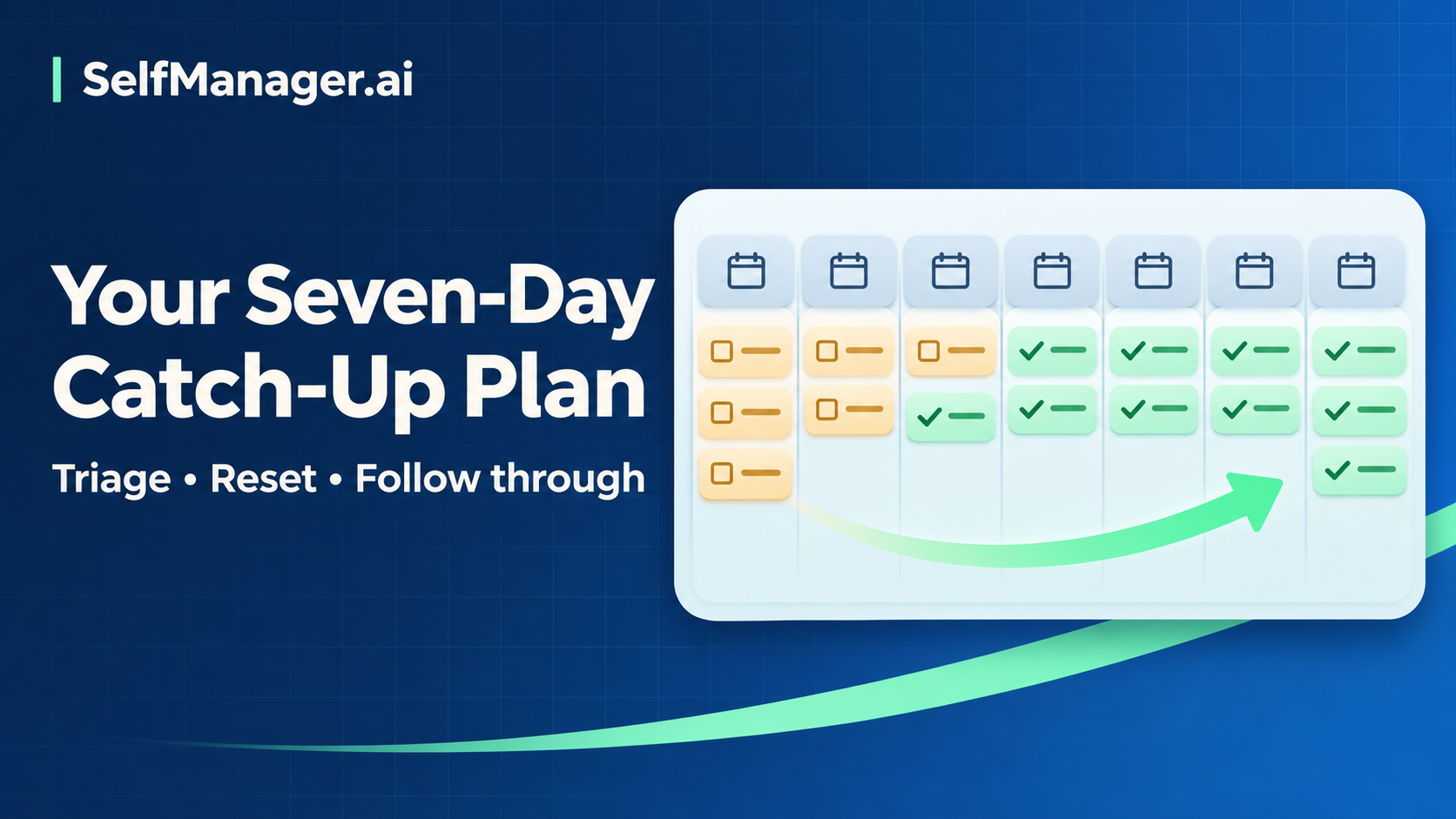
When you are falling behind, start by deciding which commitments still belong in the next seven days. Then fit those commitments into the time you actually have and communicate changes to anyone affected.
A catch-up plan does not require clearing every overdue task. It should restore a workable relationship between your commitments, capacity, and next actions. Some work will be completed; other work may need a new agreement or an explicit decision to stop.
First, find the commitments with real consequences
Gather overdue tasks from your main list, calendar, messages, and notes. Keep this capture bounded: collect what matters for the coming week instead of spending an entire day organizing old material.
For each item, identify:
- Who is relying on it.
- The actual deadline or promised date.
- What happens if it slips further.
- The remaining effort and any dependencies.
- The smallest useful next action.
An item marked overdue by an app may be a personal target you no longer need. Another task with no date may be blocking a colleague today. Use the real commitment to judge priority.
Copy this triage template
| Task / commitment | Original date | Consequence / person affected | Effort left | Decision | Next action | Date / agreement |
|---|---|---|---|---|---|---|
| [Item] | [Date] | [Concrete effect] | [Estimate] | [Keep / Renegotiate / Defer / Drop] | [Specific step] | [Work date or agreed change] |
| [Item] | [Date] | [Effect] | [Estimate] | [Decision] | [Action] | [Date] |
Use four decisions consistently:
Keep: The commitment still matters and can fit this week. Give it a work session.
Renegotiate: Someone expects a result you cannot reasonably deliver as promised. Ask for a changed date, smaller scope, different sequence, or other support. The change is proposed until accepted.
Defer: The item can move without breaking an external agreement. Give it a review date so it does not disappear.
Drop: The work is no longer worth doing or required. Close it consciously. If someone else is relying on it, discuss the cancellation rather than treating “drop” as unilateral permission.
Check capacity before building the seven-day plan
Write down fixed work, meetings, travel, care responsibilities, rest, and existing deadlines. Then estimate how much time remains for recovery work.
Keep some space uncommitted. A plan that uses every possible minute has nowhere to put an interruption or an inaccurate estimate.
Available work capacity over seven days:
Existing commitments that must continue:
Catch-up capacity after those commitments:
Buffer held back:
Time available for selected recovery tasks:

Selected tasks and effort:
Total selected effort:
If effort exceeds capacity, what must change:
Do not count an hour twice. If Tuesday's available hour is needed for an existing deadline, it cannot also be the hour that clears three overdue jobs.
A worked catch-up example
This fictional freelancer, Jordan, has eight hours available for catch-up work after normal commitments over November 9–15, 2026. Jordan reserves one hour as a buffer, leaving seven hours for selected actions.
| Commitment | Situation | Effort left | Decision | Next action |
|---|---|---|---|---|
| Client proposal | Missed Friday promise; client waiting | 3 hours | Renegotiate, then keep if agreed | Explain slip and propose Thursday delivery |
| Expense submission | Required this week | 1 hour | Keep | Gather receipts and submit |
| Partner update | Partner needs current position | 0.5 hour | Keep | Send factual progress and blocker summary |
| Draft article | Personal publication target; no external promise | 4 hours | Defer | Review next Monday |
| Old optional dashboard | No current use or owner relying on it | 2 hours | Drop | Close task and retain any useful notes |
| Proposal communication and setup | Needed to establish the recovery plan | 0.5 hour | Keep | Send message and confirm next actions |
| Portfolio revision | Useful but not urgent | 2 hours | Defer | Reassess after current commitments stabilize |
The selected work totals five and a half hours. Jordan uses the remaining one and a half planned hours for triage and the final review. The buffer remains separate. Deferring work is what makes the recovery plan fit.
Copy the seven-day recovery plan
| Day | Purpose | Planned action in Jordan's example | Time |
|---|---|---|---|
| 1: Monday | Establish the real position | Triage commitments; send proposal reset message | 1 hour |
| 2: Tuesday | Start the highest-consequence work | Draft proposal scope and main recommendation | 1 hour |
| 3: Wednesday | Advance and communicate | Draft pricing section; send partner update | 1.5 hours |
| 4: Thursday | Close the main commitment | Check proposal and deliver if revised date was accepted | 1 hour |
| 5: Friday | Finish required administration | Submit expenses and check confirmation | 1 hour |
| 6: Saturday | Absorb disruption | Buffer only; no new catch-up promise | Up to 1 hour |
| 7: Sunday | Review and prevent another pile-up | Check closures, unresolved promises, and next week's capacity | 1.5 hours |
The planned actions use seven hours, with one further hour available as buffer. Day one includes half an hour of triage and half an hour of communication. Sunday's longer review includes checking records and rebuilding the next week's commitments.
The seven-day structure is reusable, but the exact hours and dates are illustrative. Your catch-up period may start on a Thursday. Use the sequence to establish control, not to force every recovery into a Monday-start calendar.
Communicate slipped commitments early
The person waiting needs the current position, a concrete proposal, and any decision they must make. Avoid promising an aggressive new date simply to make the message feel better.
Hi [Name],

I missed the [original date] commitment for [deliverable].
The current position is [what is complete and what remains].

I propose [new date and time] for [specific scope].
If you need something earlier, I can provide [usable partial result]
by [date], with [remaining part] following separately.

Please confirm whether that works or tell me which requirement
must take priority. I will update you again by [checkpoint].
Only offer a partial result if it would help the recipient. Half a document can be useful for review; half a required submission may be unusable. If the new date is not accepted, revisit the plan instead of treating silence as agreement.
What to do when the catch-up plan slips too
Recalculate the remaining work and remaining capacity. Use the buffer for genuine disruption, then make another decision if the gap persists.
Ask whether the estimate was wrong, the task lacked a clear next action, a dependency was missing, or the available time was never realistic. Those causes need different responses. Working later every night can conceal the problem briefly without fixing the commitments.
If the backlog grows each week despite a realistic effort, this is no longer just a seven-day recovery problem. Reduce incoming work, change scope, seek support, or revisit the workload with the people involved.
Use dated records to make the next plan more accurate
SelfManager.ai can hold dated recovery tasks and time records. Record what finished and why other work moved. Do not assume that moving an item inside your planner updates an agreement with a client or colleague.
Once the urgent recovery is complete, use the 15-minute planning routine to maintain the next week's commitments. That preventive routine serves a different purpose from triaging work that has already slipped.
Common questions
Should I start with the easiest overdue task?
An easy task can help you begin, but do not let small completions displace a time-sensitive commitment with real consequences. Choose the next action that most improves the week's position.
Is deferring a task the same as renegotiating it?
No. You can usually move a personal target yourself. Changing a promise to someone else requires communication and, where needed, agreement.
What counts as a successful catch-up week?
The important commitments are completed or accurately reset, the remaining work has explicit decisions, and next week's plan fits available capacity. An empty list is not required.
Date-based AI Task Manager
Plan smarter, execute faster, achieve more
Create tasks in seconds, generate AI-powered plans, and review progress with intelligent summaries. Perfect for individuals and teams who want to stay organized without complexity.
Get started with your preferred account