
The 15-Minute Planning Routine That Prevents Missed Weeks
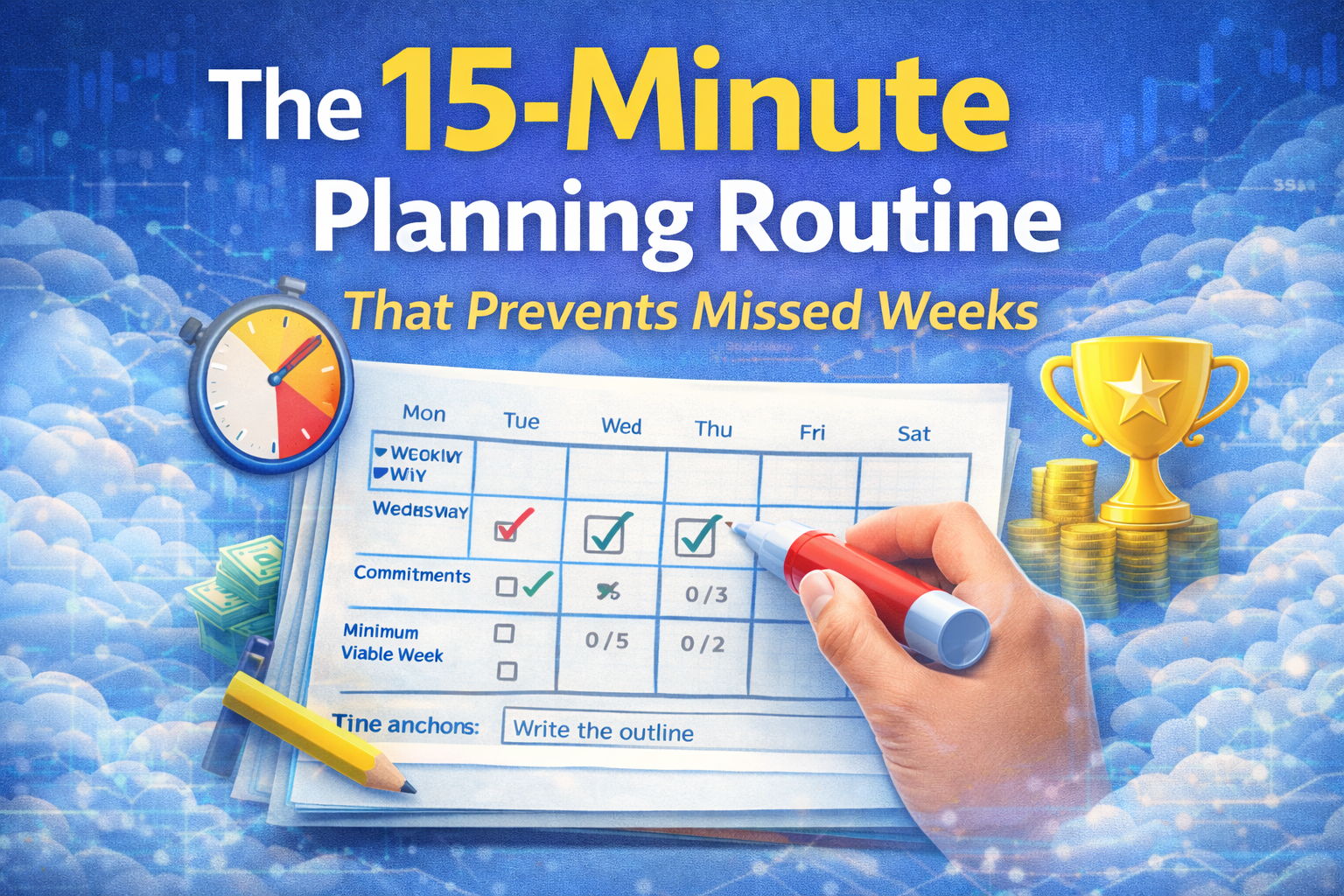
A simple weekly reset you can do even when life is chaotic
Most people don't fall off their goals because they "quit."
They fall off because they miss one week… then the next week feels messy… and by the third week, they stop trusting their own system.
The solution isn't a bigger tool or a longer planning session. It's a repeatable 15-minute routine that does three things:
- brings your week back under control
- protects the few actions that actually matter
- creates a "minimum plan" so you don't disappear when things go wrong
This is designed for real life: client work, family stuff, low-energy weeks, and unexpected events.
Why weeks get missed (and why it snowballs)
A missed week usually comes from one of these:
- your task list is too big, so planning feels painful
- your plan isn't connected to time (it's just a backlog)
- you don't have a reset ritual, so everything piles up silently
- you're trying to plan "the perfect week" instead of "a survivable week"
This routine is built to fix that.
The 15-minute routine (exact steps)
Minute 0–2: Clear the fog (quick inbox sweep)
Your brain can't plan while it's holding loose ends.
Do a fast sweep of the places where random tasks accumulate:
- messages you flagged mentally ("I should reply…")
- notes app / screenshots / paper notes
- emails you need to act on
- "oh yeah I need to…" thoughts
Rule: don't do the tasks now. Just capture them in one place.
Output: one messy list called "INBOX".
Minute 2–5: Choose your Weekly Win (one sentence)
This is the most important step.
Write one sentence:
If I finish only one thing this week, I want it to be: ______
Examples:
- "Ship the landing page update by Friday."
- "Finish the first draft of the article."
- "Close 2 client follow-ups + send 5 outreach messages."
- "Train 3 times and keep food clean on weekdays."
Why it works: it makes the week measurable and prevents your week from being "busy but pointless."
Minute 5–9: Pick 3–5 Weekly Commitments (your scoreboard)
Now choose 3–5 commitments that make the Weekly Win likely.
These should be small and trackable, not vague.
Good commitments:
- 3 deep work sessions
- 2 sales blocks
- 3 workouts
- 5 pages written
- 1 admin cleanup block
- 1 planning/review session
Bad commitments:
- "Work harder"
- "Be more consistent"
- "Fix my business"
Write them like a scoreboard:
- Deep work: 0/3
- Outreach: 0/10
- Workout: 0/3
- Writing: 0/2
Minute 9–12: Time-map the week (anchor the plan to reality)
Now connect commitments to actual time.
You only need two anchors:
- One "Start Strong" block (Mon/Tue)
- One "Save the Week" block (Thu/Fri)
Example:
- Tue 09:00–10:30 → Deep work block #1
- Thu 16:00–17:00 → Save-the-week review + catch-up
If your calendar is chaotic, just pick a best guess time. The point is to stop "floating plans."
Minute 12–14: Create your "Minimum Viable Week"
This is your anti-failure mechanism.
Write a tiny fallback plan:
If this week explodes, the minimum I will do is:
- ---
- ---
Examples:
- "1 deep work session + 1 workout"
- "Send 3 client messages + write 30 minutes"
- "Do a 10-minute review on Friday and choose next week's win"
This single step prevents missed weeks from turning into missed months.
Minute 14–15: Lock the next action (so you start fast)
End with one clear next action:
The first task I will do for my Weekly Win is: ______
I will do it on: (day/time) ______
If you don't pick the first action, the week starts with friction and you drift into inbox mode.
The routine in one copy-paste template
Weekly INBOX sweep (2 min):
- Captured tasks from: messages / notes / email / brain
Weekly Win (1 sentence):
- If I finish only one thing this week, it's: ______
Weekly Commitments (3–5):
- ____: 0/
- ____: 0/
- ____: 0/
- ____: 0/
Time anchors:
- Start Strong block: ______ (day/time)
- Save the Week block: ______ (day/time)
Minimum Viable Week:
- If the week explodes, I still do:
- ---
- ---
Next action:
- First task: ______
- Scheduled: ______
Common mistakes (and fixes)
Mistake 1: planning becomes a 60-minute "life redesign"
Fix: keep it at 15 minutes. Your system should serve execution, not replace it.
Mistake 2: you pick too many weekly commitments
Fix: cap it at 3–5. If you want more, you're probably avoiding prioritizing.
Mistake 3: your plan ignores energy and context
Fix: schedule your "Start Strong" block when you're realistically at your best.
Mistake 4: you skip the Minimum Viable Week
Fix: always define the fallback. It's the difference between resilience and restart.
A realistic example (filled in)
INBOX sweep:
- "Reply to client about scope"
- "Update pricing page copy"
- "Gym membership renewal"
- "Draft article outline"
Weekly Win:
- Publish the article draft by Friday.
Weekly commitments:
- Writing blocks: 0/3
- Admin cleanup: 0/1
- Workout: 0/2
Time anchors:
- Start Strong: Tue 09:00–10:30 (writing)
- Save the Week: Fri 16:00–17:00 (finish + publish prep)
Minimum Viable Week:
- 1 writing block + Friday review
Next action:
- Write the outline
- Scheduled: Tue 09:00
This isn't fancy. It's survivable. And it keeps your weeks from disappearing.
How SelfManager.ai fits this routine (quick, non-salesy)
If you want a clean way to implement this routine in a date-based system:
- Create a Weekly Plan table on Monday (or your chosen week start)
- Put inside it:
- the Weekly Win
- the Weekly Commitments scoreboard
- your two time anchors
- your Minimum Viable Week
- Pin the Weekly Plan table so it stays visible all week while you work
- Optionally create a Friday Review table (or section) to summarize what happened and roll forward
Because everything is tied to dates, you can scroll back and see which weeks were strong, which weeks were chaotic, and what patterns caused missed weeks—without guessing.
If you only do one thing
Do the 15-minute routine every week, even if you do it badly.
A "bad weekly plan" is still a plan. And plans prevent missed weeks.
Date-based AI Task Manager
Plan smarter, execute faster, achieve more
Create tasks in seconds, generate AI-powered plans, and review progress with intelligent summaries. Perfect for individuals and teams who want to stay organized without complexity.
Get started with your preferred account